Development of a statistical model for walnut shelling in a reciprocating millstone unit
DOI:
https://doi.org/10.15587/1729-4061.2026.365478Keywords:
reciprocating millstone, combined loadingAbstract
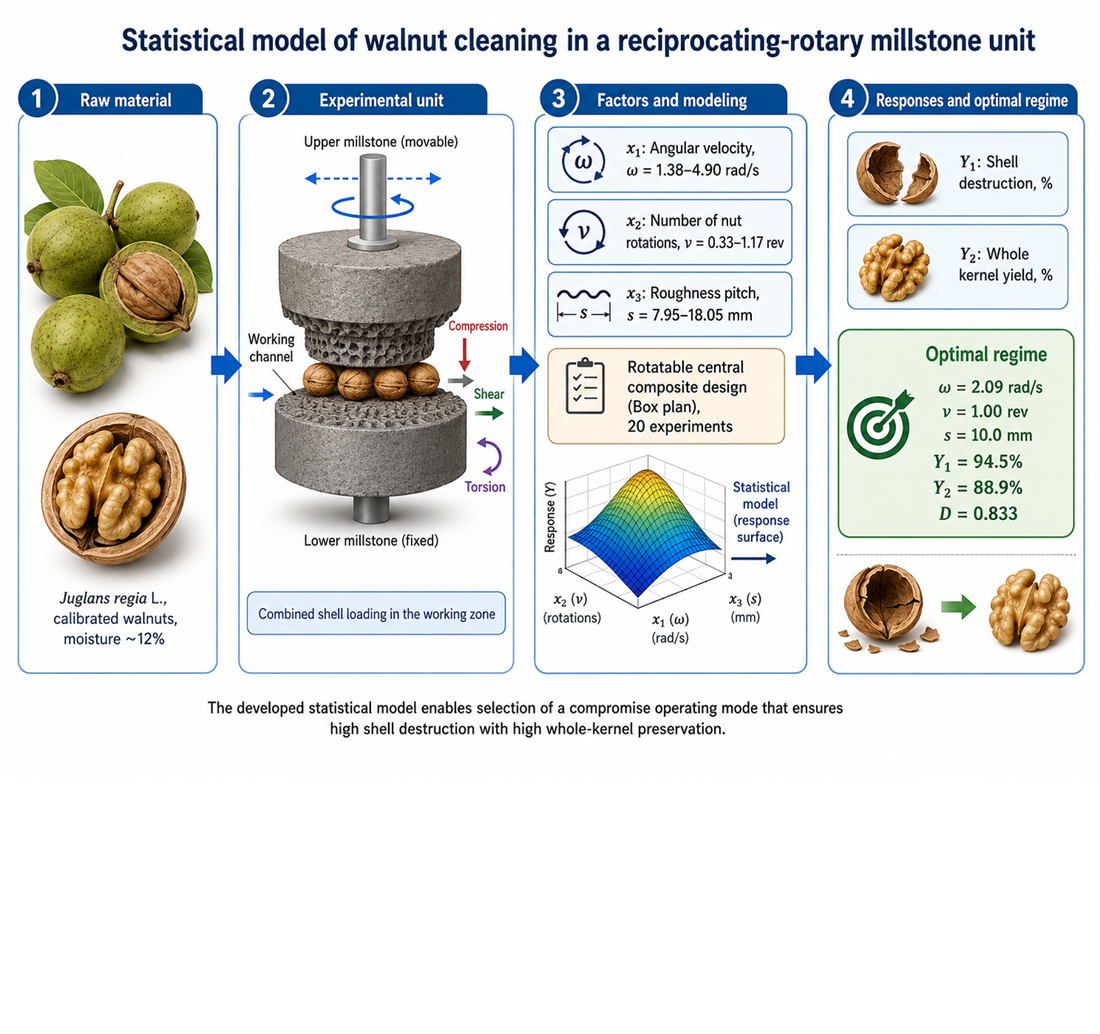
The object of this study is the process of walnut shelling in a reciprocating millstone, implementing combined compression, shear, and torsion loading. The problem being addressed is the lack of well-founded modes that simultaneously ensure complete shell destruction and a high yield of whole kernels—two conflicting requirements in processing. This study extends previous work that determined the shell fracture forces and the probabilistic nature of its failure; this work transitions from the strength characteristics of the object to machine performance.
A three-factor rotatable design of a central composite experiment (Box design) consisting of twenty trials was implemented. The factors included the angular velocity of the moving upper millstone (1.38–4.90 rad/s), the number of nut revolutions in the working channel (0.33–1.17 revolutions), and the roughness pitch of the working surfaces (7.95–18.05 mm). Two responses were recorded: shell fracture rate and whole kernel yield. Second-order regression models were obtained and tested using analysis of variance.
It was found that shell fracture rate increases with increasing angular velocity and rotational speed and decreases with increasing roughness pitch, while whole kernel yield decreases with increasing angular velocity and exhibits internal maxima at rotational speed and roughness pitch. Angular velocity is the dominant factor for both responses and serves as the main source of the tradeoff between cracking and kernel integrity. A compromise regime was identified: angular velocity of approximately 2.09 rad/s, approximately 1.0 nut revolution, and a roughness pitch of approximately 10 mm, resulting in a shell fracture rate of approximately 94.5% with a whole kernel yield of approximately 88.9%. The results serve as a basis for selecting walnut shelling machine parameters
References
- Bao, X., Chen, B., Dai, P., Li, Y., Mao, J. (2022). Construction and Verification of Spherical Thin Shell Model for Revealing Walnut Shell Crack Initiation and Expansion Mechanism. Agriculture, 12 (9), 1446. https://doi.org/10.3390/agriculture12091446
- Zhang, H., Shen, L., Lan, H., Li, Y., Liu, Y., Tang, Y., Li, W. (2018). Mechanical properties and finite element analysis of walnut under different cracking parts. International Journal of Agricultural and Biological Engineering, 11 (6), 81–88. https://doi.org/10.25165/j.ijabe.20181106.3309
- Koyuncu, M. A., Ekinci, K., Savran, E. (2004). Cracking Characteristics of Walnut. Biosystems Engineering, 87 (3), 305–311. https://doi.org/10.1016/j.biosystemseng.2003.11.001
- Altuntas, E., Erkol, M. (2009). The Effects of Moisture Content, Compression Speeds, and Axes on Mechanical Properties of Walnut Cultivars. Food and Bioprocess Technology, 4 (7), 1288–1295. https://doi.org/10.1007/s11947-009-0283-y
- Shahbazi, F. (2013). Effective conditions for extracting higher quality kernels from walnuts. Quality Assurance and Safety of Crops & Foods, 5 (3), 199–206. https://doi.org/10.3920/qas2011.0105
- Han, B., Su, G., Zeng, Y., Yang, J., Fan, X., Zhang, Y. et al. (2023). FDEM investigation on the crack propagation characteristics of walnut shell under multi-contact loadings. Frontiers in Materials, 10. https://doi.org/10.3389/fmats.2023.1293683
- Zhang, H., Liu, H., Zeng, Y., Tang, Y., Zhang, Z., Che, J. (2022). Design and Performance Evaluation of a Multi-Point Extrusion Walnut Cracking Device. Agriculture, 12 (9), 1494. https://doi.org/10.3390/agriculture12091494
- Chengmao, C., Si, S., Ran, D., Bing, L., Shuo, W. (2017). Experimental study on mechanical characteristics of nut rupturing under impact loading. International Journal of Agricultural and Biological Engineering, 10 (1), 53–60. https://doi.org/10.3965/j.ijabe.20171001.2331
- Karimi, N., Minaei, S., Hasani, D., Eyvani, A. (2008). Parameters Involved in Walnut Peeling Process. Journal of Agricultural Machinery Science, 4 (4), 389–393. Available at: https://dergipark.org.tr/en/download/article-file/119118
- Altuntas, E., Özkan, Y. (2008). Physical and Mechanical Properties of Some Walnut (Juglans regia L.) Cultivars. International Journal of Food Engineering, 4 (4). https://doi.org/10.2202/1556-3758.1349
- Aviara, N. A., Ajikashile, J. O., Lawal, A. A. (2012). Effect of moisture content and impact energy on the cracking of conophor nut. Agricultural Engineering International: CIGR Journal, 14 (2), 68–76. Available at: https://cigrjournal.org/index.php/Ejounral/article/view/2008
- Ojolo, S. J., Damisa, O., Orisaleye, J. I., Ogbonnaya, C. (2010). Design and development of cashew nut shelling machine. Journal of Engineering, Design and Technology, 8 (2), 146–157. https://doi.org/10.1108/17260531011062528
- Olaoye, J. O., Adekanye, T. A. (2018). Properties influencing cracking and separation of palm nuts in a mechanical cracker cum separator. Croatian Journal of Food Science and Technology, 10 (1), 42–50. https://doi.org/10.17508/cjfst.2018.10.1.07
- Opobiyi, A. T., Ishola, T. A., Ariyo, E. O., Abioye, K. J. (2019). Development of a Walnut (Tetracarpidium conophorum) Cracker. KMUTNB International Journal of Applied Science and Technology, 12 (1). https://doi.org/10.14416/j.ijast.2019.01.003
- Iyilade, I. J., Aviara, N. A., Oyeniyi, S. K., Aremu, A. K. (2019). Performance Evaluation of a Bush Mango (Irvingia gabonensis) Nut Cracking Machine. Agricultural Engineering International: CIGR Journal, 21 (1), 156–162. Available at: https://cigrjournal.org/index.php/Ejounral/article/download/5093/2923/22955
- Ibiyeye, D., Olunloyo, O., Aderemi, A., Emmanuel, I.-O., Akala, A., Owolola, O. (2022). Design and development of a palm kernel nut cracking unit. Technology Audit and Production Reserves, 1 (3 (63)), 30–44. https://doi.org/10.15587/2706-5448.2022.253931
- Sam, E. O., Ndirika, V. I. O., Umoh, A. T., Usoh, G. A., Umoh, E. O. (2024). Determination of the Optimum Moisture Content for the Whole Kernel Recovery During the Cracking Process of Oil Palm Nuts. Advanced Journal of Science, Technology and Engineering, 4 (4), 125–138. https://doi.org/10.52589/ajste-cwcbfgjp
- Maghsoudi, H., Khoshtaghaza, M. H., Minaei, S., Zaki Dizaji, H. (2012). Fracture Resistance of Unsplit Pistachio (Pistacia vera L.) Nuts against Splitting Force, under Compressive Loading. Journal of Agricultural Science and Technology, 14, 299–310. Available at: https://www.cabidigitallibrary.org/doi/pdf/10.5555/20123079723
- Valentini, N., Rolle, L., Stévigny, C., Zeppa, G. (2006). Mechanical behaviour of hazelnuts used for table consumption under compression loading. Journal of the Science of Food and Agriculture, 86 (8), 1257–1262. https://doi.org/10.1002/jsfa.2486
- Temov, B. M., Shalbaev, K. K., Askarov, A. D. (2022). Pat. No. 10179 RK. Ustanovka dlya ochistki greckih orehov ot skorlupy.
- Temov, B., Nurakhmetov, B., Askarov, A., Nurakhmetov, I., Nasrullin, G. (2026). Identifying patterns of walnut shell fracture under combined loading in a reciprocating millstone system. Eastern-European Journal of Enterprise Technologies, 2 (11 (140)), 6–18. https://doi.org/10.15587/1729-4061.2026.358671
Downloads
Published
How to Cite
Issue
Section
License
Copyright (c) 2026 Baurzhan Temov, Baurzhan Nurakhmetov, Ardak Askarov, Ilyas Nurakhmetov, Galymzhan Nasrullin

This work is licensed under a Creative Commons Attribution 4.0 International License.
The consolidation and conditions for the transfer of copyright (identification of authorship) is carried out in the License Agreement. In particular, the authors reserve the right to the authorship of their manuscript and transfer the first publication of this work to the journal under the terms of the Creative Commons CC BY license. At the same time, they have the right to conclude on their own additional agreements concerning the non-exclusive distribution of the work in the form in which it was published by this journal, but provided that the link to the first publication of the article in this journal is preserved.
A license agreement is a document in which the author warrants that he/she owns all copyright for the work (manuscript, article, etc.).
The authors, signing the License Agreement with TECHNOLOGY CENTER PC, have all rights to the further use of their work, provided that they link to our edition in which the work was published.
According to the terms of the License Agreement, the Publisher TECHNOLOGY CENTER PC does not take away your copyrights and receives permission from the authors to use and dissemination of the publication through the world's scientific resources (own electronic resources, scientometric databases, repositories, libraries, etc.).
In the absence of a signed License Agreement or in the absence of this agreement of identifiers allowing to identify the identity of the author, the editors have no right to work with the manuscript.
It is important to remember that there is another type of agreement between authors and publishers – when copyright is transferred from the authors to the publisher. In this case, the authors lose ownership of their work and may not use it in any way.








