Identifying of the influence of chamber temperature on the flexural properties of polyamide 12 fabricated by FDM/FFF 3D printing
DOI:
https://doi.org/10.15587/1729-4061.2026.365570Keywords:
3D printing, flexural strength, PA12, fused deposition modeling, chamber temperatureAbstract
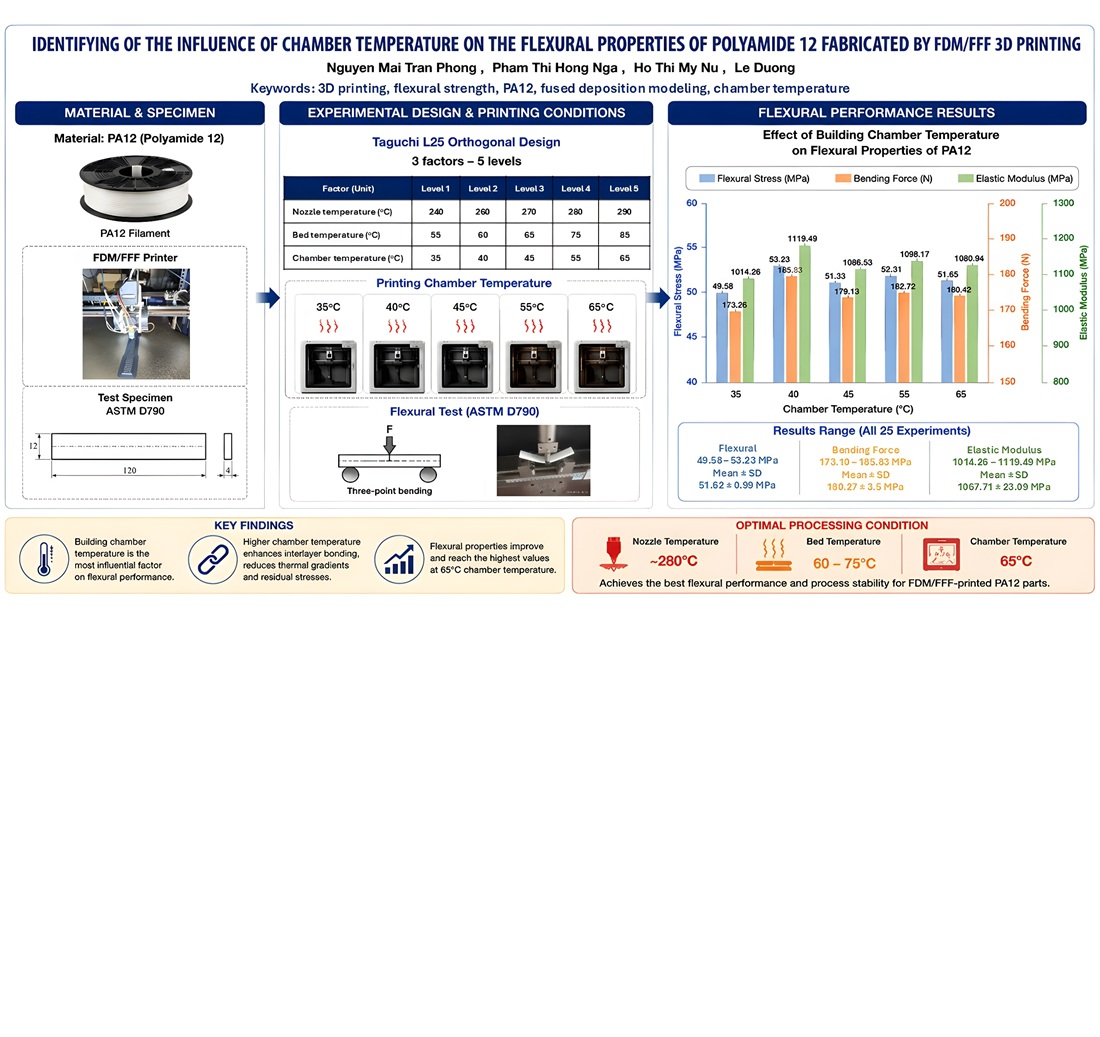
The thermal environment of the printing chamber is an important factor in determining the quality and mechanical performance of semi-crystalline polymers produced by Fused Deposition Modelling (FDM/FFF), such as Polyamide 12 (PA12). Nevertheless, the impact of temperature in the building chamber on the flexural performance of PA12 parts is not yet clear. The aim of this study is to evaluate the flexural performance of FDM/FFF-printed PA12 as a function of the building chamber temperature and different thermal processing conditions. A Taguchi L25 orthogonal design was employed to investigate the influence of nozzle temperature, bed temperature and building chamber temperature on flexural stress, bending force, elastic modulus and signal-to-noise ratio. The results showed relatively stable mechanical performance under different thermal conditions. Flexural stress ranged from 49.58 to 53.23 MPa, bending force from 173.10 to 185.83 N, and elastic modulus from 1014.26 to 1119.49 MPa. Statistical analysis indicated that building chamber temperature was the most influential, followed by nozzle temperature while bed temperature had the least impact. The optimal processing conditions were obtained at a nozzle temperature of approximately 280°C, a bed temperature of 60–75°C, and a building chamber temperature of 65°C. The improved flexural performance can be ascribed to enhanced interlayer bonding, lower thermal gradients and more stable heat transfer in the entire printing chamber. The results emphasize the important role of chamber temperature at several critical stages during printing in improving structural integrity and mechanical reliability of FDM/FFF-printed PA12 components. The obtained results can be applied to the fabrication and optimization of PA12 engineering components produced under controlled thermal conditions
References
- Maloch, J., Hnátková, E., Žaludek, M., Krátký, P. (2018). Effect of Processing Parameters on Mechanical Properties of 3D Printed Samples. Materials Science Forum, 919, 230–235. https://doi.org/10.4028/www.scientific.net/msf.919.230
- Rezayat, H., Zhou, W., Siriruk, A., Penumadu, D., Babu, S. S. (2015). Structure–mechanical property relationship in fused deposition modelling. Materials Science and Technology, 31 (8), 895–903. https://doi.org/10.1179/1743284715y.0000000010
- Siraj, I., Drégelyi-Kiss, Á. (2025). Empirical comparison of FDM additive manufacturing process parameters by application grey relational analysis and multi-linear regression. The International Journal of Advanced Manufacturing Technology, 138 (7-8), 2861–2876. https://doi.org/10.1007/s00170-025-15688-4
- Zhu, D., Ren, Y., Liao, G., Jiang, S., Liu, F., Guo, J., Xu, G. (2017). Thermal and mechanical properties of polyamide 12/graphene nanoplatelets nanocomposites and parts fabricated by fused deposition modeling. Journal of Applied Polymer Science, 134 (39). https://doi.org/10.1002/app.45332
- Lederle, F., Meyer, F., Brunotte, G.-P., Kaldun, C., Hübner, E. G. (2016). Improved mechanical properties of 3D-printed parts by fused deposition modeling processed under the exclusion of oxygen. Progress in Additive Manufacturing, 1 (1-2), 3–7. https://doi.org/10.1007/s40964-016-0010-y
- Shakeri, Z., Benfriha, K., Zirak, N., Shirinbayan, M. (2022). Mechanical strength and shape accuracy optimization of polyamide FFF parts using grey relational analysis. Scientific Reports, 12 (1). https://doi.org/10.1038/s41598-022-17302-z
- Mehdipour, F., Gebhardt, U., Kästner, M. (2021). Anisotropic and rate-dependent mechanical properties of 3D printed polyamide 12 - A comparison between selective laser sintering and multi jet fusion. Results in Materials, 11, 100213. https://doi.org/10.1016/j.rinma.2021.100213
- Ju, W., Qi, S., Gao, X., Su, Y., Liu, G., Wang, Y. et al. (2024). Tailoring the crystalline structures and mechanical properties of polyamide 1012 specimens by material extrusion-based additive manufacturing. Polymer, 293, 126676. https://doi.org/10.1016/j.polymer.2024.126676
- Vidakis, N., Petousis, M., Kechagias, J. D. (2022). Parameter effects and process modelling of Polyamide 12 3D-printed parts strength and toughness. Materials and Manufacturing Processes, 37 (11), 1358–1369. https://doi.org/10.1080/10426914.2022.2030871
- Kam, M., İpekçi, A., Şengül, Ö. (2021). Investigation of the effect of FDM process parameters on mechanical properties of 3D printed PA12 samples using Taguchi method. Journal of Thermoplastic Composite Materials, 36 (1), 307–325. https://doi.org/10.1177/08927057211006459
- Gao, X., Zhang, D., Wen, X., Qi, S., Su, Y., Dong, X. (2019). Fused deposition modeling with polyamide 1012. Rapid Prototyping Journal, 25 (7), 1145–1154. https://doi.org/10.1108/rpj-09-2018-0258
- Javadinejad, H. R., Eslami, A., Vanaei, H. R. (2024). Investigating the Mechanical Performance of 3D‐printed Parts. Industrial Strategies and Solutions for 3D Printing, 193–209. https://doi.org/10.1002/9781394150335.ch10
- Kariuki, L. W., Ikua, B. W., Karanja, S. K., Ng’ang’a, S. P., Zeidler, H. (2023). Fused filament fabrication of carbon fiber‐reinforced polymer composite: Effect of process parameters on flexural properties. Engineering Reports, 6 (8). https://doi.org/10.1002/eng2.12807
- Baba, M. N. (2022). Flatwise to Upright Build Orientations under Three-Point Bending Test of Nylon 12 (PA12) Additively Manufactured by SLS. Polymers, 14 (5), 1026. https://doi.org/10.3390/polym14051026
- Pang, R., Lai, M. K., Ismail, K. I., Yap, T. C. (2022). The Effect of Printing Temperature on Bonding Quality and Tensile Properties of Fused Deposition Modelling 3d-Printed Parts. IOP Conference Series: Materials Science and Engineering, 1257 (1), 12031. https://doi.org/10.1088/1757-899x/1257/1/012031
- Kumrai-Woodruff, R., Wang, Q. (2020). Temperature Control to Increase Inter-Layer Bonding Strength in Fused Deposition Modelling. Volume 6: 25th Design for Manufacturing and the Life Cycle Conference (DFMLC). https://doi.org/10.1115/detc2020-22342
- Su, R., Zhang, Z., Love, B. J., Shih, A. J. (2023). Fused filament fabrication of Nylon beyond the glass transition temperature in a thermally-insulated machine. Manufacturing Letters, 35, 797–804. https://doi.org/10.1016/j.mfglet.2023.08.120
- Liu, X., Tey, W. S., Choo, J. Y. C., Chen, J., Tan, P., Cai, C. et al. (2021). Enhancing the mechanical strength of Multi Jet Fusion–printed polyamide 12 and its glass fiber-reinforced composite via high-temperature annealing. Additive Manufacturing, 46, 102205. https://doi.org/10.1016/j.addma.2021.102205
- Chen, K., Koh, Z. H., Le, K. Q., Teo, H. W. B., Zheng, H., Zeng, J. et al. (2022). Effects of build positions on the thermal history, crystallization, and mechanical properties of polyamide 12 parts printed by Multi Jet Fusion. Virtual and Physical Prototyping, 17 (3), 631–648. https://doi.org/10.1080/17452759.2022.2046478
- Hérard, C. (2017). Les effets de la température lors de la fabrication additive par FDM de composites thermoplastiques renforcés et leurs propriétés mécaniques. Ecole Polytechnique. Available at: https://publications.polymtl.ca/2681/
- Dairabayeva, D., Perveen, A., Talamona, D. (2023). Influence of fused filament fabrication parameters on the flexural strength of nylon. Manufacturing Letters, 35, 502–508. https://doi.org/10.1016/j.mfglet.2023.08.002
- Osarenmwinda, J. O., Olodu, D. D. (2018). Optimization of injection moulding process parameters in the moulding of High Density Polyethylene (HDPE). Journal of Applied Sciences and Environmental Management, 22 (2), 203. https://doi.org/10.4314/jasem.v22i2.8
- Le, D., Nguyen, C. H., Pham, T. H. N., Nguyen, V. T., Pham, S. M., Le, M. T., Nguyen, T. T. (2023). Optimizing 3D Printing Process Parameters for the Tensile Strength of Thermoplastic Polyurethane Plastic. Journal of Materials Engineering and Performance, 32 (23), 10805–10816. https://doi.org/10.1007/s11665-023-07892-8
- Duong, L., Nga, P. T. H., Le, T. M. (2026). Effect of technical parameters on polylactic acid shrinkage during 3D printing. Advances in Science and Technology Research Journal, 20 (6), 356–367. https://doi.org/10.12913/22998624/218336
- Sun, S.-H., Koizumi, Y., Saito, T., Yamanaka, K., Li, Y.-P., Cui, Y., Chiba, A. (2018). Electron beam additive manufacturing of Inconel 718 alloy rods: Impact of build direction on microstructure and high-temperature tensile properties. Additive Manufacturing, 23, 457–470. https://doi.org/10.1016/j.addma.2018.08.017
- Kamoona, S. N., Masood, S. H., Mohamed, O. A. (2018). Experimental investigation on flexural properties of FDM processed Nylon 12 parts using RSM. IOP Conference Series: Materials Science and Engineering, 377, 12137. https://doi.org/10.1088/1757-899x/377/1/012137
Downloads
Published
How to Cite
Issue
Section
License
Copyright (c) 2026 Mai Tran Phong Nguyen, Thi Hong Nga Pham, Thi My Nu Ho, Duong Le

This work is licensed under a Creative Commons Attribution 4.0 International License.
The consolidation and conditions for the transfer of copyright (identification of authorship) is carried out in the License Agreement. In particular, the authors reserve the right to the authorship of their manuscript and transfer the first publication of this work to the journal under the terms of the Creative Commons CC BY license. At the same time, they have the right to conclude on their own additional agreements concerning the non-exclusive distribution of the work in the form in which it was published by this journal, but provided that the link to the first publication of the article in this journal is preserved.
A license agreement is a document in which the author warrants that he/she owns all copyright for the work (manuscript, article, etc.).
The authors, signing the License Agreement with TECHNOLOGY CENTER PC, have all rights to the further use of their work, provided that they link to our edition in which the work was published.
According to the terms of the License Agreement, the Publisher TECHNOLOGY CENTER PC does not take away your copyrights and receives permission from the authors to use and dissemination of the publication through the world's scientific resources (own electronic resources, scientometric databases, repositories, libraries, etc.).
In the absence of a signed License Agreement or in the absence of this agreement of identifiers allowing to identify the identity of the author, the editors have no right to work with the manuscript.
It is important to remember that there is another type of agreement between authors and publishers – when copyright is transferred from the authors to the publisher. In this case, the authors lose ownership of their work and may not use it in any way.








