Розробка комплексної методики оцінки економічної ефективності реалізації інвестиційного проєкту щодо забезпечення енергетичної безпеки підприємств: організаційно-економічний аспект
DOI:
https://doi.org/10.15587/1729-4061.2025.321965Ключові слова:
економічна ефективність, енергобезпека підприємств, управлінські рішення, організаційно-економічний аспектАнотація
Об'єктом дослідження є процес оцінки економічної ефективності реалізації інвестиційного проєкту, спрямованого на забезпечення енергобезпеки підприємств електроенергетичної системи на мікроекономічному рівні.
Вирішувалася проблема розробки комплексного і адаптивного підходу до оцінки економічної ефективності інвестицій, що дозволило ефективно планувати, реалізувати та коригувати інвестиційний проєкт щодо забезпечення енергетичної безпеки підприємств в умовах невизначеності.
Дослідження виявило, що традиційні підходи, такі як аналіз витрат і вигод, недостатньо враховують ризики та можливі загрози, що виникають у процесі реалізації інвестиційних проєктів.
Запропоновано удосконалену комплексну методику оцінки економічної ефективності, що складається з восьми ключових етапів, які взаємопов'язані між собою на основі розрахунків та аналізу показників економічної ефективності інвестиційного проєкту підприємства.
Особливостю цієї методики є інтеграція кількісних та якісних показників інвестиційних проєктів, що дозволяє оцінити їх ефективність та забезпечити адаптацію в реальному часу, для оперативного обгрунтування управлінських рішень в умовах невизначеності.
Обґрунтовано вибір критеріїв оцінки об'єктів інвестування для формування системи показників енергобезпеки підприємств.
Розроблено обчислювальний алгоритм, який стежить за динамікою зміни показників-індикаторів, що сприяє виробленню своєчасних управлінських рішень, щодо мінімізації ризиків енергобезпеки.
Практична значимість даного дослідження полягає в його здатності надати підприємствам методологічні основи для оптимізації інвестиційних стратегій.
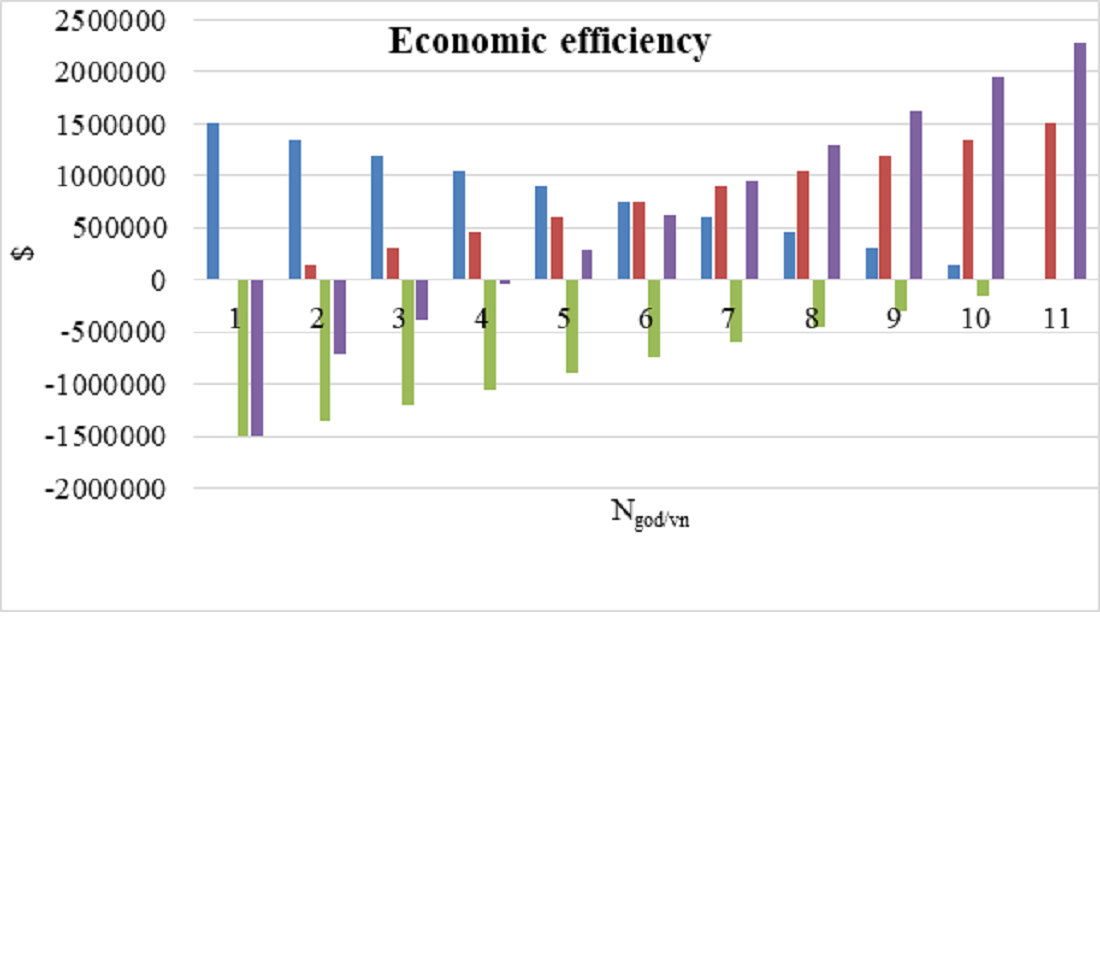
Показано, що максимальна енергобезпека і фінансові вигоди підприємств, досягаються при повному запобіганні аваріям, що забезпечує прибутковість на рівні 41 %
Посилання
- Chang, Y., Liu, C., Liu, M., Liu, W., Liu, Z., Zhang, H., Zheng, Y. (2019). Differentiation degree combination weighting method for investment decision-making risk assessment in power grid construction projects. Global Energy Interconnection, 2 (5), 465–477. https://doi.org/10.1016/j.gloei.2019.11.022
- Erfani, A., Tavakolan, M. (2020). Risk Evaluation Model of Wind Energy Investment Projects Using Modified Fuzzy Group Decision-making and Monte Carlo Simulation. Arthaniti: Journal of Economic Theory and Practice, 22 (1), 7–33. https://doi.org/10.1177/0976747920963222
- Wei, Y.-M., Qiao, L., Jiang, S.-M., Lv, X. (2020). A decision-making approach considering technology progress for investment in oil sands projects: An empirical analysis in Canada. Journal of Petroleum Science and Engineering, 195, 107741. https://doi.org/10.1016/j.petrol.2020.107741
- Camanho, A. S., Silva, M. C., Piran, F. S., Lacerda, D. P. (2024). A literature review of economic efficiency assessments using Data Envelopment Analysis. European Journal of Operational Research, 315 (1), 1–18. https://doi.org/10.1016/j.ejor.2023.07.027
- Sassanelli, C., Rosa, P., Rocca, R., Terzi, S. (2019). Circular economy performance assessment methods: A systematic literature review. Journal of Cleaner Production, 229, 440–453. https://doi.org/10.1016/j.jclepro.2019.05.019
- Joppen, R., Kühn, A., Hupach, D., Dumitrescu, R. (2019). Collecting data in the assessment of investments within production. Procedia CIRP, 79, 466–471. https://doi.org/10.1016/j.procir.2019.02.126
- Fuster-Palop, E., Prades-Gil, C., Masip, X., Viana-Fons, J. D., Payá, J. (2021). Innovative regression-based methodology to assess the techno-economic performance of photovoltaic installations in urban areas. Renewable and Sustainable Energy Reviews, 149, 111357. https://doi.org/10.1016/j.rser.2021.111357
- Gong, Y., Gu, W., Ren, W. (2022). Green Energy Economic Efficiency and Enterprise Environmental Cost Control Based on the Internet of Things. Security and Communication Networks, 2022, 1–12. https://doi.org/10.1155/2022/6824493
- Pylypenko, Y., Pylypenko, H., Prokhorova, V. V., Mnykh, O. B., Dubiei, Yu. V. (2021). Transition to a new paradigm of human capital development in the dynamic environment of the knowledge economy. Naukovyi Visnyk Natsionalnoho Hirnychoho Universytetu, 6, 170–176. https://doi.org/10.33271/nvngu/2021-6/170
- Prokhorova, V., Protsenko, V., Abuselidze, G., Mushnykova, S., Us, Yu. (2019). Safety of industrial enterprises development: evaluation of innovative and investment component. Naukovyi Visnyk Natsionalnoho Hirnychoho Universytetu, 5. https://doi.org/10.29202/nvngu/2019-5/24
- Prokhorova, V., Protsenko, V., Bezuglaya, Y., Us, J. (2018). The optimization algorithm for the directions of influence of risk factors on the system that manages the potential of machine-building enterprises. Eastern-European Journal of Enterprise Technologies, 4 (1 (94)), 6–13. https://doi.org/10.15587/1729-4061.2018.139513
- Shibaeva, N., Baban, T., Prokhorova, V., Karlova, O., Girzheva, O., Krutko, M. (2019). Methodological bases of estimating the efficiency of organizational and economic mechanism of regulatory policy in agriculture. Global Journal of Environmental Science and Management, 5, 160–171. https://doi.org/10.22034/gjesm.2019.05.SI.18
- Pylypenko, H. M., Prokhorova, V. V., Mrykhina, O. B., Koleshchuk, O. Y., Mushnykova, S. A. (2020). Cost evaluation models of R&D products of industrial enterprises. Naukovyi Visnyk Natsionalnoho Hirnychoho Universytetu, 5, 163–170. https://doi.org/10.33271/nvngu/2020-5/163
- Babenko, V., Baksalova, O., Prokhorova, V., Dykan, V., Ovchynnikova, V., Chobitok, V. (2021). Information And Consulting Service Using In The Organization Of Personnel Management. Studies of Applied Economics, 38 (4). https://doi.org/10.25115/eea.v38i4.3999
- Hendren, N. (2020). Measuring economic efficiency using inverse-optimum weights. Journal of Public Economics, 187, 104198. https://doi.org/10.1016/j.jpubeco.2020.104198
- Lv, L., Chen, Y. (2024). The Collision of digital and green: Digital transformation and green economic efficiency. Journal of Environmental Management, 351, 119906. https://doi.org/10.1016/j.jenvman.2023.119906
- Prokhorova, V., Budanov, M., Budanov, P. (2024). Devising an integrated methodology for energy safety assessment at an industrial power-generating enterprise. Transfer of Technologies: Industry, Energy, Nanotechnology, 4 (13 (130)), 118–131. https://doi.org/10.15587/1729-4061.2024.308056
- Cui, X., Zou, P. X. W., Arena, M. (2024). An innovative methodology for assessing the safety of logistics infrastructure considering carrying capacity and catastrophe property of accidents. Transport Policy, 159, 178–189. https://doi.org/10.1016/j.tranpol.2024.10.015
- Qian, X., Dai, J., Jiang, W., Cai, H., Ye, X., Shahab Vafadaran, M. (2024). Economic viability and investment returns of innovative geothermal tri-generation systems: A comparative study. Renewable Energy, 226, 120396. https://doi.org/10.1016/j.renene.2024.120396
- De Pascale, A., Arbolino, R., Szopik-Depczyńska, K., Limosani, M., Ioppolo, G. (2021). A systematic review for measuring circular economy: The 61 indicators. Journal of Cleaner Production, 281, 124942. https://doi.org/10.1016/j.jclepro.2020.124942
- Brockway, P. E., Sorrell, S., Semieniuk, G., Heun, M. K., Court, V. (2021). Energy efficiency and economy-wide rebound effects: A review of the evidence and its implications. Renewable and Sustainable Energy Reviews, 141, 110781. https://doi.org/10.1016/j.rser.2021.110781
- Sadeghi, S., Ghandehariun, S., Rosen, M. A. (2020). Comparative economic and life cycle assessment of solar-based hydrogen production for oil and gas industries. Energy, 208, 118347. https://doi.org/10.1016/j.energy.2020.118347
- Ahmad, M., Ahmed, Z., Majeed, A., Huang, B. (2021). An environmental impact assessment of economic complexity and energy consumption: Does institutional quality make a difference? Environmental Impact Assessment Review, 89, 106603. https://doi.org/10.1016/j.eiar.2021.106603
- Zakari, A., Khan, I., Tan, D., Alvarado, R., Dagar, V. (2022). Energy efficiency and sustainable development goals (SDGs). Energy, 239, 122365. https://doi.org/10.1016/j.energy.2021.122365
##submission.downloads##
Опубліковано
Як цитувати
Номер
Розділ
Ліцензія
Авторське право (c) 2025 Viktoriia Prokhorova, Mykola Budanov, Pavlo Budanov, Anna Zaitseva, Anzhelika Slastianykova

Ця робота ліцензується відповідно до Creative Commons Attribution 4.0 International License.
Закріплення та умови передачі авторських прав (ідентифікація авторства) здійснюється у Ліцензійному договорі. Зокрема, автори залишають за собою право на авторство свого рукопису та передають журналу право першої публікації цієї роботи на умовах ліцензії Creative Commons CC BY. При цьому вони мають право укладати самостійно додаткові угоди, що стосуються неексклюзивного поширення роботи у тому вигляді, в якому вона була опублікована цим журналом, але за умови збереження посилання на першу публікацію статті в цьому журналі.
Ліцензійний договір – це документ, в якому автор гарантує, що володіє усіма авторськими правами на твір (рукопис, статтю, тощо).
Автори, підписуючи Ліцензійний договір з ПП «ТЕХНОЛОГІЧНИЙ ЦЕНТР», мають усі права на подальше використання свого твору за умови посилання на наше видання, в якому твір опублікований. Відповідно до умов Ліцензійного договору, Видавець ПП «ТЕХНОЛОГІЧНИЙ ЦЕНТР» не забирає ваші авторські права та отримує від авторів дозвіл на використання та розповсюдження публікації через світові наукові ресурси (власні електронні ресурси, наукометричні бази даних, репозитарії, бібліотеки тощо).
За відсутності підписаного Ліцензійного договору або за відсутністю вказаних в цьому договорі ідентифікаторів, що дають змогу ідентифікувати особу автора, редакція не має права працювати з рукописом.
Важливо пам’ятати, що існує і інший тип угоди між авторами та видавцями – коли авторські права передаються від авторів до видавця. В такому разі автори втрачають права власності на свій твір та не можуть його використовувати в будь-який спосіб.