Improvement of the approach to choosing the optimal strategy for assessing a military serviceman
DOI:
https://doi.org/10.15587/1729-4061.2025.329088Keywords:
HR management, assessment of military servicemen, competencies, service functions, optimal selection criteriaAbstract
The object of the study is the process of choosing the optimal strategy for assessing a military serviceman.
The problem, which was being solved, is non-adaptability of the existing scientific approach to the necessity of taking into account the rapid transformation of functional responsibilities and long-term career planning when assessing military servicemen.
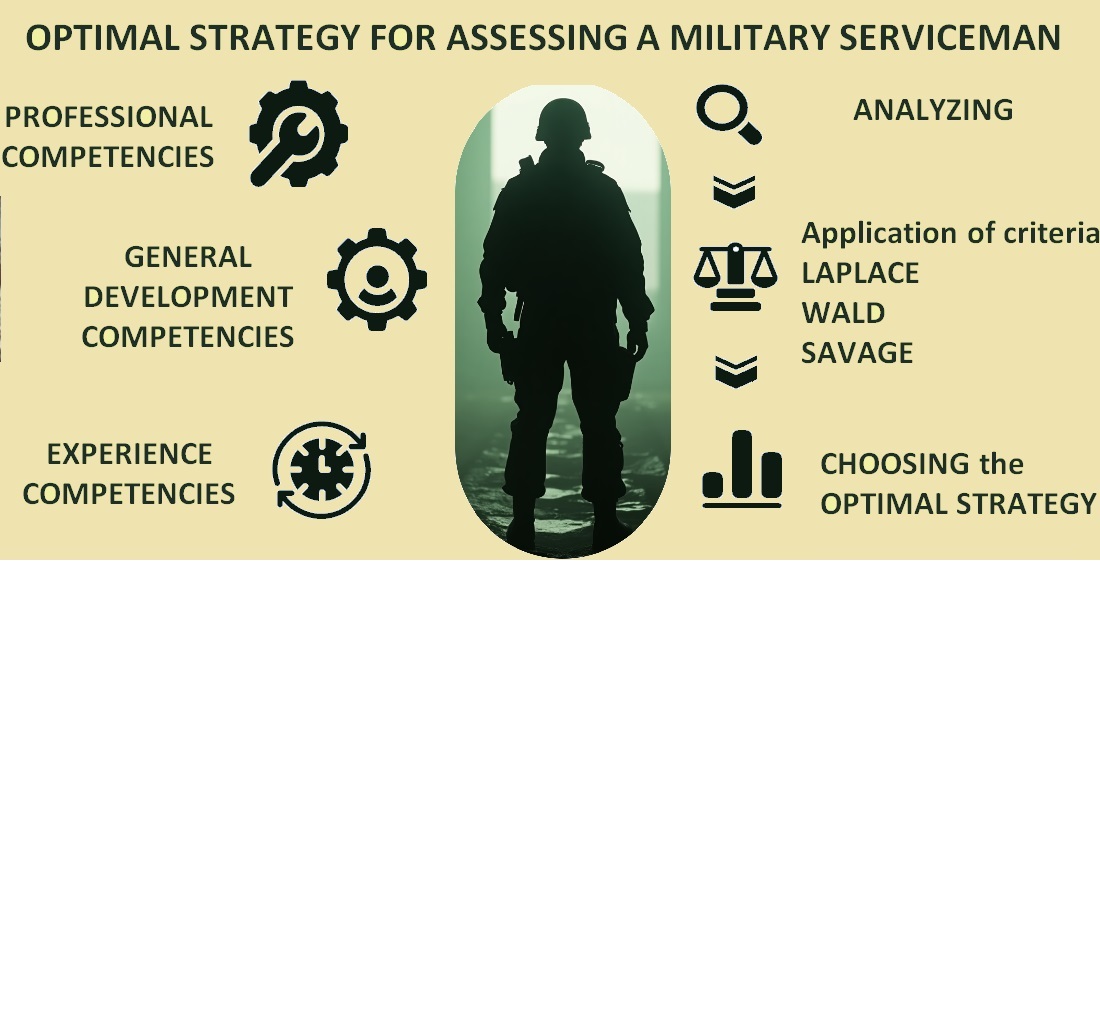
In terms of improving the approach of choosing the optimal strategy for assessing a military serviceman, the algorithm for choosing the appropriate strategy has been suggested. The algorithm is based on the application of optimal selection criteria (Laplace, Wald and Savage). The essence of the developed algorithm implies the level of uncertainty regarding the possible transformation of service functions, the possible transformation of service functions and acquired competencies.
The peculiarity of the developed algorithm is that it allows to take into account the long-term perspective of career development by considering the uncertainty in the process of transformation of service functions.
As part of improving the approach to choosing the optimal strategy for assessing a serviceman, the procedure for choosing the appropriate optimal strategy has been improved.
The peculiarity of the suggested procedure is that it is based on the identification of the level of uncertainty, the use of a tabular method for determining the correspondence of service functions to competencies, and the distribution of competencies on the basis of their acquisition. This procedure allows to increase the accuracy of determining the level of correspondence of a military serviceman’s competencies to service functions by 15% if no changes occur, and by 17% in case of minor changes and by 24% in case of fundamental changes. A distinctive feature of the procedure is the division of competencies into three groups: professional, general development, and acquired through experience.
The scope of practical application of the improved procedure is the management processes to ensure the effectiveness of HR management in the command-and-control bodies of military formations
References
- Zubarev, S. (2024). HR-management during the war: personnel support. Scientific Journal of Polonia University, 63 (2), 212–219. https://doi.org/10.23856/6328
- Levchuk, K., Bandurka, K. (2024). HR management: challenges faced by employers during martial law in Ukraine. Economic Bulletin of the Dniprovsk State Technical University, 2 (9), 90–94. https://doi.org/10.31319/2709-2879.2024iss2(9).318987pp90-94
- Soeters, J. (2023). Economics, Logistics, and (Human Resources) Management in Military Sciences. Handbook of Military Sciences, 1–17. https://doi.org/10.1007/978-3-030-02866-4_67-2
- Mazilu (Alexandrescu), E.-A. (2024). The Necessity of the Process of Modernisation of the Human Resources of the Military System. Nemzet És Biztonság, 16 (2), 90–99. https://doi.org/10.32576/nb.2023.2.6
- Setiawan, B. (2024). Enhancing Human Resources Competency in a Defense University: Strategies and Best Practices. AL-ISHLAH: Jurnal Pendidikan, 16 (3), 3101–3117. https://doi.org/10.35445/alishlah.v16i3.5796
- op den Buijs, T., Olsthoorn, P. (2023). Human Resource Management for Military Organizations: Challenges and Trends. Handbook of Military Sciences, 1–26. https://doi.org/10.1007/978-3-030-02866-4_68-1
- Özcan, K., Genç*, S. (2019). Developing An Hr Strategy Map For Military Context. The European Proceedings of Social and Behavioural Sciences, 86–97. https://doi.org/10.15405/epsbs.2019.01.02.8
- Mazari Abdessameud, O., Van Utterbeeck, F., Guerry, M.-A. (2021). Military Human Resource Planning through Flow Network Modeling. Engineering Management Journal, 34 (2), 302–313. https://doi.org/10.1080/10429247.2021.1900660
- Noor, M. M., Razali, R. (2011). Human Resources Information Systems (HRIS) for military domain - a conceptual framework. Proceedings of the 2011 International Conference on Electrical Engineering and Informatics, 1–5. https://doi.org/10.1109/iceei.2011.6021559
- Okazawa, S. (2013). A discrete event simulation environment tailored to the needs of military human resources management. 2013 Winter Simulations Conference (WSC), 2784–2795. https://doi.org/10.1109/wsc.2013.6721649
- Arifin, M. A., Tajudeen, F. P. (2020). Impact of human resources information systems in the military environment. Asia Pacific Management Review, 25 (4), 198–206. https://doi.org/10.1016/j.apmrv.2020.02.001
- Costa, I. P. de A., Terra, A. V., Moreira, M. Â. L., Pereira, M. T., Fávero, L. P. L., Santos, M. dos, Gomes, C. F. S. (2022). A Systematic Approach to the Management of Military Human Resources through the ELECTRE-MOr Multicriteria Method. Algorithms, 15 (11), 422. https://doi.org/10.3390/a15110422
- Levianto, J., Husin, Z., Kusnadi, K. (2024). HRM Model In Civil-Military Environment: Investigation Of The Influencing Factors On Performance. Management Studies and Entrepreneurship Journal (MSEJ), 5 (2), 5273–5280. Available at: https://journal.yrpipku.com/index.php/msej/article/view/4959
- Ranamukha, N. C. (2024). The Role of Human Resources Flexibility in Strategic Thinking of Strategic Level Military Officers of Sri Lanka Air Force. Journal of Management, Social Sciences and Humanities, 5 (1), 115–137. https://doi.org/10.4038/jmsh.v5i1.22
- Jnitova, V., Elsawah, S., Ryan, M. (2017). Review of simulation models in military workforce planning and management context. The Journal of Defense Modeling and Simulation: Applications, Methodology, Technology, 14 (4), 447–463. https://doi.org/10.1177/1548512917704525
- Profesiynyi standart za hrupoiu profesiy «Operatory bezpilotnykh aviatsiynykh system: operator nazemnykh zasobiv keruvannia bezpilotnym litalnym aparatom; operator dystantsiyno kerovanykh bezpilotnykh litalnykh aparativ; operator dystantsiyno kerovanykh bezpilotnykh aparativ ahropromyslovoho vyrobnytstva» (2025). Hromadskoi orhanizatsiyi «Ukrainska asotsiatsiia operatoriv bezpilotnykh aparativ». Available at: https://register.nqa.gov.ua/uploads/0/724-ilovepdf_merged_14.pdf
- Profesiynyi standart. Dystantsiynyi komandyr bezpilotnoho povitrianoho sudna (2024). Available at: https://register.nqa.gov.ua/uploads/0/682-distancijnij_komandir_bezpilotnogo_povitranogo_sudna.pdf
- Sniedovich, M. (2016). From Statistical Decision Theory to Robust Optimization: A Maximin Perspective on Robust Decision-Making. Robustness Analysis in Decision Aiding, Optimization, and Analytics, 59–87. https://doi.org/10.1007/978-3-319-33121-8_4
- Manski, C. F. (2021). Econometrics for Decision Making: Building Foundations Sketched by Haavelmo and Wald. Econometrica, 89 (6), 2827–2853. https://doi.org/10.3982/ecta17985
- Maistrenko, O., Khoma, V., Kurban, V., Savelіev, A., Shcherba, A., Karavanov, O. et al. (2023). Improving the scientific and methodological apparatus for determining the optimum strategy when selecting a grouping element for performing the task. Eastern-European Journal of Enterprise Technologies, 5 (3 (125)), 64–74. https://doi.org/10.15587/1729-4061.2023.289100
- Tuyl, F., Gerlach, R., Mengersen, K. (2008). A Comparison of Bayes-Laplace, Jeffreys, and Other Priors. The American Statistician, 62 (1), 40–44. https://doi.org/10.1198/000313008x267839
- Manski, C. F. (2017). Optimize, satisfice, or choose without deliberation? A simple minimax-regret assessment. Theory and Decision, 83 (2), 155–173. https://doi.org/10.1007/s11238-017-9592-1
- Maistrenko, O., Khoma, V., Shcherba, A., Olshevskyi, Y., Pereverzin, Y., Popkov, O. et al. (2022). Improving a procedure for determining the factors that influence the need of higher education institutions for specialists of the highest qualification. Eastern-European Journal of Enterprise Technologies, 1 (3 (115)), 86–96. https://doi.org/10.15587/1729-4061.2022.251027
- Maistrenko, O., Artamoshchenko, V., Petushkov, V., Shcherba, A., Balandin, M., Stetsiv, S. et al. (2022). Improving the methodological approach to determining the number of postpostgraduates planned for admission. Eastern-European Journal of Enterprise Technologies, 3 (3 (117)), 43–56. https://doi.org/10.15587/1729-4061.2022.259707
- Walker, G., MacDonald, J. R. (2001). Designing and Implementing an HR Scorecard. Human Resource Management, 40 (4), 365–377. https://doi.org/10.1002/hrm.1025
Downloads
Published
How to Cite
Issue
Section
License
Copyright (c) 2025 Oleksandr Maistrenko, Vitalii Khoma, Volodymyr Kurban, Yuliia Mozghova, Serhii Voitenko, Olha Babуch, Andrii Diakov, Denis Sysolyatin, Ihor Fishchuk, Serhii Horbenko

This work is licensed under a Creative Commons Attribution 4.0 International License.
The consolidation and conditions for the transfer of copyright (identification of authorship) is carried out in the License Agreement. In particular, the authors reserve the right to the authorship of their manuscript and transfer the first publication of this work to the journal under the terms of the Creative Commons CC BY license. At the same time, they have the right to conclude on their own additional agreements concerning the non-exclusive distribution of the work in the form in which it was published by this journal, but provided that the link to the first publication of the article in this journal is preserved.
A license agreement is a document in which the author warrants that he/she owns all copyright for the work (manuscript, article, etc.).
The authors, signing the License Agreement with TECHNOLOGY CENTER PC, have all rights to the further use of their work, provided that they link to our edition in which the work was published.
According to the terms of the License Agreement, the Publisher TECHNOLOGY CENTER PC does not take away your copyrights and receives permission from the authors to use and dissemination of the publication through the world's scientific resources (own electronic resources, scientometric databases, repositories, libraries, etc.).
In the absence of a signed License Agreement or in the absence of this agreement of identifiers allowing to identify the identity of the author, the editors have no right to work with the manuscript.
It is important to remember that there is another type of agreement between authors and publishers – when copyright is transferred from the authors to the publisher. In this case, the authors lose ownership of their work and may not use it in any way.







