Development of intelligent model-technological tools for e-Banking systems based on microservices
DOI:
https://doi.org/10.15587/1729-4061.2026.351604Keywords:
internet-banking, domain modeling, microservice architecture, software, metrics, qualityAbstract
The processes of designing and supporting e-Banking systems built using a microservice architecture are considered in this paper, taking into account the need to ensure an appropriate level of software quality attributes. The study resolves the task of integrating knowledge-oriented models and intelligent methods into model-technological tools required for developing a microservice architecture for systems of this class.
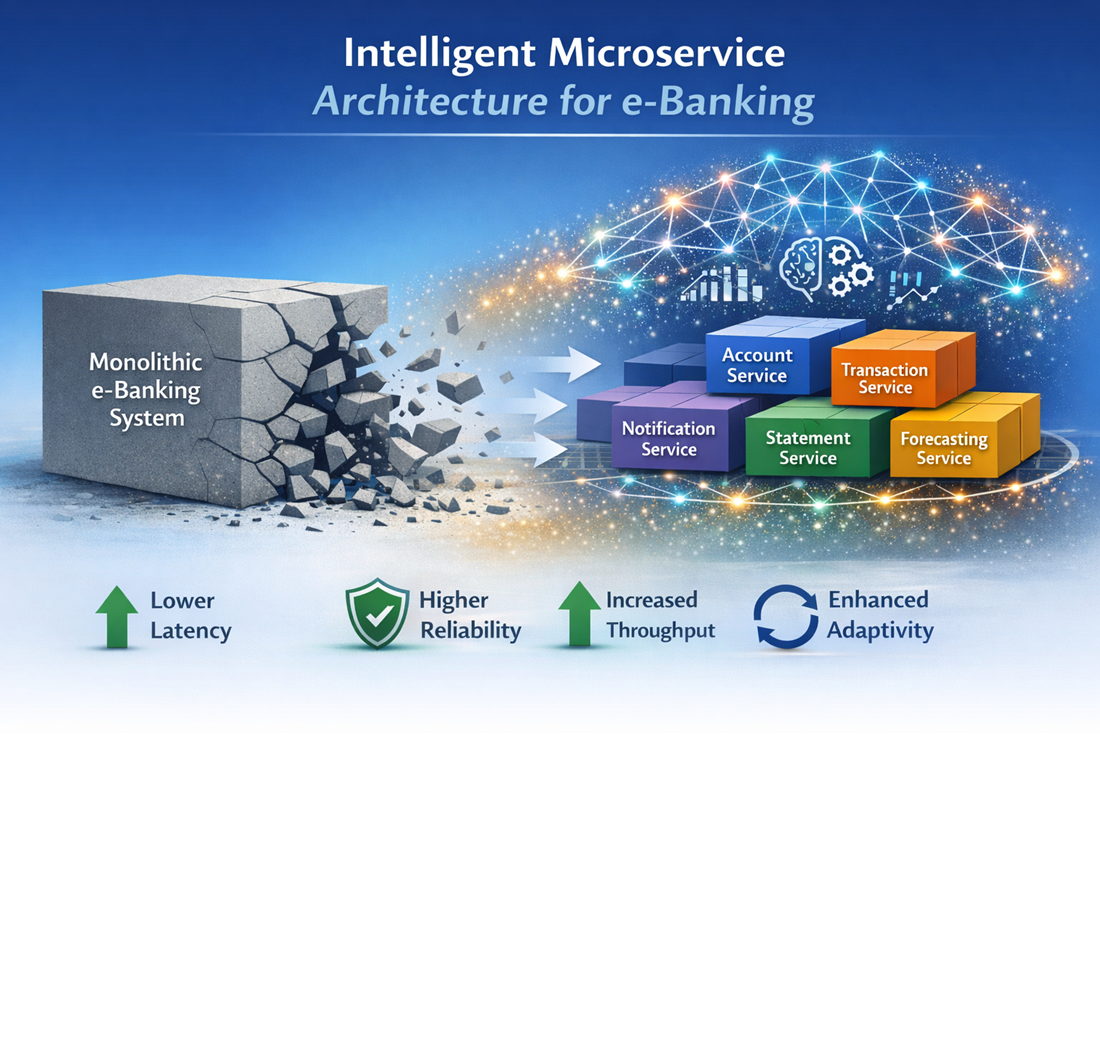
The key approaches and principles of microservice architecture design, as well as the limitations of their application in the e-Banking domain, have been investigated. The architecture has been designed; a prototype of an e-Banking system fragment was developed using the defined model-driven technological framework, followed by experimental evaluation of its quality metrics. The results demonstrate that the combination of microservice architecture, architectural patterns, and intelligent methods eliminates the shortcomings inherent to monolithic e-Banking systems and provides the required software quality levels.
The key features of the proposed approach include the integration of knowledge-oriented models and intelligent approaches into the designed architecture, as well as the adaptation of microservice architecture design patterns to the requirements and operational specificity of e-Banking systems. That made it possible to improve the performance and reliability indicators compared to monolithic architectures, which remain widely used in the development of such systems.
In practice, the proposed microservice architecture and the researched implementation tools could be applied while designing new e-Banking systems or when upgrading existing ones
References
- Deshpande, R. A. (2025). Application Of Spring Boot Microservice Architecture for Scaling Banking Applications. The American Journal of Engineering and Technology, 07 (09), 152–158. https://doi.org/10.37547/tajet/volume07issue09-09
- Daas, T. I. (2025). Design principles and tools to develop of microservice architecture for e-banking systems. Materialy ХVІ Mizhnarodnoi naukovo-praktychnoi konferentsiyi "Priorytetni shliakhy rozvytku nauky i osvity". Lviv, 51–55. Available at: http://www.lviv-forum.inf.ua/save/2025/29-30.09/%D0%97%D0%B1%D1%96%D1%80%D0%BD%D0%B8%D0%BA.pdf
- Newman, S. (2021). Building Microservices. O`Reilly Media, 612. Available at: https://www.oreilly.com/library/view/building-microservices-2nd/9781492034018/
- Anh, V. N. H. (2024). An Architectural View Model for Designing and Implementing Microservices-based Systems: Use Case in FinTech. Procedia Computer Science, 237, 667–674. https://doi.org/10.1016/j.procs.2024.05.152
- Meiappane, A., Prasanna Venkatesan, V., Jegatheeswari, V., Kalpana, B., Sarumathy, U. (2013). Pattern Based Adaptive Architecture For Internet Banking. IJITE, 3 (1-2), 287–293. https://doi.org/10.48550/arXiv.1312.2325
- Elrashidy, M. R., Mansour, H. (2025). Microservices Architecture in Fintech: A Case Study on Scalable Loan Processing with Classical Design Patterns. 2025 Intelligent Methods, Systems, and Applications (IMSA), 382–387. https://doi.org/10.1109/imsa65733.2025.11167186
- Brosens, J., Kruger, R. M., Smuts, H. (2018). Guidelines for designing e-statements for e-banking. Proceedings of the Second African Conference for Human Computer Interaction: Thriving Communities, 1–6. https://doi.org/10.1145/3283458.3283461
- Pai, K., Srinivas, B. J. (2024). Enhanced Visibility for Real-time Monitoring and Alerting in Kubernetes by Integrating Prometheus,Prometheus, Grafana, Loki, and Alerta. Interantional journal of scientific research in engineering and management, 08 (06), 1–5. https://doi.org/10.55041/ijsrem35639
- Moreschini, S., Pour, S., Lanese, I., Balouek, D., Bogner, J., Li, X. et al. (2025). AI Techniques in the Microservices Life-Cycle: a Systematic Mapping Study. Computing, 107 (4). https://doi.org/10.1007/s00607-025-01432-z
- Daas, T. I., Tkachuk, M. V. (2025). Implementation of time series analysis methods and domain modeling in developing anintelligent forecasting module in the internet banking system. Information Processing Systems, 3 (182), 34–43. https://doi.org/10.30748/soi.2025.182.04
- Daas, T. I. (2023). Towards domain modeling approach to software development for bank information systems. Materialy ХХІІІ Vseukrainskoi naukovo-tekhnichnoi konferentsiyi molodykh vchenykh, aspirantiv ta studentiv «Stan, dosiahnennia ta perspektyvy informatsiynykh system i tekhnolohiy». Odesa, 183–185. Available at: https://card-file.ontu.edu.ua/items/93ca1c32-c54c-46d7-9c89-a16f1cd5aab9
- Tomic, M., Dimitrieski, V., Vjestica, M., Župunski, R., Jeremić, A., Kaufmann, H. (2022). Towards Applying API Gateway to Support Microservice Architectures for Embedded Systems. 12th International Conference on Information Society and Technology (ICIST 2022). Kopaonik, 86–91. Available at: https://www.researchgate.net/publication/361952256_Towards_Applying_API_Gateway_to_Support_Microservice_Architectures_for_Embedded_Systems
- Daraghmi, E., Zhang, C.-P., Yuan, S.-M. (2022). Enhancing Saga Pattern for Distributed Transactions within a Microservices Architecture. Applied Sciences, 12 (12), 6242. https://doi.org/10.3390/app12126242
- Daas, T. I., Tkachuk, M. V. (2025). Intelektualni pidkhody do rozrobky ta suprovodu mikroservisnykh arkhitektur: klasyfikatsiya, osnovni vyklyky ta dosvid zastosuvannia. Zbirnyk naukovykh prats mizhnarodnoi naukovo-tekhnichnoi konferentsiyi «Intelektualni tekhnolohii u mizhdystsyplinarnykh doslidzhenniakh» (ITMD-2025). Kharkiv, 101–104.
- CS. Available at: https://csltd.com.ua/
- Ćatović, A., Buzađija, N., Lemes, S. (2022). Microservice development using RabbitMQ message broker. Science, Engineering and Technology, 2 (1), 30–37. https://doi.org/10.54327/set2022/v2.i1.19
- Yalla, P., Sharma, N. (2015). Integrating Natural Language Processing and Software Engineering. International Journal of Software Engineering and Its Applications, 9 (11), 127–136. https://doi.org/10.14257/ijseia.2015.9.11.12
- Abdelnabi, E. A., Maatuk, A. M., Abdelaziz, T. M., Elakeili, S. M. (2020). Generating UML Class Diagram using NLP Techniques and Heuristic Rules. 2020 20th International Conference on Sciences and Techniques of Automatic Control and Computer Engineering (STA), 277–282. https://doi.org/10.1109/sta50679.2020.9329301
- Tkachuk, M., Zinoviev, D. (2024). Development and investigation of an algorithmic model for adaptive management of software microservices configuration. Information Processing Systems, 2 (177), 107–111. https://doi.org/10.30748/soi.2024.177.12
- OMG Unified Modeling Language TM (OMG UML). Version 2.5 (2015). Available at: https://www.omg.org/spec/UML/2.5/PDF
- Statsmodels. Available at: https://www.statsmodels.org/stable/index.html
- Spring Framework. Available at: https://spring.io/projects/spring-framework
- Oracle Cloud Infrastructure Documentation. Monitoring. Available at: https://docs.oracle.com/en-us/iaas/Content/Monitoring/Concepts/alarmsbestpractices.htm
Downloads
Published
How to Cite
Issue
Section
License
Copyright (c) 2026 Tymur Daas, Mykola Tkachuk

This work is licensed under a Creative Commons Attribution 4.0 International License.
The consolidation and conditions for the transfer of copyright (identification of authorship) is carried out in the License Agreement. In particular, the authors reserve the right to the authorship of their manuscript and transfer the first publication of this work to the journal under the terms of the Creative Commons CC BY license. At the same time, they have the right to conclude on their own additional agreements concerning the non-exclusive distribution of the work in the form in which it was published by this journal, but provided that the link to the first publication of the article in this journal is preserved.
A license agreement is a document in which the author warrants that he/she owns all copyright for the work (manuscript, article, etc.).
The authors, signing the License Agreement with TECHNOLOGY CENTER PC, have all rights to the further use of their work, provided that they link to our edition in which the work was published.
According to the terms of the License Agreement, the Publisher TECHNOLOGY CENTER PC does not take away your copyrights and receives permission from the authors to use and dissemination of the publication through the world's scientific resources (own electronic resources, scientometric databases, repositories, libraries, etc.).
In the absence of a signed License Agreement or in the absence of this agreement of identifiers allowing to identify the identity of the author, the editors have no right to work with the manuscript.
It is important to remember that there is another type of agreement between authors and publishers – when copyright is transferred from the authors to the publisher. In this case, the authors lose ownership of their work and may not use it in any way.







