Devising a methodological approach to determining priorities for digital transformation of transport enterprises
DOI:
https://doi.org/10.15587/1729-4061.2026.351698Keywords:
priority of digital technologies, transport enterprise, management, innovative development, methodological approachAbstract
The process that improves decision-making for prioritizing the implementation of digital technologies at a transport enterprise under the conditions of uncertainty associated with war and European integration has been investigated in this study.
The objective need to improve the efficiency of decisions is predetermined by resource constraints faced by enterprises, especially under conditions of martial law.
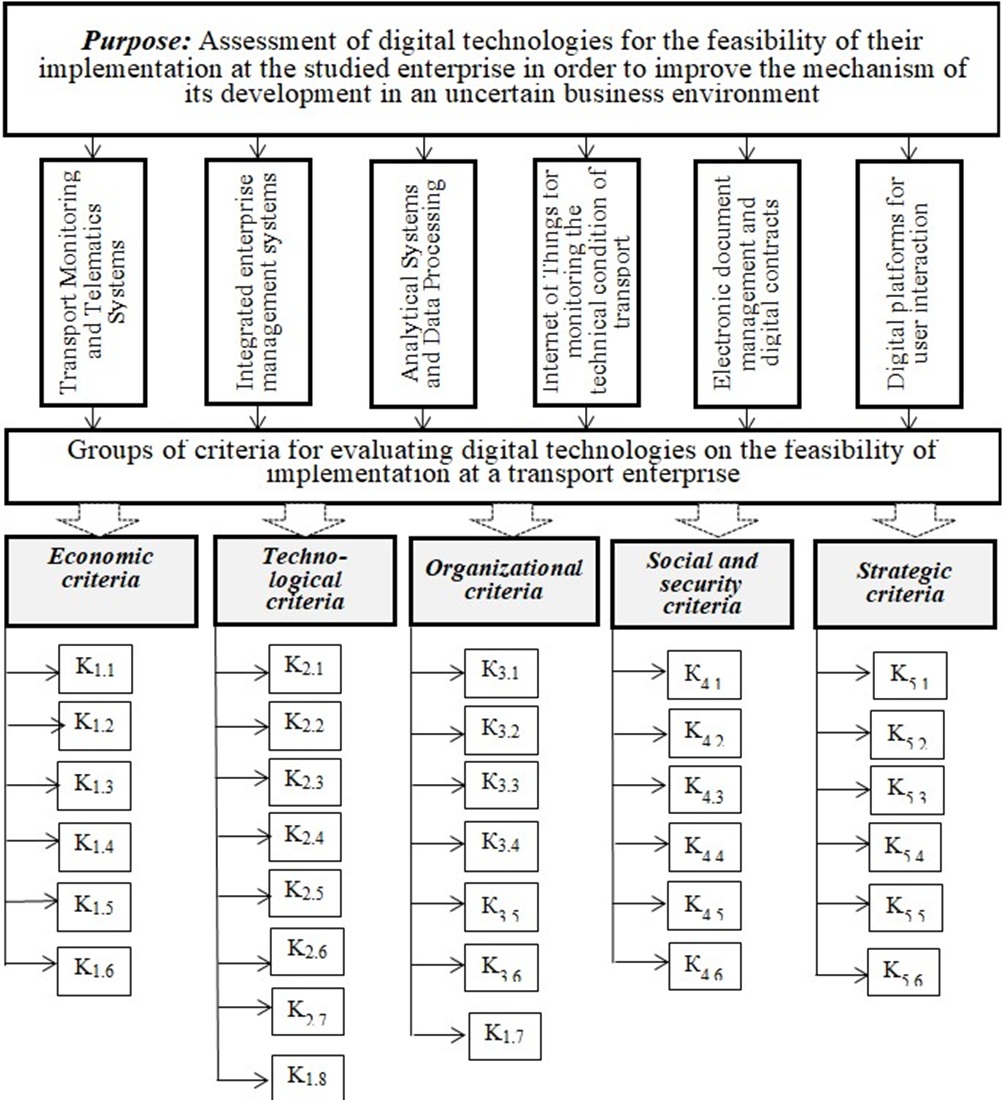
To solve the problem, it has been proposed using a methodological approach based on the hierarchy analysis method. A system of criteria for assessing the priority of digital technologies for transport enterprises was built, which consists of the following groups: economic, technological, organizational-managerial, social-security, and strategic. It was established that the most significant criteria for evaluating digital technologies for the studied enterprises are operational stability (0.4214), technological reliability (0.2621), physical security of infrastructure (0.2987), management flexibility under risk conditions (0.4237), protection of life and health of employees (0.4593), as well as compliance with the legislation of Ukraine and EU norms (0.2713).
The priority of implementing digital technologies for the studied group of transport enterprises was justified based on the construction of a multi-criteria model and the application of the Analytic Hierarchy Process. The following digital technologies were considered to be of the highest priority: transport monitoring and telematics systems, electronic document management, digital contracts and digital interaction platforms.
The objectivity and consistency of the results is attributed to the fact that the evaluation was based on substantiated criteria that provided a multidimensional reflection of the impact of digitalization on the activities of enterprises. A feature of the improved methodological approach is its higher universality. It is suitable for practical application in various modes of transport and for a wide continuum of digital technologies
References
- Lebedeva, L., Shkuropadska, D. (2024). Resilience of transport logistics in EU and Ukraine. Foreign Trade: Economics, Finance, Law, 135 (4), 108–127. https://doi.org/10.31617/3.2024(135)07
- Pozniak, O., Kharakhash, N., Suvorova, I. (2025). Integration of Artificial Intelligence and Electronic Document Management in Logistics: Comparative Analysis of Ukraine, Europe, and the USA. Electronic Scientific Journal Intellectualization of Logistics and Supply Chain Management #1 2020, 33, 93–109. https://doi.org/10.46783/smart-scm/2025-33-7
- Regulation (EU) 2020/1056 of the European Parliament and of the Council of 15 July 2020 on electronic freight transport information (Text with EEA relevance). Available at: https://eur-lex.europa.eu/eli/reg/2020/1056/oj
- Cichosz, M., Wallenburg, C. M., Knemeyer, A. M. (2020). Digital transformation at logistics service providers: barriers, success factors and leading practices. The International Journal of Logistics Management, 31 (2), 209–238. https://doi.org/10.1108/ijlm-08-2019-0229
- Postrelko, Y. (2025). Digital transformation of urban transport systems: classification of approaches and recommendations for Ukraine. Herald of Khmelnytskyi National University. Technical Sciences, 357 (5.2), 300–307. https://doi.org/10.31891/2307-5732-2025-357-98
- Gavrykov, D. (2025). Innovative and digital transformations as a path to sustainable development of transport complex enterprises. International Science Journal of Management, Economics & Finance, 4 (4), 96–103. https://doi.org/10.46299/j.isjmef.20250404.10
- Li, P., Chen, Y., Guo, X. (2025). Digital transformation and supply chain resilience. International Review of Economics & Finance, 99, 104033. https://doi.org/10.1016/j.iref.2025.104033
- Bakioğlu, G. (2025). Prioritization of Digital Technology Applications in Intermodal Freight Transport using CRITIC-based Picture Fuzzy TOPSIS Method. International Journal of Automotive Science And Technology, 9 (2), 230–240. https://doi.org/10.30939/ijastech..1639635
- Alkan, N., Kahraman, C. (2022). Prioritization of Supply Chain Digital Transformation Strategies Using Multi-Expert Fermatean Fuzzy Analytic Hierarchy Process. Informatica, 34 (1), 1–33. https://doi.org/10.15388/22-infor493
- Zitrický, V., Bulková, Z., Gašparík, J., Abramović, B. (2025). Digital transformation of public transport through travel applications. Transportation Research Procedia, 91, 688–695. https://doi.org/10.1016/j.trpro.2025.10.088
- Mollaoglu, M., Gul, M. (2025). Digital transformation in container shipping: evaluation of factors and strategies from a firm-based perspective. Maritime Policy & Management, 1–36. https://doi.org/10.1080/03088839.2025.2552756
- Alavi-Borazjani, S. A., Bengue, A. A., Chkoniya, V., Shafique, M. N. (2025). An Overview of Critical Success Factors for Digital Shipping Corridors: A Roadmap for Maritime Logistics Modernization. Sustainability, 17 (12), 5537. https://doi.org/10.3390/su17125537
- Saaty, T. L. (2001). Fundamentals of the Analytic Hierarchy Process. The Analytic Hierarchy Process in Natural Resource and Environmental Decision Making, 15–35. https://doi.org/10.1007/978-94-015-9799-9_2
- Saaty, T. L. (2001). Fundamentals of Decision Making and Priority Theory With the Analytic Hierarchy Process. Vol. VI of the AHP Series. Pittsburgh. Available at: https://books.google.de/books?id=wct10TlbbIUC&printsec=frontcover&hl=uk&source=gbs_ge_summary_r&cad=0#v=onepage&q&f=false
- Partola, A. I., Palyvoda, O. M., Boniar, S. M. (2020). Innovatsiynyi rozvytok transportu Ukrainy: klasternyi pidkhid. Kyiv: Derzhavnyi universytet infrastruktury ta tekhnolohiy, 206.
- Saaty, T. L. (2008). Relative measurement and its generalization in decision making why pairwise comparisons are central in mathematics for the measurement of intangible factors the analytic hierarchy/network process. Revista de La Real Academia de Ciencias Exactas, Fisicas y Naturales. Serie A. Matematicas, 102 (2), 251–318. https://doi.org/10.1007/bf03191825
Downloads
Published
How to Cite
Issue
Section
License
Copyright (c) 2026 Olena Palyvoda, Yevhenii Vorobiov, Iryna Tarnovska

This work is licensed under a Creative Commons Attribution 4.0 International License.
The consolidation and conditions for the transfer of copyright (identification of authorship) is carried out in the License Agreement. In particular, the authors reserve the right to the authorship of their manuscript and transfer the first publication of this work to the journal under the terms of the Creative Commons CC BY license. At the same time, they have the right to conclude on their own additional agreements concerning the non-exclusive distribution of the work in the form in which it was published by this journal, but provided that the link to the first publication of the article in this journal is preserved.
A license agreement is a document in which the author warrants that he/she owns all copyright for the work (manuscript, article, etc.).
The authors, signing the License Agreement with TECHNOLOGY CENTER PC, have all rights to the further use of their work, provided that they link to our edition in which the work was published.
According to the terms of the License Agreement, the Publisher TECHNOLOGY CENTER PC does not take away your copyrights and receives permission from the authors to use and dissemination of the publication through the world's scientific resources (own electronic resources, scientometric databases, repositories, libraries, etc.).
In the absence of a signed License Agreement or in the absence of this agreement of identifiers allowing to identify the identity of the author, the editors have no right to work with the manuscript.
It is important to remember that there is another type of agreement between authors and publishers – when copyright is transferred from the authors to the publisher. In this case, the authors lose ownership of their work and may not use it in any way.







