Design of autonomous gaze-tracking system for inclusive education
DOI:
https://doi.org/10.15587/1729-4061.2026.351773Keywords:
eye-tracking, inclusive education, motor disorders, VR headset, accessibility of education, adaptive technologiesAbstract
Eye-tracking technology as a means of ensuring the accessibility of education for people with severe musculoskeletal disorders has been investigated in this study. A number of assistive technologies have been devised up to now that possess significant educational potential, but their autonomous use is mainly associated with such difficulties as dependence on the instability of wireless networks or external computing resources. The need to overcome the technological gap between the capabilities of assistive technologies and their real autonomy is a task addressed in this work.
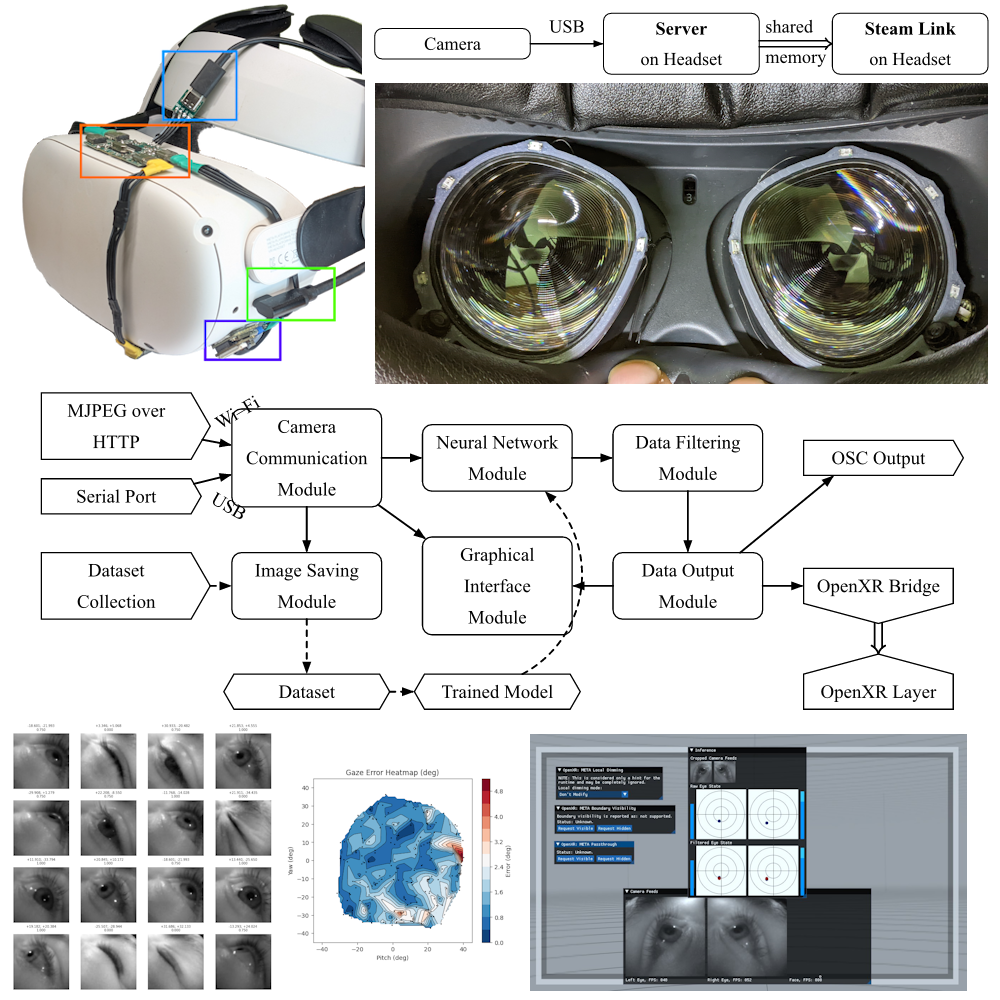
The study's result is the designed fully autonomous architecture based on virtual reality headsets (Meta Quest), which enables the execution of all eye image processing activities and provides direct interface control using the device's processor. The hardware was improved (frame miniaturization, transition to a wired USB interface were carried out); software was developed in the Rust language in the OpenXR API (Application Programming Interface) layer format.
That has made it possible to get rid of network delays and ensure the system's operation, resistant to any conditions. Direct interaction with the headset hardware is provided by effective optimization of convolutional neural networks and the use of low-level system calls. An immersive graphical user interface (GUI) was designed, successfully tested for system configuration and calibration. The GUI became available directly in the virtual space of the headset.
The results could be used for individual learning at home, as well as at inclusive educational institutions or rehabilitation centers that organize training for people with severe musculoskeletal disorders
References
- Nyström, M., Holmqvist, K. (2010). An adaptive algorithm for fixation, saccade, and glissade detection in eyetracking data. Behavior Research Methods, 42 (1), 188–204. https://doi.org/10.3758/brm.42.1.188
- Holmqvist, K., Nyström, M., Andersson, R., Dewhurst, R., Jarodzka, H., van de Weijer, J. (2011). Eye Tracking: A Comprehensive Guide to Methods and Measures. Oxford, 560.
- Kapp, S., Barz, M., Mukhametov, S., Sonntag, D., Kuhn, J. (2021). ARETT: Augmented Reality Eye Tracking Toolkit for Head Mounted Displays. Sensors, 21 (6), 2234. https://doi.org/10.3390/s21062234
- Holmqvist, K., Örbom, S. L., Hooge, I. T. C., Niehorster, D. C., Alexander, R. G., Andersson, R. et al. (2022). RETRACTED ARTICLE: Eye tracking: empirical foundations for a minimal reporting guideline. Behavior Research Methods, 55 (1), 364–416. https://doi.org/10.3758/s13428-021-01762-8
- Šmidekova, Z., Minarikova, E., Janík, M., Holmqvist, K. (2019). Using eye-tracking to investigate differences in teachers' professional vision IN action and ON action. Journal of Eye Movement Research, 12 (7), 260. Available at: https://openurl.ebsco.com/EPDB%3Agcd%3A7%3A10210567/detailv2?sid=ebsco%3Aplink%3Ascholar&id=ebsco%3Agcd%3A142777840&crl=c&link_origin=scholar.google.com
- Sim, G., Bond, R. (2021). Eye tracking in Child Computer Interaction: Challenges and opportunities. International Journal of Child-Computer Interaction, 30, 100345. https://doi.org/10.1016/j.ijcci.2021.100345
- El Moucary, C., Kassem, A., Rizk, D., Rizk, R., Sawan, S., Zakhem, W. (2024). A low-cost full-scale auto eye-tracking system for mobility-impaired patients. AEU - International Journal of Electronics and Communications, 174, 155023. https://doi.org/10.1016/j.aeue.2023.155023
- Sugianto, M., Zhou, Y., Qiu, J. (2025). Eye tracking-based dual task in rehabilitation of motor and cognitive function in post-stroke patients: a literature review. Bulletin of Faculty of Physical Therapy, 30 (1). https://doi.org/10.1186/s43161-025-00295-x
- Sunny, M. S. H., Zarif, M. I. I., Rulik, I., Sanjuan, J., Rahman, M. H., Ahamed, S. I. et al. (2021). Eye-gaze control of a wheelchair mounted 6DOF assistive robot for activities of daily living. Journal of NeuroEngineering and Rehabilitation, 18 (1). https://doi.org/10.1186/s12984-021-00969-2
- Bogachkov, Y., Uhan, P. (2025). Models of blended learning in the context of mixed processes. Information Technologies and Learning Tools, 107 (3), 239–260. https://doi.org/10.33407/itlt.v107i3.5920
- Batsenko, S., Bohachkov, Yu., Burov, O., Horbachenko, V., Korkishko, I., Lytvynova, S., Nosenko, Yu. ta in. (2025). Imersyvni tekhnolohiyi dlia pidtrymky zmishanoho navchannia v zakladakh zahalnoi serednoi osvity. Kyiv: ITsO NAPN Ukrainy, 174. Available at: https://lib.iitta.gov.ua/id/eprint/746953/1/ПОСІБНИК.pdf
- Sedinkin, O., Derkach, M., Skarga-Bandurova, I., Matiuk, D. (2024). Systema dlia vidstezhennia rukhu ochei na osnovi mashynnoho navchannia. Computer-integrated technologies: education, science, production, 55, 199–205. https://doi.org/10.36910/6775-2524-0560-2024-55-25
- Barkovska, O., Liapin, Y., Muzyka, T., Ryndyk, I., Botnar, P. (2024). Gaze direction monitoring model in computer system for academic performance assessment. Information Technologies and Learning Tools, 99 (1), 63–75. https://doi.org/10.33407/itlt.v99i1.5503
- Introducing Bigscreen Beyond 2 with next-gen optics and eyetracking. Available at: https://store.bigscreenvr.com/blogs/beyond/introducing-bigscreen-beyond-2
- My interview with Play For Dream about their headset, Android XR, enterprise licensing, China, and more! Available at: https://skarredghost.com/2025/06/05/play-for-dream-interview-android-xr/
- Vive Focus Vision Announced. Available at: https://www.uploadvr.com/vive-focus-vision-announced/
- Introducing Galaxy XR: Opening New Worlds. Available at: https://news.samsung.com/us/introducing-galaxy-xr-opening-new-worlds/
- Valve Officially Announces Steam Frame, A "Streaming-First" Standalone VR Headset. Available at: https://www.uploadvr.com/valve-steam-frame-official-announcement-features-details/
- Project-Babble/Baballonia. Available at: https://github.com/Project-Babble/Baballonia
- Geche, F., Mitsa, O., Mulesa, O., Horvat, P. (2022). Synthesis of a Two Cascade Neural Network for Time Series Forecasting. 2022 IEEE 3rd International Conference on System Analysis & Intelligent Computing (SAIC), 1–5. https://doi.org/10.1109/saic57818.2022.9922991
- Lupei, M., Shlahta, M., Mitsa, O., Horoshko, Y., Tsybko, H., Gorbachuk, V. (2022). Development of an Interactive Map Within the Implementation of Actual State and Public Directions. 2022 12th International Conference on Advanced Computer Information Technologies (ACIT). https://doi.org/10.1109/acit54803.2022.9913191
- Mitsa, O., Sharkan, V., Maksymchuk, V., Varha, S., Shkurko, H. (2023). Ethnocultural, Educational and Scientific Potential of the Interactive Dialects Map. 2023 IEEE International Conference on Smart Information Systems and Technologies (SIST), 226–231. https://doi.org/10.1109/sist58284.2023.10223544
Downloads
Published
How to Cite
Issue
Section
License
Copyright (c) 2026 Andrii Symkin, Oleksandr Mitsa, Yurii Horoshko, Hanna Tsybko, Viktor Shakotko

This work is licensed under a Creative Commons Attribution 4.0 International License.
The consolidation and conditions for the transfer of copyright (identification of authorship) is carried out in the License Agreement. In particular, the authors reserve the right to the authorship of their manuscript and transfer the first publication of this work to the journal under the terms of the Creative Commons CC BY license. At the same time, they have the right to conclude on their own additional agreements concerning the non-exclusive distribution of the work in the form in which it was published by this journal, but provided that the link to the first publication of the article in this journal is preserved.
A license agreement is a document in which the author warrants that he/she owns all copyright for the work (manuscript, article, etc.).
The authors, signing the License Agreement with TECHNOLOGY CENTER PC, have all rights to the further use of their work, provided that they link to our edition in which the work was published.
According to the terms of the License Agreement, the Publisher TECHNOLOGY CENTER PC does not take away your copyrights and receives permission from the authors to use and dissemination of the publication through the world's scientific resources (own electronic resources, scientometric databases, repositories, libraries, etc.).
In the absence of a signed License Agreement or in the absence of this agreement of identifiers allowing to identify the identity of the author, the editors have no right to work with the manuscript.
It is important to remember that there is another type of agreement between authors and publishers – when copyright is transferred from the authors to the publisher. In this case, the authors lose ownership of their work and may not use it in any way.







