Optimization of channel packet loss in wireless sensor communication systems using model predictive control
DOI:
https://doi.org/10.15587/1729-4061.2026.352116Keywords:
wireless sensor network, WNCS, packet loss, SINR, Bernoulli process, finite-state Markov chain, TDMA, CSMA/CA, MPCAbstract
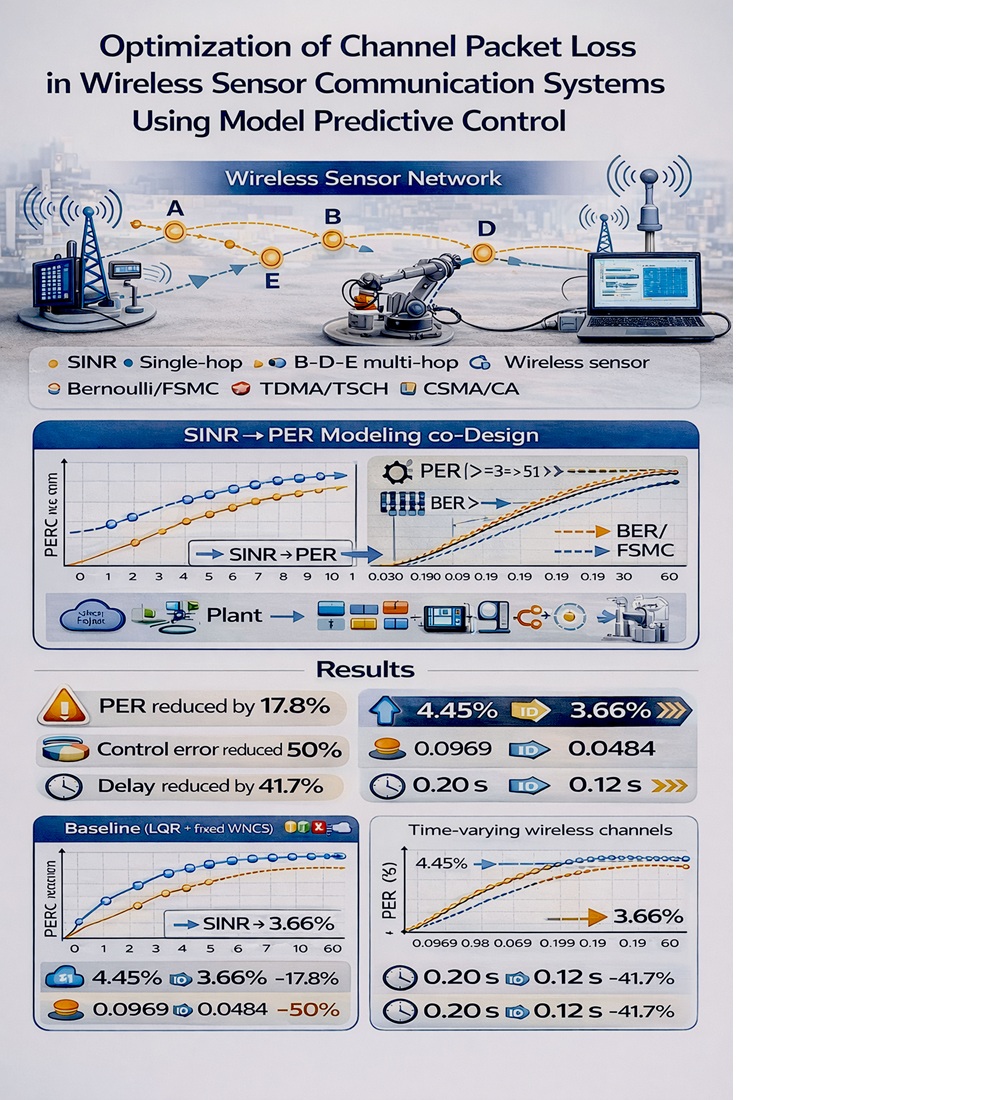
The object of the study is an IEEE 802.15.4 (2.4 GHz) wireless networked control system (WNCS) closing the loop over a wireless sensor network. Fading and interference increase packet loss and delay, reducing stability margins and control quality. The unresolved problem is the lack of a unified end-to-end (E2E) loss model that links PHY signal quality, multi-hop routing and medium access to closed-loop behavior and can be embedded into controller synthesis. An SINR-based channel model (path loss, lognormal shadowing, multipath fading) is mapped to BER and packet error probability; E2E loss for single-hop and multi-hop routes is obtained using Bernoulli and finite-state Markov (FSMC) processes. For verification, original packet traces are captured with an IEEE 802.15.4 sniffer/logger and stored before processing (timestamp, node identifier, sequence number, RSSI/LQI and delivery outcome) to compute PER, latency and burstiness and to parameterize the SINR-to-PER mapping and loss models. Simulations show that TDMA/TSCH achieves up to 40% lower loss than CSMA/CA, while E2E loss rises from 3% to 32% as hop count increases from 1 to 8. An MPC-based co-design jointly adapts transmit power, sampling period and retransmissions. Compared with a fixed-parameter LQR baseline, E2E PER is reduced from 4.45% to 3.66%, average delay from 0.20 s to 0.12 s, and integral absolute error by 50%. The gains are attributed to reduced contention under TDMA scheduling and predictor-driven MPC adaptation. The approach targets industrial monitoring and control with fixed sampling, slowly varying interference and static multi-hop topologies, where parameters can be identified offline and used for online MPC adaptation
References
- Pezzutto, M., Dey, S., Garone, E., Gatsis, K., Johansson, K. H., Schenato, L. (2024). Wireless control: Retrospective and open vistas. Annual Reviews in Control, 58, 100972. https://doi.org/10.1016/j.arcontrol.2024.100972
- Hamdan, M. M., Mahmoud, M. M. (2022). Analysis and Challenges in Wireless Networked Control System: A Survey. International Journal of Robotics and Control Systems, 2 (3), 492–522. https://doi.org/10.31763/ijrcs.v2i3.731
- Huang, K., Liu, W., Li, Y., Savkin, A., Vucetic, B. (2020). Wireless Feedback Control With Variable Packet Length for Industrial IoT. IEEE Wireless Communications Letters, 9 (9), 1586–1590. https://doi.org/10.1109/lwc.2020.2998611
- Liu, Y., Wang, J., Gomes, L., Sun, W. (2021). Adaptive Robust Control for Networked Strict-Feedback Nonlinear Systems with State and Input Quantization. Electronics, 10 (22), 2783. https://doi.org/10.3390/electronics10222783
- Shi, T., Guan, Y., Zheng, Y. (2022). Model predictive control of networked control systems with disturbances and deception attacks under communication constraints. International Journal of Robust and Nonlinear Control, 35 (7), 2717–2735. https://doi.org/10.1002/rnc.6363
- Kuatova, M., Tuleshov, A., Baurzhan, A., Jomartov, A., Tuleshov, Y., Sayakov, O. (2025). Development and Validation of An Automated Crank Press System Integrating the Stephenson II Six-Bar Linkage and Model Predictive Control. ES Materials & Manufacturing. https://doi.org/10.30919/mm1799
- Lee, M.-F. R., Chiu, F.-H. S., Huang, H.-C., Ivancsits, C. (2013). Generalized Predictive Control in a Wireless Networked Control System. International Journal of Distributed Sensor Networks, 9 (12), 475730. https://doi.org/10.1155/2013/475730
- Florenzan Reyes, L. F., Smarra, F., Lun, Y. Z., D’Innocenzo, A. (2021). Learning Markov models of fading channels in wireless control networks: a regression trees based approach. 2021 29th Mediterranean Conference on Control and Automation (MED), 232–237. https://doi.org/10.1109/med51440.2021.9480310
- Kim, M.-J., Lee, H.-I., Choi, J.-H., Lim, K. J., Mo, C. (2022). Development of a Soil Organic Matter Content Prediction Model Based on Supervised Learning Using Vis-NIR/SWIR Spectroscopy. Sensors, 22 (14), 5129. https://doi.org/10.3390/s22145129
- Silva, C. A. G. da, Santos, E. L. dos (2023). A Compensation Model for Packet Loss Using Kalman Filter in Wireless Network Control Systems. Energies, 16 (8), 3329. https://doi.org/10.3390/en16083329
- Yue, X., Liu, Y. (2022). Performance Analysis of Intelligent Reflecting Surface Assisted NOMA Networks. IEEE Transactions on Wireless Communications, 21 (4), 2623–2636. https://doi.org/10.1109/twc.2021.3114221
- Jia, Y., Ye, C., Cui, Y. (2020). Analysis and Optimization of an Intelligent Reflecting Surface-Assisted System With Interference. IEEE Transactions on Wireless Communications, 19 (12), 8068–8082. https://doi.org/10.1109/twc.2020.3019088
- Orea-Flores, I. Y., Rivero-Angeles, M. E., Gonzalez-Ambriz, S.-J., Anaya, E. A., Saleem, S. (2024). Performance Analysis of Wireless Sensor Networks Using Damped Oscillation Functions for the Packet Transmission Probability. Computers, 13 (11), 285. https://doi.org/10.3390/computers13110285
- Zila, A., Ouchatti, A., Mouzouna, Y. (2025). Exploring Node Failure and Packet Loss in Wireless Sensor Networks: A Comprehensive Simulation Analysis. International Journal of Communication Systems, 38 (13). https://doi.org/10.1002/dac.70174
- Lun, Y. Z., Rinaldi, C., D’Innocenzo, A., Santucci, F. (2024). Co-Designing Wireless Networked Control Systems on IEEE 802.15.4-Based Links Under Wi-Fi Interference. IEEE Access, 12, 71157–71183. https://doi.org/10.1109/access.2024.3402082
- Vayssade, T., Azais, F., Latorre, L., Lefevre, F. (2019). Low-Cost Digital Test Solution for Symbol Error Detection of RF ZigBee Transmitters. IEEE Transactions on Device and Materials Reliability, 19 (1), 16–24. https://doi.org/10.1109/tdmr.2019.2898769
- Díez, V., Arriola, A., Val, I., Velez, M. (2020). Reliability evaluation of point-to-point links based on IEEE 802.15.4 physical layer for IWSAN applications. AEU - International Journal of Electronics and Communications, 113, 152967. https://doi.org/10.1016/j.aeue.2019.152967
- Barac, F., Gidlund, M., Zhang, T. (2014). Scrutinizing Bit- and Symbol-Errors of IEEE 802.15.4 Communication in Industrial Environments. IEEE Transactions on Instrumentation and Measurement, 63 (7), 1783–1794. https://doi.org/10.1109/tim.2013.2293235
- Chen, D., Zhuang, Y., Huai, J., Sun, X., Yang, X., Awais Javed, M. et al. (2021). Coexistence and Interference Mitigation for WPANs and WLANs From Traditional Approaches to Deep Learning: A Review. IEEE Sensors Journal, 21 (22), 25561–25589. https://doi.org/10.1109/jsen.2021.3117399
- Yang, D., Xu, Y., Gidlund, M. (2011). Wireless Coexistence between IEEE 802.11- and IEEE 802.15.4-Based Networks: A Survey. International Journal of Distributed Sensor Networks, 7 (1), 912152. https://doi.org/10.1155/2011/912152
- Yu, Y.-S., Chen, Y.-S. (2020). A Measurement-Based Frame-Level Error Model for Evaluation of Industrial Wireless Sensor Networks. Sensors, 20 (14), 3978. https://doi.org/10.3390/s20143978
- Brown, J., Roedig, U., Boano, C. A., Romer, K. (2014). Estimating packet reception rate in noisy environments. 39th Annual IEEE Conference on Local Computer Networks Workshops, 583–591. https://doi.org/10.1109/lcnw.2014.6927706
- Satoh, D., Kobayashi, K., Yamashita, Y. (2018). MPC-based Co-design of Control and Routing for Wireless Sensor and Actuator Networks. International Journal of Control, Automation and Systems, 16 (3), 953–960. https://doi.org/10.1007/s12555-017-0170-7
- Kidane, Z. M., Dargie, W. (2025). Impact of Cross Technology Interference on Time Synchronization and Join Time in Low-Power Wireless Networks. https://doi.org/10.2139/ssrn.5119414
- Balbi, M., Doherty, L., Watteyne, T. (2025). A comprehensive survey on channel hopping and scheduling enhancements for TSCH networks. Journal of Network and Computer Applications, 238, 104164. https://doi.org/10.1016/j.jnca.2025.104164
- Kidane, Z. M., Dargie, W. (2025). Cross-technology interference: detection, avoidance, and coexistence mechanisms in the ISM bands. CCF Transactions on Pervasive Computing and Interaction, 7 (3), 356–375. https://doi.org/10.1007/s42486-025-00185-0
- Wen, H., Lin, C., Chen, Z.-J., Yin, H., He, T., Dutkiewicz, E. (2009). An Improved Markov Model for IEEE 802.15.4 Slotted CSMA/CA Mechanism. Journal of Computer Science and Technology, 24 (3), 495–504. https://doi.org/10.1007/s11390-009-9240-5
- Kim, S., Kim, B.-S., Kim, K. H., Kim, K.-I. (2019). Opportunistic Multipath Routing in Long-Hop Wireless Sensor Networks. Sensors, 19 (19), 4072. https://doi.org/10.3390/s19194072
- Marelli, D. E., Sui, T., Rohr, E. R., Fu, M. (2019). Stability of Kalman filtering with a random measurement equation: Application to sensor scheduling with intermittent observations. Automatica, 99, 390–402. https://doi.org/10.1016/j.automatica.2018.11.003
- Li, P., Zhao, Y.-B., Kang, Y. (2022). Integrated Channel-Aware Scheduling and Packet-Based Predictive Control for Wireless Cloud Control Systems. IEEE Transactions on Cybernetics, 52 (5), 2735–2749. https://doi.org/10.1109/tcyb.2020.3019179
- Liu, W., Quevedo, D. E., Li, Y., Johansson, K. H., Vucetic, B. (2022). Remote State Estimation With Smart Sensors Over Markov Fading Channels. IEEE Transactions on Automatic Control, 67 (6), 2743–2757. https://doi.org/10.1109/tac.2021.3090741
- Girgis, A. M., Park, J., Bennis, M., Debbah, M. (2021). Predictive Control and Communication Co-Design via Two-Way Gaussian Process Regression and AoI-Aware Scheduling. IEEE Transactions on Communications, 69 (10), 7077–7093. https://doi.org/10.1109/tcomm.2021.3099156
Downloads
Published
How to Cite
Issue
Section
License
Copyright (c) 2026 Ainur Ormanbekova, Anar Khabay, Yerkebulan Tuleshov, Nurlan Sarsenbayev, Zhazira Julayeva, Serikbek Ibekeyev, Maral Abulkhanova, Askhat Tlegenov, Magzhan Igen

This work is licensed under a Creative Commons Attribution 4.0 International License.
The consolidation and conditions for the transfer of copyright (identification of authorship) is carried out in the License Agreement. In particular, the authors reserve the right to the authorship of their manuscript and transfer the first publication of this work to the journal under the terms of the Creative Commons CC BY license. At the same time, they have the right to conclude on their own additional agreements concerning the non-exclusive distribution of the work in the form in which it was published by this journal, but provided that the link to the first publication of the article in this journal is preserved.
A license agreement is a document in which the author warrants that he/she owns all copyright for the work (manuscript, article, etc.).
The authors, signing the License Agreement with TECHNOLOGY CENTER PC, have all rights to the further use of their work, provided that they link to our edition in which the work was published.
According to the terms of the License Agreement, the Publisher TECHNOLOGY CENTER PC does not take away your copyrights and receives permission from the authors to use and dissemination of the publication through the world's scientific resources (own electronic resources, scientometric databases, repositories, libraries, etc.).
In the absence of a signed License Agreement or in the absence of this agreement of identifiers allowing to identify the identity of the author, the editors have no right to work with the manuscript.
It is important to remember that there is another type of agreement between authors and publishers – when copyright is transferred from the authors to the publisher. In this case, the authors lose ownership of their work and may not use it in any way.







