Оптимізація втрат пакетів каналу в бездротових системах датчикового зв'язку з використанням модельного прогнозуючого керування
DOI:
https://doi.org/10.15587/1729-4061.2026.352116Ключові слова:
бездротова сенсорна мережа, WNCS, втрата пакетів, SINR, процес Бернуллі, ланцюг Маркова зі скінченними станами, TDMA, CSMA/CA, MPCАнотація
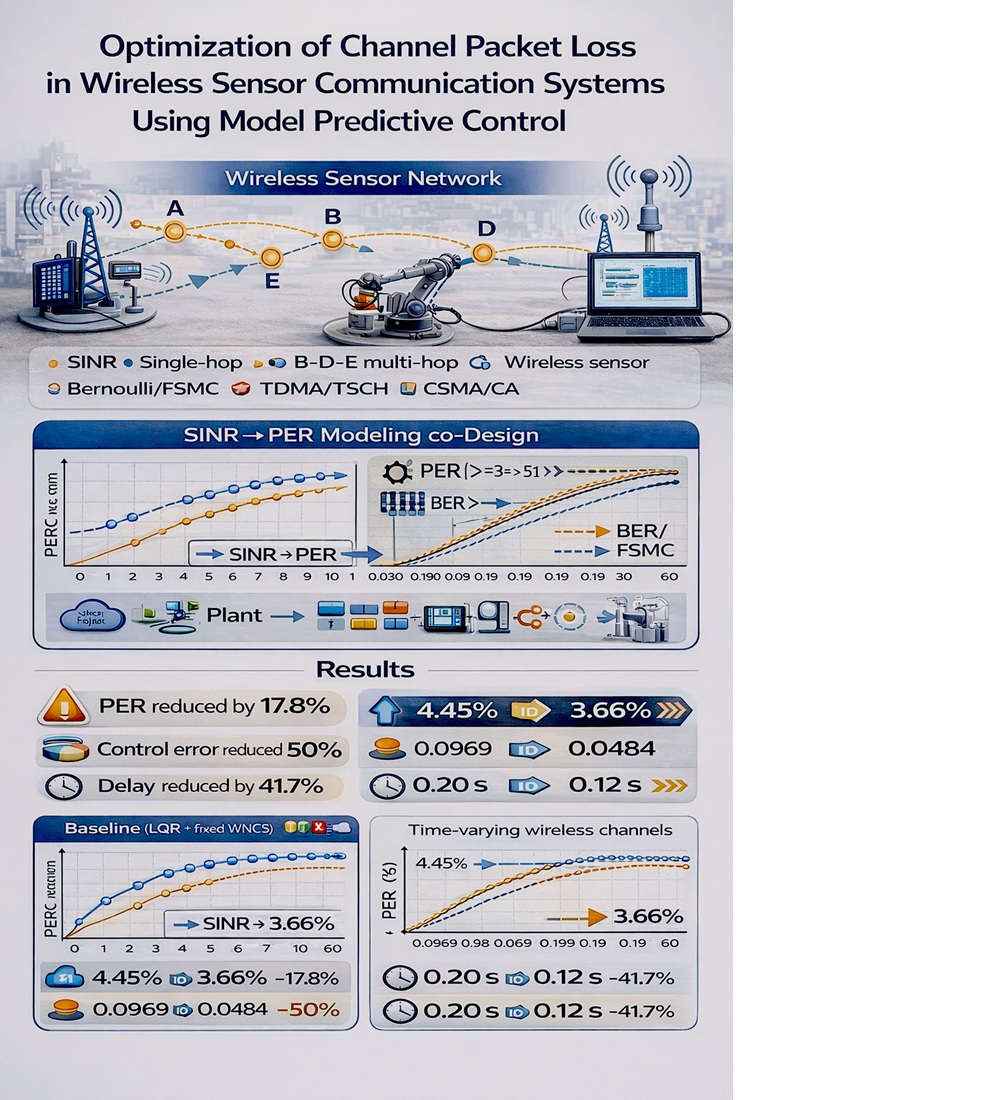
Об'єктом дослідження є бездротова мережева система керування (WNCS) стандарту IEEE 802.15.4 (2,4 ГГц), яка замикає петлю через бездротову сенсорну мережу. Завмирання та перешкоди збільшують втрати та затримки пакетів, знижуючи запаси стійкості та якість керування. Невирішеною проблемою є відсутність єдиної моделі наскрізних втрат (E2E), яка б пов'язувала якість сигналу PHY, багатострибкову маршрутизацію та доступ до середовища із поведінкою замкнутого циклу та могла б бути вбудована в синтез контролера. Модель каналу на основі SINR (втрати на шляху, логарифмічно нормальне затінення, багатошляхові завмирання) відображається на BER та ймовірність помилки пакетів; втрати E2E для однострибкових та багатострибкових маршрутів отримуються за допомогою процесів Бернуллі та Маркова зі скінченними станами (FSMC). Для перевірки оригінальні траси пакетів фіксуються за допомогою сніфера/реєстратора IEEE 802.15.4 та зберігаються перед обробкою (позначка часу, ідентифікатор вузла, порядковий номер, RSSI/LQI та результат доставки) для обчислення PER, затримки та пакетності, а також для параметризації відображення SINR-PER та моделей втрат. Моделювання показує, що TDMA/TSCH досягає до 40% менших втрат, ніж CSMA/CA, тоді як втрати E2E зростають з 3% до 32% зі збільшенням кількості стрибків від 1 до 8. Спільне проектування на основі MPC спільно адаптує потужність передачі, період дискретизації та повторні передачі. Порівняно з базовим рівнем LQR з фіксованими параметрами, PER E2E зменшується з 4,45% до 3,66%, середня затримка з 0,20 с до 0,12 с, а інтегральна абсолютна похибка - на 50%. Переваги пояснюються зменшенням конкуренції при плануванні TDMA та адаптації MPC на основі предикторів. Цей підхід спрямований на промисловий моніторинг та керування з фіксованою дискретизацією, повільно змінними перешкодами та статичними багатострибковими топологіями, де параметри можна ідентифікувати офлайн та використовувати для онлайн-адаптації MPC
Посилання
- Pezzutto, M., Dey, S., Garone, E., Gatsis, K., Johansson, K. H., Schenato, L. (2024). Wireless control: Retrospective and open vistas. Annual Reviews in Control, 58, 100972. https://doi.org/10.1016/j.arcontrol.2024.100972
- Hamdan, M. M., Mahmoud, M. M. (2022). Analysis and Challenges in Wireless Networked Control System: A Survey. International Journal of Robotics and Control Systems, 2 (3), 492–522. https://doi.org/10.31763/ijrcs.v2i3.731
- Huang, K., Liu, W., Li, Y., Savkin, A., Vucetic, B. (2020). Wireless Feedback Control With Variable Packet Length for Industrial IoT. IEEE Wireless Communications Letters, 9 (9), 1586–1590. https://doi.org/10.1109/lwc.2020.2998611
- Liu, Y., Wang, J., Gomes, L., Sun, W. (2021). Adaptive Robust Control for Networked Strict-Feedback Nonlinear Systems with State and Input Quantization. Electronics, 10 (22), 2783. https://doi.org/10.3390/electronics10222783
- Shi, T., Guan, Y., Zheng, Y. (2022). Model predictive control of networked control systems with disturbances and deception attacks under communication constraints. International Journal of Robust and Nonlinear Control, 35 (7), 2717–2735. https://doi.org/10.1002/rnc.6363
- Kuatova, M., Tuleshov, A., Baurzhan, A., Jomartov, A., Tuleshov, Y., Sayakov, O. (2025). Development and Validation of An Automated Crank Press System Integrating the Stephenson II Six-Bar Linkage and Model Predictive Control. ES Materials & Manufacturing. https://doi.org/10.30919/mm1799
- Lee, M.-F. R., Chiu, F.-H. S., Huang, H.-C., Ivancsits, C. (2013). Generalized Predictive Control in a Wireless Networked Control System. International Journal of Distributed Sensor Networks, 9 (12), 475730. https://doi.org/10.1155/2013/475730
- Florenzan Reyes, L. F., Smarra, F., Lun, Y. Z., D’Innocenzo, A. (2021). Learning Markov models of fading channels in wireless control networks: a regression trees based approach. 2021 29th Mediterranean Conference on Control and Automation (MED), 232–237. https://doi.org/10.1109/med51440.2021.9480310
- Kim, M.-J., Lee, H.-I., Choi, J.-H., Lim, K. J., Mo, C. (2022). Development of a Soil Organic Matter Content Prediction Model Based on Supervised Learning Using Vis-NIR/SWIR Spectroscopy. Sensors, 22 (14), 5129. https://doi.org/10.3390/s22145129
- Silva, C. A. G. da, Santos, E. L. dos (2023). A Compensation Model for Packet Loss Using Kalman Filter in Wireless Network Control Systems. Energies, 16 (8), 3329. https://doi.org/10.3390/en16083329
- Yue, X., Liu, Y. (2022). Performance Analysis of Intelligent Reflecting Surface Assisted NOMA Networks. IEEE Transactions on Wireless Communications, 21 (4), 2623–2636. https://doi.org/10.1109/twc.2021.3114221
- Jia, Y., Ye, C., Cui, Y. (2020). Analysis and Optimization of an Intelligent Reflecting Surface-Assisted System With Interference. IEEE Transactions on Wireless Communications, 19 (12), 8068–8082. https://doi.org/10.1109/twc.2020.3019088
- Orea-Flores, I. Y., Rivero-Angeles, M. E., Gonzalez-Ambriz, S.-J., Anaya, E. A., Saleem, S. (2024). Performance Analysis of Wireless Sensor Networks Using Damped Oscillation Functions for the Packet Transmission Probability. Computers, 13 (11), 285. https://doi.org/10.3390/computers13110285
- Zila, A., Ouchatti, A., Mouzouna, Y. (2025). Exploring Node Failure and Packet Loss in Wireless Sensor Networks: A Comprehensive Simulation Analysis. International Journal of Communication Systems, 38 (13). https://doi.org/10.1002/dac.70174
- Lun, Y. Z., Rinaldi, C., D’Innocenzo, A., Santucci, F. (2024). Co-Designing Wireless Networked Control Systems on IEEE 802.15.4-Based Links Under Wi-Fi Interference. IEEE Access, 12, 71157–71183. https://doi.org/10.1109/access.2024.3402082
- Vayssade, T., Azais, F., Latorre, L., Lefevre, F. (2019). Low-Cost Digital Test Solution for Symbol Error Detection of RF ZigBee Transmitters. IEEE Transactions on Device and Materials Reliability, 19 (1), 16–24. https://doi.org/10.1109/tdmr.2019.2898769
- Díez, V., Arriola, A., Val, I., Velez, M. (2020). Reliability evaluation of point-to-point links based on IEEE 802.15.4 physical layer for IWSAN applications. AEU - International Journal of Electronics and Communications, 113, 152967. https://doi.org/10.1016/j.aeue.2019.152967
- Barac, F., Gidlund, M., Zhang, T. (2014). Scrutinizing Bit- and Symbol-Errors of IEEE 802.15.4 Communication in Industrial Environments. IEEE Transactions on Instrumentation and Measurement, 63 (7), 1783–1794. https://doi.org/10.1109/tim.2013.2293235
- Chen, D., Zhuang, Y., Huai, J., Sun, X., Yang, X., Awais Javed, M. et al. (2021). Coexistence and Interference Mitigation for WPANs and WLANs From Traditional Approaches to Deep Learning: A Review. IEEE Sensors Journal, 21 (22), 25561–25589. https://doi.org/10.1109/jsen.2021.3117399
- Yang, D., Xu, Y., Gidlund, M. (2011). Wireless Coexistence between IEEE 802.11- and IEEE 802.15.4-Based Networks: A Survey. International Journal of Distributed Sensor Networks, 7 (1), 912152. https://doi.org/10.1155/2011/912152
- Yu, Y.-S., Chen, Y.-S. (2020). A Measurement-Based Frame-Level Error Model for Evaluation of Industrial Wireless Sensor Networks. Sensors, 20 (14), 3978. https://doi.org/10.3390/s20143978
- Brown, J., Roedig, U., Boano, C. A., Romer, K. (2014). Estimating packet reception rate in noisy environments. 39th Annual IEEE Conference on Local Computer Networks Workshops, 583–591. https://doi.org/10.1109/lcnw.2014.6927706
- Satoh, D., Kobayashi, K., Yamashita, Y. (2018). MPC-based Co-design of Control and Routing for Wireless Sensor and Actuator Networks. International Journal of Control, Automation and Systems, 16 (3), 953–960. https://doi.org/10.1007/s12555-017-0170-7
- Kidane, Z. M., Dargie, W. (2025). Impact of Cross Technology Interference on Time Synchronization and Join Time in Low-Power Wireless Networks. https://doi.org/10.2139/ssrn.5119414
- Balbi, M., Doherty, L., Watteyne, T. (2025). A comprehensive survey on channel hopping and scheduling enhancements for TSCH networks. Journal of Network and Computer Applications, 238, 104164. https://doi.org/10.1016/j.jnca.2025.104164
- Kidane, Z. M., Dargie, W. (2025). Cross-technology interference: detection, avoidance, and coexistence mechanisms in the ISM bands. CCF Transactions on Pervasive Computing and Interaction, 7 (3), 356–375. https://doi.org/10.1007/s42486-025-00185-0
- Wen, H., Lin, C., Chen, Z.-J., Yin, H., He, T., Dutkiewicz, E. (2009). An Improved Markov Model for IEEE 802.15.4 Slotted CSMA/CA Mechanism. Journal of Computer Science and Technology, 24 (3), 495–504. https://doi.org/10.1007/s11390-009-9240-5
- Kim, S., Kim, B.-S., Kim, K. H., Kim, K.-I. (2019). Opportunistic Multipath Routing in Long-Hop Wireless Sensor Networks. Sensors, 19 (19), 4072. https://doi.org/10.3390/s19194072
- Marelli, D. E., Sui, T., Rohr, E. R., Fu, M. (2019). Stability of Kalman filtering with a random measurement equation: Application to sensor scheduling with intermittent observations. Automatica, 99, 390–402. https://doi.org/10.1016/j.automatica.2018.11.003
- Li, P., Zhao, Y.-B., Kang, Y. (2022). Integrated Channel-Aware Scheduling and Packet-Based Predictive Control for Wireless Cloud Control Systems. IEEE Transactions on Cybernetics, 52 (5), 2735–2749. https://doi.org/10.1109/tcyb.2020.3019179
- Liu, W., Quevedo, D. E., Li, Y., Johansson, K. H., Vucetic, B. (2022). Remote State Estimation With Smart Sensors Over Markov Fading Channels. IEEE Transactions on Automatic Control, 67 (6), 2743–2757. https://doi.org/10.1109/tac.2021.3090741
- Girgis, A. M., Park, J., Bennis, M., Debbah, M. (2021). Predictive Control and Communication Co-Design via Two-Way Gaussian Process Regression and AoI-Aware Scheduling. IEEE Transactions on Communications, 69 (10), 7077–7093. https://doi.org/10.1109/tcomm.2021.3099156
##submission.downloads##
Опубліковано
Як цитувати
Номер
Розділ
Ліцензія
Авторське право (c) 2026 Ainur Ormanbekova, Anar Khabay, Yerkebulan Tuleshov, Nurlan Sarsenbayev, Zhazira Julayeva, Serikbek Ibekeyev, Maral Abulkhanova, Askhat Tlegenov, Magzhan Igen

Ця робота ліцензується відповідно до Creative Commons Attribution 4.0 International License.
Закріплення та умови передачі авторських прав (ідентифікація авторства) здійснюється у Ліцензійному договорі. Зокрема, автори залишають за собою право на авторство свого рукопису та передають журналу право першої публікації цієї роботи на умовах ліцензії Creative Commons CC BY. При цьому вони мають право укладати самостійно додаткові угоди, що стосуються неексклюзивного поширення роботи у тому вигляді, в якому вона була опублікована цим журналом, але за умови збереження посилання на першу публікацію статті в цьому журналі.
Ліцензійний договір – це документ, в якому автор гарантує, що володіє усіма авторськими правами на твір (рукопис, статтю, тощо).
Автори, підписуючи Ліцензійний договір з ПП «ТЕХНОЛОГІЧНИЙ ЦЕНТР», мають усі права на подальше використання свого твору за умови посилання на наше видання, в якому твір опублікований. Відповідно до умов Ліцензійного договору, Видавець ПП «ТЕХНОЛОГІЧНИЙ ЦЕНТР» не забирає ваші авторські права та отримує від авторів дозвіл на використання та розповсюдження публікації через світові наукові ресурси (власні електронні ресурси, наукометричні бази даних, репозитарії, бібліотеки тощо).
За відсутності підписаного Ліцензійного договору або за відсутністю вказаних в цьому договорі ідентифікаторів, що дають змогу ідентифікувати особу автора, редакція не має права працювати з рукописом.
Важливо пам’ятати, що існує і інший тип угоди між авторами та видавцями – коли авторські права передаються від авторів до видавця. В такому разі автори втрачають права власності на свій твір та не можуть його використовувати в будь-який спосіб.