Revealing the effect of additive printing technological parameters on the adhesion properties of 3D elements integrated into printed substrates
DOI:
https://doi.org/10.15587/1729-4061.2026.352153Keywords:
FDM printing, adhesive strength, polymer composite materials, wear resistance, structural characteristics, qualityAbstract
This paper investigates the process that forms an adhesive bond between the polylactic acid (PLA) polymer and textile substrates during direct Fused Deposition Modeling (FDM) printing, which is used to make printed products with integrated 3D elements. The task addressed relates to the insufficient understanding of the influence exerted by the structural characteristics of textile materials and additive printing parameters on the quality and stability of the adhesive layer.
This study has established patterns of interaction between PLA and fabrics of different densities, thicknesses, and surface topographies.
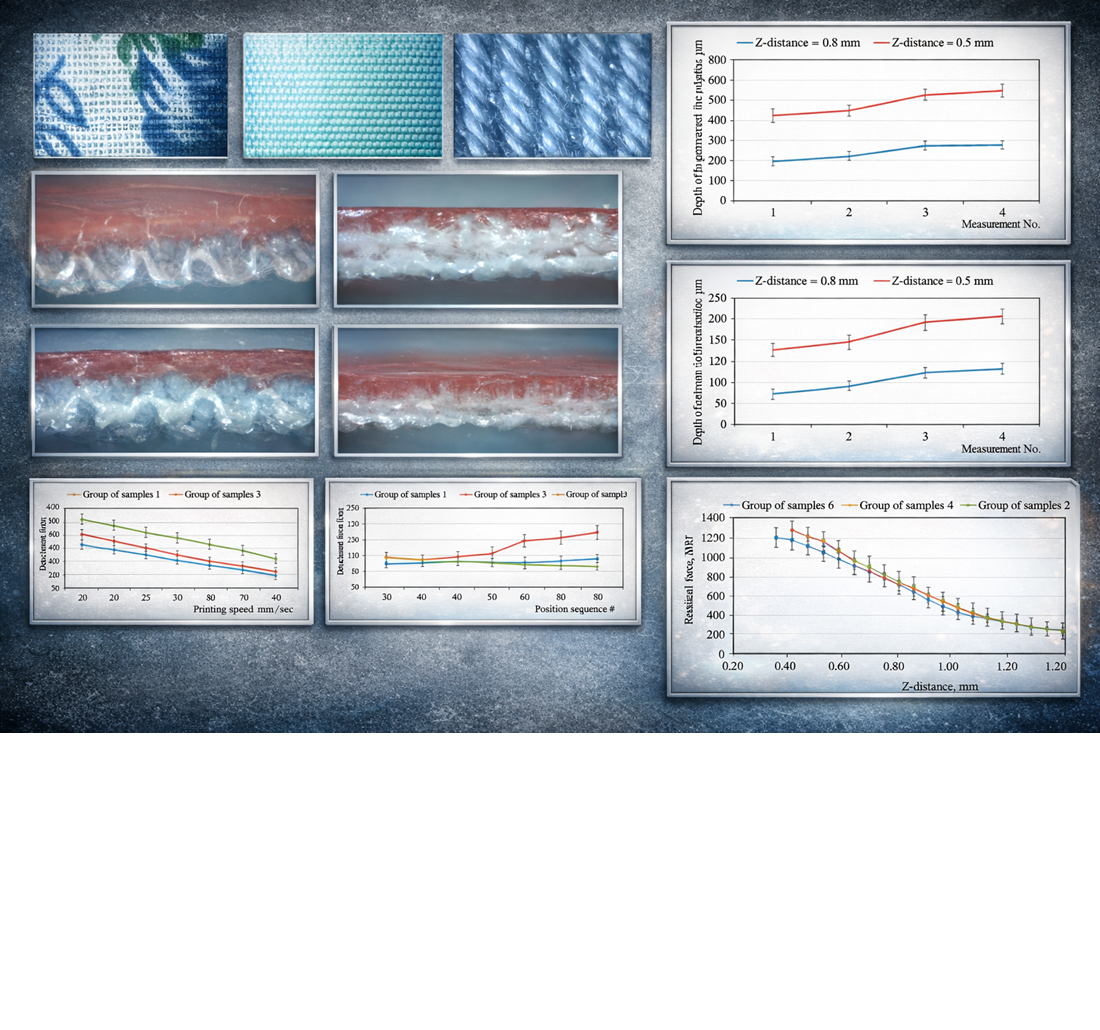
Mechanical pull-off tests were conducted to quantitatively assess the adhesive strength and determine the relationship between the pull-off force and the technological parameters of printing. It is shown that increased extrusion temperatures, average extruder travel speed, and minimum Z-distance between the nozzle and the base enable the formation of a more stable bond. The effect of preliminary application of an adhesive layer was investigated, which in certain cases further increases the adhesive interaction.
The results have made it possible to solve the task by comprehensively taking into account the structural features of textile bases and the physical and technological factors of FDM printing. The identified patterns are explained by a combination of thermomechanical effects during PLA extrusion and the ability of textile fibers to provide micromechanical fixation of the polymer.
The findings could be effectively used in the context of the introduction of additive technologies in printing.
References
- Liu, J., Sun, L., Xu, W., Wang, Q., Yu, S., Sun, J. (2019). Current advances and future perspectives of 3D printing natural-derived biopolymers. Carbohydrate Polymers, 207, 297–316. https://doi.org/10.1016/j.carbpol.2018.11.077
- Raddatz, L., Austerjost, J., Beutel, S. (2017). 3D‐Druck: Chancen, Möglichkeiten, Risiken. Chemie in Unserer Zeit, 52 (1), 42–50. https://doi.org/10.1002/ciuz.201700802
- Lemi, M. T., Lemu, H. G., Gutema, E. M. (2025). Review of Recent Advancements in 3D Printing Technologies for Textile Applications. Textile & Leather Review, 8, 72–104. https://doi.org/10.31881/tlr.2024.169
- Sitotaw, D. B., Ahrendt, D., Kyosev, Y., Kabish, A. K. (2020). Additive Manufacturing and Textiles – State-of-the-Art. Applied Sciences, 10 (15), 5033. https://doi.org/10.3390/app10155033
- Amor, N., Noman, M. T., Petru, M. (2021). Classification of Textile Polymer Composites: Recent Trends and Challenges. Polymers, 13 (16), 2592. https://doi.org/10.3390/polym13162592
- Tsou, C.-H., Yao, W.-H., Wu, C.-S., Tsou, C.-Y., Hung, W.-S., Chen, J.-C. et al. (2019). Preparation and characterization of renewable composites from Polylactide and Rice husk for 3D printing applications. Journal of Polymer Research, 26 (9). https://doi.org/10.1007/s10965-019-1882-6
- Gorlachova, M., Mahltig, B. (2021). 3D-printing on textiles – an investigation on adhesion properties of the produced composite materials. Journal of Polymer Research, 28 (6). https://doi.org/10.1007/s10965-021-02567-1
- Krapež Tomec, D., Balzano, A., Žigon, J., Šernek, M., Kariž, M. (2022). The Effect of Printing Parameters and Wood Surface Preparation on the Adhesion of Directly 3D-Printed PLA on Wood. Journal of Renewable Materials, 10 (7), 1787–1796. https://doi.org/10.32604/jrm.2022.019760
- Bogović, S., Čorak, A. (2022). A New Method for Testing the Breaking Force of a Polylactic Acid-Fabric Joint for the Purpose of Making a Protective Garment. Materials, 15 (10), 3549. https://doi.org/10.3390/ma15103549
- Han, Y., Yun, C. (2024). Effect of substrate fabric characteristics on the peel strength of 3D-printed composite fabrics. Fashion and Textiles, 11 (1). https://doi.org/10.1186/s40691-024-00405-8
- Mpofu, N. S., Mwasiagi, J. I., Nkiwane, L. C., Njuguna, D. (2019). Use of regression to study the effect of fabric parameters on the adhesion of 3D printed PLA polymer onto woven fabrics. Fashion and Textiles, 6 (1). https://doi.org/10.1186/s40691-019-0180-6
- Hashemi Sanatgar, R., Campagne, C., Nierstrasz, V. (2017). Investigation of the adhesion properties of direct 3D printing of polymers and nanocomposites on textiles: Effect of FDM printing process parameters. Applied Surface Science, 403, 551–563. https://doi.org/10.1016/j.apsusc.2017.01.112
- Kozior, T., Blachowicz, T., Ehrmann, A. (2020). Adhesion of three-dimensional printing on textile fabrics: Inspiration from and for other research areas. Journal of Engineered Fibers and Fabrics, 15. https://doi.org/10.1177/1558925020910875
- ISO/ASTM 52915:2020. Specification for additive manufacturing file format (AMF) Version 1.2. Available at: https://www.iso.org/standard/74640.html
- Mekhanichni kharakterystyky. PLA Zhovtyi napivprozoryi. Available at: https://monofilament.com.ua/ua/products/standartnye-materialy/pla/pla-zheltyj-poluprozrachnyj-o1-75mm-ves0-75kg
- Prajapati, S., Sharma, J. K., Kumar, S., Pandey, S., Pandey, M. K. (2024). A review on comparison of physical and mechanical properties of PLA, ABS, TPU, and PETG manufactured engineering components by using fused deposition modelling. Materials Today: Proceedings. https://doi.org/10.1016/j.matpr.2024.05.018
- XYZprinting da Vinci Super 3D printer. Specifications. Available at: https://top3dshop.com/product/xyzprinting-da-vinci-super-3d-printer
- Ekşi, S., Karakaya, C. (2025). Effects of Process Parameters on Tensile Properties of 3D-Printed PLA Parts Fabricated with the FDM Method. Polymers, 17 (14), 1934. https://doi.org/10.3390/polym17141934
- Spoerk, M., Arbeiter, F., Cajner, H., Sapkota, J., Holzer, C. (2017). Parametric optimization of intra‐ and inter‐layer strengths in parts produced by extrusion‐based additive manufacturing of poly(lactic acid). Journal of Applied Polymer Science, 134 (41). https://doi.org/10.1002/app.45401
- Popescu, D., Amza, C. G. (2024). 3D Printing onto Textiles: A Systematic Analysis of the Adhesion Studies. 3D Printing and Additive Manufacturing, 11 (2), e586–e606. https://doi.org/10.1089/3dp.2022.0100
- Song, X., Ye, Y., Huang, S., Han, X., Huang, Z., Guan, W. et al. (2024). 3D printing of continuous cotton thread reinforced poly (lactic acid). Scientific Reports, 14 (1). https://doi.org/10.1038/s41598-024-81699-y
- DSTU ISO 139:2007. Textiles. Standard atmospheres for conditioning and testing (ISO 139:2005, IDТ). Available at: https://online.budstandart.com/ua/catalog/doc-page?id_doc=50428
- DSTU EN 12127:2009. Materialy tekstylni. Tkanyny. Vyznachennia masy na odynytsiu ploshchi z vykorystanniam malykh prob (EN 12127:1997, IDT). Available at: https://docs.dbn.co.ua/4044_1583178494165.html
- GOYOJO. Available at: https://goyojotools.com
- D Laser Scanning Confocal Microscope. VK-X series. Available at: https://www.keyence.com/products/microscope/laser-microscope/vk-x100_x200/models/vk-x100k/
- Textiles - Determination of thickness of textiles and textile products (ISO 5084:1996) - German version EN ISO 5084:1996. Available at: https://www.boutique.afnor.org/en-gb/standard/din-en-iso-5084/textiles-determination-of-thickness-of-textiles-and-textile-products-iso-50/eu024254/146707
- Tsyfrovyi indykatornyi tovshchynomir dlia paperu, tkanyny, shkiry, polietylenu 0-25.4 mm (0.01mm) PROTESTER 5317-25. Available at: https://protester.com.ua/531725/?srsltid=AfmBOopTihVbkX849__3ezHqiMKa8a2cGs-_f_KJMKMFATeWQnKF4qJd&utm_
- ASTM E3-11(2017). Standard Guide for Preparation of Metallographic Specimens. https://doi.org/10.1520/e0003-11r17
- IsoMet 1000. BUEHLER. Available at: https://www.buehler.com/products/sectioning/precision-cutters/isomet-1000-precision-cutter/
- Digital Microscope. VHX-6000 series. Available at: https://www.keyence.eu/products/microscope/digital-microscope/vhx-6000/models/vhx-6000/
- Malengier, B., Hertleer, C., Cardon, L., Van Langenhove, L. (2017). 3D printing on textiles: Testing of adhesion. ITMC2017 - International Conference on Intelligent Textiles and Mass Customisation. Available at: https://backoffice.biblio.ugent.be/download/8535084/8535085
- Özev, M.-S., Ehrmann, A. (2023). Sandwiching textiles with FDM Printing. Communications in Development and Assembling of Textile Products, 4 (1), 88–94. https://doi.org/10.25367/cdatp.2023.4.p88-94
- Testometric. Available at: https://www.testometric.co.uk/
- Kyrychok, T., Vorobyova, V., Klymenko, T., Bilousova, A., Bardovskyi, B., Volodko, M., Avdiakov, Y. (2025). Investigation of adhesive properties of polymer and paper printed substrates treated with corona discharge. Seventeenth International Conference on Correlation Optics, 10. https://doi.org/10.1117/12.3088006
- Ehrmann, A., Steinmetz, P. (2021). Influence of elastic 3D printed polymers on the mechanical properties and tribology of textile fabrics. Communications in Development and Assembling of Textile Products, 2 (2), 115–122. https://doi.org/10.25367/cdatp.2021.2.p115-122
- Wojtyła, S., Klama, P., Baran, T. (2017). Is 3D printing safe? Analysis of the thermal treatment of thermoplastics: ABS, PLA, PET, and nylon. Journal of Occupational and Environmental Hygiene, 14 (6), D80–D85. https://doi.org/10.1080/15459624.2017.1285489
Downloads
Published
How to Cite
Issue
Section
License
Copyright (c) 2026 Tetiana Kyrychok, Tetiana Klymenko, Maryna Volodko, Vladyslav Doroshchuk

This work is licensed under a Creative Commons Attribution 4.0 International License.
The consolidation and conditions for the transfer of copyright (identification of authorship) is carried out in the License Agreement. In particular, the authors reserve the right to the authorship of their manuscript and transfer the first publication of this work to the journal under the terms of the Creative Commons CC BY license. At the same time, they have the right to conclude on their own additional agreements concerning the non-exclusive distribution of the work in the form in which it was published by this journal, but provided that the link to the first publication of the article in this journal is preserved.
A license agreement is a document in which the author warrants that he/she owns all copyright for the work (manuscript, article, etc.).
The authors, signing the License Agreement with TECHNOLOGY CENTER PC, have all rights to the further use of their work, provided that they link to our edition in which the work was published.
According to the terms of the License Agreement, the Publisher TECHNOLOGY CENTER PC does not take away your copyrights and receives permission from the authors to use and dissemination of the publication through the world's scientific resources (own electronic resources, scientometric databases, repositories, libraries, etc.).
In the absence of a signed License Agreement or in the absence of this agreement of identifiers allowing to identify the identity of the author, the editors have no right to work with the manuscript.
It is important to remember that there is another type of agreement between authors and publishers – when copyright is transferred from the authors to the publisher. In this case, the authors lose ownership of their work and may not use it in any way.







