Виявлення впливу технологічних параметрів адитивного друку на адгезійні властивості інтегрованих 3D-елементів до задрукованих основ
DOI:
https://doi.org/10.15587/1729-4061.2026.352153Ключові слова:
FDM-друк, адгезійна міцність, полімерні композитні матеріали, зносостійкість, структурні характеристики, якістьАнотація
Об’єктом дослідження визначено процес формування адгезійного з’єднання між текстильними основами та полімером PLA (Polylactic acid ) під час прямого FDM-друку (Fused Deposition Modeling), що використовується при виготовленні поліграфічної продукції з інтегрованими 3D-елементами. Проблема, яка розглядалась у роботі, зумовлена недостатнім розумінням впливу структурних особливостей текстильних основ та параметрів адативного друку на стабільність адгезійного з’єднання.
Дослідження дозволили встановити особливості взаємодії PLA із тканинними основами різної щільності та товщини, а також визначити ряд закономірностей.
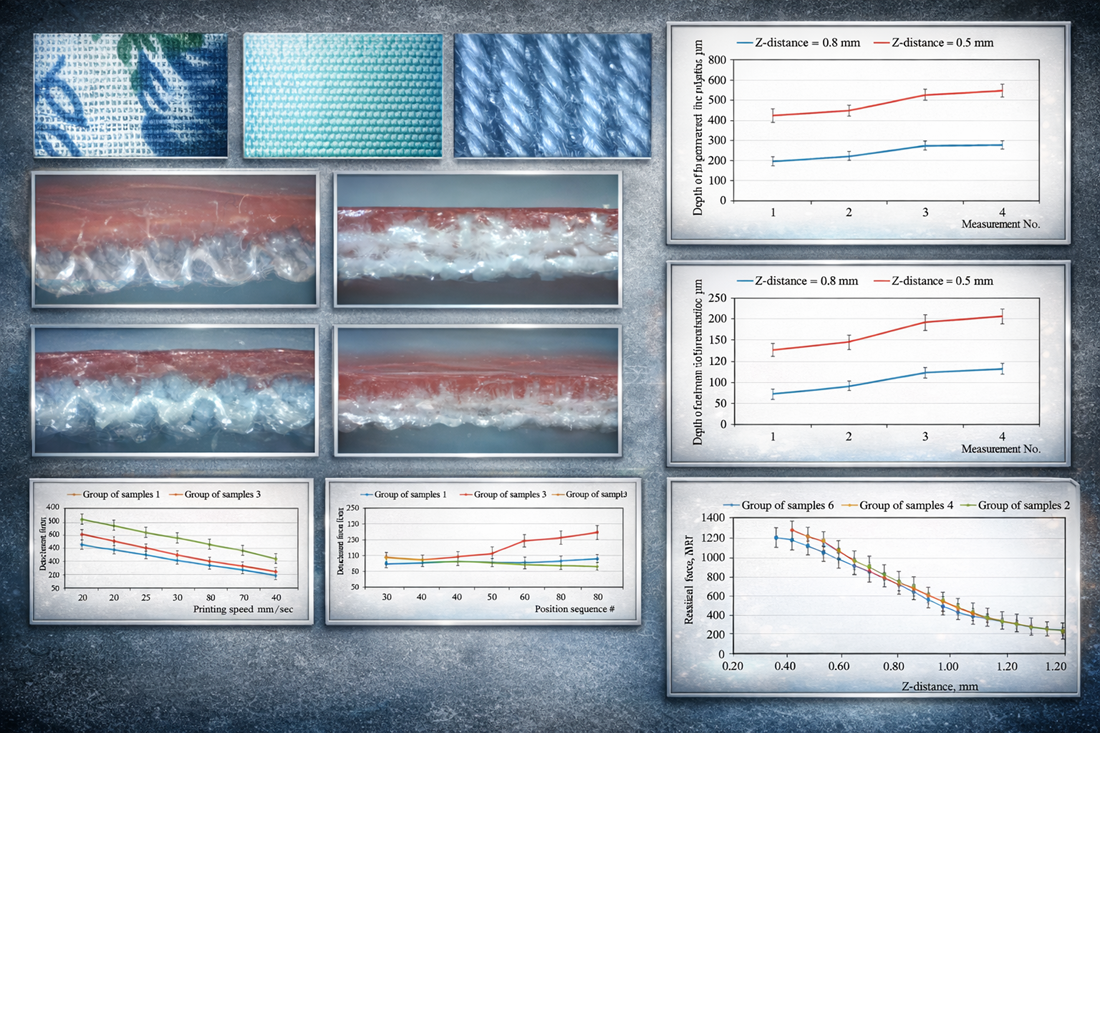
Проведено механічні випробування на відрив, за результатами яких кількісно оцінено інтегральний опір руйнуванню, а також визначено залежність між силою відриву та технологічними параметрами друку. Встановлено, що формування стабільного зчеплення забезпечується підвищення температури екструзії, середньої швидкості переміщення екструдера, а також дотриманням мінімальної Z-відстань між соплом і текстильною основою.
Одержані результати дали змогу вирішити визначену проблему шляхом комплексного врахування структурних характеристик текстильних основ та технологічних параметрів FDM-друку. Встановлені закономірності обумовлено сукупністю термомеханічної дії у зоні екструзії PLA та спроможністю текстильних волокон сприяти проникненню та механічному закріпленню полімеру. Отримані результати дослідження можуть бути рекомендовані до використання за умов інтеграції адитивних технологій у сферу поліграфічного виробництва для формування захисних, декоративних та функціональних 3D-елементів у поліграфічній продукції пакувального та палітурного призначення
Посилання
- Liu, J., Sun, L., Xu, W., Wang, Q., Yu, S., Sun, J. (2019). Current advances and future perspectives of 3D printing natural-derived biopolymers. Carbohydrate Polymers, 207, 297–316. https://doi.org/10.1016/j.carbpol.2018.11.077
- Raddatz, L., Austerjost, J., Beutel, S. (2017). 3D‐Druck: Chancen, Möglichkeiten, Risiken. Chemie in Unserer Zeit, 52 (1), 42–50. https://doi.org/10.1002/ciuz.201700802
- Lemi, M. T., Lemu, H. G., Gutema, E. M. (2025). Review of Recent Advancements in 3D Printing Technologies for Textile Applications. Textile & Leather Review, 8, 72–104. https://doi.org/10.31881/tlr.2024.169
- Sitotaw, D. B., Ahrendt, D., Kyosev, Y., Kabish, A. K. (2020). Additive Manufacturing and Textiles – State-of-the-Art. Applied Sciences, 10 (15), 5033. https://doi.org/10.3390/app10155033
- Amor, N., Noman, M. T., Petru, M. (2021). Classification of Textile Polymer Composites: Recent Trends and Challenges. Polymers, 13 (16), 2592. https://doi.org/10.3390/polym13162592
- Tsou, C.-H., Yao, W.-H., Wu, C.-S., Tsou, C.-Y., Hung, W.-S., Chen, J.-C. et al. (2019). Preparation and characterization of renewable composites from Polylactide and Rice husk for 3D printing applications. Journal of Polymer Research, 26 (9). https://doi.org/10.1007/s10965-019-1882-6
- Gorlachova, M., Mahltig, B. (2021). 3D-printing on textiles – an investigation on adhesion properties of the produced composite materials. Journal of Polymer Research, 28 (6). https://doi.org/10.1007/s10965-021-02567-1
- Krapež Tomec, D., Balzano, A., Žigon, J., Šernek, M., Kariž, M. (2022). The Effect of Printing Parameters and Wood Surface Preparation on the Adhesion of Directly 3D-Printed PLA on Wood. Journal of Renewable Materials, 10 (7), 1787–1796. https://doi.org/10.32604/jrm.2022.019760
- Bogović, S., Čorak, A. (2022). A New Method for Testing the Breaking Force of a Polylactic Acid-Fabric Joint for the Purpose of Making a Protective Garment. Materials, 15 (10), 3549. https://doi.org/10.3390/ma15103549
- Han, Y., Yun, C. (2024). Effect of substrate fabric characteristics on the peel strength of 3D-printed composite fabrics. Fashion and Textiles, 11 (1). https://doi.org/10.1186/s40691-024-00405-8
- Mpofu, N. S., Mwasiagi, J. I., Nkiwane, L. C., Njuguna, D. (2019). Use of regression to study the effect of fabric parameters on the adhesion of 3D printed PLA polymer onto woven fabrics. Fashion and Textiles, 6 (1). https://doi.org/10.1186/s40691-019-0180-6
- Hashemi Sanatgar, R., Campagne, C., Nierstrasz, V. (2017). Investigation of the adhesion properties of direct 3D printing of polymers and nanocomposites on textiles: Effect of FDM printing process parameters. Applied Surface Science, 403, 551–563. https://doi.org/10.1016/j.apsusc.2017.01.112
- Kozior, T., Blachowicz, T., Ehrmann, A. (2020). Adhesion of three-dimensional printing on textile fabrics: Inspiration from and for other research areas. Journal of Engineered Fibers and Fabrics, 15. https://doi.org/10.1177/1558925020910875
- ISO/ASTM 52915:2020. Specification for additive manufacturing file format (AMF) Version 1.2. Available at: https://www.iso.org/standard/74640.html
- Mekhanichni kharakterystyky. PLA Zhovtyi napivprozoryi. Available at: https://monofilament.com.ua/ua/products/standartnye-materialy/pla/pla-zheltyj-poluprozrachnyj-o1-75mm-ves0-75kg
- Prajapati, S., Sharma, J. K., Kumar, S., Pandey, S., Pandey, M. K. (2024). A review on comparison of physical and mechanical properties of PLA, ABS, TPU, and PETG manufactured engineering components by using fused deposition modelling. Materials Today: Proceedings. https://doi.org/10.1016/j.matpr.2024.05.018
- XYZprinting da Vinci Super 3D printer. Specifications. Available at: https://top3dshop.com/product/xyzprinting-da-vinci-super-3d-printer
- Ekşi, S., Karakaya, C. (2025). Effects of Process Parameters on Tensile Properties of 3D-Printed PLA Parts Fabricated with the FDM Method. Polymers, 17 (14), 1934. https://doi.org/10.3390/polym17141934
- Spoerk, M., Arbeiter, F., Cajner, H., Sapkota, J., Holzer, C. (2017). Parametric optimization of intra‐ and inter‐layer strengths in parts produced by extrusion‐based additive manufacturing of poly(lactic acid). Journal of Applied Polymer Science, 134 (41). https://doi.org/10.1002/app.45401
- Popescu, D., Amza, C. G. (2024). 3D Printing onto Textiles: A Systematic Analysis of the Adhesion Studies. 3D Printing and Additive Manufacturing, 11 (2), e586–e606. https://doi.org/10.1089/3dp.2022.0100
- Song, X., Ye, Y., Huang, S., Han, X., Huang, Z., Guan, W. et al. (2024). 3D printing of continuous cotton thread reinforced poly (lactic acid). Scientific Reports, 14 (1). https://doi.org/10.1038/s41598-024-81699-y
- DSTU ISO 139:2007. Textiles. Standard atmospheres for conditioning and testing (ISO 139:2005, IDТ). Available at: https://online.budstandart.com/ua/catalog/doc-page?id_doc=50428
- DSTU EN 12127:2009. Materialy tekstylni. Tkanyny. Vyznachennia masy na odynytsiu ploshchi z vykorystanniam malykh prob (EN 12127:1997, IDT). Available at: https://docs.dbn.co.ua/4044_1583178494165.html
- GOYOJO. Available at: https://goyojotools.com
- D Laser Scanning Confocal Microscope. VK-X series. Available at: https://www.keyence.com/products/microscope/laser-microscope/vk-x100_x200/models/vk-x100k/
- Textiles - Determination of thickness of textiles and textile products (ISO 5084:1996) - German version EN ISO 5084:1996. Available at: https://www.boutique.afnor.org/en-gb/standard/din-en-iso-5084/textiles-determination-of-thickness-of-textiles-and-textile-products-iso-50/eu024254/146707
- Tsyfrovyi indykatornyi tovshchynomir dlia paperu, tkanyny, shkiry, polietylenu 0-25.4 mm (0.01mm) PROTESTER 5317-25. Available at: https://protester.com.ua/531725/?srsltid=AfmBOopTihVbkX849__3ezHqiMKa8a2cGs-_f_KJMKMFATeWQnKF4qJd&utm_
- ASTM E3-11(2017). Standard Guide for Preparation of Metallographic Specimens. https://doi.org/10.1520/e0003-11r17
- IsoMet 1000. BUEHLER. Available at: https://www.buehler.com/products/sectioning/precision-cutters/isomet-1000-precision-cutter/
- Digital Microscope. VHX-6000 series. Available at: https://www.keyence.eu/products/microscope/digital-microscope/vhx-6000/models/vhx-6000/
- Malengier, B., Hertleer, C., Cardon, L., Van Langenhove, L. (2017). 3D printing on textiles: Testing of adhesion. ITMC2017 - International Conference on Intelligent Textiles and Mass Customisation. Available at: https://backoffice.biblio.ugent.be/download/8535084/8535085
- Özev, M.-S., Ehrmann, A. (2023). Sandwiching textiles with FDM Printing. Communications in Development and Assembling of Textile Products, 4 (1), 88–94. https://doi.org/10.25367/cdatp.2023.4.p88-94
- Testometric. Available at: https://www.testometric.co.uk/
- Kyrychok, T., Vorobyova, V., Klymenko, T., Bilousova, A., Bardovskyi, B., Volodko, M., Avdiakov, Y. (2025). Investigation of adhesive properties of polymer and paper printed substrates treated with corona discharge. Seventeenth International Conference on Correlation Optics, 10. https://doi.org/10.1117/12.3088006
- Ehrmann, A., Steinmetz, P. (2021). Influence of elastic 3D printed polymers on the mechanical properties and tribology of textile fabrics. Communications in Development and Assembling of Textile Products, 2 (2), 115–122. https://doi.org/10.25367/cdatp.2021.2.p115-122
- Wojtyła, S., Klama, P., Baran, T. (2017). Is 3D printing safe? Analysis of the thermal treatment of thermoplastics: ABS, PLA, PET, and nylon. Journal of Occupational and Environmental Hygiene, 14 (6), D80–D85. https://doi.org/10.1080/15459624.2017.1285489
##submission.downloads##
Опубліковано
Як цитувати
Номер
Розділ
Ліцензія
Авторське право (c) 2026 Tetiana Kyrychok, Tetiana Klymenko, Maryna Volodko, Vladyslav Doroshchuk

Ця робота ліцензується відповідно до Creative Commons Attribution 4.0 International License.
Закріплення та умови передачі авторських прав (ідентифікація авторства) здійснюється у Ліцензійному договорі. Зокрема, автори залишають за собою право на авторство свого рукопису та передають журналу право першої публікації цієї роботи на умовах ліцензії Creative Commons CC BY. При цьому вони мають право укладати самостійно додаткові угоди, що стосуються неексклюзивного поширення роботи у тому вигляді, в якому вона була опублікована цим журналом, але за умови збереження посилання на першу публікацію статті в цьому журналі.
Ліцензійний договір – це документ, в якому автор гарантує, що володіє усіма авторськими правами на твір (рукопис, статтю, тощо).
Автори, підписуючи Ліцензійний договір з ПП «ТЕХНОЛОГІЧНИЙ ЦЕНТР», мають усі права на подальше використання свого твору за умови посилання на наше видання, в якому твір опублікований. Відповідно до умов Ліцензійного договору, Видавець ПП «ТЕХНОЛОГІЧНИЙ ЦЕНТР» не забирає ваші авторські права та отримує від авторів дозвіл на використання та розповсюдження публікації через світові наукові ресурси (власні електронні ресурси, наукометричні бази даних, репозитарії, бібліотеки тощо).
За відсутності підписаного Ліцензійного договору або за відсутністю вказаних в цьому договорі ідентифікаторів, що дають змогу ідентифікувати особу автора, редакція не має права працювати з рукописом.
Важливо пам’ятати, що існує і інший тип угоди між авторами та видавцями – коли авторські права передаються від авторів до видавця. В такому разі автори втрачають права власності на свій твір та не можуть його використовувати в будь-який спосіб.