Development of a unified spectral-correlation phase mathematical model for single-pass joint estimation of time delay and direction of arrival in noisy wideband signals
DOI:
https://doi.org/10.15587/1729-4061.2026.352271Keywords:
spectral-correlation analysis, mathematical modeling, one-pass estimation, time delay and direction of arrival, wideband signalsAbstract
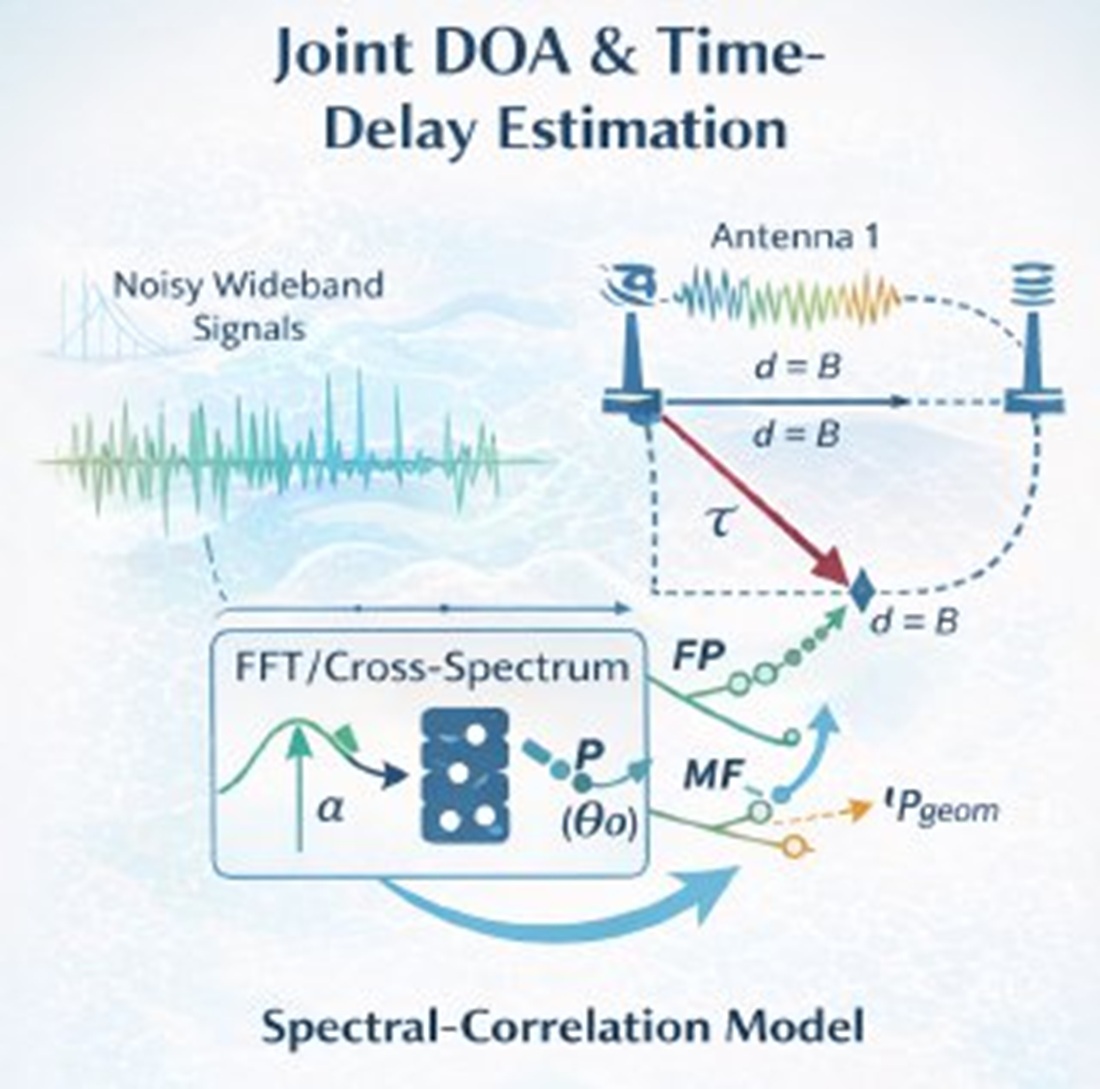
The object of this study is the delay and direction of arrival (DOA) of wideband signals in additive noise observed by a synchronized two-channel receiving system. The problem is that most wideband delay and DOA estimation methods rely on multi-stage or iterative procedures – such as peak search, covariance and eigen-decomposition, angular scanning, or sparse recovery – which increase computational load and restrict real-time applicability.
The essence of the obtained results is a unified spectral-correlation model that enables joint estimation of delay and DOA directly from the phase of the complex cross-spectrum. The delay is determined from the linear phase slope with respect to frequency, while the DOA is obtained from a deterministic phase offset defined by the known antenna baseline. This formulation eliminates iterative refinement and angular scanning and reduces computational complexity to O(Nlog2N).
Numerical experiments with linear frequency-modulated signals in Gaussian noise demonstrate predictable accuracy behavior: with increasing signal-to-noise ratio, the DOA root-mean-square error decreases from 0.15–0.18° to 0.03–0.04°, while the delay error decreases from tens of nanoseconds to a few nanoseconds.
These results are explained by the deterministic relationship between time shifts, spatial delays, and phase behavior in the frequency domain under stationary noise conditions. The proposed model can be applied in practice for synchronized two-channel wideband reception with known geometry and fixed antenna baseline in real-time passive monitoring and direction-finding systems.
References
- Grenier, D., Elahian, B., Blanchard-Lapierre, A. (2014). Joint delay and direction of arrivals estimation in mobile communications. Signal, Image and Video Processing, 10 (1), 45–54. https://doi.org/10.1007/s11760-014-0700-1
- El-Khamy, S. E., El-Shazly, A. M., Eltrass, A. S. (2024). A Compressive Sensing Based Computationally Efficient High-Resolution DOA Estimation of Wideband Signals Using Generalized Coprime Arrays. Wireless Personal Communications, 134 (3), 1571–1597. https://doi.org/10.1007/s11277-024-10969-9
- Tang, Y., Deng, W., Li, J., Zhang, X. (2023). Direction of Arrival Estimation of Coherent Wideband Sources Using Nested Array. Sensors, 23 (15), 6984. https://doi.org/10.3390/s23156984
- Zeng, Y., Lu, G. (2016). Efficient wideband signals’ direction of arrival estimation method with unknown number of signals. International Journal of Distributed Sensor Networks, 12 (11), 155014771667655. https://doi.org/10.1177/1550147716676557
- Turlykozhayeva, D., Temesheva, S., Ussipov, N., Bolysbay, A., Akhmetali, A., Akhtanov, S., Tang, X. (2024). Experimental Performance Comparison of Proactive Routing Protocols in Wireless Mesh Network Using Raspberry Pi 4. Telecom, 5 (4), 1008–1020. https://doi.org/10.3390/telecom5040051
- Turlykozhayeva, D. A., Akhtanov, S. N., Zhanabaev, Z. Z., Ussipov, N. M., Akhmetali, A. (2025). A routing algorithm for wireless mesh network based on information entropy theory. IET Communications, 19 (1). https://doi.org/10.1049/cmu2.70011
- Turlykozhayeva, D., Wójcik, W., Akhmetali, A., Ussipov, N., Temesheva, S., Akhtanov, S. (2024). Single gateway placement in wireless mesh networks. Physical Sciences and Technology, 11 (1-2), 43–48. https://doi.org/10.26577/phst2024v11i1a5
- Turlykozhayeva, D. A. (2024). Evaluating routing algorithms across different wireless mesh network topologies using ns-3 simulator. Eurasian Physical Technical Journal, 21 (2 (48)), 70–82. https://doi.org/10.31489/2024no2/70-82
- Smailov, N., Nussupov, Y., Taissariyeva, K., Kuttybayev, A., Baigulbayeva, M., Turumbetov, M. et al. (2025). Identification of dangerous situations in the road infrastructure using unmanned aerial vehicles. Technology Audit and Production Reserves, 6 (2 (86)), 97–102. https://doi.org/10.15587/2706-5448.2025.347074
- Abdelkhalek, M., Ben Amor, S., Affes, S. (2024). Data-Aided Maximum Likelihood Joint Angle and Delay Estimator Over Orthogonal Frequency Division Multiplex Single-Input Multiple-Output Channels Based on New Gray Wolf Optimization Embedding Importance Sampling. Sensors, 24 (17), 5821. https://doi.org/10.3390/s24175821
- Liu, L., Gu, J.-F., Wei, P. (2019). Joint DOA and frequency estimation with sub-Nyquist sampling. Signal Processing, 154, 87–96. https://doi.org/10.1016/j.sigpro.2018.08.009
- Cui, X., Yu, K., Lu, S. (2018). Approximate Closed-Form TDOA-Based Estimator for Acoustic Direction Finding via Constrained Optimization. IEEE Sensors Journal, 18 (8), 3360–3371. https://doi.org/10.1109/jsen.2018.2803150
- Selva, J. (2018). Efficient Wideband DOA Estimation Through Function Evaluation Techniques. IEEE Transactions on Signal Processing, 66 (12), 3112–3123. https://doi.org/10.1109/tsp.2018.2824256
- Zhong, J., Chen, T., Peng, F., Bi, X., Chen, Z. (2022). Direction of arrival estimation based on slope fitting of wideband array signal in fractional Fourier transform domain. IET Radar, Sonar & Navigation, 17 (3), 422–434. https://doi.org/10.1049/rsn2.12350
- Du, J., Cui, W., Ba, B., Jian, C., Zhang, L. (2022). Joint Estimation for Time Delay and Direction of Arrival in Reconfigurable Intelligent Surface with OFDM. Sensors, 22 (18), 7083. https://doi.org/10.3390/s22187083
- Gaber, A., Omar, A. (2015). A Study of Wireless Indoor Positioning Based on Joint TDOA and DOA Estimation Using 2-D Matrix Pencil Algorithms and IEEE 802.11ac. IEEE Transactions on Wireless Communications, 14 (5), 2440–2454. https://doi.org/10.1109/twc.2014.2386869
- Liu, L., Liu, H. (2016). Joint Estimation of DOA and TDOA of Multiple Reflections in Mobile Communications. IEEE Access, 1–1. https://doi.org/10.1109/access.2016.2584088
- Jin, F., Qiu, T., Luan, S., Cui, W. (2019). Joint Estimation of the DOA and the Number of Sources for Wideband Signals Using Cyclic Correntropy. IEEE Access, 7, 42482–42494. https://doi.org/10.1109/access.2019.2904287
- Choo, Y., Park, Y., Seong, W. (2020). Detection of Direction-Of-Arrival in Time Domain Using Compressive Time Delay Estimation with Single and Multiple Measurements. Sensors, 20 (18), 5431. https://doi.org/10.3390/s20185431
- Zhou, X., Liu, Y., Zhang, J., Tong, D., Yang, X. (2025). Broadband Direction Finding by Phase Correlation With Circular Time‐Modulated Array Antennas. International Journal of Antennas and Propagation, 2025 (1). https://doi.org/10.1155/ijap/8070799
- Tsyporenko, V. G., Tsyporenko, V. V., Andreiev, O. V., Sabibolda, A. M. (2021). Digital spectral correlation method for measuring radio signal reception delay and direction finding. Technical Engineering, 2 (88), 113–121. https://doi.org/10.26642/ten-2021-2(88)-113-121
- Smailov, N., Tsyporenko, V., Ualiyev, Z., Issova, А., Dosbayev, Z., Tashtay, Y. et al. (2025). Improving accuracy of the spectral-correlation direction finding and delay estimation using machine learning. Eastern-European Journal of Enterprise Technologies, 2 (5 (134)), 15–24. https://doi.org/10.15587/1729-4061.2025.327021
- Sabibolda, A., Tsyporenko, V., Tsyporenko, V., Smailov, N., Zhunussov, K., Abdykadyrov, A. et al. (2022). Improving the accuracy and performance speed of the digital spectral-correlation method for measuring delay in radio signals and direction finding. Eastern-European Journal of Enterprise Technologies, 1 (9 (115)), 6–14. https://doi.org/10.15587/1729-4061.2022.252561
- Smailov, N., Tsyporenko, V., Sabibolda, A., Tsyporenko, V., Kabdoldina, A., Zhekambayeva, M. et al. (2023). Improving the accuracy of a digital spectral correlation-interferometric method of direction finding with analytical signal reconstruction for processing an incomplete spectrum of the signal. Eastern-European Journal of Enterprise Technologies, 5 (9 (125)), 14–25. https://doi.org/10.15587/1729-4061.2023.288397
- Sabibolda, A., Tsyporenko, V., Smailov, N., Tsyporenko, V., Abdykadyrov, A. (2024). Estimation of the Time Efficiency of a Radio Direction Finder Operating on the Basis of a Searchless Spectral Method of Dispersion-Correlation Radio Direction Finding. Advances in Asian Mechanism and Machine Science, 62–70. https://doi.org/10.1007/978-3-031-67569-0_8
- Abdullayev, M., Kuttybayeva, A., Tazhen, K., Khabay, A., Ospanova, N., Tashtay, Y. et al. (2025). Development of a stratospheric airship-based network architecture for telecommunication in remote areas. Eastern-European Journal of Enterprise Technologies, 5 (9 (137)), 82–92. https://doi.org/10.15587/1729-4061.2025.340990
- Seidaliyeva, U., Ilipbayeva, L., Utebayeva, D., Smailov, N., Matson, E. T., Tashtay, Y. et al. (2025). LiDAR Technology for UAV Detection: From Fundamentals and Operational Principles to Advanced Detection and Classification Techniques. Sensors, 25 (9), 2757. https://doi.org/10.3390/s25092757
- Smailov, N., Akmardin, S., Ayapbergenova, A., Ayapbergenova, G., Kadyrova, R., Sabibolda, A. (2025). Analiza wydajności VLC w optycznych systemach komunikacji bezprzewodowej do zastosowań wewnętrznych. Informatyka, Automatyka, Pomiary w Gospodarce i Ochronie Środowiska, 15 (2), 135–138. https://doi.org/10.35784/iapgos.6971
- Abdykadyrov, A., Abdullayev, M., Kuttybayeva, A., Tazhen, K., Kystaubayev, N. et al. (2025). Development and evaluation of radio frequency management approaches for stratospheric communication systems. Eastern-European Journal of Enterprise Technologies, 3 (5 (135)), 17–29. https://doi.org/10.15587/1729-4061.2025.331607
- Zhao, Y., Zheng, G., Wang, J., Liu, J., Dong, S., Xin, J. (2025). Efficient Support Vector Regression for Wideband DOA Estimation Using a Genetic Algorithm. Sensors, 25 (9), 2915. https://doi.org/10.3390/s25092915
- Li, L., Younan, N. H., Shi, X. (2019). Joint Estimation of Doppler Stretch and Time Delay of Wideband Echoes for LFM Pulse Radar Based on Sigmoid-FRFT Transform under the Impulsive Noise Environment. Electronics, 8 (2), 121. https://doi.org/10.3390/electronics8020121
Downloads
Published
How to Cite
Issue
Section
License
Copyright (c) 2026 Anar Khabay, Nurzhigit Smailov, Gulbakhar Yussupova, Amandyk Tuleshov, Valentyn Tsyporenko, Vitaliy Tsyporenko, Zhandos Dosbayev, Gulden Khairusheva, Akezhan Sabibolda

This work is licensed under a Creative Commons Attribution 4.0 International License.
The consolidation and conditions for the transfer of copyright (identification of authorship) is carried out in the License Agreement. In particular, the authors reserve the right to the authorship of their manuscript and transfer the first publication of this work to the journal under the terms of the Creative Commons CC BY license. At the same time, they have the right to conclude on their own additional agreements concerning the non-exclusive distribution of the work in the form in which it was published by this journal, but provided that the link to the first publication of the article in this journal is preserved.
A license agreement is a document in which the author warrants that he/she owns all copyright for the work (manuscript, article, etc.).
The authors, signing the License Agreement with TECHNOLOGY CENTER PC, have all rights to the further use of their work, provided that they link to our edition in which the work was published.
According to the terms of the License Agreement, the Publisher TECHNOLOGY CENTER PC does not take away your copyrights and receives permission from the authors to use and dissemination of the publication through the world's scientific resources (own electronic resources, scientometric databases, repositories, libraries, etc.).
In the absence of a signed License Agreement or in the absence of this agreement of identifiers allowing to identify the identity of the author, the editors have no right to work with the manuscript.
It is important to remember that there is another type of agreement between authors and publishers – when copyright is transferred from the authors to the publisher. In this case, the authors lose ownership of their work and may not use it in any way.







