Determining the effect of edible gelatin, agar-agar, and chitosan coatings on the storage of cucumber fruits
DOI:
https://doi.org/10.15587/1729-4061.2026.352396Keywords:
cucumber, coated fruits, natural losses, gelatin, agar-agar, chitosan, edible compositionsAbstract
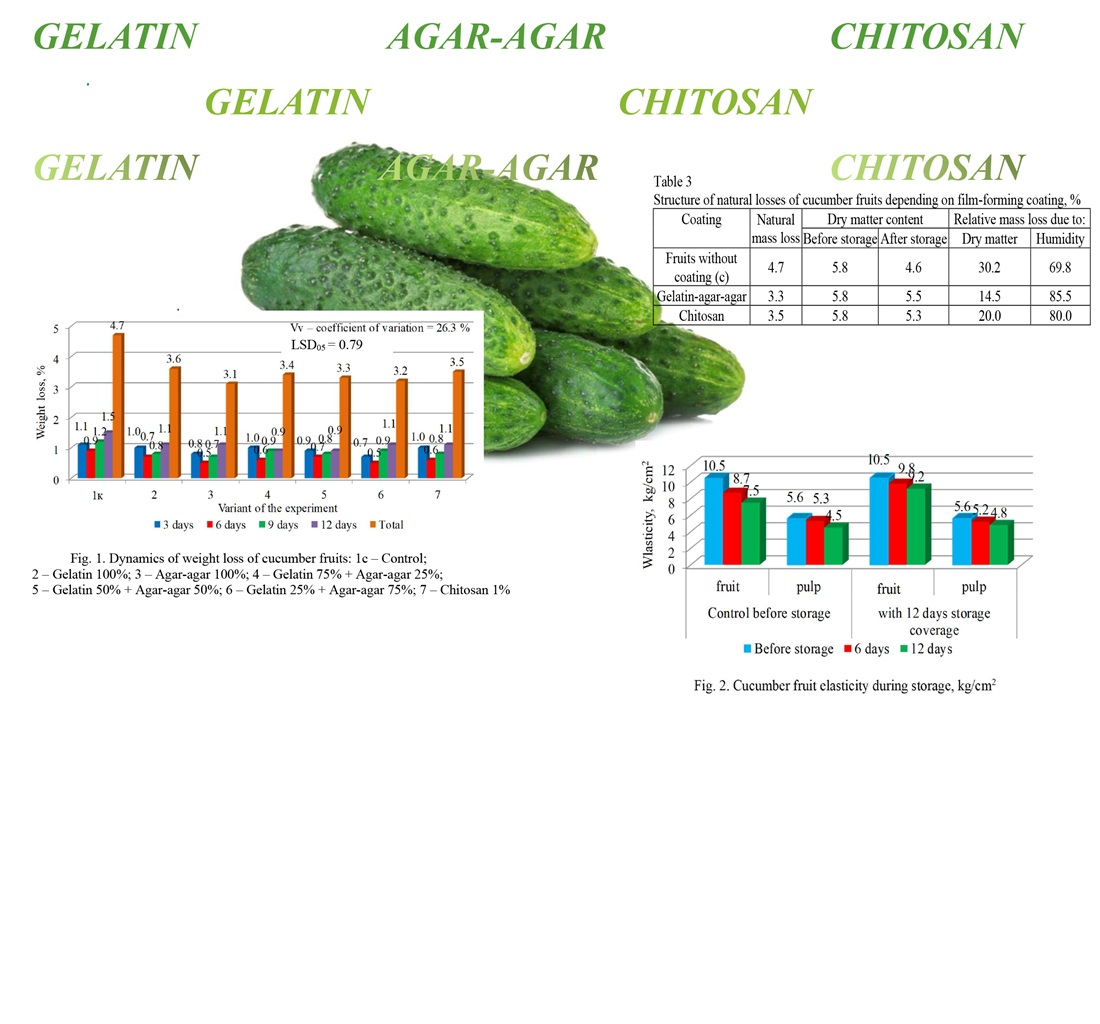
This study examines the technology of pre-treating cucumber fruits using edible coatings based on gelatin, agar-agar of various concentrations, as well as chitosan with the addition of garlic essential oil. The task addressed is to identify safer and more effective post-harvest treatment technologies for cucumbers, which could reduce produce losses during storage and extend their shelf life.
The materials under investigation were cucumber fruits, gelatin, agar-agar, chitosan, as well as garlic essential oil. The ratio of gelatin to agar-agar in the coating matrix gelatin:agar-agar was 100%:0; 0:100; 75%:25%; 50%:50%; and 25%:75%, with chitosan at 1%. The influence of this coating on water-holding capacity, physicochemical, structural-mechanical, and microbiological parameters of cucumber fruits was evaluated.
It was established that treatment with edible compositions significantly (НІР05 = 0.79) reduces natural weight loss of cucumbers during storage at a temperature of 15±1°C to a range of 3.1% to 3.6%. Weight loss in untreated fruits amounted to 4.7%. The agar-agar-based coating provided the lowest weight loss of 3.1%.
It was shown that daily weight loss of cucumbers ranged from 0.63% to 0.75% when treated with edible compositions. Untreated fruits lost up to 1.37% of their weight daily. The addition of 2% garlic essential oil to the coating inhibited the development of microorganisms by 1.5–1.7 times.
The study found that after 6 days of storage, the coated fruits exhibited 11.2% higher elasticity than the control group, and 18.5% higher at the end of the storage period. The effectiveness of the edible coating was confirmed by correlation coefficient r = 0.9317–0.9881
References
- Min, K., Sim, Y., Lee, E. J. (2025). Impaired primary metabolism and elevated osmotic stress are involved in chilling injury of cucumber (Cucumis sativus L.) fruit peel. Postharvest Biology and Technology, 229, 113678. https://doi.org/10.1016/j.postharvbio.2025.113678
- Melnyk, O. H. (2021). Effective management of household waste in the context of the introduction of a circular economy in ukraine, taking into account the experience of the European Union. Juridical Scientific and Electronic Journal, 8, 181–185. https://doi.org/10.32782/2524-0374/2021-8/40
- Pranoto, Y., Rakshit, S. K., Salokhe, V. M. (2005). Enhancing antimicrobial activity of chitosan films by incorporating garlic oil, potassium sorbate and nisin. LWT - Food Science and Technology, 38 (8), 859–865. https://doi.org/10.1016/j.lwt.2004.09.014
- Ilyas, R., Aisyah, H., Nordin, A., Ngadi, N., Zuhri, M., Asyraf, M. et al. (2022). Natural-Fiber-Reinforced Chitosan, Chitosan Blends and Their Nanocomposites for Various Advanced Applications. Polymers, 14 (5), 874. https://doi.org/10.3390/polym14050874
- Di Millo, B., Martínez-Blay, V., Pérez-Gago, M., Argente-Sanchis, M., Grimal, A., Baraldi, E., Palou, L. (2021). Antifungal Hydroxypropyl Methylcellulose (HPMC)-Lipid Composite Edible Coatings and Modified Atmosphere Packaging (MAP) to Reduce Postharvest Decay and Improve Storability of ‘Mollar De Elche’ Pomegranates. Coatings, 11 (3), 308. https://doi.org/10.3390/coatings11030308
- Al-Hilifi, S. A., Al-Ali, R. M., Al-Ibresam, O. T., Kumar, N., Paidari, S., Trajkovska Petkoska, A., Agarwal, V. (2022). Physicochemical, Morphological, and Functional Characterization of Edible Anthocyanin-Enriched Aloevera Coatings on Fresh Figs (Ficus carica L.). Gels, 8 (10), 645. https://doi.org/10.3390/gels8100645
- Cheng, Y.-J., Wu, Y.-J., Lee, F.-W., Ou, L.-Y., Chen, C.-N., Chu, Y.-Y., Kuan, Y.-C. (2022). Impact of Storage Condition on Chemical Composition and Antifungal Activity of Pomelo Extract against Colletotrichum gloeosporioides and Anthracnose in Post-harvest Mango. Plants, 11 (15), 2064. https://doi.org/10.3390/plants11152064
- Pusik, L., Pusik, V., Bondarenko, V., Mulienok, Y., Shubenko, L., Muliarchuk, O. et al. (2025). Determination of the effect of chitosan treatment before storage on the storage of mulberry fruits. Eastern-European Journal of Enterprise Technologies, 1 (11 (133)), 28–37. https://doi.org/10.15587/1729-4061.2025.323334
- Prylipko, T. M., Koval, T. V., Kostash, V. B. (2021). Slovnyk-dovidnyk z tekhnolohiyi kharchovykh produktiv iz syrovyny tvarynnoho pokhodzhennia. Kamianets-Podilskyi: Vita Druk, 380. Available at: http://188.190.43.194:7980/jspui/bitstream/123456789/8972/1/slovnyk.pdf
- Ningrum, A., Widyastuti Perdani, A., Supriyadi, Siti Halimatul Munawaroh, H., Aisyah, S., Susanto, E. (2021). Characterization of Tuna Skin Gelatin Edible Films with Various Plasticizers‐Essential Oils and Their Effect on Beef Appearance. Journal of Food Processing and Preservation, 45 (9). https://doi.org/10.1111/jfpp.15701
- Haryati, D., Ningrum, A., Witasari, L. D. (2024). Characterization of yellowfin tuna (Thunnus albacares) skin gelatin extracted by bromelain hydrolysis and ultrasound pre‐treatment. Journal of Food Science, 90 (1). https://doi.org/10.1111/1750-3841.17610
- Ningrum, A., Hapsari, M. W., Nisa, A. A., Munawaroh, H. S. H. (2020). Edible film characteristic from yellowfin skin tuna (Thunnus albacares) gelatin enriched with cinnamon (Cinnamomum zeylanicum) and roselle (Hibiscus sabdariffa). Food Research, 4 (5), 1646–1652. https://doi.org/10.26656/fr.2017.4(5).097
- Yeddes, W., Djebali, K., Aidi Wannes, W., Horchani-Naifer, K., Hammami, M., Younes, I., Saidani Tounsi, M. (2020). Gelatin-chitosan-pectin films incorporated with rosemary essential oil: Optimized formulation using mixture design and response surface methodology. International Journal of Biological Macromolecules, 154, 92–103. https://doi.org/10.1016/j.ijbiomac.2020.03.092
- Heristika, W., Ningrum, A., Supriyadi, S., Munawaroh, H. S. H., Show, P. L. (2023). Development of Composite Edible Coating from Gelatin-Pectin Incorporated Garlic Essential Oil on Physicochemical Characteristics of Red Chili (Capsicum annnum L.). Gels, 9 (1), 49. https://doi.org/10.3390/gels9010049
- Handayasari, F., Suyatma, N. E., Nurjanah, S. (2019). Physiochemical and antibacterial analysis of gelatin–chitosan edible film with the addition of nitrite and garlic essential oil by response surface methodology. Journal of Food Processing and Preservation, 43 (12). https://doi.org/10.1111/jfpp.14265
- Barreto, T. A., Andrade, S. C. A., Maciel, J. F., Arcanjo, N. M. O., Madruga, M. S., Meireles, B. et al. (2016). A Chitosan Coating Containing Essential Oil from Origanum vulgare L. to Control Postharvest Mold Infections and Keep the Quality of Cherry Tomato Fruit. Frontiers in Microbiology, 7. https://doi.org/10.3389/fmicb.2016.01724
- Bill, M., Sivakumar, D., Korsten, L., Thompson, A. K. (2014). The efficacy of combined application of edible coatings and thyme oil in inducing resistance components in avocado (Persea americana Mill.) against anthracnose during post-harvest storage. Crop Protection, 64, 159–167. https://doi.org/10.1016/j.cropro.2014.06.015
- Cherevko, O. I., Dubinina, A. A., Letuta, T. M., Lenert, S. O., Frolova, T. V., Shcherbakova, T. V. et al. (2019). Pat. No. UA 122759. Plivkove pokryttia dlia obrobky plodiv baklazhana pered zberihanniam. No. a201912141; declareted: 23.12.2019; published: 28.12.2020. Available at: https://sis.nipo.gov.ua/media/INVENTIONS/2019/a201912141/published_description.pdf
- Kehila, S., Alkalai-Tuvia, S., Chalupowicz, D., Poverenov, E., Fallik, E. (2021). Can Edible Coatings Maintain Sweet Pepper Quality after Prolonged Storage at Sub-Optimal Temperatures? Horticulturae, 7 (10), 387. https://doi.org/10.3390/horticulturae7100387
- Wang, R., Zhai, X., Hartel, R. W., Chang, Y., Pang, W., Han, W. et al. (2024). Effects of saccharide type and extended heating on the Maillard reaction and physicochemical properties of high-solid gelatin gels. Food Chemistry, 459, 140249. https://doi.org/10.1016/j.foodchem.2024.140249
- Urías-Orona, V., Muy-Rangel, D., Osuna-Enciso, T., Sañudo-Barajas, A., Báez-Sañudo, M., Valdez-Torres, B. et al. (2012). Estado Hídrico Y Cambios Anatómicos En La Calabacita (Cucurbita pepo L.) ALMACENADA. Revista Fitotecnia Mexicana, 35 (3), 221. https://doi.org/10.35196/rfm.2012.3.221
- Siddiqui, M. W., Homa, F., Lata, D., Ahmad, M. S., Surabhi. (2020). Exogenous Nitric Oxide Delays Ripening and Maintains Postharvest Quality of Pointed Gourd During Storage. Journal of Plant Growth Regulation, 40 (6), 2371–2378. https://doi.org/10.1007/s00344-020-10270-6
- Shiekh, K. A., Ngiwngam, K., Tongdeesoontorn, W. (2021). Polysaccharide-Based Active Coatings Incorporated with Bioactive Compounds for Reducing Postharvest Losses of Fresh Fruits. Coatings, 12 (1), 8. https://doi.org/10.3390/coatings12010008
- Tongnuanchan, P., Benjakul, S., Prodpran, T., Pisuchpen, S., Osako, K. (2016). Mechanical, thermal and heat sealing properties of fish skin gelatin film containing palm oil and basil essential oil with different surfactants. Food Hydrocolloids, 56, 93–107. https://doi.org/10.1016/j.foodhyd.2015.12.005
- Mikhailik, V. A., Dmitrenko, N. V., Snezhkin, Yu. F. (2014). Change in the Specific Heat Capacity of Parenchymal Tissues of Apples due to Dehydration. Journal of Engineering Physics and Thermophysics, 87 (1), 48–53. https://doi.org/10.1007/s10891-014-0983-7
- Ghosh, M., Singh, A. K. (2022). Potential of engineered nanostructured biopolymer based coatings for perishable fruits with Coronavirus safety perspectives. Progress in Organic Coatings, 163, 106632. https://doi.org/10.1016/j.porgcoat.2021.106632
- Pusik, L., Pusik, V., Vlasovets, V., Gaevaya, L., Rozhkov, A., Lyubymova, N. et al. (2019). Studying the loss of mass by cauliflower depending on agrobiological factors, varietal features, and package technique. Eastern-European Journal of Enterprise Technologies, 2 (11 (98)), 22–31. https://doi.org/10.15587/1729-4061.2019.162072
- Belinska, Ye. V. (2012). Tryvale zberihannia koreneplodiv redysky: naukove obgruntuvannia, praktychne zastosuvannia. Poltava: RVV PUET, 112.
Downloads
Published
How to Cite
Issue
Section
License
Copyright (c) 2026 Ludmila Pusik, Veronika Bondarenko, Vlаdimir Pusik, Oksana Serhiienko, Liudmyla Terokhina, Maxim Gurin, Oleksii Soldatenko, Volodymyr Voitsekhivskyi, Oksana Muliarchuk, Mykola Orlovsky

This work is licensed under a Creative Commons Attribution 4.0 International License.
The consolidation and conditions for the transfer of copyright (identification of authorship) is carried out in the License Agreement. In particular, the authors reserve the right to the authorship of their manuscript and transfer the first publication of this work to the journal under the terms of the Creative Commons CC BY license. At the same time, they have the right to conclude on their own additional agreements concerning the non-exclusive distribution of the work in the form in which it was published by this journal, but provided that the link to the first publication of the article in this journal is preserved.
A license agreement is a document in which the author warrants that he/she owns all copyright for the work (manuscript, article, etc.).
The authors, signing the License Agreement with TECHNOLOGY CENTER PC, have all rights to the further use of their work, provided that they link to our edition in which the work was published.
According to the terms of the License Agreement, the Publisher TECHNOLOGY CENTER PC does not take away your copyrights and receives permission from the authors to use and dissemination of the publication through the world's scientific resources (own electronic resources, scientometric databases, repositories, libraries, etc.).
In the absence of a signed License Agreement or in the absence of this agreement of identifiers allowing to identify the identity of the author, the editors have no right to work with the manuscript.
It is important to remember that there is another type of agreement between authors and publishers – when copyright is transferred from the authors to the publisher. In this case, the authors lose ownership of their work and may not use it in any way.