Development of the SciTrack information system for automating reporting in the educational process
DOI:
https://doi.org/10.15587/1729-4061.2026.353013Keywords:
Information system, Python, Tkinter, Reporting automation, Smart technologiesAbstract
The object of the study is the automation of accounting and reporting of scientific activities in educational organizations. The problem addressed is the inefficiency and high labor intensity of existing approaches, as well as the limited adaptability of available solutions to institutional needs. With the digitalization of educational organizations, there is a growing demand for effective information systems that automate accounting processes and generate reports on academic and pedagogical activities. Existing solutions, mainly international and local Enterprise Resource Planning (ERP) systems, offer extensive functionality but are complex, resource-intensive, and poorly adapted to educational institutions.
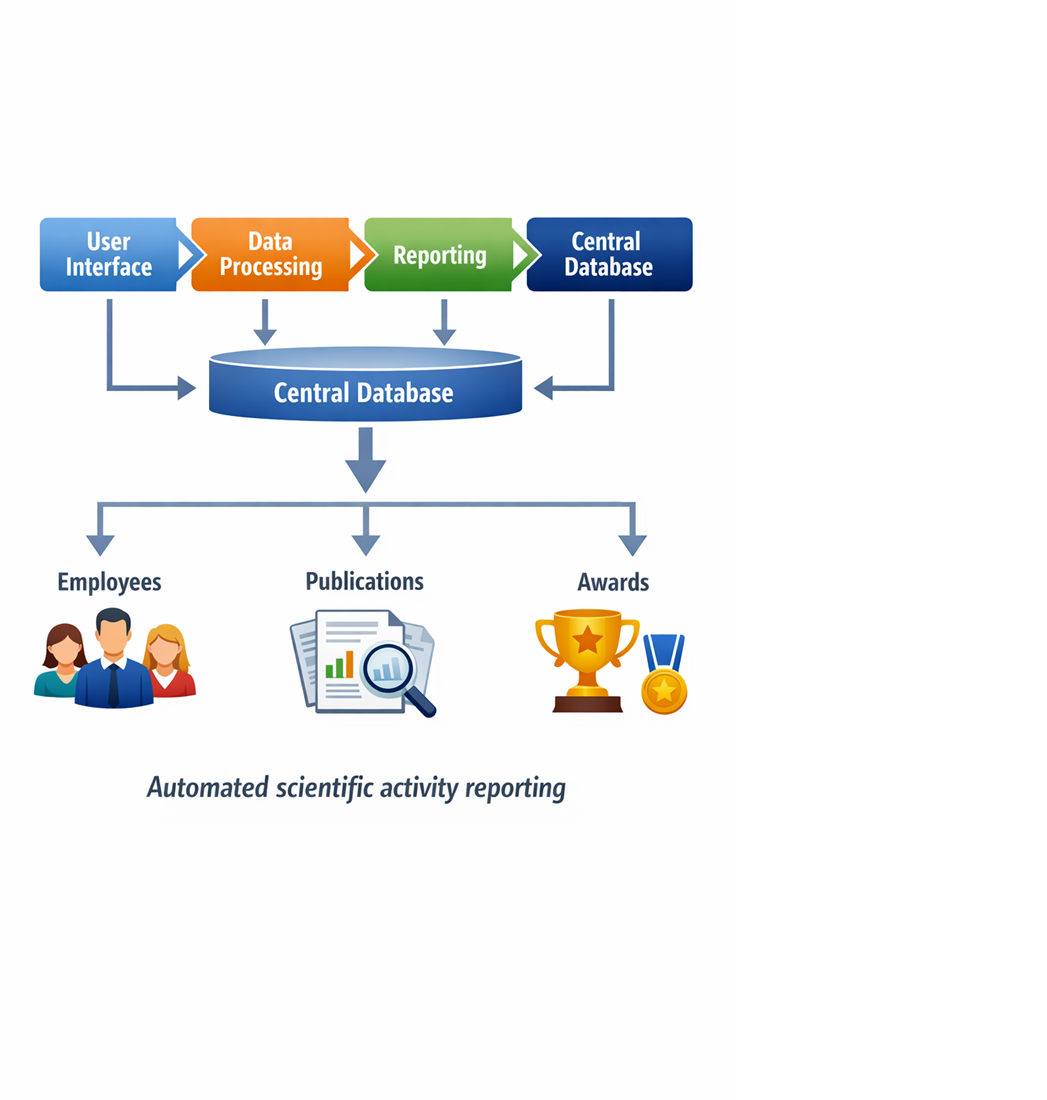
A modular information system was designed and implemented, managing data on staff, publications, and awards, with a unified data model and automated report generation. The essence of the results lies in the development and validation of the SciTrack (Republic of Kazakhstan) system, which integrates all scientific activity data into a single structured environment and ensures automated processing and reporting.
Its modular design and centralized database eliminate data duplication, reduce manual work, and accelerate report preparation. SciTrack is easy to customize, simpler to implement than traditional ERP systems, and automatically calculates summary indicators, such as total publications and awards. Standardized data structures, centralized storage, and automated algorithms implemented in Python with a Tkinter interface explain these results.
The system improves reporting efficiency, reduces labor costs, and enhances analytical quality, demonstrating practical value for educational organizations. It can be deployed in universities with basic information technologies infrastructure requiring regular monitoring of research performance
References
- Bates, A. W., Sangrà, A. (2011). Managing Technology in Higher Education: Strategies for Transforming Teaching and Learning. Wiley. Available at: https://www.wiley.com/en-us/Managing+Technology+in+Higher+Education%3A+Strategies+for+Transforming+Teaching+and+Learning-p-9780470584729
- Dahlstrom, E., Brooks, D. C., Bichsel, J. (2014). The Current Ecosystem of Learning Management Systems in Higher Education: Student, Faculty, and IT Perspectives. EDUCAUSE. https://doi.org/10.13140/RG.2.1.3751.6005
- Woelert, P. (2023). Administrative burden in higher education institutions: a conceptualisation and a research agenda. Journal of Higher Education Policy and Management, 45 (4), 409–422. https://doi.org/10.1080/1360080x.2023.2190967
- Davenport, T. H. (1998). Putting the Enterprise into the Enterprise System. Harvard Business Review, 76 (4), 121–131. Available at: https://hbr.org/1998/07/putting-the-enterprise-into-the-enterprise-system
- Sholeh, Moch. B., Samodra, R. F., Widodo, A. P. (2024). Benefits and Challenges of ERP Implementation in Higher Education Institutions: A Systematic Literature Review. Jurnal Sistem Informasi Bisnis, 15 (1), 21–33. https://doi.org/10.14710/vol15iss1pp21-33
- Jordon, N., Adetoyese, O. (2025). The Role of Modular Systems in Modern Enterprise Resource Planning (ERP) Solutions. Available at: https://www.researchgate.net/publication/391009786_The_Role_of_Modular_Systems_in_Modern_Enterprise_Resource_Planning_ERP_Solutions
- Islam, M. (2020). Data Analysis: Types, Process, Methods, Techniques and Tools. International Journal on Data Science and Technology, 6 (1), 10. https://doi.org/10.11648/j.ijdst.20200601.12
- Noviandy, T. R., Idroes, G. M., Paristiowati, M., Idroes, R. (2025). Techniques and Tools in Learning Analytics and Educational Data Mining: A Review. Journal of Educational Management and Learning, 3 (1), 44–52. https://doi.org/10.60084/jeml.v3i1.308
- Li, F. (2022). Research on Data Visualization Technology Based on Python. International Journal of Multidisciplinary Research and Analysis, 05 (05). https://doi.org/10.47191/ijmra/v5-i5-03
- Rakhmetov, M., Abdykerimova, E., Alzhanov, G., Orazbayeva, B., Kuanbayeva, B. (2026). Methodological Framework for Designing AI-Based Distance Learning Platforms. International Journal of Information and Education Technology, 16 (1), 117–125. https://doi.org/10.18178/ijiet.2026.16.1.2488
- Mussiraliyeva, S., Omarov, B., Bolatbek, M., Bagitova, K., Alimzhanova, Z. (2021). Bigram Based Deep Neural Network for Extremism Detection in Online User Generated Contents in the Kazakh Language. Advances in Computational Collective Intelligence, 559–570. https://doi.org/10.1007/978-3-030-88113-9_45
- Toliupa, S., Tereikovskyi, I., Tereikovska, L., Mussiraliyeva, S., Bagitova, K. (2020). Deep Neural Network Model for Recognition of Speaker’s Emotion. 2020 IEEE International Conference on Problems of Infocommunications. Science and Technology (PIC S&T), 172–176. https://doi.org/10.1109/picst51311.2020.9468017
- Rakhmetov, M., Kuanbayeva, B., Saltanova, G., Zhusupkalieva, G., Abdykerimova, E. (2024). Improving the training on creating a distance learning platform in higher education: evaluating their results. Frontiers in Education, 9. https://doi.org/10.3389/feduc.2024.1372002
Downloads
Published
How to Cite
Issue
Section
License
Copyright (c) 2026 Zhanna Shangitova, Malika Shangitova, Baktygul Assanova, Shynar Yelezhanova, Zhadra Moldasheva, Elvira Gaisina

This work is licensed under a Creative Commons Attribution 4.0 International License.
The consolidation and conditions for the transfer of copyright (identification of authorship) is carried out in the License Agreement. In particular, the authors reserve the right to the authorship of their manuscript and transfer the first publication of this work to the journal under the terms of the Creative Commons CC BY license. At the same time, they have the right to conclude on their own additional agreements concerning the non-exclusive distribution of the work in the form in which it was published by this journal, but provided that the link to the first publication of the article in this journal is preserved.
A license agreement is a document in which the author warrants that he/she owns all copyright for the work (manuscript, article, etc.).
The authors, signing the License Agreement with TECHNOLOGY CENTER PC, have all rights to the further use of their work, provided that they link to our edition in which the work was published.
According to the terms of the License Agreement, the Publisher TECHNOLOGY CENTER PC does not take away your copyrights and receives permission from the authors to use and dissemination of the publication through the world's scientific resources (own electronic resources, scientometric databases, repositories, libraries, etc.).
In the absence of a signed License Agreement or in the absence of this agreement of identifiers allowing to identify the identity of the author, the editors have no right to work with the manuscript.
It is important to remember that there is another type of agreement between authors and publishers – when copyright is transferred from the authors to the publisher. In this case, the authors lose ownership of their work and may not use it in any way.







