Development of crypto-code constructions on hyperelliptic curves
DOI:
https://doi.org/10.15587/1729-4061.2026.356495Keywords:
post-quantum cryptography, hyperelliptic curve, cryptographic code construction, Rao–Nama scheme, algebraic-geometric codeAbstract
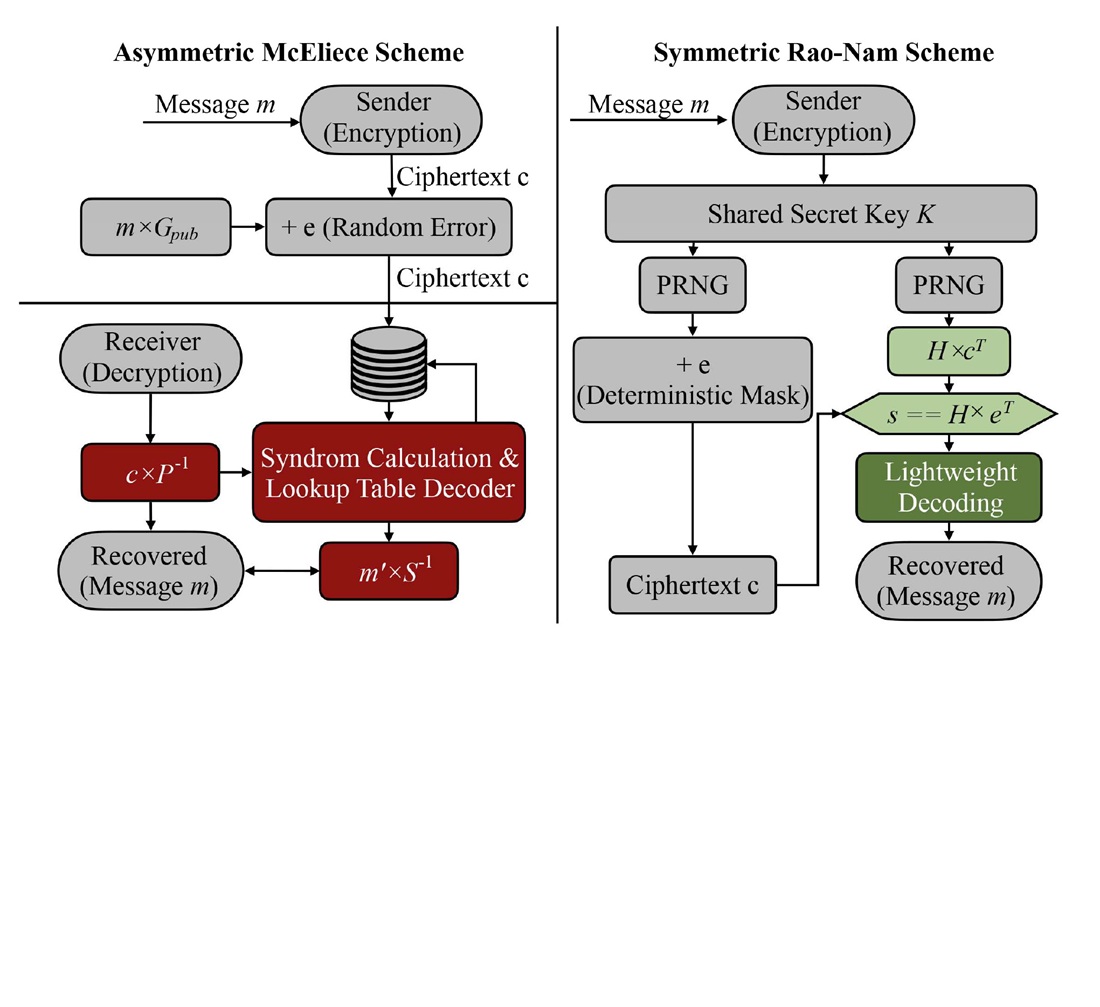
The subject of this study is the algebraic processes of data formation, encoding and syndrome decoding in cryptographic code constructions based on hyperelliptic curves of higher genera over Galois fields. The problem addressed lies in the excessive computational complexity and energy consumption of post-quantum asymmetric cryptosystems, which precludes their use on hardware platforms with resource constraints. The results obtained include the construction of a mathematical model of an algebraic-geometric code in projective coordinates, the development of a point mapping algorithm, and the generation of sparse matrices. The implementation of hyperelliptic structures into the symmetric Rao–Nama scheme has enabled a reduction in energy consumption of 20–60% compared to the asymmetric McElys scheme. The increase in the overall efficiency of the system is explained by the complete elimination of the resource-intensive operation of inverting Galois field elements thanks to an isomorphic transition to projective space, as well as the complete avoidance of solving matrix equations during the process of decrypting cryptograms. The distinctive features of the results obtained, which enabled the solution of the problem under investigation, lie in the fact that the targeted selection of row vectors for the evaluation matrices allowed the Hamming weight of the code to be artificially minimized. At the same time, the synergy of multidimensional algebraic geometry with symmetric architecture ensured an approximation to linear time complexity of decoding. The scope and conditions for the practical application of the results obtained cover the use of synthesized cryptographic code constructs in nodes of modern cyber-physical systems and Internet of Things (IoT) networks under conditions of severe computational resource constraints and autonomous power supply limits.
References
- Yevseiev, S., Rzayev, K., Korol, O., Imanova, Z. (2016). Development of mceliece modified asymmetric crypto-code system on elliptic truncated codes. Eastern-European Journal of Enterprise Technologies, 4 (9 (82)), 18. https://doi.org/10.15587/1729-4061.2016.75250
- Yevseiev, S., Tsyhanenko, O., Ivanchenko, S., Aleksiyev, V., Verheles, D., Volkov, S. et al. (2018). Practical implementation of the Niederreiter modified cryptocode system on truncated elliptic codes. Eastern-European Journal of Enterprise Technologies, 6 (4 (96)), 24–31. https://doi.org/10.15587/1729-4061.2018.150903
- Yevseiev, S., Hryhorii, K., Liekariev, Y. (2016). Developing of multi-factor authentication method based on niederreiter-mceliece modified crypto-code system. Eastern-European Journal of Enterprise Technologies, 6 (4 (84)), 11–23. https://doi.org/10.15587/1729-4061.2016.86175
- Yevseiev, S., Korol, O., Kots, H. (2017). Construction of hybrid security systems based on the crypto-code structures and flawed codes. Eastern-European Journal of Enterprise Technologies, 4 (9 (88)), 4–21. https://doi.org/10.15587/1729-4061.2017.108461
- Alimoradi, R. (2016). A Study of Hyperelliptic Curves in Cryptography. International Journal of Computer Network and Information Security, 8 (8), 67–72. https://doi.org/10.5815/ijcnis.2016.08.08
- Sato, K., Onuki, H., Takagi, T. (2024). Explicit addition formulae on hyperelliptic curves of genus 2 for isogeny-based cryptography. JSIAM Letters, 16, 65–68. https://doi.org/10.14495/jsiaml.16.65
- Fan, J., Fan, X., Song, N., Wang, L. (2022). Hyperelliptic Covers of Different Degree for Elliptic Curves. Mathematical Problems in Engineering, 2022, 1–11. https://doi.org/10.1155/2022/9833393
- Furukawa, E., Kawazoe, M., Takahashi, T. (2004). Counting Points for Hyperelliptic Curves of Type y 2=x 5+ax over Finite Prime Fields. Selected Areas in Cryptography, 26–41. https://doi.org/10.1007/978-3-540-24654-1_3
- Hubrechts, H. (2011). Memory efficient hyperelliptic curve point counting. International Journal of Number Theory, 07 (01), 203–214. https://doi.org/10.1142/s1793042111004034
- Xiong, M., Zaharescu, A. (2012). Statistics of the Jacobians of hyperelliptic curves over finite fields. Mathematical Research Letters, 19 (2), 255–272. https://doi.org/10.4310/mrl.2012.v19.n2.a1
- Kurlberg, P., Rudnick, Z. (2009). The fluctuations in the number of points on a hyperelliptic curve over a finite field. Journal of Number Theory, 129 (3), 580–587. https://doi.org/10.1016/j.jnt.2008.09.004
- Chinis, I. J. (2016). Traces of high powers of the Frobenius class in the moduli space of hyperelliptic curves. Research in Number Theory, 2 (1). https://doi.org/10.1007/s40993-016-0043-9
- Conceição, R. (2020). On integral points on isotrivial elliptic curves over function fields. Bulletin of the Australian Mathematical Society, 102 (2), 177–185. https://doi.org/10.1017/s0004972720000155
- Katz, E., Rabinoff, J., Zureick-Brown, D. (2016). Uniform bounds for the number of rational points on curves of small Mordell–Weil rank. Duke Mathematical Journal, 165 (16). https://doi.org/10.1215/00127094-3673558
- Abbasi, M., Cardoso, F., Váz, P., Silva, J., Martins, P. (2025). A Practical Performance Benchmark of Post-Quantum Cryptography Across Heterogeneous Computing Environments. Cryptography, 9 (2), 32. https://doi.org/10.3390/cryptography9020032
- Pohasii, S., Yevseiev, S., Zhuchenko, O., Milov, O., Lysechko, V., Kovalenko, O. et al. (2022). Development of crypto-code constructs based on LDPC codes. Eastern-European Journal of Enterprise Technologies, 2 (9 (116)), 44–59. https://doi.org/10.15587/1729-4061.2022.254545
- Yevseiev, S., Tsyhanenko, O., Gavrilova, A., Guzhva, V., Milov, O., Moskalenko, V. et al. (2019). Development of Niederreiter hybrid crypto-code structure on flawed codes. Eastern-European Journal of Enterprise Technologies, 1 (9 (97)), 27–38. https://doi.org/10.15587/1729-4061.2019.156620
- Yevseiev, S., Gavrilova, A., Tomashevsky, B., Samadov, F. (2019). Research of crypto-code designs construction for using in post quantum cryptography. Development Management, 16 (4), 26–39. https://doi.org/10.21511/dm.4(4).2018.03
Downloads
Published
How to Cite
Issue
Section
License
Copyright (c) 2026 Olena Akhiiezer, Oleksandr Kushnerov, Hanna Nelasa, Olha Korol, Klym Yamkovyi, Oleksandr Voitko, Vladyslav Sokol, Olena Voloshchuk, Oleksandr Novoseletskyi, Oleh Nelasyi

This work is licensed under a Creative Commons Attribution 4.0 International License.
The consolidation and conditions for the transfer of copyright (identification of authorship) is carried out in the License Agreement. In particular, the authors reserve the right to the authorship of their manuscript and transfer the first publication of this work to the journal under the terms of the Creative Commons CC BY license. At the same time, they have the right to conclude on their own additional agreements concerning the non-exclusive distribution of the work in the form in which it was published by this journal, but provided that the link to the first publication of the article in this journal is preserved.
A license agreement is a document in which the author warrants that he/she owns all copyright for the work (manuscript, article, etc.).
The authors, signing the License Agreement with TECHNOLOGY CENTER PC, have all rights to the further use of their work, provided that they link to our edition in which the work was published.
According to the terms of the License Agreement, the Publisher TECHNOLOGY CENTER PC does not take away your copyrights and receives permission from the authors to use and dissemination of the publication through the world's scientific resources (own electronic resources, scientometric databases, repositories, libraries, etc.).
In the absence of a signed License Agreement or in the absence of this agreement of identifiers allowing to identify the identity of the author, the editors have no right to work with the manuscript.
It is important to remember that there is another type of agreement between authors and publishers – when copyright is transferred from the authors to the publisher. In this case, the authors lose ownership of their work and may not use it in any way.





