Визначення факторів, що впливають на виробництво соку та вина з аборигенного сорту винограду Байаншира
DOI:
https://doi.org/10.15587/1729-4061.2025.323382Ключові слова:
фенольні сполуки, амінний азот, ультрафіолетові промені, твердий залишок, масообмінАнотація
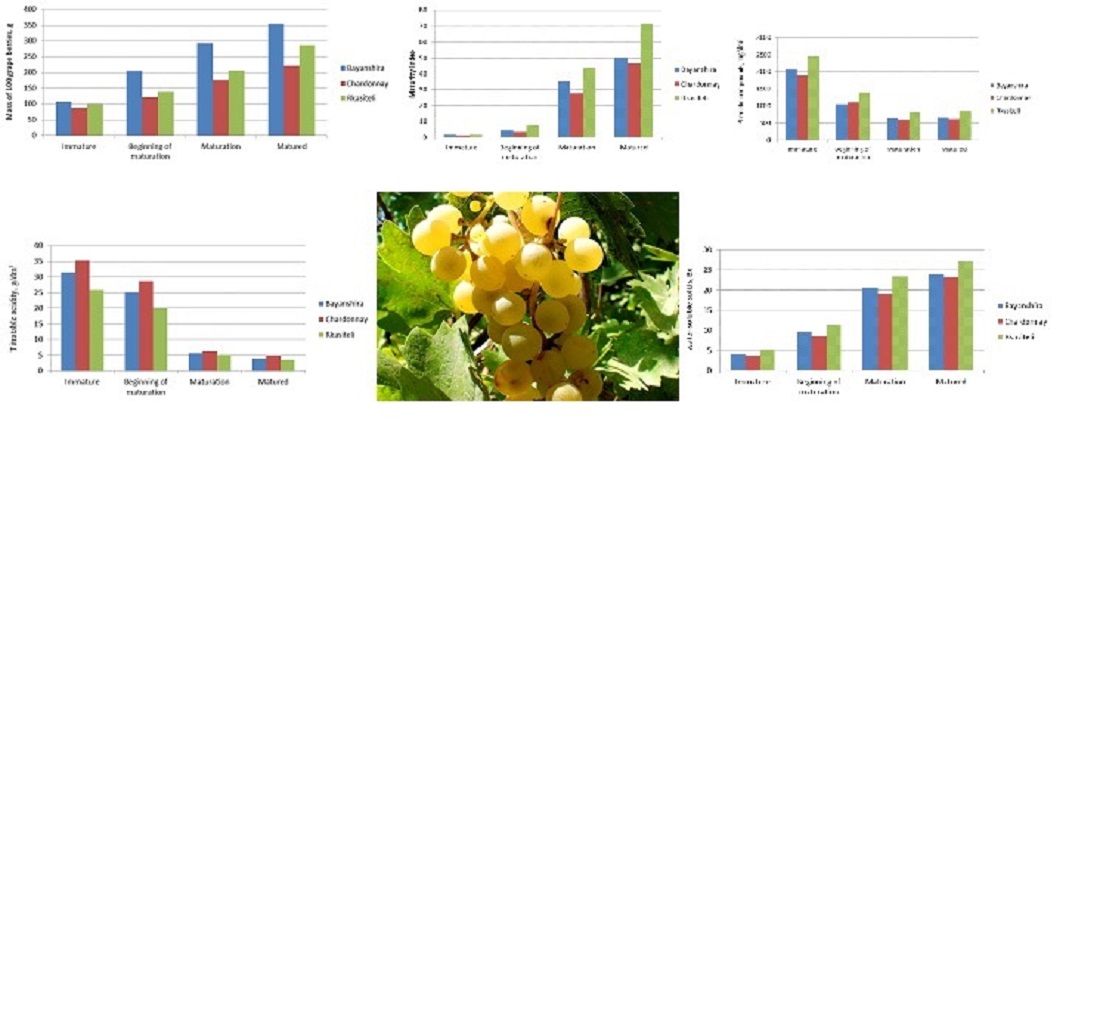
Об'єктом дослідження є зразки соку та вина, отримані з виноградного сорту Байаншира. Було проведено низку досліджень цього сорту винограду, проте динаміка дозрівання ягід і механічний склад грона, а також вплив застосованих технологічних методів на показники соку та вина ще недостатньо вивчені. Дослідження динаміки дозрівання ягід показало, що індекс дозрівання зростав у міру дозрівання та коливався в межах 27,46–43,92. Середня довжина грона становила 21,93 см, ширина — 9,70 см, маса — 172,11 г, середня кількість ягід у гроні — 61,46 шт., маса гребеня в гроні — 6,54 г. Середня довжина ягоди була 18,46 мм, ширина — 18,40 мм, середня маса ягоди — 3,67 г.
Під час переробки та зберігання виноградного соку, обробленого білим методом різними способами, було встановлено, що фізико-хімічний склад гарячепастеризованих зразків був більш схильний до змін порівняно з контрольними зразками, тоді як зразки, оброблені ультрафіолетовими променями, практично не змінювали свій природний колір і склад.
Надходження азотистих речовин у вино зростало під час витримки на дріжджовому осаді від 30 до 90 днів. Підвищення температури з 8–11 °C до 25–30 °C значно збільшувало надходження азотистих речовин із дріжджового осаду у вино порівняно з іншими варіантами.
Ці дослідження є важливими для виробництва з точки зору визначення динаміки дозрівання винограду на різних стадіях росту, перетворень, що відбуваються у фізико-хімічному складі під час зберігання соку, обробленого різними методами, а також регулювання процесів, що відбуваються на етапах підготовки вина. Отримані результати можуть бути використані в сімейних господарствах та виноробних підприємствах
Посилання
- Ivanova, V., Stefova, M., Vojnoski, B., Dörnyei, Á., Márk, L., Dimovska, V. et al. (2011). Identification of polyphenolic compounds in red and white grape varieties grown in R. Macedonia and changes of their content during ripening. Food Research International, 44 (9), 2851–2860. https://doi.org/10.1016/j.foodres.2011.06.046
- Arana, I., Jarén, C., Arazuri, S. (2005). Maturity, Variety and Origin Determination in White Grapes (Vitis Vinifera L.) Using near Infrared Reflectance Technology. Journal of Near Infrared Spectroscopy, 13 (6), 349–357. https://doi.org/10.1255/jnirs.566
- Fataliyev, H., Malikov, A., Lezgiyev, Y., Gadimova, N., Musayev, T., Aliyeva, G. (2024). Identifying of the wine-making potential of the autochthon madrasa grape variety of different colors and quality. Eastern-European Journal of Enterprise Technologies, 2 (11 (128)), 56–63. https://doi.org/10.15587/1729-4061.2024.302971
- Fataliyev, H., Malikov, A., Lazgiyev, Y., Haydarov, E., Agayeva, S., Baloghlanova, K. et al. (2023). Effect of maceration regime on phenolic compound quantity and color quality of madrasa wine samples. Food Science and Technology, 17 (4). https://doi.org/10.15673/fst.v17i4.2784
- Fataliyev, H., Gadimova, N., Huseynova, S., Isgandarova, S., Heydarov, E., Mammadova, S. (2024). Enrichment of functional drinks using grape pomace extracts, analysis of physicochemical indicators. Eastern-European Journal of Enterprise Technologies, 3 (11 (129)), 37–45. https://doi.org/10.15587/1729-4061.2024.307039
- Silva-Barbieri, D., Salazar, F. N., López, F., Brossard, N., Escalona, N., Pérez-Correa, J. R. (2022). Advances in White Wine Protein Stabilization Technologies. Molecules, 27 (4), 1251. https://doi.org/10.3390/molecules27041251
- Liu, Z., Xu, L., Wang, J., Duan, C., Sun, Y., Kong, Q., He, F. (2023). Research progress of protein haze in white wines. Food Science and Human Wellness, 12 (5), 1427–1438. https://doi.org/10.1016/j.fshw.2023.02.004
- Kamaladdin, F. H., Galib, A. S., Elman, H. E., Elxan, A. S., Mammadtagi, A. I., Abbasgulu, H. A., Tofig, C. K. (2022). The research of effect of diluents to the amount of pesticide residues in wine. Food Science and Technology, 42. https://doi.org/10.1590/fst.39322
- Kamaladdin, F. H., Razim, A. G., Elman, H. E., Tofiq, C. K., Galib, A. S., Hasil, F. S. et al. (2023). The research of factors affecting the amount of aromatic compounds in white muscat wine samples. Food Science and Technology, 43. https://doi.org/10.1590/fst.70222
- Prakash, O., A., S., Kudachikar, V. B. (2020). Physicochemical Changes, Phenolic Profile and Antioxidant Capacities of Colored and White Grape (Vitis Vinifera L.) Varieties during Berry Development and Maturity. International Journal of Fruit Science, 20, S1773–S1783. https://doi.org/10.1080/15538362.2020.1833809
- Xiao, H., Li, A., Li, M., Sun, Y., Tu, K., Wang, S., Pan, L. (2018). Quality assessment and discrimination of intact white and red grapes from Vitis vinifera L. at five ripening stages by visible and near-infrared spectroscopy. Scientia Horticulturae, 233, 99–107. https://doi.org/10.1016/j.scienta.2018.01.041
- Mammadova, S. M., Fataliyev, H. K., Gadimova, N. S., Aliyeva, G. R., Tagiyev, A. T., Baloglanova, K. V. (2020). Production of functional products using grape processing residuals. Food Science and Technology, 40, 422–428. https://doi.org/10.1590/fst.30419
- Savoi, S., Wong, D. C. J., Arapitsas, P., Miculan, M., Bucchetti, B., Peterlunger, E. et al. (2016). Transcriptome and metabolite profiling reveals that prolonged drought modulates the phenylpropanoid and terpenoid pathway in white grapes (Vitis vinifera L.). BMC Plant Biology, 16 (1). https://doi.org/10.1186/s12870-016-0760-1
- Garrido, A., Engel, J., Mumm, R., Conde, A., Cunha, A., De Vos, R. C. H. (2021). Metabolomics of Photosynthetically Active Tissues in White Grapes: Effects of Light Microclimate and Stress Mitigation Strategies. Metabolites, 11 (4), 205. https://doi.org/10.3390/metabo11040205
- Odinayev, M., Buriev, K., Sultonov, K., Eralieva, S. (2021). Analysis of mechanical properties, biochemical composition and technological parameters of grape (Vitis) raisin varieties in conditions of Uzbekistan. E3S Web of Conferences, 284, 03023. https://doi.org/10.1051/e3sconf/202128403023
- Nabiyev, A., Kazimova, İ., Mammadaliyeva, M., Maharramova, S., Nasrullayeva, G., Yusifova, M. (2024). Determining biochemical qualitative indicators of grapes during long-term storage. Eastern-European Journal of Enterprise Technologies, 2 (11 (128)), 64–75. https://doi.org/10.15587/1729-4061.2024.302794
- Delić, M., Behmen, F., Sefo, S., Drkenda, P., Matijašević, S., Mandić, A. (2023). Effect of Pruning on Mechanical Composition of Bunch of Table Grape Varieties (Vitis Vinifera L.). 32nd Scientific-Expert Conference of Agriculture and Food Industry, 72–81. https://doi.org/10.1007/978-3-031-47467-5_8
- Prculovski, Z., Petkov, M., Boskov, K., Popović, T., Korunovska, B. (2024). Bunch load as a factor on the quality of the grapevine varieties'ribier'and'italia'. Poljoprivreda i Sumarstvo, 70 (2), 159–169. https://doi.org/10.17707/agricultforest.70.2.12
- Makuev, G. A., Isrigova, T. A., Mukailov, M. D., Salmanov, M. M., Magomedov, M. G. (2022). Technological assessment of native grapes varieties for winemaking in the conditions of Southern Dagestan. IOP Conference Series: Earth and Environmental Science, 979 (1), 012018. https://doi.org/10.1088/1755-1315/979/1/012018
- Khosrov, M. U. (2024). Mechanical and enocarpological characteristics of a number of technical and table grape varieties planted and cultivated in Azerbaijan. In The World Of Science and Education.
- Milanović, V., Cardinali, F., Ferrocino, I., Boban, A., Franciosa, I., Gajdoš Kljusurić, J. et al. (2022). Croatian white grape variety Maraština: First taste of its indigenous mycobiota. Food Research International, 162, 111917. https://doi.org/10.1016/j.foodres.2022.111917
- Cataldo, E., Salvi, L., Paoli, F., Fucile, M., Mattii, G. B. (2021). Effect of Agronomic Techniques on Aroma Composition of White Grapevines: A Review. Agronomy, 11 (10), 2027. https://doi.org/10.3390/agronomy11102027
- Liu, X., Liu, C., Fan, X., Zhang, Y., Sun, L., Lin, M. et al. (2024). Aroma profiling analysis of grape berries based on electronic nose detection. Scientia Horticulturae, 336, 113425. https://doi.org/10.1016/j.scienta.2024.113425
- Fataliyev, H. K. (2013). Winemaking practicum. Baku: Elm, 328.
- Sheskin, D. J. (2020). Handbook of Parametric and Nonparametric Statistical Procedures. Chapman and Hall/CRC, 1928. https://doi.org/10.1201/9780429186196
- Gadimova, N., Fataliyev, H., Heydarov, E., Lezgiyev, Y., Isgandarova, S. (2023). Development of a model and optimization of the interaction of factors in the grain malting process and its application in the production of functional beverages. Eastern-European Journal of Enterprise Technologies, 5 (11 (125)), 43–56. https://doi.org/10.15587/1729-4061.2023.289421
- de Souza, V. R., Popović, V., Bissonnette, S., Ros, I., Mats, L., Duizer, L. et al. (2020). Quality changes in cold pressed juices after processing by high hydrostatic pressure, ultraviolet-c light and thermal treatment at commercial regimes. Innovative Food Science & Emerging Technologies, 64, 102398. https://doi.org/10.1016/j.ifset.2020.102398
##submission.downloads##
Опубліковано
Як цитувати
Номер
Розділ
Ліцензія
Авторське право (c) 2025 Hasil Fataliyev, Yahya Aghazade, Elnur Heydarov, Natavan Gadimova, Mehman Ismailov, Konul Imanova

Ця робота ліцензується відповідно до Creative Commons Attribution 4.0 International License.
Закріплення та умови передачі авторських прав (ідентифікація авторства) здійснюється у Ліцензійному договорі. Зокрема, автори залишають за собою право на авторство свого рукопису та передають журналу право першої публікації цієї роботи на умовах ліцензії Creative Commons CC BY. При цьому вони мають право укладати самостійно додаткові угоди, що стосуються неексклюзивного поширення роботи у тому вигляді, в якому вона була опублікована цим журналом, але за умови збереження посилання на першу публікацію статті в цьому журналі.
Ліцензійний договір – це документ, в якому автор гарантує, що володіє усіма авторськими правами на твір (рукопис, статтю, тощо).
Автори, підписуючи Ліцензійний договір з ПП «ТЕХНОЛОГІЧНИЙ ЦЕНТР», мають усі права на подальше використання свого твору за умови посилання на наше видання, в якому твір опублікований. Відповідно до умов Ліцензійного договору, Видавець ПП «ТЕХНОЛОГІЧНИЙ ЦЕНТР» не забирає ваші авторські права та отримує від авторів дозвіл на використання та розповсюдження публікації через світові наукові ресурси (власні електронні ресурси, наукометричні бази даних, репозитарії, бібліотеки тощо).
За відсутності підписаного Ліцензійного договору або за відсутністю вказаних в цьому договорі ідентифікаторів, що дають змогу ідентифікувати особу автора, редакція не має права працювати з рукописом.
Важливо пам’ятати, що існує і інший тип угоди між авторами та видавцями – коли авторські права передаються від авторів до видавця. В такому разі автори втрачають права власності на свій твір та не можуть його використовувати в будь-який спосіб.