Comparison of deep learning-based models for detection of diseased trees using an image compression algorithm
DOI:
https://doi.org/10.15587/1729-4061.2024.314148Keywords:
YOLO model, image compression, computer vision, forest management, deep learningAbstract
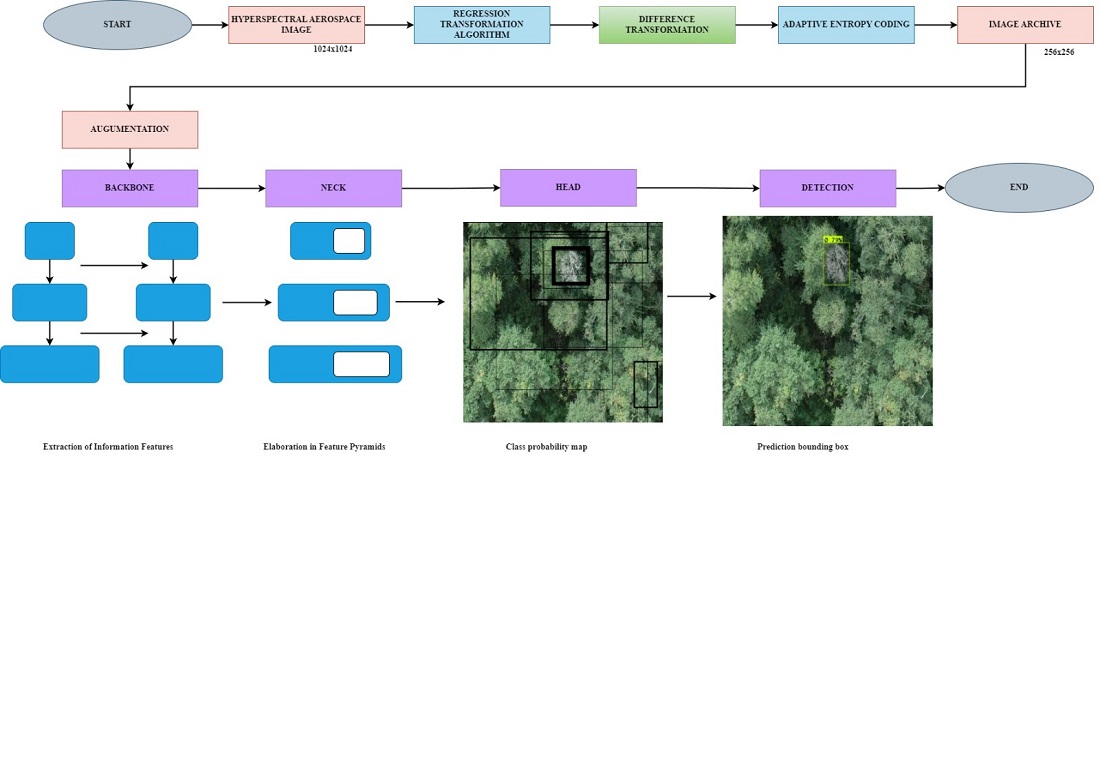
The object of the research is the application of deep learning algorithms using an improved mathematical lossless image compression method for recognizing and identifying dead trees in aerospace images.
The main problem that has been solved is the archiving of images due to their large volume on disk and the possibility of their further processing by deep learning methods such as convolutional and capsule neural networks, which have shown high efficiency and accuracy in image recognition and classification tasks using the proposed new image compression method.
The article presents a comparative analysis of the performance of three YOLO (You Only Look Once) models with different types of architectures, such as YOLOv5, YOLOv7 and YOLOv8, to assess the effectiveness of their work for the task of recognizing aerospace tree images obtained from satellites, drones, and aircrafts.
Comprehensive analysis of YOLO models presents that model YOLO v8 turned out to be most effective with a positive accuracy of 88.2 %, a recall of 77.4 %, and a mAP50 score of 87.2 %. Moreover, the average detection time was only 0.052 seconds for each image, even though the model size remains very small – 21.5 MB. These results suggest a much better usage of time and precise identification of dead trees, and classified targets with high efficiency.
From the research, there is significant prospects of global forest management especially on forest reduction and protection of ecosystems through accurate assessment on the health of forestry. The proposed approach is universal and can be used in real life conditions, providing a good compromise of the speed, accuracy and resources required for forest monitoring and management
References
- Kumar, S., Chaudhuri, S., Banerjee, B., Ali, F. (2019). Onboard Hyperspectral Image Compression Using Compressed Sensing and Deep Learning. Computer Vision – ECCV 2018 Workshops, 30–42. https://doi.org/10.1007/978-3-030-11012-3_3
- Wenbin, W., Wu, Y., Li, J. (2018). The Hyper-spectral Image Compression Based on K-Means Clustering and Parallel Prediction Algorithm*. MATEC Web of Conferences, 173, 03071. https://doi.org/10.1051/matecconf/201817303071
- Samah, N. A. A., Noor, N. R. M., Bakar, E. A., Desa, M. K. M. (2020). CCSDS-MHC on Raspberry Pi for Lossless Hyperspectral Image Compression. IOP Conference Series: Materials Science and Engineering, 943 (1), 012004. https://doi.org/10.1088/1757-899x/943/1/012004
- Sarinova, A., Zamyatin, A. (2020). Hyperspectral regression lossless compression algorithm of aerospace images. E3S Web of Conferences, 149, 02003. https://doi.org/10.1051/e3sconf/202014902003
- Xue, J., Zhao, Y., Liao, W., Chan, J. C.-W. (2019). Nonlocal Tensor Sparse Representation and Low-Rank Regularization for Hyperspectral Image Compressive Sensing Reconstruction. Remote Sensing, 11 (2), 193. https://doi.org/10.3390/rs11020193
- Fu, W., Li, S., Fang, L., Benediktsson, J. A. (2017). Adaptive Spectral–Spatial Compression of Hyperspectral Image With Sparse Representation. IEEE Transactions on Geoscience and Remote Sensing, 55 (2), 671–682. https://doi.org/10.1109/tgrs.2016.2613848
- Lee, S., Lee, E., Choi, H., Lee, C. (2005). Compression of hyperspectral images with 2D wavelet transform using adjacent information and SPIHT algorithm. Proceedings. 2005 IEEE International Geoscience and Remote Sensing Symposium, 2005. IGARSS ’05., 1, 117–119. https://doi.org/10.1109/igarss.2005.1526118
- Cheng, K.-J., Dill, J. C. (2014). An Improved EZW Hyperspectral Image Compression. Journal of Computer and Communications, 02 (02), 31–36. https://doi.org/10.4236/jcc.2014.22006
- Shen, H., Pan, W. D., Wu, D. (2017). Predictive Lossless Compression of Regions of Interest in Hyperspectral Images With No-Data Regions. IEEE Transactions on Geoscience and Remote Sensing, 55 (1), 173–182. https://doi.org/10.1109/tgrs.2016.2603527
- Kefalas, N., Theodoridis, G. (2019). Low-memory and high-performance architectures for the CCSDS 122.0-B-1 compression standard. Integration, 69, 85–97. https://doi.org/10.1016/j.vlsi.2018.03.004
- Davidson, R. L., Bridges, C. P. (2017). GPU accelerated multispectral EO imagery optimised CCSDS-123 lossless compression implementation. 2017 IEEE Aerospace Conference, 1–12. https://doi.org/10.1109/aero.2017.7943817
- Ruiz, L., Torres, M., Gómez, A., Díaz, S., González, J. M., Cavas, F. (2020). Detection and Classification of Aircraft Fixation Elements during Manufacturing Processes Using a Convolutional Neural Network. Applied Sciences, 10 (19), 6856. https://doi.org/10.3390/app10196856
- Belwalkar, A., Nath, A., Dikshit, O. (2018). Spectral-spatial classification of hyperspectral remote sensing images using variational autoencoder and convolution neural network. The International Archives of the Photogrammetry, Remote Sensing and Spatial Information Sciences, XLII–5, 613–620. https://doi.org/10.5194/isprs-archives-xlii-5-613-2018
- Maggiori, E., Plaza, A., Tarabalka, Y. (2017). Models for Hyperspectral Image Analysis: From Unmixing to Object-Based Classification. Mathematical Models for Remote Sensing Image Processing, 37–80. https://doi.org/10.1007/978-3-319-66330-2_2
- Pouyanfar, S., Sadiq, S., Yan, Y., Tian, H., Tao, Y., Reyes, M. P. et al. (2018). A Survey on Deep Learning. ACM Computing Surveys, 51 (5), 1–36. https://doi.org/10.1145/3234150
- Wang, Z., Zhou, Y., Li, G. (2019). Anomaly detection for machinery by using Big Data Real-Time processing and clustering technique. Proceedings of the 2019 3rd International Conference on Big Data Research, 5, 30–36. https://doi.org/10.1145/3372454.3372480
- Du, H., Zhang, W., Guan, N., Yi, W. (2019). Scope-aware data cache analysis for OpenMP programs on multi-core processors. Journal of Systems Architecture, 98, 443–452. https://doi.org/10.1016/j.sysarc.2019.04.001
- Balakrishnan, S., Langerman, D., Gretok, E., George, A. D. (2018). Deep Learning for Hyperspectral Image Classification on Embedded Platforms. 2018 IEEE International Conference on Image Processing, Applications and Systems (IPAS), 12, 187–191. https://doi.org/10.1109/ipas.2018.8708899
- Ball, J. E., Wei, P. (2018). Deep Learning Hyperspectral Image Classification using Multiple Class-Based Denoising Autoencoders, Mixed Pixel Training Augmentation, and Morphological Operations. IGARSS 2018 - 2018 IEEE International Geoscience and Remote Sensing Symposium, 740, 6903–6906. https://doi.org/10.1109/igarss.2018.8519368
- Abramov, N., Ardentov, A., Emeljanova, Ju., Talalaev, A., Fralenko, V., Shishkin, O. (2015). The architecture of the system for spacecraft state monitoring and forecasting. Program Systems: Theory and Applications, 6 (2), 85–99. https://doi.org/10.25209/2079-3316-2015-6-2-85-99
- Ghamisi, P., Yokoya, N., Li, J., Liao, W., Liu, S., Plaza, J. et al. (2017). Advances in Hyperspectral Image and Signal Processing: A Comprehensive Overview of the State of the Art. IEEE Geoscience and Remote Sensing Magazine, 5 (4), 37–78. https://doi.org/10.1109/mgrs.2017.2762087
- Lu, B., Dao, P., Liu, J., He, Y., Shang, J. (2020). Recent Advances of Hyperspectral Imaging Technology and Applications in Agriculture. Remote Sensing, 12 (16), 2659. https://doi.org/10.3390/rs12162659
- Sarinova, A., Rzayeva, L., Tendikov, N., Shayea, I. (2023). Simple Implementation of Terrain Classification Models via Fully Convolutional Neural Networks. 2023 10th International Conference on Wireless Networks and Mobile Communications (WINCOM), 10, 1–6. https://doi.org/10.1109/wincom59760.2023.10323012
- Sarinova, A., Dunayev, P., Bekbayeva, A., Mekhtiyev, A., Sarsikeyev, Y. (2022). Development of compression algorithms for hyperspectral aerospace images based on discrete orthogonal transformations. Eastern-European Journal of Enterprise Technologies, 1 (2 (115)), 22–30. https://doi.org/10.15587/1729-4061.2022.251404
- Sarinova, A., Neftissov, A., Rzayeva, L., Yessenov, A., Kirichenko, L., Kazambayev, I. (2024). Development of an algorithm for compressing aerospace images for the subsequent recognition and identification of various objects. Eastern-European Journal of Enterprise Technologies, 3 (2 (129)), 83–94. https://doi.org/10.15587/1729-4061.2024.306973
Downloads
Published
How to Cite
Issue
Section
License
Copyright (c) 2024 Assiya Sarinova, Leila Rzayeva, Gulnara Abitova, Alimzhan Yessenov, Ansar Sansyzbayev, Yerassyl Omirtay

This work is licensed under a Creative Commons Attribution 4.0 International License.
The consolidation and conditions for the transfer of copyright (identification of authorship) is carried out in the License Agreement. In particular, the authors reserve the right to the authorship of their manuscript and transfer the first publication of this work to the journal under the terms of the Creative Commons CC BY license. At the same time, they have the right to conclude on their own additional agreements concerning the non-exclusive distribution of the work in the form in which it was published by this journal, but provided that the link to the first publication of the article in this journal is preserved.
A license agreement is a document in which the author warrants that he/she owns all copyright for the work (manuscript, article, etc.).
The authors, signing the License Agreement with TECHNOLOGY CENTER PC, have all rights to the further use of their work, provided that they link to our edition in which the work was published.
According to the terms of the License Agreement, the Publisher TECHNOLOGY CENTER PC does not take away your copyrights and receives permission from the authors to use and dissemination of the publication through the world's scientific resources (own electronic resources, scientometric databases, repositories, libraries, etc.).
In the absence of a signed License Agreement or in the absence of this agreement of identifiers allowing to identify the identity of the author, the editors have no right to work with the manuscript.
It is important to remember that there is another type of agreement between authors and publishers – when copyright is transferred from the authors to the publisher. In this case, the authors lose ownership of their work and may not use it in any way.








