Enhancing the halal potato chips supply chain: innovative risk mitigation strategies for sustainable growth
DOI:
https://doi.org/10.15587/1729-4061.2025.316197Keywords:
halal, supply chain, micro-scale enterprises, risk mitigation, institutional supply chain, HoR, ISMAbstract
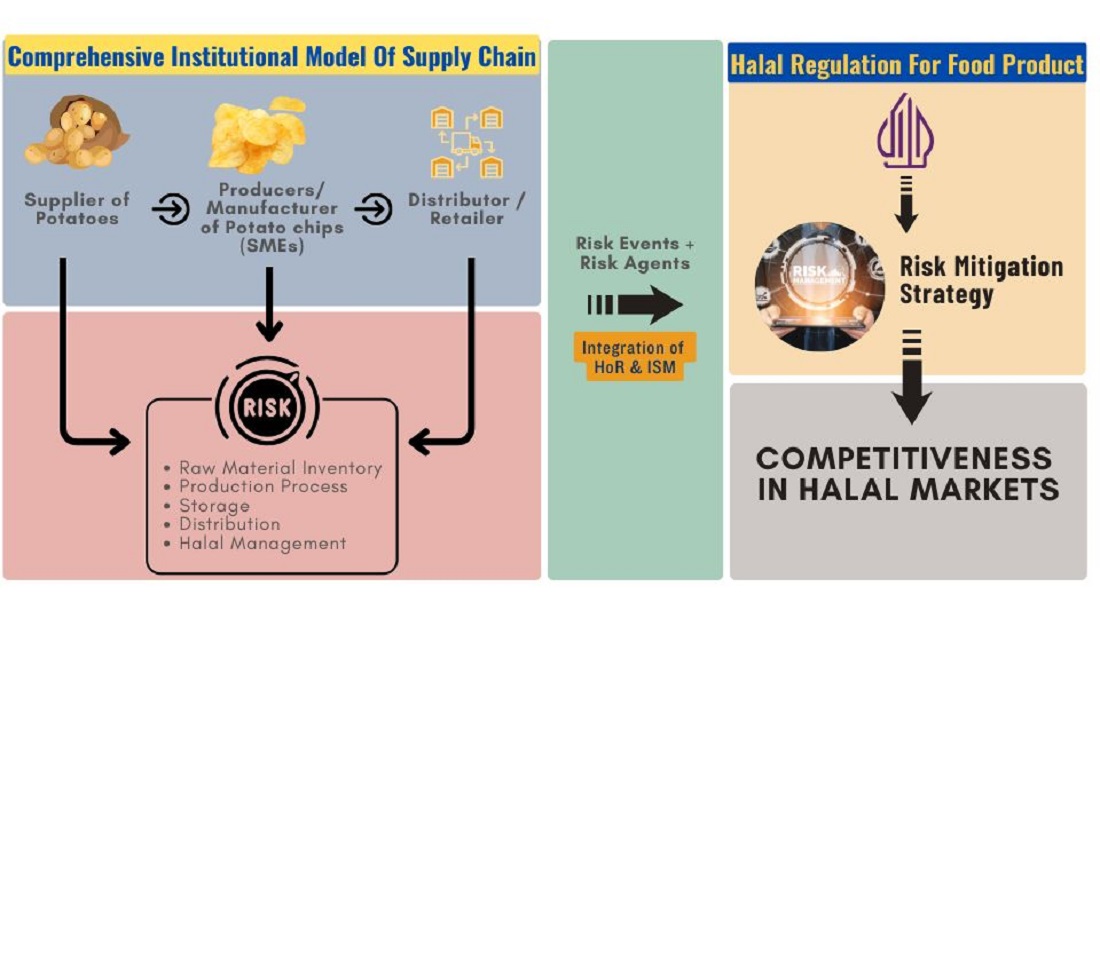
Consumer trust is an important asset in the distribution of the halal supply chain. The object of this research is the halal supply chain for micro-scale potato chip enterprises, involving suppliers, producers, and retailers. The final product's halal status may be at risk caused by factors like sourcing raw materials, production processes, storage, distribution, and halal management at various supply chain phases. The problem to be solved is to develop a comprehensive institutional model of the potato chip supply chain, identify and assess these halal-related risks, map risk agents based on risk events, and develop alternative mitigation strategies to minimize potential threats. To accomplish this, an integrated methodology, including the House of Risk (HoR) and Interpretive Structural Modelling (ISM) methodologies, is implemented. The findings reveal the identification of 69 risk events and 70 risk agents, all associated with planning, purchasing, production, and distribution. Thirty priority risk agents requiring immediate attention were determined using the Pareto Diagram and ISM. Based on the ISM analysis, risk agents were categorized into independent and dependent variables within the potato chip business cluster.
The integration of HoR and ISM effectively prioritizes risk agents and uncovers their interrelationships, enabling robust mitigation strategies. The approved approach provides a comprehensive risk assessment framework, allowing producers to control the main risk factors affecting halal product integrity, and enhance consumer trust. These findings are particularly valuable for micro-scale potato chip enterprises to strengthen their halal supply chain integrity, improve risk management practices, and increase competitiveness in halal markets
References
- Tambunan, T. (2019). Recent evidence of the development of micro, small and medium enterprises in Indonesia. Journal of Global Entrepreneurship Research, 9 (1). https://doi.org/10.1186/s40497-018-0140-4
- Wahdania, N. Z., Mustaniroh, S. A., Santoso, I., Purwaningsih, I. (2021). Clustering of potato chips SMEs in Batu City, Indonesia. IOP Conference Series: Earth and Environmental Science, 924 (1), 012060. https://doi.org/10.1088/1755-1315/924/1/012060
- Maharijaya, A., Nur Salma, L., Amarilis, S. (2020). Produksi dan Kualitas Umbi Beberapa Genotipe Kentang (Solanum tuberosum L.) Koleksi IPB untuk Olahan Keripik Kentang. Jurnal Agronomi Indonesia (Indonesian Journal of Agronomy), 48 (3), 275–282. https://doi.org/10.24831/jai.v48i3.32979
- Rasi, R. Z., Masrom, N. R., Omar, S. S., Ahmad, M. F., Sham, R. (2017). Withdrawn article: Designing Halal Supply Chain: Malaysia’s Halal Industry Scenarios. MATEC Web of Conferences, 135, 00040. https://doi.org/10.1051/matecconf/201713500040
- Emrouznejad, A., Abbasi, S., Sıcakyüz, Ç. (2023). Supply chain risk management: A content analysis-based review of existing and emerging topics. Supply Chain Analytics, 3, 100031. https://doi.org/10.1016/j.sca.2023.100031
- Tarei, P. K., Thakkar, J. J., Nag, B. (2020). Benchmarking the relationship between supply chain risk mitigation strategies and practices: an integrated approach. Benchmarking: An International Journal, 27 (5), 1683–1715. https://doi.org/10.1108/bij-12-2019-0523
- Deng, X., Yang, X., Zhang, Y., Li, Y., Lu, Z. (2019). Risk propagation mechanisms and risk management strategies for a sustainable perishable products supply chain. Computers & Industrial Engineering, 135, 1175–1187. https://doi.org/10.1016/j.cie.2019.01.014
- Wu, D., Olson, D. L. (2008). Supply chain risk, simulation, and vendor selection. International Journal of Production Economics, 114 (2), 646–655. https://doi.org/10.1016/j.ijpe.2008.02.013
- Ahmad, T. L., Susanty, A. (2019). House of Risk Approach for Assessing Supply Chain Risk Management of Material Procurement in Construction Industry. IOP Conference Series: Materials Science and Engineering, 598 (1), 012060. https://doi.org/10.1088/1757-899x/598/1/012060
- Ali, M. H., Suleiman, N., Khalid, N., Tan, K. H., Tseng, M.-L., Kumar, M. (2021). Supply chain resilience reactive strategies for food SMEs in coping to COVID-19 crisis. Trends in Food Science & Technology, 109, 94–102. https://doi.org/10.1016/j.tifs.2021.01.021
- Ab Talib, M. S., Abdul Hamid, A. B., Zulfakar, M. H. (2015). Halal supply chain critical success factors: a literature review. Journal of Islamic Marketing, 6 (1), 44–71. https://doi.org/10.1108/jima-07-2013-0049
- Marucheck, A., Greis, N., Mena, C., Cai, L. (2011). Product safety and security in the global supply chain: Issues, challenges and research opportunities. Journal of Operations Management, 29 (7-8), 707–720. https://doi.org/10.1016/j.jom.2011.06.007
- Natalia, C., Br. Hutapea, Y. F. T., Oktavia, C. W., Hidayat, T. P. (2020). Interpretive Structural Modeling and House of Risk Implementation for Risk Association Analysis and Determination of Risk Mitigation Strategy. Jurnal Ilmiah Teknik Industri, 19 (1), 10–21. https://doi.org/10.23917/jiti.v19i1.9014
- Bonne, K., Verbeke, W. (2007). Religious values informing halal meat production and the control and delivery of halal credence quality. Agriculture and Human Values, 25 (1), 35–47. https://doi.org/10.1007/s10460-007-9076-y
- Ahamed, N. N., Vignesh, R., Alam, T. (2023). Tracking and tracing the halal food supply chain management using blockchain, RFID, and QR code. Multimedia Tools and Applications, 83 (16), 48987–49012. https://doi.org/10.1007/s11042-023-17474-4
- Blossey, G., Eisenhardt, J., Hahn, G. (2019). Blockchain Technology in Supply Chain Management: An Application Perspective. Proceedings of the 52nd Hawaii International Conference on System Sciences. https://doi.org/10.24251/hicss.2019.824
- Masudin, I., Rahmatullah, B. B., Agung, M. A., Dewanti, I. A., Restuputri, D. P. (2022). Traceability System in Halal Procurement: A Bibliometric Review. Logistics, 6 (4), 67. https://doi.org/10.3390/logistics6040067
- Nurjamjam, S. (2018). The Influence of Halal Certification and Halal Quality Assurance Practices on Business Competitive Advantage: Case Study of MSMEs in West Java. Indonesian Journal of Halal Studies (IJHS), 1 (1), 69–80. Available at: https://ejournal.uinsalatiga.ac.id/index.php/ijhs/article/view/1664
- Tieman, M., van der Vorst, J. G. A. J., Che Ghazali, M. (2012). Principles in halal supply chain management. Journal of Islamic Marketing, 3 (3), 217–243. https://doi.org/10.1108/17590831211259727
- Hashim, H. I. C., Shariff, S. M. M. (2016). Halal Supply Chain Management Training: Issues and Challenges. Procedia Economics and Finance, 37, 33–38. https://doi.org/10.1016/s2212-5671(16)30089-2
- Alfarizi, M., Ngatindriatun (2022). Commitment to Halal Practices of Indonesian Culinary MSMEs in the Production Chain: The Impact of Halal Literacy and Attitudes. JSEAIS: Journal of Southeast Asian Islam and Society, 1 (1). Available at: https://e-journal.lp2m.uinjambi.ac.id/ojp/index.php/JSAIS/article/view/1767
- Salindal, N. A. (2018). Halal certification compliance and its effects on companies’ innovative and market performance. Journal of Islamic Marketing, 10 (2), 589–605. https://doi.org/10.1108/jima-04-2018-0080
Downloads
Published
How to Cite
Issue
Section
License
Copyright (c) 2025 Siti Asmaul Mustaniroh, Sucipto Sucipto, Yuyun Pujiastuti, Nadya Prabaningtias, Putri Rita Saputri, Maharani Pertiwi Koentjoro, Rizka Aulia Rahma

This work is licensed under a Creative Commons Attribution 4.0 International License.
The consolidation and conditions for the transfer of copyright (identification of authorship) is carried out in the License Agreement. In particular, the authors reserve the right to the authorship of their manuscript and transfer the first publication of this work to the journal under the terms of the Creative Commons CC BY license. At the same time, they have the right to conclude on their own additional agreements concerning the non-exclusive distribution of the work in the form in which it was published by this journal, but provided that the link to the first publication of the article in this journal is preserved.
A license agreement is a document in which the author warrants that he/she owns all copyright for the work (manuscript, article, etc.).
The authors, signing the License Agreement with TECHNOLOGY CENTER PC, have all rights to the further use of their work, provided that they link to our edition in which the work was published.
According to the terms of the License Agreement, the Publisher TECHNOLOGY CENTER PC does not take away your copyrights and receives permission from the authors to use and dissemination of the publication through the world's scientific resources (own electronic resources, scientometric databases, repositories, libraries, etc.).
In the absence of a signed License Agreement or in the absence of this agreement of identifiers allowing to identify the identity of the author, the editors have no right to work with the manuscript.
It is important to remember that there is another type of agreement between authors and publishers – when copyright is transferred from the authors to the publisher. In this case, the authors lose ownership of their work and may not use it in any way.








