The development of business environment dynamics to improve the relationship between network capability and MSME performance
DOI:
https://doi.org/10.15587/1729-4061.2025.318050Keywords:
MSME performance, network capability, environmental dynamics, fashion craft, craft fashion sectorAbstract
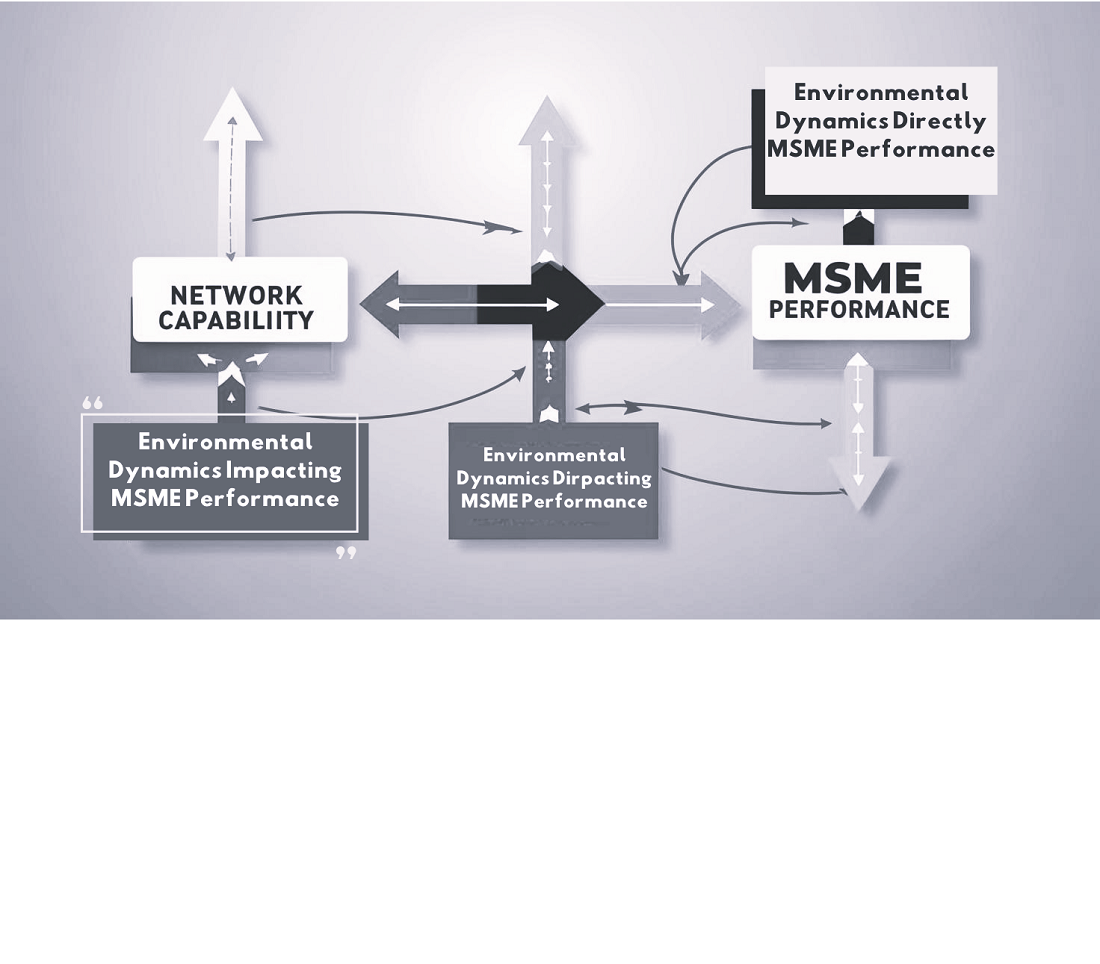
This study focuses on the performance of micro, small, and medium enterprises (MSMEs) in the craft fashion sector in Malang Raya, by examining the influence of network capability on MSME performance and the moderating role of environmental dynamics. The main problem raised is the low performance of MSMEs in this sector, even though the Malang Raya area has great potential with a high number of tourists. MSMEs still face difficulties in utilizing market opportunities due to limited network access and adaptation to environmental dynamics. The results of the study show that network capability significantly improves MSME performance by strengthening access to resources, collaboration, and innovation. In addition, environmental dynamics – such as changes in market demand and the level of competition – moderate this relationship by increasing the impact of network capability on MSME performance. Data analysis shows that MSMEs with strong network capabilities are better able to capture market opportunities through collaboration with suppliers, customers, and strategic partners. Meanwhile, high environmental dynamics encourage flexibility and innovation in product development, thereby strengthening network effectiveness and increasing competitiveness. The uniqueness of this research result lies in the finding that the synergy between network capability and environmental adaptation enables MSMEs to overcome market barriers and increase profitability. This finding is relevant not only for the craft fashion sector in Malang Raya but also for other creative economy sectors with dynamic market conditions. Implementation of this result requires MSME investment in business network development as well as government policy support that encourages collaboration and training
References
- Agustina, A. (2022). Implementasi Peraturan Bkpm Nomor 6 Tahun 2020 Tentang Tatacara Pengendalian Dan Pelaksanaan Penanaman Modal Di Kabupaten Balangan. Jurnal Administrasi Publik Dan Pembangunan, 4 (1), 1. https://doi.org/10.20527/jpp.v4i1.5193
- Dhamayantie, E., Fauzan, R. (2017). Penguatan karakteristik dan kompetensi kewirausahaan untuk meningkatkan kinerja umkm. Matrik: Jurnal Manajemen, Strategi Bisnis Dan Kewirausahaan. https://doi.org/10.24843/matrik:jmbk.2017.v11.i01.p07
- Utami, B., Sudarmiatin, S., Hermawan, A. (2022). Strategy Formulating Based On Critical Success Factors In Mutiara Bakery MSMES. International Journal of Environmental, Sustainability, and Social Science, 3 (2), 218–226. https://doi.org/10.38142/ijesss.v3i2.131
- Maghsoudi Ganjeh, Y., Khani, N., Alem Tabriz, A. (2019). Social media usage and commercialization performance: role of networking capability. Journal of Science and Technology Policy Management, 10 (5), 1174–1195. https://doi.org/10.1108/jstpm-10-2018-0102
- Abou-Moghli, A. A., Al-kasasbeh, M. M. (2012). Social Network and the Success of Business Start-Up. International Journal of Business and Management, 7 (9). https://doi.org/10.5539/ijbm.v7n9p134
- Wu, Y., Tham, J. (2023). The impact of environmental regulation, Environment, Social and Government Performance, and technological innovation on enterprise resilience under a green recovery. Heliyon, 9 (10), e20278. https://doi.org/10.1016/j.heliyon.2023.e20278
- Sulistyo, H. (2020). The Role of Network Capability and Knowledge Creation in Improving SMEs Business Performance in Indonesia. Proceedings of the 1st International Conference on Islamic Civilization, ICIC 2020, 27th August 2020, Semarang, Indonesia. https://doi.org/10.4108/eai.27-8-2020.2303273
- Mu, J. (2013). Networking capability, new venture performance and entrepreneurial rent. Journal of Research in Marketing and Entrepreneurship, 15 (2), 101–123. https://doi.org/10.1108/jrme-06-2012-0011
- Yang, C., Liu, H. (2012). Boosting firm performance via enterprise agility and network structure. Management Decision, 50 (6), 1022–1044. https://doi.org/10.1108/00251741211238319
- Davis, J. P., Aggarwal, V. A. (2020). Knowledge mobilization in the face of imitation: Microfoundations of knowledge aggregation and firm‐level innovation. Strategic Management Journal, 41 (11), 1983–2014. https://doi.org/10.1002/smj.3187
- Torkkeli, L., Puumalainen, K., Saarenketo, S., Kuivalainen, O. (2011). Chapter 5 The Effect of Network Competence and Environmental Hostility on the Propensity of SMEs to Internationalise. Entrepreneurship in the Global Firm, 97–114. https://doi.org/10.1108/s1745-8862(2011)0000006008
- Teece, D. J. (2018). Business models and dynamic capabilities. Long Range Planning, 51 (1), 40–49. https://doi.org/10.1016/j.lrp.2017.06.007
- Wang, Z., Wang, N. (2012). Knowledge sharing, innovation and firm performance. Expert Systems with Applications, 39 (10), 8899–8908. https://doi.org/10.1016/j.eswa.2012.02.017
- Liliani, L., Wiliana, J. (2018). Kapabilitas Dinamis UMKM dalam Merespons Perubahan Lingkungan Bisnis. Business and Finance Journal, 3 (1). https://doi.org/10.33086/bfj.v3i1.417
- Ramadani, V. (2015). The Woman Entrepreneur in Albania: An Exploratory Study on Motivation, Problems and Success Factors. Journal of Balkan and Near Eastern Studies, 17 (2), 204–221. https://doi.org/10.1080/19448953.2014.997488
Downloads
Published
How to Cite
Issue
Section
License
Copyright (c) 2025 Riesta Devi Kumalasari, Ahmad Sudiro, Rofiaty Rofiaty, Djumahir Djumahir

This work is licensed under a Creative Commons Attribution 4.0 International License.
The consolidation and conditions for the transfer of copyright (identification of authorship) is carried out in the License Agreement. In particular, the authors reserve the right to the authorship of their manuscript and transfer the first publication of this work to the journal under the terms of the Creative Commons CC BY license. At the same time, they have the right to conclude on their own additional agreements concerning the non-exclusive distribution of the work in the form in which it was published by this journal, but provided that the link to the first publication of the article in this journal is preserved.
A license agreement is a document in which the author warrants that he/she owns all copyright for the work (manuscript, article, etc.).
The authors, signing the License Agreement with TECHNOLOGY CENTER PC, have all rights to the further use of their work, provided that they link to our edition in which the work was published.
According to the terms of the License Agreement, the Publisher TECHNOLOGY CENTER PC does not take away your copyrights and receives permission from the authors to use and dissemination of the publication through the world's scientific resources (own electronic resources, scientometric databases, repositories, libraries, etc.).
In the absence of a signed License Agreement or in the absence of this agreement of identifiers allowing to identify the identity of the author, the editors have no right to work with the manuscript.
It is important to remember that there is another type of agreement between authors and publishers – when copyright is transferred from the authors to the publisher. In this case, the authors lose ownership of their work and may not use it in any way.








