Identifying governance contextual dimensions in Indonesia regional government-owned enterprises
DOI:
https://doi.org/10.15587/1729-4061.2025.318560Keywords:
contextual dimension, corporate governance, regional government-owned enterprise, multi-case studiesAbstract
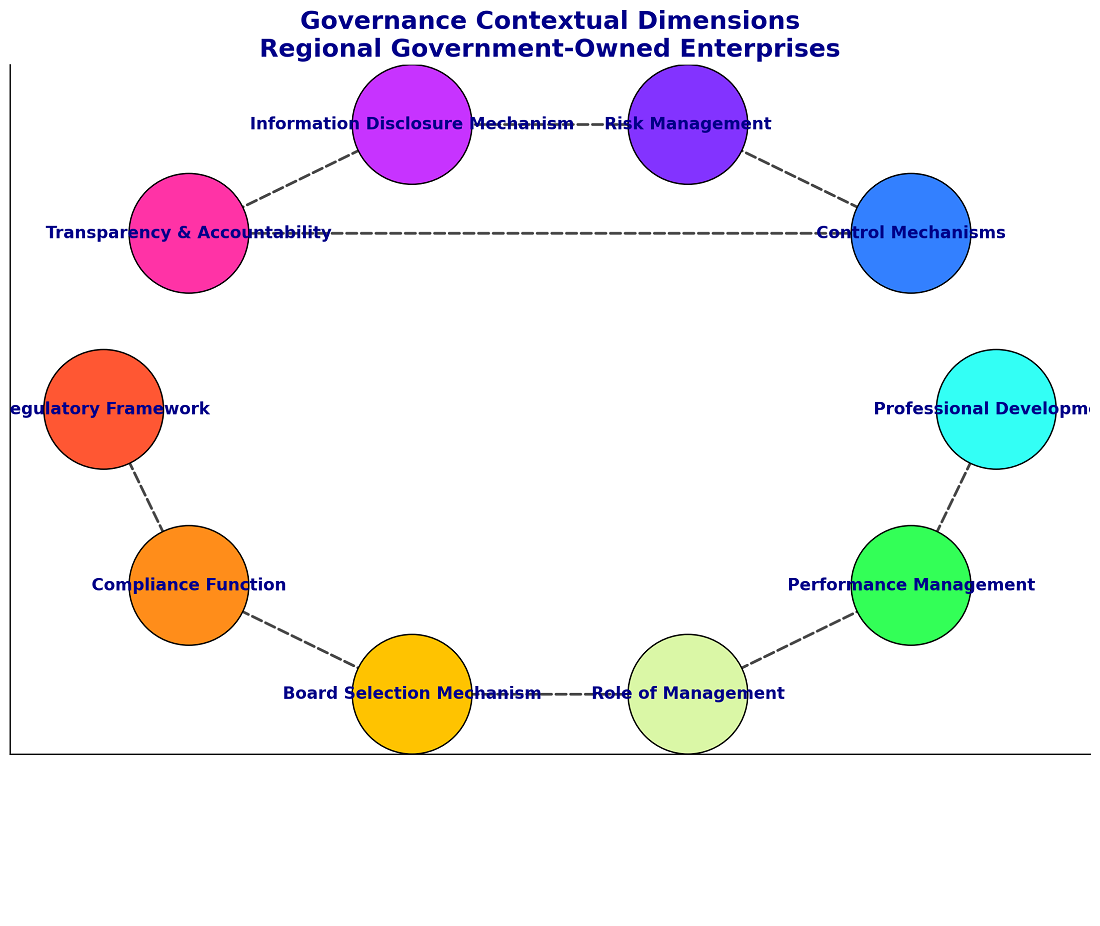
This research explores governance implementation in commercial organizations owned by regional governments in Indonesia. This is driven by the shortcomings in governance implementation observed in some regional government-owned enterprises in Indonesia. In addition, it is also rooted in the limited availability of publication on governance practices in such kind of companies. This study aims to identify contextual dimensions or specific characteristics faced by the management of regional government-owned enterprises when implementing governance. This study utilized a qualitative research method, with case studies of two regional companies in South Sulawesi. Four thematic attributes, that consist of commitment, structuring and functioning board, control environment, disclosures and accountability used as a reference. The research employed a two-stage data analysis approach, within case analysis and cross-case analysis. This study concludes that there are nine main critical success factors for implementing governance in regional-owned enterprises, namely a clear legal framework, the existence of a compliance unit, the selection mechanism for selecting the board of directors, the role and function of top management, performance management, professional development programs, control mechanisms, risk management, and information disclosure mechanism. The interplay between these elements is crucial for fostering a culture of good governance and achieving sustainable development within regional government-owned companies. The factors are not isolated but reinforce each other, emphasizing the need for a holistic approach to governance. Various other factors that may emerge in governance implementation practices require further exploration in the future
References
- Sugiharto, A. J. (2021). Kerugian Badan Usaha Milik Negara (BUMN) Sebagai Kerugian Keuangan Negara. Jurnal Education and Development, 9 (1), 158–160. Available at: https://journal.ipts.ac.id/index.php/ED/article/view/2329
- Arti, N. D. B., Rizky, R. Y. (2023). Analisis korupsi dan upaya mewujudkan good governance di Indonesia. Jurnal Ilmiah Administrasi Pemerintahan Daerah, 15 (2), 135–149. https://doi.org/10.33701/jiapd.v15i2.3798
- Transparency in Corporate Reporting Badan Usaha Milik Daerah (TRAC BUMD) ‘Sengkarut Tata Kelola Perusahaan Daerah di Indonesia’ (2023). Transparancy International Indonesia.
- Tren Penindakan Kasus Korupsi Badan Usaha Milik Negara (BUMN) 2016–2021 (2022). ICW. Available at: https://www.antikorupsi.org/sites/default/files/dokumen/Tren%20Korupsi%20BUMN%202016-2021a.pdf
- Ghofar, A., Islam, S. M. N. (2015). Corporate Governance and Contingency Theory. In Contributions to Management Science. Springer International Publishing. https://doi.org/10.1007/978-3-319-10996-1
- Yaacob, H., Basiuni, J. (2014). Corporate governance model of a state-owned enterprise: evidence from an Asian emerging market. Corporate Governance, 14 (4), 504–514. https://doi.org/10.1108/cg-12-2012-0097
- IFC Corporate Governance Progression Matrix for State-Owned Enterprises (2019). IFC. Available at: https://www.ifc.org/content/dam/ifc/doc/2023/IFC-CG-Progression-Matrix-SOE-020822.pdf
- Kujala, J., Aaltonen, K., Gotcheva, N., Lahdenperä, P. (2020). Dimensions of governance in interorganizational project networks. International Journal of Managing Projects in Business, 14 (3), 625–651. https://doi.org/10.1108/ijmpb-12-2019-0312
- Pomeranz, E. F., Stedman, R. C. (2020). Measuring good governance: piloting an instrument for evaluating good governance principles. Journal of Environmental Policy & Planning, 22 (3), 428–440. https://doi.org/10.1080/1523908x.2020.1753181
- Kuo, L. (2017). Reputation as a governance mechanism? Evidence from payout policy of insider‐controlled firms in Taiwan. Journal of Business Finance & Accounting, 44 (9-10), 1443–1476. https://doi.org/10.1111/jbfa.12261
- Anheier, H. K., Fröhlich, C., List, R. A. (2023). Sub‐Saharan Africa: Towards better governance and sustainability? Global Policy, 14 (S4), 124–135. https://doi.org/10.1111/1758-5899.13283
- Einhorn, S., Fietz, B., Guenther, T. W., Guenther, E. (2023). The relationship of organizational culture with management control systems and environmental management control systems. Review of Managerial Science, 18 (8), 2321–2371. https://doi.org/10.1007/s11846-023-00687-0
- Shi, W., Connelly, B. L., Hoskisson, R. E. (2016). External corporate governance and financial fraud: cognitive evaluation theory insights on agency theory prescriptions. Strategic Management Journal, 38 (6), 1268–1286. https://doi.org/10.1002/smj.2560
- Heaton, S., Teece, D., Agronin, E. (2022). Dynamic capabilities and governance: An empirical investigation of financial performance of the higher education sector. Strategic Management Journal, 44 (2), 520–548. https://doi.org/10.1002/smj.3444
- Stewart, J. (2012). Multiple-case Study Methods in Governance-related Research. Public Management Review, 14 (1), 67–82. https://doi.org/10.1080/14719037.2011.589618
- Creswell, J. W., Creswell, J. D. (2018). Research Design: Qualitative, Quantitative, and Mixed Methods Approaches. Sage.
- Hannah, D. P., Eisenhardt, K. M. (2018). How firms navigate cooperation and competition in nascent ecosystems. Strategic Management Journal, 39 (12), 3163–3192. https://doi.org/10.1002/smj.2750
- Yee, W.-H., Tang, S.-Y., Lo, C. W.-H. (2024). Constructing regulatory regimes for sustainable development: commitment to resolve, clarity, and reasonableness. Journal of Environmental Policy & Planning, 26 (4), 449–463. https://doi.org/10.1080/1523908x.2024.2369287
- Mariotti, S., Marzano, R. (2021). The effects of competition policy, regulatory quality and trust on inward FDI in host countries. International Business Review, 30 (6), 101887. https://doi.org/10.1016/j.ibusrev.2021.101887
- Won, S., Bidwell, M. (2023). Finding the right path to the top: How past interorganizational moves impact executive selection outcomes. Strategic Management Journal, 44 (10), 2341–2376. https://doi.org/10.1002/smj.3502
- Park, C. (2020). Enhancing the transparency and accountability of state-owned enterprises. ADBI Working Paper Series. Available at: https://www.adb.org/sites/default/files/publication/561151/adbi-wp1070.pdf
- DesJardine, M. R., Zhang, M., Shi, W. (2022). How Shareholders Impact Stakeholder Interests: A Review and Map for Future Research. Journal of Management, 49 (1), 400–429. https://doi.org/10.1177/01492063221126707
- Stulz, R. M. (2023). Crisis risk and risk management. European Financial Management, 29 (5), 1377–1400. https://doi.org/10.1111/eufm.12441
- de Goër de Herve, M., Schinko, T., Handmer, J. (2023). Risk justice: Boosting the contribution of risk management to sustainable development. Risk Analysis. https://doi.org/10.1111/risa.14157
- Keremidchiev, S., Nedelchev, M. (2020). Practices on Accountability and Transparency of State-Owned Enterprises. Socio-Economic Analyses, 12 (2). https://doi.org/10.54664/itow6240
- Arif, M. R., Ishak, A. A. A., Tamrin, T., Jayadi, M. (2024). Exploring control environment practices in local government-owned companies. EKUITAS (Jurnal Ekonomi Dan Keuangan), 8 (3), 418–433. https://doi.org/10.24034/j25485024.y2024.v8.i3.6546
- Lakoma, K. (2023). A comparative study of governance changes on the perceptions of accountability in Fire and Rescue Services in England. Public Administration, 102 (1), 3–20. https://doi.org/10.1111/padm.12923
Downloads
Published
How to Cite
Issue
Section
License
Copyright (c) 2025 Muhammad Ridwan Arif, Aza Alina Md. Kassim, Sirajuddin Omsa, Dien Triana, Annisa Annisa, Angel Fifian Danduru

This work is licensed under a Creative Commons Attribution 4.0 International License.
The consolidation and conditions for the transfer of copyright (identification of authorship) is carried out in the License Agreement. In particular, the authors reserve the right to the authorship of their manuscript and transfer the first publication of this work to the journal under the terms of the Creative Commons CC BY license. At the same time, they have the right to conclude on their own additional agreements concerning the non-exclusive distribution of the work in the form in which it was published by this journal, but provided that the link to the first publication of the article in this journal is preserved.
A license agreement is a document in which the author warrants that he/she owns all copyright for the work (manuscript, article, etc.).
The authors, signing the License Agreement with TECHNOLOGY CENTER PC, have all rights to the further use of their work, provided that they link to our edition in which the work was published.
According to the terms of the License Agreement, the Publisher TECHNOLOGY CENTER PC does not take away your copyrights and receives permission from the authors to use and dissemination of the publication through the world's scientific resources (own electronic resources, scientometric databases, repositories, libraries, etc.).
In the absence of a signed License Agreement or in the absence of this agreement of identifiers allowing to identify the identity of the author, the editors have no right to work with the manuscript.
It is important to remember that there is another type of agreement between authors and publishers – when copyright is transferred from the authors to the publisher. In this case, the authors lose ownership of their work and may not use it in any way.








