Development and implementation of a numerical approach for optimal control of oscillations in coupled systems with distributed and lumped parameters
DOI:
https://doi.org/10.15587/1729-4061.2025.322053Keywords:
wave equations, oscillatory processes, method of successive approximations, controlled boundary effectsAbstract
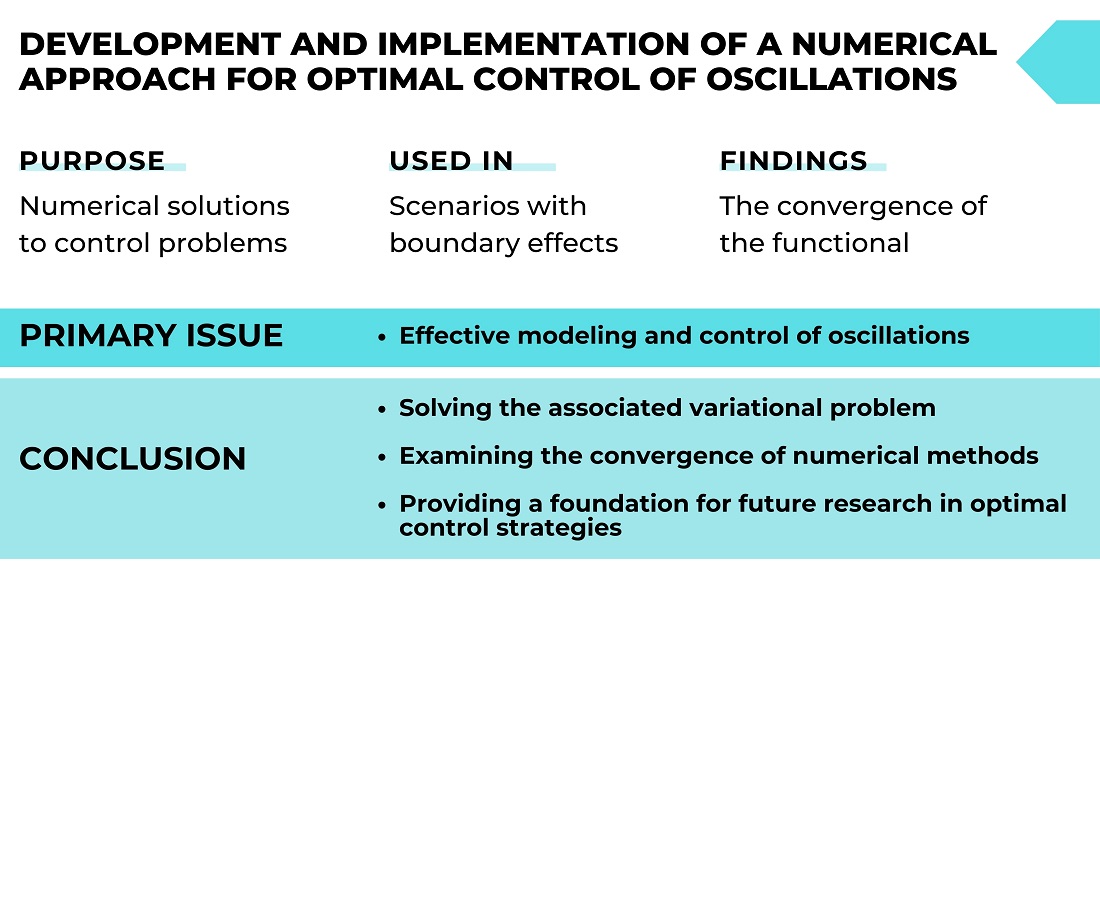
This study focuses on numerical solutions to control problems in oscillatory systems consisting of two distinct objects. The primary issue addressed is the effective modeling and control of oscillations in these systems, particularly through the interaction of two objects. The research yields significant results by demonstrating a method to transform the complex boundary value problem into a more manageable system of ordinary differential equations using the method of straight lines. The findings reveal the influence of boundary conditions on the dynamics of an object characterized by distributed parameters. The results’ unique features include applying Pontryagin’s maximum principle to solve the associated variational problem, effectively integrating the behavior of both objects in the system. The numerical approach adopted in this research simplifies the problem and enhances the precision of the solutions obtained. Moreover, the study examines the convergence of numerical methods, improving their applicability to practical scenarios. The computational results demonstrate the convergence of the functional and show that the gradient projection method provides a convergent sequence in the control space, even for ill-posed optimal control problems. The conditions under which these results are most applicable include scenarios where boundary effects play a critical role in system dynamics, offering a robust framework for further investigation and application in real-world systems. This work significantly contributes to the understanding of oscillatory systems and provides a foundation for future research in optimal control strategies, thereby advancing the field of dynamic system control
References
- Herisanu, N., Marinca, B., Marinca, V. (2022). Dynamics of the Vibro-Impact Nonlinear Damped and Forced Oscillator under the Influence of the Electromagnetic Actuation. Mathematics, 10 (18), 3301. https://doi.org/10.3390/math10183301
- Bichri, A., Mahfoud, J., Belhaq, M. (2018). Electromagnetic Control of Nonlinear Behavior of an Excited Cantilever Beam in a Single Mode Approximation. Journal of Vibration Testing and System Dynamics, 2 (1), 1–8. https://doi.org/10.5890/jvtsd.2018.03.001
- Yoo, C.-H. (2017). Active Control of Aeroelastic Vibrations for Electromechanical Missile Fin Actuation Systems. Journal of Guidance, Control, and Dynamics, 40 (12), 3299–3306. https://doi.org/10.2514/1.g002821
- Alvarez, E., Cabrales, H., Castro, T. (2021). Optimal Control Theory for a System of Partial Differential Equations Associated with Stratified Fluids. Mathematics, 9 (21), 2672. https://doi.org/10.3390/math9212672
- Butkovsky, G. (1969). Distributed Control Systems. Elsevier. Available at: https://ia902906.us.archive.org/7/items/in.ernet.dli.2015.134507/2015.134507.Distributed-Control-Systems.pdf
- Kononenko, V. O. (1969). Vibrating systems with a limited power supply. Scripta Technica, 245.
- Egorov, A. I. (1965). Optimal processes in systems containing distributed parameter plants. Avtomatika i Telemekhanika, 26 (6), 977–994.
- Mamtiyev, K., Rzayeva, U. (2024). Finding and implementing the numerical solution of an optimal control problem for oscillations in a coupled objects system. Eastern-European Journal of Enterprise Technologies, 2 (2 (128)), 64–74. https://doi.org/10.15587/1729-4061.2024.301714
- Faltas, M. S., El-Sapa, S. (2018). Rectilinear oscillations of two spherical particles embedded in an unbounded viscous fluid. Microsystem Technologies, 25 (1), 39–49. https://doi.org/10.1007/s00542-018-3928-9
- Sun, K., Wang, X., Guo, R. (2023). Stabilization of Nonlinear Systems with External Disturbances Using the DE-Based Control Method. Symmetry, 15 (5), 987. https://doi.org/10.3390/sym15050987
- Guo, S., Qiu, B.-L., Zhu, C.-Q., Yang, Y.-Y. G., Wu, D., Liang, Q.-H., Han, N.-Y. (2016). Effects of comprehensive function of factors on retention behavior of microparticles in gravitational field-flow fractionation. Journal of Chromatography B, 1031, 1–7. https://doi.org/10.1016/j.jchromb.2016.07.009
- Petersková, M., Valderrama, C., Gibert, O., Cortina, J. L. (2012). Extraction of valuable metal ions (Cs, Rb, Li, U) from reverse osmosis concentrate using selective sorbents. Desalination, 286, 316–323. https://doi.org/10.1016/j.desal.2011.11.042
- Mul, O. V., Torres, D. F. M. (2005). Analysis of vibrations in large flexible hybrid systems. Nonlinear Analysis: Theory, Methods & Applications, 63 (3), 350–363. https://doi.org/10.1016/j.na.2005.05.024
- Karagülle, H., Malgaca, L., Dirilmiş, M., Akdağ, M., Yavuz, Ş. (2015). Vibration control of a two-link flexible manipulator. Journal of Vibration and Control, 23 (12), 2023–2034. https://doi.org/10.1177/1077546315607694
- He, X., Li, D., Unjoh, S. (2023). Joint state–parameter estimation for structures with seismic isolation and damping systems: Theoretical observability and experimental verification. Mechanical Systems and Signal Processing, 203, 110733. https://doi.org/10.1016/j.ymssp.2023.110733
- Li, S., Wang, C., Wu, S. (2024). Spindle oscillations emerge at the critical state of electrically coupled networks in the thalamic reticular nucleus. Cell Reports, 43 (10), 114790. https://doi.org/10.1016/j.celrep.2024.114790
- Baetov, A. K., Beksultanov, Zh. T., Asanova, Zh. K., Soltohkulova, Zh. M. (2020). Optimum control of a quasilinear oscillatory system with distributed parameters. Modern High Technologies, 10, 9–16. https://doi.org/10.17513/snt.38247
- Omar, N., Serra-Capizzano, S., Qaraad, B., Alharbi, F., Moaaz, O., Elabbasy, E. M. (2024). More Effective Criteria for Testing the Oscillation of Solutions of Third-Order Differential Equations. Axioms, 13 (3), 139. https://doi.org/10.3390/axioms13030139
- Henrion, D., Kružík, M., Weisser, T. (2019). Optimal control problems with oscillations, concentrations and discontinuities. Automatica, 103, 159–165. https://doi.org/10.1016/j.automatica.2019.01.030
- Diene, O., Bhaya, A. (2015). On the robustness of numerical algorithms for linear systems and signal processing in finite precision arithmetic. International Journal of Adaptive Control and Signal Processing, 29 (12), 1539–1560. https://doi.org/10.1002/acs.2562
Downloads
Published
How to Cite
Issue
Section
License
Copyright (c) 2025 Kamil Mamtiyev, Ulviyya Rzayeva, Aygun Abdulova

This work is licensed under a Creative Commons Attribution 4.0 International License.
The consolidation and conditions for the transfer of copyright (identification of authorship) is carried out in the License Agreement. In particular, the authors reserve the right to the authorship of their manuscript and transfer the first publication of this work to the journal under the terms of the Creative Commons CC BY license. At the same time, they have the right to conclude on their own additional agreements concerning the non-exclusive distribution of the work in the form in which it was published by this journal, but provided that the link to the first publication of the article in this journal is preserved.
A license agreement is a document in which the author warrants that he/she owns all copyright for the work (manuscript, article, etc.).
The authors, signing the License Agreement with TECHNOLOGY CENTER PC, have all rights to the further use of their work, provided that they link to our edition in which the work was published.
According to the terms of the License Agreement, the Publisher TECHNOLOGY CENTER PC does not take away your copyrights and receives permission from the authors to use and dissemination of the publication through the world's scientific resources (own electronic resources, scientometric databases, repositories, libraries, etc.).
In the absence of a signed License Agreement or in the absence of this agreement of identifiers allowing to identify the identity of the author, the editors have no right to work with the manuscript.
It is important to remember that there is another type of agreement between authors and publishers – when copyright is transferred from the authors to the publisher. In this case, the authors lose ownership of their work and may not use it in any way.








