Gamification of decision support process for adolescents’ career choice
DOI:
https://doi.org/10.15587/1729-4061.2025.322428Keywords:
multilayer perceptron, gamification of career guidance, real-time electronic assessmentAbstract
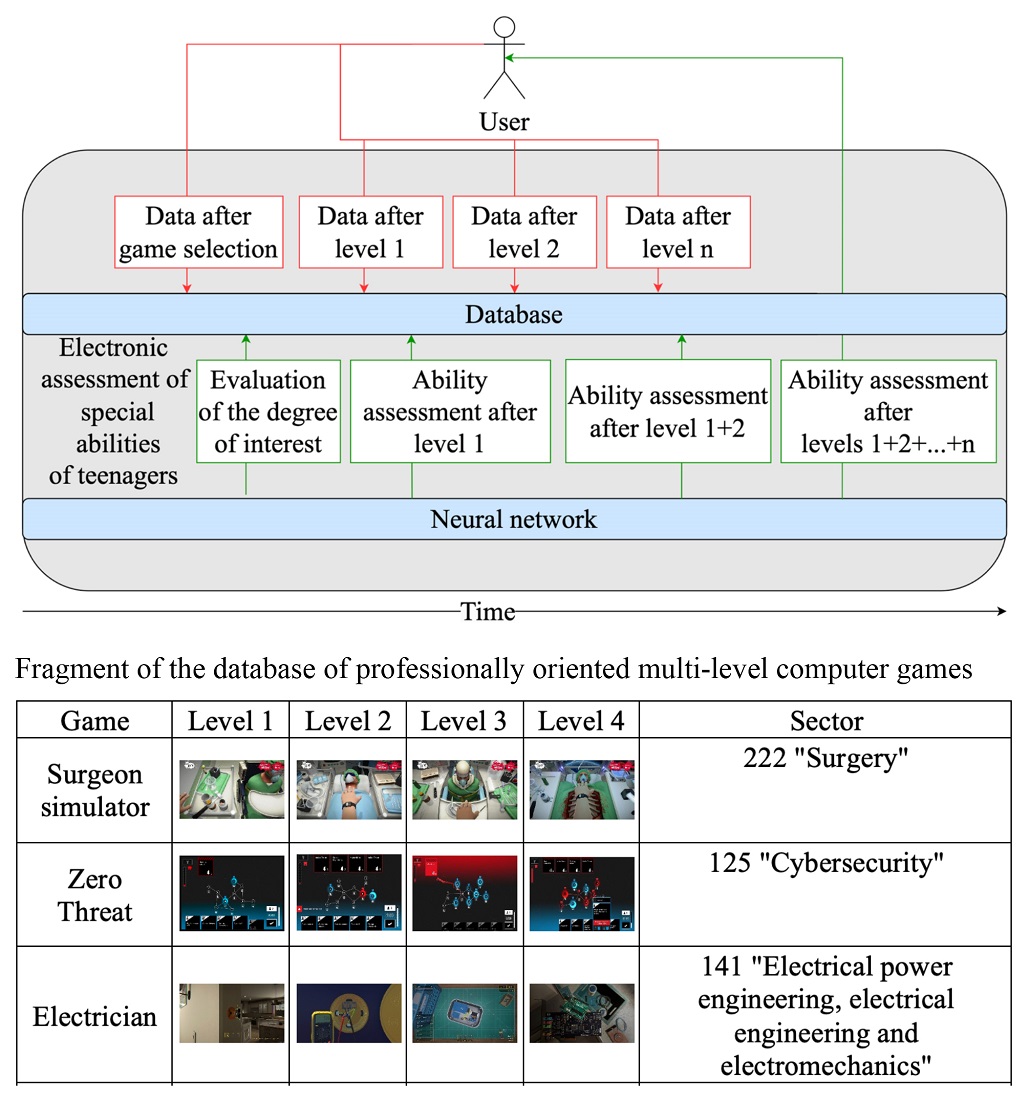
The object of this study is the process of forming recommendations for adolescents regarding their choice of profession based on performance in a multi-level, profession-oriented computer game. The problem addressed is the gamification of adolescents’ professional self-identification A multilayer perceptron with two sequential hidden layers of 32 and 16 nodes has been proposed to generate recommendations in real time. The task is formulated as a categorization problem using game performance data, including interest level, learning readiness, time spent, and the number of attempts for level completion. The neural network design allows integration with various games and expansion of the training dataset. Combining "time" and "number of attempts" ensures the accuracy and efficiency of the training process, mitigating evaluation bias caused by users guessing strategies through frequent attempts. Experts validate the game’s alignment with professional qualification requirements and assess adolescents’ readiness to acquire necessary competencies. Abilities are evaluated by comparing the gameplay parameters of users with those of specialists. The specialist’s results serve as benchmarks to normalize data, forming the basis for recommendations. Unlike previous approaches, this study accounts for both the time taken to complete each level and the number of attempts, ensuring fairer evaluations. The practical significance of the work is to offer users accessible tools for career decision-making through engaging in profession-oriented games. The neural network model has the potential for implementation in career guidance systems, provided the training dataset is expanded and the system undergoes additional testing under a trial mode for refinement and adaptation
References
- Tayfur, S. N., Prior, S., Roy, A. S., Fitzpatrick, L. I., Forsyth, K. (2021). Adolescent psychosocial factors and participation in education and employment in young adulthood: A systematic review and meta-analyses. Educational Research Review, 34, 100404. https://doi.org/10.1016/j.edurev.2021.100404
- Petrenko, O. K. (2023). Pidvyshchennia konkurentozdatnosti maibutnikh fakhivtsiv u sferi profesiynoi osvity. Ivano-Frankivsk.
- Profesiina oriientatsiya: sut, zavdannia ta osnovni pryntsypy. Referat. Available at: https://osvita.ua/vnz/reports/sociology/30007/
- van Roy, R., Zaman, B. (2018). Need-supporting gamification in education: An assessment of motivational effects over time. Computers & Education, 127, 283–297. https://doi.org/10.1016/j.compedu.2018.08.018
- Urdzina-Merca, I., Dislere, V. (2018). Information and Communication Technology-Based Career Guidance Model for Young People. Rural Environment. Education. Personality. (REEP) : Proceedings of the 11th International Scientific Conference, 11, 406–415. https://doi.org/10.22616/reep.2018.050
- Crişan, C., Pavelea, A., Ghimbuluţ, O. (2015). A Need Assessment on Students’ Career Guidance. Procedia - Social and Behavioral Sciences, 180, 1022–1029. https://doi.org/10.1016/j.sbspro.2015.02.196
- Vazhlyvist zastosuvannia ihrovykh metodiv u proforientatsiyi. Available at: https://bizgame.top/korporativnyiy-blog-uk/vazhlyvist-zastosuvannya-igrovyh-metodiv-u-proforiyentacziyi/
- Prensky, M. (2001). Digital Natives, Digital Immigrants Part 1. On the Horizon, 9 (5), 1–6. https://doi.org/10.1108/10748120110424816
- Antonov, Ye. V. (2022). Heimifikatsiya osvitnoho protsesu: analiz poniattia. Innovatsiyni transformatsiy v suchasniy osviti: vyklyky, realiyi, stratehiyi: zb. materialiv IV Vseukr. vidkr. nauk.-prakt. onlain-forumu. Kyiv, 250–252. Available at: http://eprints.zu.edu.ua/35833/1/%D0%A2%D0%B5%D0%B7%D0%B8_%D0%9A%D0%B8%D1%97%D1%96%D0%B2.pdf
- Horban, O., Maletska, M. (2020). Philosophical and educational aspects of videogame activity in conditions of online learning. Osvitolohichnyi dyskurs, 3 (30), 1–18. Available at: https://www.academia.edu/86837633/ФІЛОСОФСЬКО_ОСВІТНІ_АСПЕКТИ_ВІДЕОІГРОВОЇ_ДІЯЛЬНОСТІ_В_УМОВАХ_ОНЛАЙН_НАВЧАННЯ
- Lyashchenko, T., Hryshunina, M., Pichkur, V. (2018). Gamifification as one of the innovative forms of the training process. Upravlinnia rozvytkom skladnykh system, 35, 113–123. Available at: https://repositary.knuba.edu.ua/server/api/core/bitstreams/49c87cb2-b3a0-417f-8db1-facc2e9e17f2/content
- Kazarian, S. (2021). Yak heimifikatsiya pronykla v usi sfery nashoho zhyttia. Istoriya fenomena ta keisy ukrainskykh tsyfrovykh produktiv. Available at: https://telegraf.design/yak-gejmifikatsiya-pronykla-v-usi-sfery-nashogo-zhyttya/
- Konstankevych, L., Radkevych, M., Lekhitskiy, T. (2022). Gamification as an innovative approach in the educational process. New pedagogical thought, 111 (3), 47–51. https://doi.org/10.37026/2520-6427-2022-111-3-47-51
- Kryvonos, O., Kryvonos, M., Yatsenko, O., Yatsenko, O., Torhonska, A. (2022). Shaping the digital competence of students in core classes. Science and Technology Today, 7 (7). https://doi.org/10.52058/2786-6025-2022-7(7)-128-141
- Mekhed, K. (2020). Gamification in education as an innovative means of realizing the competency approach at higher educational establishments. Visnyk Natsionalnoho universytetu «Chernihivskyi kolehium» imeni T. H. Shevchenka, 7 (163), 19–22. https://doi.org/10.5281/zenodo.3758978
- Shi, Y.-R., Shih, J.-L. (2012). Game-Based Career Guidance Systems Design Concept. 2012 IEEE Fourth International Conference On Digital Game And Intelligent Toy Enhanced Learning, 187–191. https://doi.org/10.1109/digitel.2012.53
- Putz, L.-M., Doppler, V., Stockhammer, V. (2022). Gamified workshops in career choice: Gamification to reduce the lack of personnel in the logistics sector. CEUR Workshop Proceedings, 124–134. Available at: http://ceur-ws.org/Vol-3147/paper13.pdf
- Poliakov, M., Mezzane, D., Terenchuk, S., Riabchun, Y., Rusnak, P., Biloshchytska, S. (2022). Gamefication of Youth’s Career Guidance Self-Identification. 2022 International Conference on Smart Information Systems and Technologies (SIST), 1–6. https://doi.org/10.1109/sist54437.2022.9945751
- Terenchuk, S., Riabchun, Yu., Poltorachenko, N., Poliakov, M., Levashenko, V. (2022). Information technology of adolescents` professional self-identification. 3rd International Workshop on Intelligent Information Technologies & Systems of Information Security (IntelITSIS-2022), 208–217.
- Supervised versus unsupervised learning: What's the difference? Available at: https://www.ibm.com/think/topics/supervised-vs-unsupervised-learning
- Machine learning 101: Supervised, unsupervised, reinforcement learning explained. Available at: https://datasciencedojo.com/blog/machine-learning-101/
- Poliakov, M., Yeremenko, B. (2024). Info-Communication System of the Electronic Estimation of Adolescents’ Special Abilities. Management of Development of Complex Systems, 58, 139–145. https://doi.org/10.32347/2412-9933.2024.58.139-145
- How ReLU includes non linearity in neural network? Available at: https://medium.com/@kumaranupam2020/how-relu-includes-non-linearity-in-neural-network-b9f03fbcbac9
- Softmax Activation Function: Everything You Need to Know. Available at: https://www.pinecone.io/learn/softmax-activation/
- Categorical Cross-Entropy in Multi-Class Classification. Available at: https://www.geeksforgeeks.org/categorical-cross-entropy-in-multi-class-classification/
- Adam Optimizer. Available at: https://www.ultralytics.com/fr/glossary/adam-optimizer
Downloads
Published
How to Cite
Issue
Section
License
Copyright (c) 2025 Mykyta Poliakov, Bohdan Yeremenko, Natalia Poltorachenko, Yuliia Riabchun

This work is licensed under a Creative Commons Attribution 4.0 International License.
The consolidation and conditions for the transfer of copyright (identification of authorship) is carried out in the License Agreement. In particular, the authors reserve the right to the authorship of their manuscript and transfer the first publication of this work to the journal under the terms of the Creative Commons CC BY license. At the same time, they have the right to conclude on their own additional agreements concerning the non-exclusive distribution of the work in the form in which it was published by this journal, but provided that the link to the first publication of the article in this journal is preserved.
A license agreement is a document in which the author warrants that he/she owns all copyright for the work (manuscript, article, etc.).
The authors, signing the License Agreement with TECHNOLOGY CENTER PC, have all rights to the further use of their work, provided that they link to our edition in which the work was published.
According to the terms of the License Agreement, the Publisher TECHNOLOGY CENTER PC does not take away your copyrights and receives permission from the authors to use and dissemination of the publication through the world's scientific resources (own electronic resources, scientometric databases, repositories, libraries, etc.).
In the absence of a signed License Agreement or in the absence of this agreement of identifiers allowing to identify the identity of the author, the editors have no right to work with the manuscript.
It is important to remember that there is another type of agreement between authors and publishers – when copyright is transferred from the authors to the publisher. In this case, the authors lose ownership of their work and may not use it in any way.








