Development of a production technology for cooked sausages using buckwheat extracts and their impact on quality and storage life
DOI:
https://doi.org/10.15587/1729-4061.2025.323144Keywords:
buckwheat extracts, bioflavonoids, cooked sausages, meat sausages, antioxidant activity, peroxide value, acid value, natural preservativesAbstract
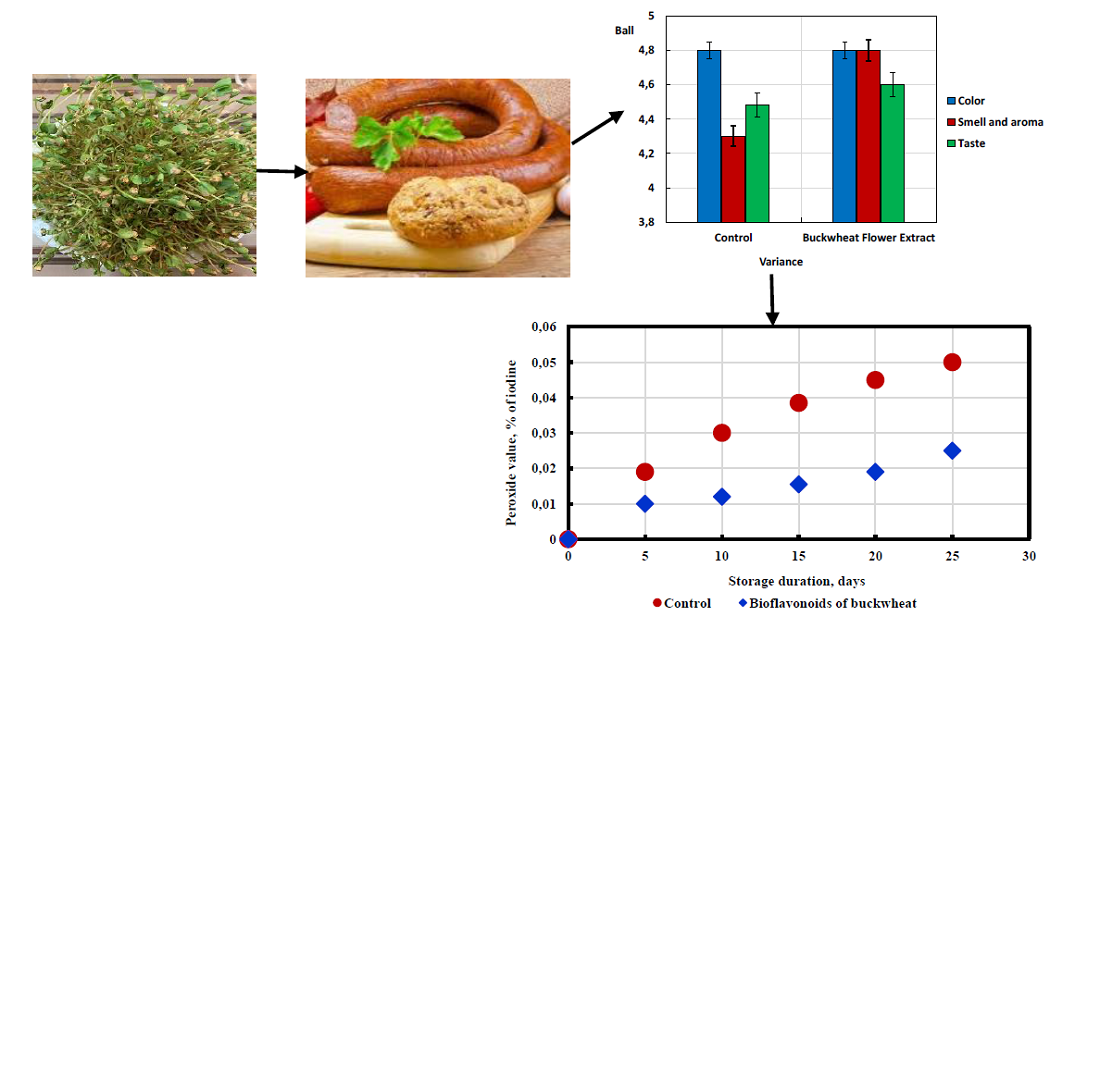
The paper examines the production of meat sausages using buckwheat extracts, which possess antioxidant activity and are of great interest to the food industry. Adding buckwheat extract to cooked sausages has shown significant advantages in preserving quality and nutritional value. Products containing the extract retained their organoleptic properties longer and exhibited lower oxidation rates, confirming buckwheat's high antioxidant activity. The use of natural additives to enhance the quality and extend the shelf life of finished products is a relevant issue. The paper provides a detailed description of experimental results on different fat varieties, confirming the positive impact of buckwheat extracts on their oxidation stability. Research has revealed significant improvements in the moisture-binding capacity, as well as increased biological value of meat sausages. A recipe and production technology for cooked sausages using a meat additive containing buckwheat extract have been developed. The inclusion of this extract significantly slows down the accumulation of primary and secondary oxidation products and reduces the concentration of carbonyl compounds in the finished product. Adding buckwheat extract at 0.025 % by weight of fat to the sausage recipe proved particularly effective. The obtained results highlight the potential of buckwheat extracts as effective antioxidants that enhance the oxidation stability of meat sausages, improve their nutritional properties, and extend shelf life without synthetic preservatives. This provides a basis for implementation in real industrial production
References
- Danihelová, M., Šturdík, E. (2012). Nutritional and health benefits of buckwheat. Potravinarstvo Slovak Journal of Food Sciences, 6 (3), 1–9. https://doi.org/10.5219/206
- Sah, D., Sen, D., Debnath, P. (2012). Buckwheat (Fagopyrum esculentum) - A potential coarse grain crop for food and nutritional security. International Journal of Bio-Resource and Stress Management, 3 (2), 259–262. Available at: https://ojs.pphouse.org/index.php/IJBSM/article/view/266
- Safar, G. N., Abdul, A. N., Amirkhan, B. A., Natiq, S. Y. (2022). Development of new types of combined meat products and dynamic changes depending of their indicators on various technological stages of production. Food Science and Technology, 42. https://doi.org/10.1590/fst.59220
- Ranucci, D., Roila, R., Andoni, E., Braconi, P., Branciari, R. (2019). Punica granatum and Citrus spp. Extract Mix Affects Spoilage Microorganisms Growth Rate in Vacuum-Packaged Cooked Sausages Made from Pork Meat, Emmer Wheat (Triticum dicoccum Schübler), Almond (Prunus dulcis Mill.) and Hazelnut (Corylus avellana L.). Foods, 8 (12), 664. https://doi.org/10.3390/foods8120664
- Gurbanov, N., Gadimova, N., Osmanova, S., Ismailov, E., Akhundova, N. (2022). Chemical composition, thermal stability of pomegranate peel and seed powders and their application in food production. Eastern-European Journal of Enterprise Technologies, 6 (11 (120)), 24–33. https://doi.org/10.15587/1729-4061.2022.268983
- Martuscelli, M., Serio, A., Capezio, O., Mastrocola, D. (2020). Safety, Quality and Analytical Authentication of ḥalāl Meat Products, with Particular Emphasis on Salami: A Review. Foods, 9 (8), 1111. https://doi.org/10.3390/foods9081111
- Gasanzade, S. R. (2018). Optimization of technological methods of buckwheat cultivation in Ganja-Kazakh zone of Azerbaijan. Agrarian Science, 320 (11-12), 45–48. https://doi.org/10.32634/0869-8155-2018-320-11-45-48
- Gurbanov, N. H., Gadimova, N. S., Gurbanova, R. I., Akhundova, N. A., Babashli, A. A. (2020). Substantiation and development of technology for a new assortment of combined sour-milk drinks based on bio modified bean raw materials. Food Science and Technology, 40 (2), 517–522. https://doi.org/10.1590/fst.04219
- Mazahir, M., Ahmed, A., Akram khan, M., Mariam, A., Riaz, S. (2023). Comparative study of physicochemical and functional properties of different buckwheat varieties and their milling fractions. International Food Research Journal, 30 (5), 1261–1273. https://doi.org/10.47836/ifrj.30.5.14
- Gadimova, N., Fataliyev, H., Allahverdiyeva, Z., Musayev, T., Akhundova, N., Babashli, A. (2022). Obtaining and investigation of the chemical composition of powdered malt and polymalt extracts for application in the production of non-alcoholic functional beverages. Eastern-European Journal of Enterprise Technologies, 5 (11 (119)), 66–74. https://doi.org/10.15587/1729-4061.2022.265762
- Akhundova, N., Babashli, A., Gadimova, N. (2024). Development of technology for fermented milk product “Gatyg” based on buckwheat varieties grown in Azerbaijan. Eastern-European Journal of Enterprise Technologies, 5 (11 (131)), 16–23. https://doi.org/10.15587/1729-4061.2024.312155
- Sytar, O. (2015). Phenolic acids in the inflorescences of different varieties of buckwheat and their antioxidant activity. Journal of King Saud University - Science, 27 (2), 136–142. https://doi.org/10.1016/j.jksus.2014.07.001
- Steadman, K. J., Burgoon, M. S., Lewis, B. A., Edwardson, S. E., Obendorf, R. L. (2001). Minerals, phytic acid, tannin and rutin in buckwheat seed milling fractions. Journal of the Science of Food and Agriculture, 81 (11), 1094–1100. https://doi.org/10.1002/jsfa.914
- Giménez-Bastida, J. A., Zieliński, H. (2015). Buckwheat as a Functional Food and Its Effects on Health. Journal of Agricultural and Food Chemistry, 63 (36), 7896–7913. https://doi.org/10.1021/acs.jafc.5b02498
- Bal-Prylypko, L., Yancheva, M., Paska, M., Ryabovol, M., Nikolaenko, M., Israelian, V. et al. (2022). The study of the intensification of technological parameters of the sausage production process. Potravinarstvo Slovak Journal of Food Sciences, 16, 27–41. https://doi.org/10.5219/1712
- Tultabayeva, T., Tokysheva, G., Zhakupova, G., Konysbaeva, D., Mukhtarkhanova, R., Matibayeva, A. et al. (2023). Enhancing Nutrition and Palatability: The Development of Cooked Sausages with Protein Hydrolysate from Secondary Raw Materials for the Elderly. Applied Sciences, 13(18), 10462. https://doi.org/10.3390/app131810462
- Danyliv, M. M., Vasilenko, O. A., Ozherelyeva, O. N., Shestakova, Y. A. (2019). Improvement of sausage production technology. IOP Conference Series: Earth and Environmental Science, 341 (1), 012131. https://doi.org/10.1088/1755-1315/341/1/012131
- Tuxtauev, Sh., Mirxasilov, M., Akramova, R., Choriyev, A. (2022). Study of the Technology of Production of Sausage Products Based on Food Additives. Texas Journal of Multidisciplinary Studies, A Bi-Monthly, Peer Reviewed International Journal, 7, 134–138. Available at: https://zienjournals.com/index.php/tjm/article/view/1257/1031
- Carballo, J. (2021). Sausages: Nutrition, Safety, Processing and Quality Improvement. Foods, 10 (4), 890. https://doi.org/10.3390/foods10040890
- Salejda, A. M., Olender, K., Zielińska-Dawidziak, M., Mazur, M., Szperlik, J., Miedzianka, J. et al. (2022). Frankfurter-Type Sausage Enriched with Buckwheat By-Product as a Source of Bioactive Compounds. Foods, 11 (5), 674. https://doi.org/10.3390/foods11050674
- Pietrzak, D., Zwolan, A., Chmiel, M., Adamczak, L., Cegiełka, A., Hać-Szymańczuk, E. et al. (2022). The Effects of Extracts from Buckwheat Hulls on the Quality Characteristics of Chicken Meatballs during Refrigerated Storage. Applied Sciences, 12 (19), 9612. https://doi.org/10.3390/app12199612
- Lee, S.-H., Kim, G.-W., Choe, J., Kim, H.-Y. (2018). Effect of Buckwheat (Fagopyrum esculentum) Powder on the Physicochemical and Sensory Properties of Emulsion-type Sausage. Korean Journal for Food Science of Animal Resources, 38 (5), 927–935. https://doi.org/10.5851/kosfa.2018.e25
- Yessengaziyeva, A., Uzakov, Y., Chernukha, I., Kaimbayeva, L., Kalashinova, L., Zhantleuov, D. (2023). The use of buckwheat flour in the technology of semi-smoked sausage. Potravinarstvo Slovak Journal of Food Sciences, 17, 311–323. https://doi.org/10.5219/1861
- Manessis, G., Kalogianni, A. I., Lazou, T., Moschovas, M., Bossis, I., Gelasakis, A. I. (2020). Plant-Derived Natural Antioxidants in Meat and Meat Products. Antioxidants, 9 (12), 1215. https://doi.org/10.3390/antiox9121215
Downloads
Published
How to Cite
Issue
Section
License
Copyright (c) 2025 Nazilya Akhundova, Aynur Babashli

This work is licensed under a Creative Commons Attribution 4.0 International License.
The consolidation and conditions for the transfer of copyright (identification of authorship) is carried out in the License Agreement. In particular, the authors reserve the right to the authorship of their manuscript and transfer the first publication of this work to the journal under the terms of the Creative Commons CC BY license. At the same time, they have the right to conclude on their own additional agreements concerning the non-exclusive distribution of the work in the form in which it was published by this journal, but provided that the link to the first publication of the article in this journal is preserved.
A license agreement is a document in which the author warrants that he/she owns all copyright for the work (manuscript, article, etc.).
The authors, signing the License Agreement with TECHNOLOGY CENTER PC, have all rights to the further use of their work, provided that they link to our edition in which the work was published.
According to the terms of the License Agreement, the Publisher TECHNOLOGY CENTER PC does not take away your copyrights and receives permission from the authors to use and dissemination of the publication through the world's scientific resources (own electronic resources, scientometric databases, repositories, libraries, etc.).
In the absence of a signed License Agreement or in the absence of this agreement of identifiers allowing to identify the identity of the author, the editors have no right to work with the manuscript.
It is important to remember that there is another type of agreement between authors and publishers – when copyright is transferred from the authors to the publisher. In this case, the authors lose ownership of their work and may not use it in any way.








