Devising a methodology for assessing seasonal thermal energy generation by a combined heat source
DOI:
https://doi.org/10.15587/1729-4061.2025.323755Keywords:
air source heat pump, hourly temperature data, bivalent pointAbstract
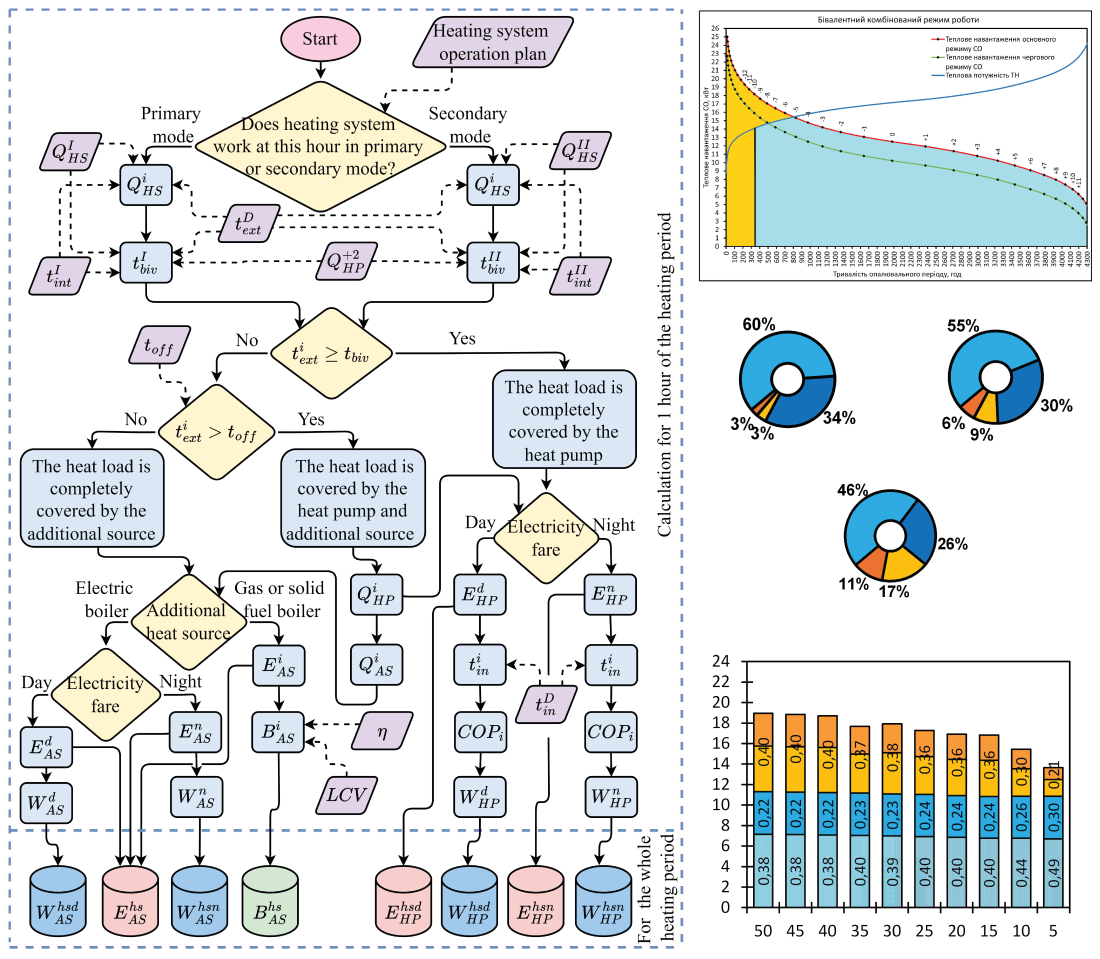
The object of this study is the process of calculating the distribution of heat generation and energy consumption by heat sources. The task addressed was estimating the seasonal heat generation by a combined heat source with an air heat pump. A methodology for quantifying the seasonal heat generation and energy consumption by sources as part of a combined heat source with an air heat pump has been devised. This methodology makes it possible to take into account different bivalent operation schemes, variable mode of the heating system, and different electricity tariffs. The ability to take these factors into account increases the accuracy of the results but also increases the complexity of the calculation process. In order to automate the calculation using the devised methodology, an algorithm was built, and an example of its implementation was demonstrated. The results show that the distribution of seasonal heat generation largely depends on the values of the bivalent point temperature and the heat pump shutdown temperature. In addition, they demonstrate the dependence of the calculated amount of heat consumed during the heating period and the distribution of its generation between sources on the number of the last heating periods taken into account. With a decrease in the number of past heating periods taken into account, the amount of heat consumed per season gradually decreases and the share covered by the heat pump increases. This indicates a gradual decrease in the duration of low temperatures in winter and proves the importance of relevance of the climatic data used for analysis.
The methodology devised in this study makes it possible to determine the appropriate ratio of thermal power of heat sources in a combination and increases the accuracy of calculating the payback period of equipment
References
- Khan, S. A., O‘Hegarty, R., Finn, D., Kinnane, O. (2024). Environmental footprint analysis of domestic air source heat pumps. Resources, Conservation & Recycling Advances, 22, 200217. https://doi.org/10.1016/j.rcradv.2024.200217
- Skochko, V., Solonnikov, V., Pohosov, O., Haba, K., Kulinko, Ye., Koziachyna, B. (2024). Minimization of Heat Losses in District Heating Networks by Optimizing their Configuration. Problems of the Regional Energetics, 3 (63), 182–195. https://doi.org/10.52254/1857-0070.2024.3-63.15
- Pasichnyk, P., Pryimak, O., Pohosov, O., Kulinko, Y., Koziachyna, B. (2024). Experimental Study of the Aerodynamic Characteristics of a Solar Air Collector with an Absorber Made of Carbon Textile. Proceedings of EcoComfort 2024, 426–435. https://doi.org/10.1007/978-3-031-67576-8_38
- Srithapon, C., Månsson, D. (2023). Predictive control and coordination for energy community flexibility with electric vehicles, heat pumps and thermal energy storage. Applied Energy, 347, 121500. https://doi.org/10.1016/j.apenergy.2023.121500
- Botticella, F., Viscito, L. (2015). Seasonal Performance Analysis of a Residential Heat Pump Using Different Fluids with Low Environmental Impact. Energy Procedia, 82, 878–885. https://doi.org/10.1016/j.egypro.2015.11.832
- Naldi, C., Dongellini, M., Morini, G. L. (2015). Climate Influence on Seasonal Performances of Air-to-water Heat Pumps for Heating. Energy Procedia, 81, 100–107. https://doi.org/10.1016/j.egypro.2015.12.064
- Mouzeviris, G. A., Papakostas, K. T. (2020). Air-to-water heat pumps: the impact of climate, compressor technology, water output temperature and sizing on the seasonal coefficient of performance for heating. IOP Conference Series: Materials Science and Engineering, 997 (1), 012150. https://doi.org/10.1088/1757-899x/997/1/012150
- Xie, X., Luo, Z., Grimmond, S., Liu, Y., Ugalde-Loo, C. E., Bailey, M. T., Wang, X. (2024). Could residential air-source heat pumps exacerbate outdoor summer overheating and winter overcooling in UK 2050s climate scenarios? Sustainable Cities and Society, 115, 105811. https://doi.org/10.1016/j.scs.2024.105811
- Mauro, A. W., Pelella, F., Viscito, L. (2023). Performance degradation of air source heat pumps under faulty conditions. Case Studies in Thermal Engineering, 45, 103010. https://doi.org/10.1016/j.csite.2023.103010
- Terry, N., Galvin, R. (2023). How do heat demand and energy consumption change when households transition from gas boilers to heat pumps in the UK. Energy and Buildings, 292, 113183. https://doi.org/10.1016/j.enbuild.2023.113183
- Vocale, P., Morini, G. L., Spiga, M. (2014). Influence of Outdoor Air Conditions on the Air Source Heat Pumps Performance. Energy Procedia, 45, 653–662. https://doi.org/10.1016/j.egypro.2014.01.070
- Bogdanov, D., Satymov, R., Breyer, C. (2024). Impact of temperature dependent coefficient of performance of heat pumps on heating systems in national and regional energy systems modelling. Applied Energy, 371, 123647. https://doi.org/10.1016/j.apenergy.2024.123647
- Milev, G., Al-Habaibeh, A., Fanshawe, S., Siena, F. L. (2023). Investigating the effect of the defrost cycles of air-source heat pumps on their electricity demand in residential buildings. Energy and Buildings, 300, 113656. https://doi.org/10.1016/j.enbuild.2023.113656
- Gollamudi, S., Fauchoux, M., Krishnan, E., Ramin, H., Joseph, A., Simonson, C. (2024). Methodology to evaluate design modifications intended to eliminate frosting and high discharge temperatures in air-source heat pumps (ASHPs) in cold climates. Energy and Buildings, 312, 114209. https://doi.org/10.1016/j.enbuild.2024.114209
- Ayad, A., Wong, S., Delisle, V. (2025). Modeling of heat pumps load profiles for power systems integration. Electric Power Systems Research, 238, 111059. https://doi.org/10.1016/j.epsr.2024.111059
- Historical Weather Data. Meteoblue. Available at: https://www.meteoblue.com/en/weather/archive/export
- AiWa H EVI Urban Outdoor. WAMAK. Available at: https://www.wamak.eu/en/commercial/heat-pumps/air-water/aiwa-h-evi-urban-outdoor
- Chakyrova, D., Rusev, D., Doseva, N. (2019). Estimation of Seasonal Efficiency of Air-to-Water Heat Pump Used in Heating Mode for Different Climatic Zones in Bulgaria. Journal of Engineering Science and Technology Review, 149–153. Available at: https://www.researchgate.net/publication/352062767_Estimation_of_Seasonal_Efficiency_of_Air-to-ater_Heat_Pump_Used_in_Heating_Mode_for_Different_Climatic_Zones_in_Bulgaria
- Glamazdin, P., Koziachyna, B. (2024). Accounting for climate changes when constructing the Rossander graph. Ventilation, Illumination and Heat Gas Supply, 49, 38–55. https://doi.org/10.32347/2409-2606.2024.49.38-55
Downloads
Published
How to Cite
Issue
Section
License
Copyright (c) 2025 Oleksandr Pohosov, Pavlo Pasichnyk, Yevhen Kulinko, Bohdan Koziachyna, Olexandr Melnychenko, Valentyn Osypov

This work is licensed under a Creative Commons Attribution 4.0 International License.
The consolidation and conditions for the transfer of copyright (identification of authorship) is carried out in the License Agreement. In particular, the authors reserve the right to the authorship of their manuscript and transfer the first publication of this work to the journal under the terms of the Creative Commons CC BY license. At the same time, they have the right to conclude on their own additional agreements concerning the non-exclusive distribution of the work in the form in which it was published by this journal, but provided that the link to the first publication of the article in this journal is preserved.
A license agreement is a document in which the author warrants that he/she owns all copyright for the work (manuscript, article, etc.).
The authors, signing the License Agreement with TECHNOLOGY CENTER PC, have all rights to the further use of their work, provided that they link to our edition in which the work was published.
According to the terms of the License Agreement, the Publisher TECHNOLOGY CENTER PC does not take away your copyrights and receives permission from the authors to use and dissemination of the publication through the world's scientific resources (own electronic resources, scientometric databases, repositories, libraries, etc.).
In the absence of a signed License Agreement or in the absence of this agreement of identifiers allowing to identify the identity of the author, the editors have no right to work with the manuscript.
It is important to remember that there is another type of agreement between authors and publishers – when copyright is transferred from the authors to the publisher. In this case, the authors lose ownership of their work and may not use it in any way.








