Розробка методики оцінки сезонної генерації теплової енергії комбінованим джерелом теплоти
DOI:
https://doi.org/10.15587/1729-4061.2025.323755Ключові слова:
повітряний тепловий насос, погодинні температурні дані, точка бівалентностіАнотація
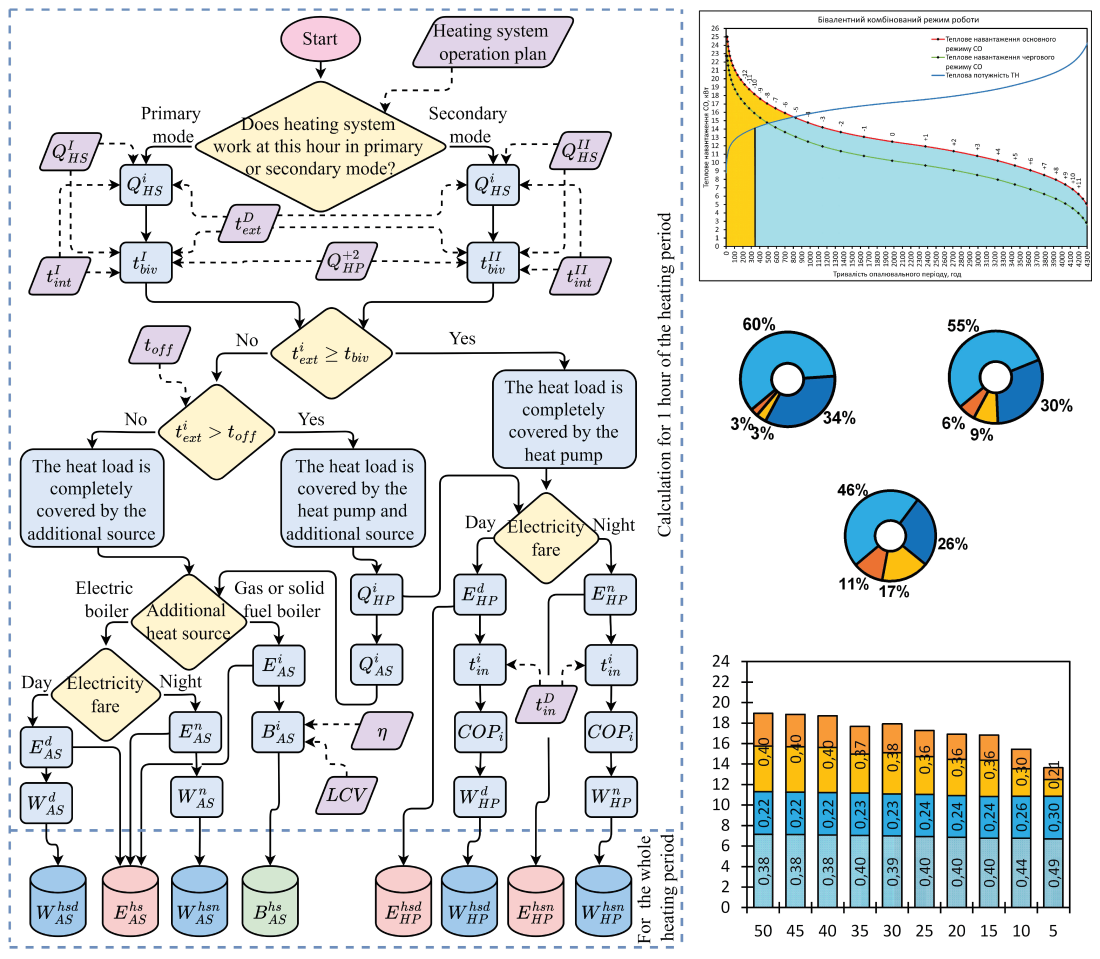
Розглянуто об’єкт дослідження – процес розрахунку розподілу генерації теплової енергії та споживання енергоресурсів джерелами теплоти. Досліджено проблематику оцінки сезонної генерації теплової енергії комбінованим джерелом теплоти з повітряним тепловим насосом. Розроблено методику оцінки сезонної генерації теплової енергії та споживання енергоресурсів джерелами у складі комбінованого джерела теплоти з повітряним тепловим насосом. Дана методика дозволяє врахувати різні бівалентні схеми роботи, змінний режим системи опалення та різні тарифи електроенергії. Завдяки можливості врахувати ці фактори підвищується точність та деталізація результатів, але і зростає складність та об’ємність процесу розрахунку. Для того, щоб автоматизувати розрахунок за розробленою методикою було побудовано алгоритм та продемонстровано приклад його реалізації. Результати доводять, що розподіл сезонної генерації теплової енергії значною мірою залежить від величин прийнятої температури точки бівалентності та температури вимкнення теплового насоса. Крім того, вони демонструють залежність розрахункової кількості теплоти спожитої за опалювальний період та розподілу її генерації між джерелами від кількості останніх опалювальних періодів, прийнятих до аналізу. При зменшенні кількості прийнятих останніх опалювальних періодів поступово зменшується величина спожитої за сезон теплової енергії та збільшується частка, яку покриває тепловий насос. Це свідчить про поступове зменшення тривалості стояння низьких температур зимових періодів та доводить значущість актуальності кліматичних даних, що приймаються до аналізу.
Розроблена в даному дослідженні методика дозволяє визначити доцільне співвідношення теплової потужності джерел теплоти у складі комбінації та підвищує точність розрахунку терміну окупності обладнання
Посилання
- Khan, S. A., O‘Hegarty, R., Finn, D., Kinnane, O. (2024). Environmental footprint analysis of domestic air source heat pumps. Resources, Conservation & Recycling Advances, 22, 200217. https://doi.org/10.1016/j.rcradv.2024.200217
- Skochko, V., Solonnikov, V., Pohosov, O., Haba, K., Kulinko, Ye., Koziachyna, B. (2024). Minimization of Heat Losses in District Heating Networks by Optimizing their Configuration. Problems of the Regional Energetics, 3 (63), 182–195. https://doi.org/10.52254/1857-0070.2024.3-63.15
- Pasichnyk, P., Pryimak, O., Pohosov, O., Kulinko, Y., Koziachyna, B. (2024). Experimental Study of the Aerodynamic Characteristics of a Solar Air Collector with an Absorber Made of Carbon Textile. Proceedings of EcoComfort 2024, 426–435. https://doi.org/10.1007/978-3-031-67576-8_38
- Srithapon, C., Månsson, D. (2023). Predictive control and coordination for energy community flexibility with electric vehicles, heat pumps and thermal energy storage. Applied Energy, 347, 121500. https://doi.org/10.1016/j.apenergy.2023.121500
- Botticella, F., Viscito, L. (2015). Seasonal Performance Analysis of a Residential Heat Pump Using Different Fluids with Low Environmental Impact. Energy Procedia, 82, 878–885. https://doi.org/10.1016/j.egypro.2015.11.832
- Naldi, C., Dongellini, M., Morini, G. L. (2015). Climate Influence on Seasonal Performances of Air-to-water Heat Pumps for Heating. Energy Procedia, 81, 100–107. https://doi.org/10.1016/j.egypro.2015.12.064
- Mouzeviris, G. A., Papakostas, K. T. (2020). Air-to-water heat pumps: the impact of climate, compressor technology, water output temperature and sizing on the seasonal coefficient of performance for heating. IOP Conference Series: Materials Science and Engineering, 997 (1), 012150. https://doi.org/10.1088/1757-899x/997/1/012150
- Xie, X., Luo, Z., Grimmond, S., Liu, Y., Ugalde-Loo, C. E., Bailey, M. T., Wang, X. (2024). Could residential air-source heat pumps exacerbate outdoor summer overheating and winter overcooling in UK 2050s climate scenarios? Sustainable Cities and Society, 115, 105811. https://doi.org/10.1016/j.scs.2024.105811
- Mauro, A. W., Pelella, F., Viscito, L. (2023). Performance degradation of air source heat pumps under faulty conditions. Case Studies in Thermal Engineering, 45, 103010. https://doi.org/10.1016/j.csite.2023.103010
- Terry, N., Galvin, R. (2023). How do heat demand and energy consumption change when households transition from gas boilers to heat pumps in the UK. Energy and Buildings, 292, 113183. https://doi.org/10.1016/j.enbuild.2023.113183
- Vocale, P., Morini, G. L., Spiga, M. (2014). Influence of Outdoor Air Conditions on the Air Source Heat Pumps Performance. Energy Procedia, 45, 653–662. https://doi.org/10.1016/j.egypro.2014.01.070
- Bogdanov, D., Satymov, R., Breyer, C. (2024). Impact of temperature dependent coefficient of performance of heat pumps on heating systems in national and regional energy systems modelling. Applied Energy, 371, 123647. https://doi.org/10.1016/j.apenergy.2024.123647
- Milev, G., Al-Habaibeh, A., Fanshawe, S., Siena, F. L. (2023). Investigating the effect of the defrost cycles of air-source heat pumps on their electricity demand in residential buildings. Energy and Buildings, 300, 113656. https://doi.org/10.1016/j.enbuild.2023.113656
- Gollamudi, S., Fauchoux, M., Krishnan, E., Ramin, H., Joseph, A., Simonson, C. (2024). Methodology to evaluate design modifications intended to eliminate frosting and high discharge temperatures in air-source heat pumps (ASHPs) in cold climates. Energy and Buildings, 312, 114209. https://doi.org/10.1016/j.enbuild.2024.114209
- Ayad, A., Wong, S., Delisle, V. (2025). Modeling of heat pumps load profiles for power systems integration. Electric Power Systems Research, 238, 111059. https://doi.org/10.1016/j.epsr.2024.111059
- Historical Weather Data. Meteoblue. Available at: https://www.meteoblue.com/en/weather/archive/export
- AiWa H EVI Urban Outdoor. WAMAK. Available at: https://www.wamak.eu/en/commercial/heat-pumps/air-water/aiwa-h-evi-urban-outdoor
- Chakyrova, D., Rusev, D., Doseva, N. (2019). Estimation of Seasonal Efficiency of Air-to-Water Heat Pump Used in Heating Mode for Different Climatic Zones in Bulgaria. Journal of Engineering Science and Technology Review, 149–153. Available at: https://www.researchgate.net/publication/352062767_Estimation_of_Seasonal_Efficiency_of_Air-to-ater_Heat_Pump_Used_in_Heating_Mode_for_Different_Climatic_Zones_in_Bulgaria
- Glamazdin, P., Koziachyna, B. (2024). Accounting for climate changes when constructing the Rossander graph. Ventilation, Illumination and Heat Gas Supply, 49, 38–55. https://doi.org/10.32347/2409-2606.2024.49.38-55
##submission.downloads##
Опубліковано
Як цитувати
Номер
Розділ
Ліцензія
Авторське право (c) 2025 Oleksandr Pohosov, Pavlo Pasichnyk, Yevhen Kulinko, Bohdan Koziachyna, Olexandr Melnychenko, Valentyn Osypov

Ця робота ліцензується відповідно до Creative Commons Attribution 4.0 International License.
Закріплення та умови передачі авторських прав (ідентифікація авторства) здійснюється у Ліцензійному договорі. Зокрема, автори залишають за собою право на авторство свого рукопису та передають журналу право першої публікації цієї роботи на умовах ліцензії Creative Commons CC BY. При цьому вони мають право укладати самостійно додаткові угоди, що стосуються неексклюзивного поширення роботи у тому вигляді, в якому вона була опублікована цим журналом, але за умови збереження посилання на першу публікацію статті в цьому журналі.
Ліцензійний договір – це документ, в якому автор гарантує, що володіє усіма авторськими правами на твір (рукопис, статтю, тощо).
Автори, підписуючи Ліцензійний договір з ПП «ТЕХНОЛОГІЧНИЙ ЦЕНТР», мають усі права на подальше використання свого твору за умови посилання на наше видання, в якому твір опублікований. Відповідно до умов Ліцензійного договору, Видавець ПП «ТЕХНОЛОГІЧНИЙ ЦЕНТР» не забирає ваші авторські права та отримує від авторів дозвіл на використання та розповсюдження публікації через світові наукові ресурси (власні електронні ресурси, наукометричні бази даних, репозитарії, бібліотеки тощо).
За відсутності підписаного Ліцензійного договору або за відсутністю вказаних в цьому договорі ідентифікаторів, що дають змогу ідентифікувати особу автора, редакція не має права працювати з рукописом.
Важливо пам’ятати, що існує і інший тип угоди між авторами та видавцями – коли авторські права передаються від авторів до видавця. В такому разі автори втрачають права власності на свій твір та не можуть його використовувати в будь-який спосіб.