Devising a method for assessing the performance of exergetic efficiency of a pressure wave exchanger
DOI:
https://doi.org/10.15587/1729-4061.2025.323891Keywords:
exergetic efficiency, pressure exchanger, purging of rotor channels, fresh charge, recirculation of combustion productsAbstract
With all their undeniable advantages, forced engines equipped with gas turbine supercharging (GTS) have a significant inherent drawback of the turbocharger (TC), which is associated with the inertia of the TC rotor, causing a discrepancy between the flow characteristics of the supercharger and the hydraulic needs of the engine under transient modes, during sharp acceleration of the vehicle.
As an alternative option and one of the effective methods for forcing the engine in order to obtain high technical, economic, and environmental performance indicators of the working process under transient operating modes, a wave pressure exchanger (WPE) is considered as the object of this study. However, the available information related to the energy exchange of working fluids in the units of the wave exchanger has not yet been sufficiently studied. To partially solve this problem, a method has been devised for assessing the exergetic efficiency of WPE, which takes into account the effect of partial exhaust gas recirculation, purging the rotor cells with a fresh charge.
Based on the results of development studies, in the presence of a pattern of change in these parameters (purging and recirculation), it is possible to influence the process of improving the working cycle and the exergetic efficiency of the pressure exchanger.
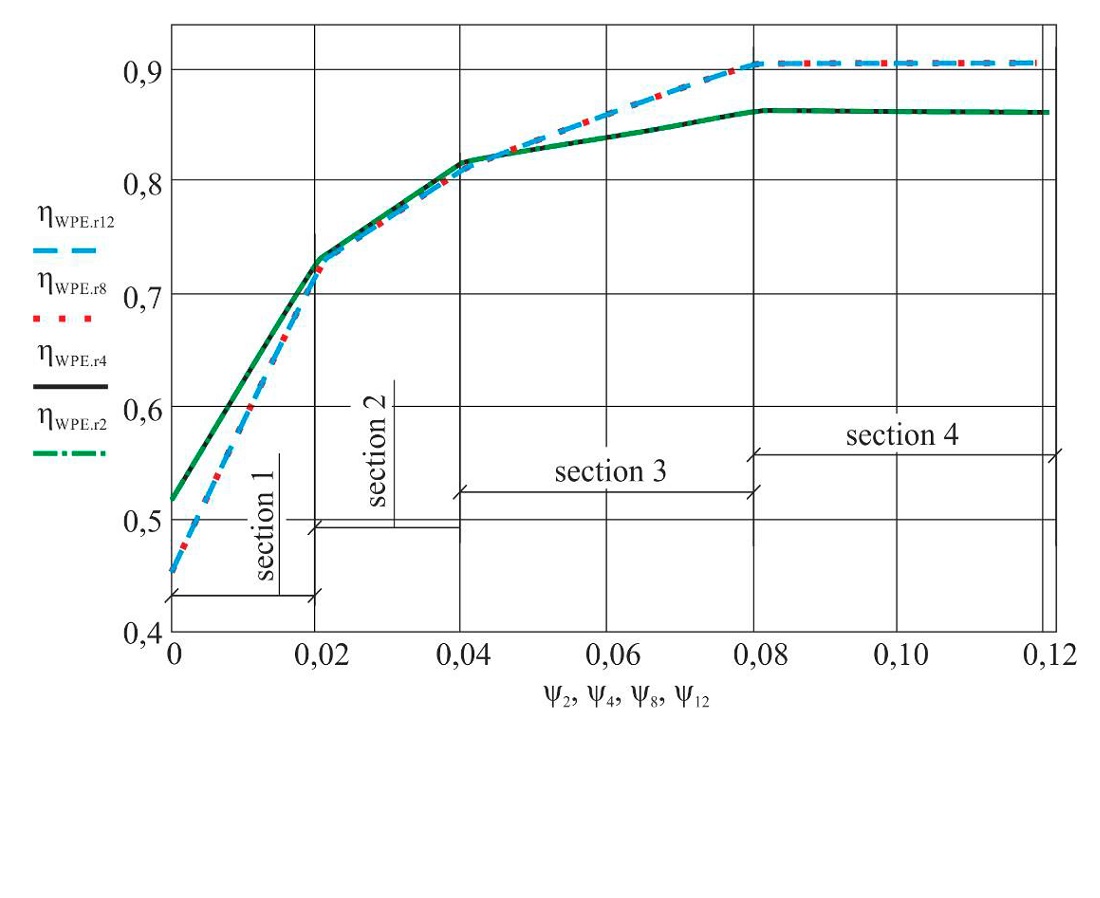
A rational combination of purging the rotor cells with a fresh charge (from 4 to 8 %) and reusing part of the combustion products (recirculation from 3 to 5 %) in the working process of the supercharger ensured an increase in the exergetic efficiency of WPE from 0.72 to 0.91 and partially solved the research problem.
The resulting data can be implemented both at the early stages of WPE design and for existing modifications of supercharging units, in the process of their further modernization and improvement
References
- Akbari, P., Nalim, R., Mueller, N. (2006). A Review of Wave Rotor Technology and Its Applications. Journal of Engineering for Gas Turbines and Power, 128 (4), 717–735. https://doi.org/10.1115/1.2204628
- Costiuc, I., Chiru, A. (2017). EVOLUTION of the Pressure Wave Supercharger Concept. IOP Conference Series: Materials Science and Engineering, 252, 012081. https://doi.org/10.1088/1757-899x/252/1/012081
- Costiuc, I., Chiru, A., Costiuc, L. (2022). A Review of Engine’s Performance When Supercharging by a Pressure Wave Supercharger. Energies, 15 (8), 2721. https://doi.org/10.3390/en15082721
- Costiuc, I., Chiru, A., Costiuc, L. (2018). Pressure Wave Technology - An interesting approach in supercharging. The Romanian Journal of Technical Sciences. Applied Mechanics, 63 (1), 50–73. Available at: https://rjts-applied-mechanics.ro/index.php/rjts/article/view/225/
- Korohodskyi, V., Kryshtopa, S., Migal, V., Rogovyi, A., Polivyanchuk, A., Slyn’ko, G. et al. (2020). Determining the characteristics for the rational adjusting of an fuel-air mixture composition in a two-stroke engine with internal carburation. Eastern-European Journal of Enterprise Technologies, 2 (5 (104)), 39–52. https://doi.org/10.15587/1729-4061.2020.200766
- Manoylo, V., Arhun, Shch., Migal, V., Hnatova, H., Korohodskyi, V., Zenkin, E., Shevchenko, I. (2023). Estimating Dynamic and Flow Characteristics of Electromagnetic Dispenser for The Kraz Truck Converted to Gas. International Journal of Integrated Engineering, 15 (4). https://doi.org/10.30880/ijie.2023.15.04.013
- Zsiga, N., Skopil, M. A., Wang, M., Klein, D., Soltic, P. (2021). Comparison of Turbocharging and Pressure Wave Supercharging of a Natural Gas Engine for Light Commercial Trucks and Vans. Energies, 14 (17), 5306. https://doi.org/10.3390/en14175306
- Jamil, A., Baharom, M. B., A. Aziz, A. R. (2021). IC engine in-cylinder cold-flow analysis – A critical review. Alexandria Engineering Journal, 60 (3), 2921–2945. https://doi.org/10.1016/j.aej.2021.01.040
- Korohodskyi, V., Rogovyi, A., Voronkov, O., Polivyanchuk, A., Gakal, P., Lysytsia, O. et al. (2021). Development of a three-zone combustion model for stratified-charge spark-ignition engine. Eastern-European Journal of Enterprise Technologies, 2 (5 (110)), 46–57. https://doi.org/10.15587/1729-4061.2021.228812
- Leahu, C. I., Radu, S. (2019). Reducing NOx emissions from diesel engines supercharged with pressure wave compressor driven by the electric motor. IOP Conference Series: Materials Science and Engineering, 568 (1), 012028. https://doi.org/10.1088/1757-899x/568/1/012028
- Stuart, C., Spence, S. W., Teichel, S., Starke, A. (2020). Design and evaluation of an active inlet swirl control device for automotive turbocharger compressors. 14th International Conference on Turbochargers and Turbocharging, 1–14. https://doi.org/10.1201/9781003132172-01
- Manoilo, V. M., Kozlov, Yu. Yu. (2018). Systema rehuliuvannia nadduvu avtotraktornykh dvyhuniv dlia transportnykh zasobiv APK. Tekhnika i tekhnolohiya APK, 10-11 (108), 19–21. Available at: http://nbuv.gov.ua/UJRN/Titapk_2018_10-11_8
- Abramchuk, F. I., Manoylo, V. M., Kabanov, A. N., Lipinskiy, M. S. (2010). Puti povysheniya tehniko-ekonomicheskih pokazateley gazovyh dvigateley s iskrovym zazhiganiem. Dvigateli vnutrennego sgoraniya, 1, 7–11. Available at: https://repository.kpi.kharkov.ua/handle/KhPI-Press/128
- Traupel, V. (1963). Teplovye turbomashiny. Moscow: Gosenergoizdat, 340.
- Hörber, H. U. (1969). Alschätrung der Verluste in inslationär-gasdunamischen Kanaltrommel-druck-tauschern. ETH, 241.
- Traupel, V. (1958). Teplovye turbiny. Vol. 1. Berlin: Shpringer, 362.
- Waleffe, J., Jenny, E., Muller, K. (1960). Pat. No. 378595. Brennkraft-maschine mit einem als Aufladegerät wirken-den Drucktauscher.
Downloads
Published
How to Cite
Issue
Section
License
Copyright (c) 2025 Volodymyr Manoylo, Volodymyr Korohodskyi, Alexander Voronkov, Andrii Avramenko, Ihor Nikitchenko, Ihor Shevchenko, Oleksandr Iesipov, Sergey Polyashenko, Eduard Teslenko, Daria Lemishko

This work is licensed under a Creative Commons Attribution 4.0 International License.
The consolidation and conditions for the transfer of copyright (identification of authorship) is carried out in the License Agreement. In particular, the authors reserve the right to the authorship of their manuscript and transfer the first publication of this work to the journal under the terms of the Creative Commons CC BY license. At the same time, they have the right to conclude on their own additional agreements concerning the non-exclusive distribution of the work in the form in which it was published by this journal, but provided that the link to the first publication of the article in this journal is preserved.
A license agreement is a document in which the author warrants that he/she owns all copyright for the work (manuscript, article, etc.).
The authors, signing the License Agreement with TECHNOLOGY CENTER PC, have all rights to the further use of their work, provided that they link to our edition in which the work was published.
According to the terms of the License Agreement, the Publisher TECHNOLOGY CENTER PC does not take away your copyrights and receives permission from the authors to use and dissemination of the publication through the world's scientific resources (own electronic resources, scientometric databases, repositories, libraries, etc.).
In the absence of a signed License Agreement or in the absence of this agreement of identifiers allowing to identify the identity of the author, the editors have no right to work with the manuscript.
It is important to remember that there is another type of agreement between authors and publishers – when copyright is transferred from the authors to the publisher. In this case, the authors lose ownership of their work and may not use it in any way.








