Devising a method for categorizing combat wheeled vehicles using fuzzy cluster analysis
DOI:
https://doi.org/10.15587/1729-4061.2025.324546Keywords:
wheeled combat vehicle, fuzzy cluster analysis, combat mass, fuzzy c-means algorithmAbstract
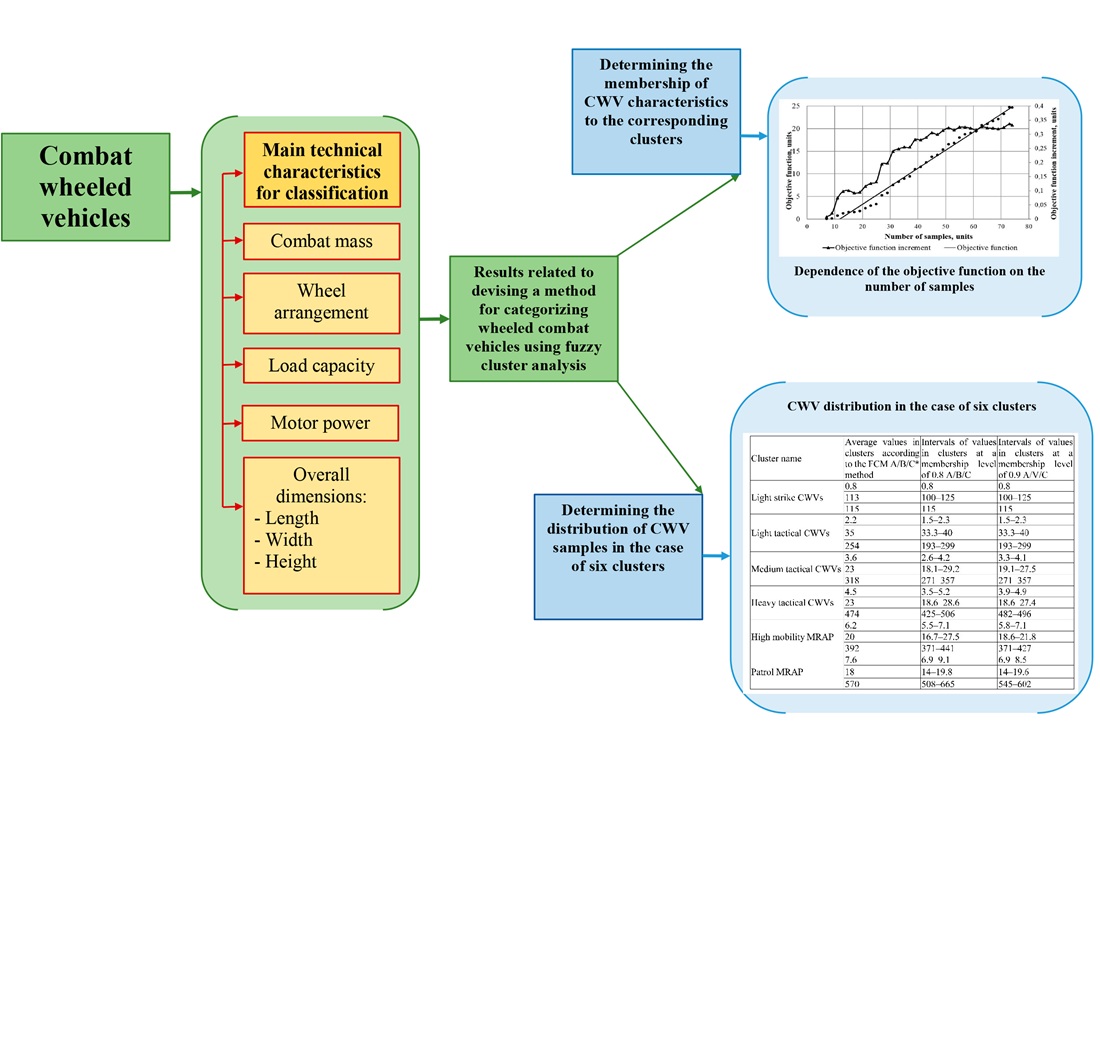
The object of this study is combat wheeled vehicles (CWVs). The task addressed is the categorization of CWVs. The devised CWV categorization method is based on the use of the fuzzy c-means (FCM) algorithm, which determines the centers of fuzzy clusters and their corresponding functions and memberships, which can take values in the interval from 0 to 1. Therefore, the degrees of membership of CWV samples to fuzzy clusters have been determined, which together define the fuzzy division of the initial set of CWV samples. The minimum number of samples required to solve the fuzzy clustering problem by determining the values of the objective function and the magnitude of its increment per sample with a sequential increase in the number of samples is 55 pieces. It has been confirmed that the maximum number of clusters at level 6 satisfies the needs of categorization and does not require their increase due to the presence of individual CWV samples with large degrees of membership in 2-clusters. It has been proven that with a weight parameter value of 1.68, the fuzziness of the membership matrix ensures an average level of membership of samples to 6 clusters at a level of not less than 99 %. The proposed CWV categorization method establishes a correspondence between the technical characteristics of the samples and their functional purpose. This makes it possible to take into account the uncertainties caused by the assignment of samples with intermediate characteristics between groups to one group. The resulting categorization results establish benchmarks to which CWV samples should approach when designing CWV types, which are constructed on the basis of unified units and assemblies. The results of this study could be used to determine CWV samples of the same type under conditions of a significant variety of options for providing units
References
- Kuprinenko, A., Chornyi, M., Mocherad, V., Ghahrodi, H. L. (2020). Concept Designing of Armoured Fighting Vehicles for Future Combat. Defence Science Journal, 70 (4), 397–403. https://doi.org/10.14429/dsj.70.14706
- Beliakov, G., Cao, T., Mak-Hau, V. (2022). Aggregation of Interacting Criteria in Land Combat Vehicle Selection by Using Fuzzy Measures. IEEE Transactions on Fuzzy Systems, 30 (9), 3979–3989. https://doi.org/10.1109/tfuzz.2021.3135972
- Davydovs’kyi, L. S., Bisyk, S. P., Chepkov, I. B., Vas’kivs’kyi, M. I., Katok, O. A., Slyvins’kyi, O. A. (2019). Alternatives of Energy Absorption Element Design Parameters for an Armored Combat Vehicle Seat Under Explosive Loading. Strength of Materials, 51 (6), 900–907. https://doi.org/10.1007/s11223-020-00140-7
- Yoo, C., Park, K., Choi, S. Y. (2016). The vulnerability assessment of ground combat vehicles using target functional modeling and FTA. International Journal of Precision Engineering and Manufacturing, 17 (5), 651–658. https://doi.org/10.1007/s12541-016-0079-8
- Heo, J., Jung, S. (2013). The Structure and Principal of the Tank and Armored Vehicles. Yang Seo Kag.
- The Military Balance 2024 (2024). The International Institute for Strategic Studies (IISS). https://doi.org/10.4324/9781003485834
- Muspratt, A. (2019). Maintaining NATO overmatch: Modernising armoured vehicles. DefenceiQ. Available at: https://www.defenceiq.com/armoured-vehicles/articles/future-armoured-vehicle-requirements
- Kincheloe, W., Edwards, E., Klopcic, J. T., Walbert, J., Deitz, P., Reed, Jr., H. et al. (2009). Fundamentals of Ground Combat System Ballistic Vulnerability/Lethality. American Institute of Aeronautics and Astronautics, Inc. https://doi.org/10.2514/4.860157
- Hennig, C., Meila, M., Murtagh, F., Rocci, R. (Eds.) (2015). Handbook of Cluster Analysis. Chapman and Hall/CRC. https://doi.org/10.1201/b19706
- Golub, V., Homa, V., Kurban, V., Sedov, S. (2019). Regarding the Definition of the Concept of Building an Armament System for the Needs of the Armed Forces of Ukraine. Science and Defense, 3, 31–35.
- Huang, X., Qi, X., Wang, W., Li, Q., He, H. (2024). Supplier selection of complex equipment in a military-civilian collaborative two-tier supply network with uncertain preference: A matching perspective. Journal of Management Science and Engineering, 9 (3), 328–347. https://doi.org/10.1016/j.jmse.2024.02.002
- Zabala-López, A., Linares-Vásquez, M., Haiduc, S., Donoso, Y. (2024). A survey of data-centric technologies supporting decision-making before deploying military assets. Defence Technology, 42, 226–246. https://doi.org/10.1016/j.dt.2024.07.012
- Louf, R., Barthelemy, M. (2014). A typology of street patterns. Journal of The Royal Society Interface, 11 (101), 20140924. https://doi.org/10.1098/rsif.2014.0924
- Rahman, A. R. H., Malik, S. A., Kumar, J. R., Balaguru, V., Sivakumar, P. (2017). A Design of Experiments Methodology for Evaluating Configuration for a Generation Next Main Battle Tank. Defence Science Journal, 68 (1), 19. https://doi.org/10.14429/dsj.68.12182
- Ramesh, S. (2017). The Armoured Tracked Vehicle - Future Perspective. Defence Science Journal, 67 (4), 341. https://doi.org/10.14429/dsj.67.11544
- Hoffenson, S., Arepally, S., Papalambros, P. Y. (2013). A multi-objective optimization framework for assessing military ground vehicle design for safety. The Journal of Defense Modeling and Simulation: Applications, Methodology, Technology, 11 (1), 33–46. https://doi.org/10.1177/1548512912459596
- Madhu, V., Bhat, T. (2011). Armour Protection and Affordable Protection for Futuristic Combat Vehicles. Defence Science Journal, 61 (4), 394–402. https://doi.org/10.14429/dsj.61.365
- Grujicic, M., Arakere, G., Bell, W. C., Haque, I. (2009). Computational investigation of the effect of up-armouring on the reduction in occupant injury or fatality in a prototypical high-mobility multi-purpose wheeled vehicle subjected to mine blast. Proceedings of the Institution of Mechanical Engineers, Part D: Journal of Automobile Engineering, 223 (7), 903–920. https://doi.org/10.1243/09544070jauto1170
- Foss, C. F. (2000). Jane's Tanks & Combat Vehicles Recognition Guide. HarperCollins Publishers, 448.
- Risby, M. S., Suhaimi, K., Sheng, T. K., M. S., A. S., N, M. H. (2019). Heavy Military Land Vehicle Mass Properties Estimation Using Hoisting and Pendulum Motion Method. Defence Science Journal, 69 (6), 550–556. https://doi.org/10.14429/dsj.69.13478
- Trikande, M., Jagirdar, V., Sujithkumar, M. (2014). Evaluation of semi-active suspension control strategies for 8x8 armoured vehicle using stochastic road profile inputs. IFAC Proceedings Volumes, 47 (1), 941–948. https://doi.org/10.3182/20140313-3-in-3024.00035
- Vantsevich, V. V., Gorsich, D. J., Volontsevych, D. O., Veretennikov, I. A., Paldan, J. R., Moradi, L. (2023). Vehicle design for terrain mobility: A modeling technique of powertrain power conversion and realization. Journal of Terramechanics, 106, 75–88. https://doi.org/10.1016/j.jterra.2023.01.003
- King, J. L., Jackson, E., Brinker, C., Sarvestani, S. S. (2023). Wheel tracks, rutting a new Oregon Trail: A survey of autonomous vehicle cybersecurity and survivability analysis research. Advances in Computers, 67–106. https://doi.org/10.1016/bs.adcom.2022.12.002
- Gajda, J., Mielczarek, M. (2014). Automatic Vehicle Classification in Systems with Single Inductive Loop Detector. Metrology and Measurement Systems, 21 (4), 619–630. https://doi.org/10.2478/mms-2014-0048
- Thota, L. S., Badawy, A. S., Changalasetty, S. B., Ghribi, W. (2015). Classify vehicles: Classification or clusterization? 2015 International Conference on Circuits, Power and Computing Technologies [ICCPCT-2015], 1–7. https://doi.org/10.1109/iccpct.2015.7159421
- Singhal, G., Bansod, B., Mathew, L. (2018). Unmanned Aerial Vehicle Classification, Applications and Challenges: A Review. https://doi.org/10.20944/preprints201811.0601.v1
- Golub, V., Kurban, V., Sedov, S., Golub, G. (2022). Classification of Combat Wheeled Vehicles Using Cluster Analysis Methods. Advances in Military Technology, 17 (1), 5–16. https://doi.org/10.3849/aimt.01499
- Bezdek, J. C. (1981). Pattern Recognition with Fuzzy Objective Function Algorithms. Springer US. https://doi.org/10.1007/978-1-4757-0450-1
Downloads
Published
How to Cite
Issue
Section
License
Copyright (c) 2025 Victor Golub, Serhii Bisyk, Gennadii Golub, Nataliya Tsyvenkova, Sviatoslav Sedov, Volodymyr Nadykto, Oleh Marus, Yaroslav Yarosh

This work is licensed under a Creative Commons Attribution 4.0 International License.
The consolidation and conditions for the transfer of copyright (identification of authorship) is carried out in the License Agreement. In particular, the authors reserve the right to the authorship of their manuscript and transfer the first publication of this work to the journal under the terms of the Creative Commons CC BY license. At the same time, they have the right to conclude on their own additional agreements concerning the non-exclusive distribution of the work in the form in which it was published by this journal, but provided that the link to the first publication of the article in this journal is preserved.
A license agreement is a document in which the author warrants that he/she owns all copyright for the work (manuscript, article, etc.).
The authors, signing the License Agreement with TECHNOLOGY CENTER PC, have all rights to the further use of their work, provided that they link to our edition in which the work was published.
According to the terms of the License Agreement, the Publisher TECHNOLOGY CENTER PC does not take away your copyrights and receives permission from the authors to use and dissemination of the publication through the world's scientific resources (own electronic resources, scientometric databases, repositories, libraries, etc.).
In the absence of a signed License Agreement or in the absence of this agreement of identifiers allowing to identify the identity of the author, the editors have no right to work with the manuscript.
It is important to remember that there is another type of agreement between authors and publishers – when copyright is transferred from the authors to the publisher. In this case, the authors lose ownership of their work and may not use it in any way.








