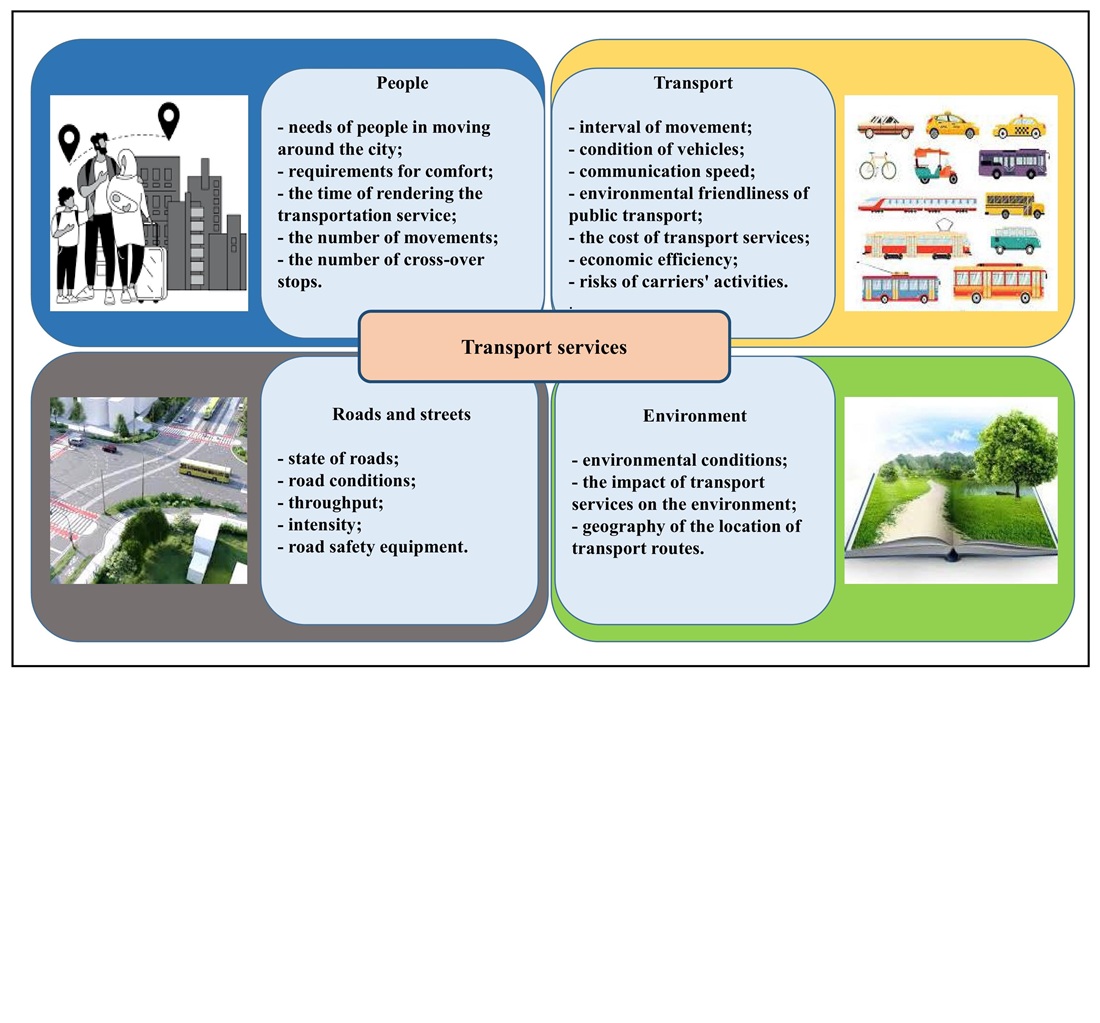
Devising a method for assessing the level of transport services in the "People – Transport – Road – Environment" system
DOI:
https://doi.org/10.15587/1729-4061.2025.325104Keywords:
quality level, logistics model, ROC analysis, Wald test, service predictorsAbstract
The object of this study is the process of assessing the level of public transport service provision in cities. The task is to devise a method for assessing the level of public transport service provision in terms of the influence of characteristics of the elements within the "People – Transport – Road – Environment" system. It was determined that these characteristics could serve as predictors – parameters and forecasting tools that determine the level of quality of public transport services for city residents. A logistic model has been built, which underlies the method for assessing the level of public transport service provision. This approach could allow for a comprehensive and interconnected study of social and technological factors of transport activity of subjects.
A method for diagnosing the logistic model for adequacy and consistency with empirical data has been proposed, which is based on the application of the Hosmer-Lemeshov agreement criterion and ROC analysis.
The method for assessing the level of public transport service provision was tested using an example of a city of regional significance. The adequacy of the method was confirmed using the Hosmer-Lemeshaw criterion and ROC analysis, which were 8.892 and 0.3428, respectively. Based on the verification results, proposals have been devised to improve the predictors of the activities of urban carriers. The effectiveness of the proposed measures was assessed by the percentage change in the time spent by city residents on travel, which was 17.5 %. This confirms the acceptability of the method devised.
The scope of using the method includes activities of business entities that provide transport services to the people in cities and to local government bodies. The prospect of this study is its application to assessing the level of quality of transport services by other types of passenger transport
References
- Willberg, E., Tenkanen, H., Miller, H. J., Pereira, R. H. M., Toivonen, T. (2023). Measuring just accessibility within planetary boundaries. Transport Reviews, 44 (1), 140–166. https://doi.org/10.1080/01441647.2023.2240958
- Melnychenko, O., Ignatenko, O., Tsybulskyi, V., Degtiarova, A., Kashuba, M., Derehuz, I. (2024). Development of a mechanism for information security risk management of transport service provision systems. Eastern-European Journal of Enterprise Technologies, 1 (3 (127)), 27–36. https://doi.org/10.15587/1729-4061.2024.298144
- Kharchenko, A., Tsybulskyi, V., Chechuha, O., Zavorotnii, S., Shuliak, I. (2022). Building a model for managing the cost and duration of motor road projects. Eastern-European Journal of Enterprise Technologies, 3 (3 (117)), 13–22. https://doi.org/10.15587/1729-4061.2022.256213
- Wang, Y., Cao, M., Liu, Y., Ye, R., Gao, X., Ma, L. (2022). Public transport equity in Shenyang: Using structural equation modelling. Research in Transportation Business & Management, 42, 100555. https://doi.org/10.1016/j.rtbm.2020.100555
- Ojo, T. K. (2017). Quality of public transport service: an integrative review and research agenda. Transportation Letters, 11 (2), 104–116. https://doi.org/10.1080/19427867.2017.1283835
- Moslem, S., Alkharabsheh, A., Ismael, K., Duleba, S. (2020). An Integrated Decision Support Model for Evaluating Public Transport Quality. Applied Sciences, 10 (12), 4158. https://doi.org/10.3390/app10124158
- Santos, J. B. dos, Lima, J. P. (2021). Quality of public transportation based on the multi-criteria approach and from the perspective of user’s satisfaction level: A case study in a Brazilian city. Case Studies on Transport Policy, 9 (3), 1233–1244. https://doi.org/10.1016/j.cstp.2021.05.015
- Tarandushka, L., Shlionchak, I., Tarandushka, I. (2022). Assessment of the Quality Passenger Service by Public Transport in Cherkasy. Central Ukrainian Scientific Bulletin. Technical Sciences, 2 (5 (36)), 253–261. https://doi.org/10.32515/2664-262x.2022.5(36).2.253-261
- Watthanaklang, D., Jomnonkwao, S., Champahom, T., Wisutwattanasak, P. (2024). Exploring accessibility and service quality perceptions on local public transportation in Thailand. Case Studies on Transport Policy, 15, 101144. https://doi.org/10.1016/j.cstp.2023.101144
- Bin MD Saad, N. A. (2023). Deployment of Lean Six Sigma in Transportation Sector. International Journal of Empirical Research Methods, 1 (2), 74–80. https://doi.org/10.59762/ijerm205275791220231205140246
- Dubernet, I., Axhausen, K. W. (2019). The German value of time and value of reliability study: the survey work. Transportation, 47 (3), 1477–1513. https://doi.org/10.1007/s11116-019-10052-4
- Jamal, S., Newbold, K. B. (2020). Factors Associated with Travel Behavior of Millennials and Older Adults: A Scoping Review. Sustainability, 12 (19), 8236. https://doi.org/10.3390/su12198236
- De Vos, J., Ermagun, A., Shaw, F. A. (2023). Wait time, travel time and waiting during travel: existing research and future directions. Transport Reviews, 43 (5), 805–810. https://doi.org/10.1080/01441647.2023.2220206
- Rashidi, S., Ataeian, S., Ranjitkar, P. (2022). Estimating bus dwell time: A review of the literature. Transport Reviews, 43 (1), 32–61. https://doi.org/10.1080/01441647.2021.2023692
- Merlin, L. A., Jehle, U. (2023). Global interest in walking accessibility: a scoping review. Transport Reviews, 43 (5), 1021–1054. https://doi.org/10.1080/01441647.2023.2189323
- Miller, E. (2023). The current state of activity-based travel demand modelling and some possible next steps. Transport Reviews, 43 (4), 565–570. https://doi.org/10.1080/01441647.2023.2198458
- Gkiotsalitis, K., Cats, O., Liu, T. (2022). A review of public transport transfer synchronisation at the real-time control phase. Transport Reviews, 43 (1), 88–107. https://doi.org/10.1080/01441647.2022.2035014
- Hensher, D. A., Hietanen, S. (2022). Mobility as a feature (MaaF): rethinking the focus of the second generation of mobility as a service (MaaS). Transport Reviews, 43 (3), 325–329. https://doi.org/10.1080/01441647.2022.2159122
- Maheshwari, R., Van Acker, V., De Vos, J., Witlox, F. (2023). A multi-perspective review of the impact of a workplace relocation on commuting behaviour, commuting satisfaction and subjective well-being. Transport Reviews, 43 (3), 385–406. https://doi.org/10.1080/01441647.2022.2119296
- Wang, X., Wong, Y. D., Chen, T., Yuen, K. F. (2022). Consumer logistics in contemporary shopping: a synthesised review. Transport Reviews, 43 (3), 502–532. https://doi.org/10.1080/01441647.2022.2131010
- Conceição, M. A., Monteiro, M. M., Kasraian, D., van den Berg, P., Haustein, S., Alves, I. et al. (2022). The effect of transport infrastructure, congestion and reliability on mental wellbeing: a systematic review of empirical studies. Transport Reviews, 43 (2), 264–302. https://doi.org/10.1080/01441647.2022.2100943
- Zaidi, A., Al Luhayb, A. S. M. (2023). Two Statistical Approaches to Justify the Use of the Logistic Function in Binary Logistic Regression. Mathematical Problems in Engineering, 2023 (1). https://doi.org/10.1155/2023/5525675
- Bangchang, K. N. (2024). Application of Bayesian variable selection in logistic regression model. AIMS Mathematics, 9 (5), 13336–13345. https://doi.org/10.3934/math.2024650
- Kasiri, L. A., Guan Cheng, K. T., Sambasivan, M., Sidin, S. Md. (2017). Integration of standardization and customization: Impact on service quality, customer satisfaction, and loyalty. Journal of Retailing and Consumer Services, 35, 91–97. https://doi.org/10.1016/j.jretconser.2016.11.007
- Kent, J. L., Crane, M., Waidyatillake, N., Stevenson, M., Pearson, L. (2023). Urban form and physical activity through transport: a review based on the d-variable framework. Transport Reviews, 43 (4), 726–754. https://doi.org/10.1080/01441647.2023.2165575
- Kosmidis, I., Müller-Eie, D. (2023). The synergy of bicycles and public transport: a systematic literature review. Transport Reviews, 44 (1), 34–68. https://doi.org/10.1080/01441647.2023.2222911
- Borucka, A. (2020). Logistic regression in modeling and assessment of transport services. Open Engineering, 10 (1), 26–34. https://doi.org/10.1515/eng-2020-0029
- Logistic Regression Four Ways with Python (2022). University of Virginia. Available at: https://library.virginia.edu/data/articles/logistic-regression-four-ways-with-python
- Tomaino, G., Walters, D. J. (2024). Presenting time‐series data as absolute versus relative changes impacts judgments and choices. Journal of Consumer Psychology, 34 (3), 510–518. https://doi.org/10.1002/jcpy.1391
- Pho, K.-H., McAleer, M. (2021). Specification and Estimation of a Logistic Function, with Applications in the Sciences and Social Sciences. Advances in Decision Sciences, 25 (2), 74–104. https://doi.org/10.47654/v25y2021i2p74-104
Downloads
Published
How to Cite
Issue
Section
License
Copyright (c) 2025 Olexandr Melnychenko, Oleksandr Ignatenko, Vitalii Tsybulskyi, Oleksandr Chechuha, Inna Vyhovska, Igor Derehuz, Akim Alimov

This work is licensed under a Creative Commons Attribution 4.0 International License.
The consolidation and conditions for the transfer of copyright (identification of authorship) is carried out in the License Agreement. In particular, the authors reserve the right to the authorship of their manuscript and transfer the first publication of this work to the journal under the terms of the Creative Commons CC BY license. At the same time, they have the right to conclude on their own additional agreements concerning the non-exclusive distribution of the work in the form in which it was published by this journal, but provided that the link to the first publication of the article in this journal is preserved.
A license agreement is a document in which the author warrants that he/she owns all copyright for the work (manuscript, article, etc.).
The authors, signing the License Agreement with TECHNOLOGY CENTER PC, have all rights to the further use of their work, provided that they link to our edition in which the work was published.
According to the terms of the License Agreement, the Publisher TECHNOLOGY CENTER PC does not take away your copyrights and receives permission from the authors to use and dissemination of the publication through the world's scientific resources (own electronic resources, scientometric databases, repositories, libraries, etc.).
In the absence of a signed License Agreement or in the absence of this agreement of identifiers allowing to identify the identity of the author, the editors have no right to work with the manuscript.
It is important to remember that there is another type of agreement between authors and publishers – when copyright is transferred from the authors to the publisher. In this case, the authors lose ownership of their work and may not use it in any way.








