Determination of regulation characteristics of capacitor exciter with variable topology for self-excited induction generator
DOI:
https://doi.org/10.15587/1729-4061.2025.326178Keywords:
induction generator, capacitor exciter, autonomous power grid, voltage quality, reactive power, microgridAbstract
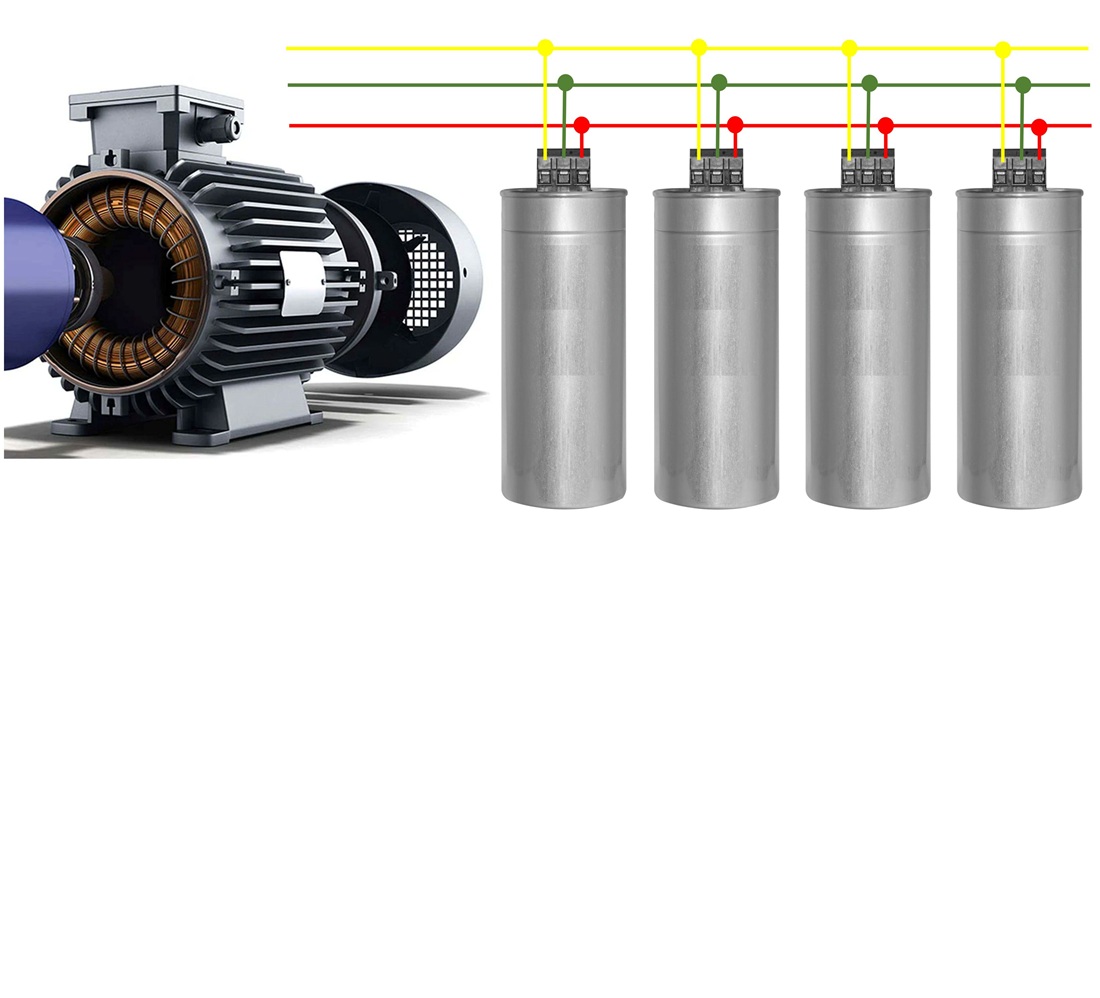
The object of the study is a capacitor exciter with variable topology, designed to operate as part of an autonomous induction generator. Insufficient efficiency of controlling the excitation level of an autonomous induction generator when changing the speed of the drive turbine and the load impedance has been established. This reduces the quality of the generator output voltage. The possibility of using an exciter circuit based on a mixed connection of capacitors has been analyzed. The influence significance of the groups number and the number of capacitors in each group on the range width and the adjustment step has been confirmed. In particular, increasing the values of the specified factors from 2 to 4 expands the adjustment range by 16 times, and the number of steps by 827 times. With the selected intervals of factors variation and a significance level of 0.05, the influence of the capacitors value changing step, compared to the base one, on the relative value of the exciter capacitance changing step is recognized as insignificant. The total capacitance of the exciter depends significantly nonlinearly on the number of the topological state. An increase in the total capacitance is accompanied by a raising in the intensity of its growth. This allows to minimize the step change in the total capacitance (with a probability of 0.88 – up to 0.003 % of the control range width). The resulting regression mathematical model can be used to optimize the exciter structure for an autonomous induction generator of a specific type. Increasing the number of control stages will enhance the accuracy of forming the capacitive excitation current of the generator and compensating the load current inductive component. The use of an exciter with a variable topology will increase the efficiency of voltage control of an autonomous induction generator when changing the speed of the drive turbine and the load impedance
References
- Communication From The Commission To The European Parliament, The European Council, The Council, The European Economic And Social Committee And The Committee Of The Regions (2019). European Commission. Available at: https://eur-lex.europa.eu/resource.html?uri=cellar:b828d165-1c22-11ea-8c1f-01aa75ed71a1.0002.02/DOC_1&format=PDF
- Allen, M. R., Friedlingstein, P., Girardin, C. A. J., Jenkins, S., Malhi, Y., Mitchell-Larson, E. et al. (2022). Net Zero: Science, Origins, and Implications. Annual Review of Environment and Resources, 47 (1), 849–887. https://doi.org/10.1146/annurev-environ-112320-105050
- Communication From The Commission To The European Parliament, The European Council, The Council, The European Economic And Social Committee And The Committee Of The Regions (2022). European Commission. Available at: https://eur-lex.europa.eu/resource.html?uri=cellar:fc930f14-d7ae-11ec-a95f-01aa75ed71a1.0001.02/DOC_1&format=PDF
- Communication From The Commission To The European Parliament, The Council, The European Economic And Social Committee And The Committee Of The Regions (2022). European Commission. Available at: https://eur-lex.europa.eu/legal-content/EN/TXT/PDF/?uri=CELEX:52022DC0552
- Renewables 2024. Analysis and forecasts to 2030. International Energy Agency. Available at: https://www.iea.org/reports/renewables-2024
- Global wind report 2024. Global Wind Energy Council. Available at: https://img.saurenergy.com/2024/05/gwr-2024_digital-version_final-1-compressed.pdf
- Andrienko, D., Horiunov, D., Hrudova, V., Markuts, Yu., Marsholok, T., Neiter, T. et al. (2025). Zvit pro priami zbytky infrastruktury vid ruinuvan vnaslidok viyskovoi ahresiyi Rosiyi proty Ukrainy stanom na lystopad 2024 roku. Available at: https://kse.ua/wp-content/uploads/2025/02/KSE_Damages_Report-November-2024-UA.pdf
- Pro skhvalennia Enerhetychnoi stratehiyi Ukrainy na period do 2050 roku. Rozporiadzhennia Kabinetu Ministriv Ukrainy No. 373-r. Available at: https://zakon.rada.gov.ua/laws/show/373-2023-%D1%80#Text
- Alhusein, N. I. (2022). Asynchronous Wind Turbine Generator: Output Power Evaluation. Brilliance: Research of Artificial Intelligence, 1 (2), 75–80. https://doi.org/10.47709/brilliance.v1i2.1565
- Induction Generators Market (2025). Verified Market Reports. Available at: https://www.verifiedmarketreports.com/select-license/?rid=484938
- Li, H., Peng, W., Huang, C.-G., Guedes Soares, C. (2022). Failure Rate Assessment for Onshore and Floating Offshore Wind Turbines. Journal of Marine Science and Engineering, 10 (12), 1965. https://doi.org/10.3390/jmse10121965
- Alizadeh, A., Kamwa, I., Moeini, A., Mohseni-Bonab, S. M. (2023). Energy management in microgrids using transactive energy control concept under high penetration of Renewables; A survey and case study. Renewable and Sustainable Energy Reviews, 176, 113161. https://doi.org/10.1016/j.rser.2023.113161
- Mahato, S. N., Singh, S. P., Sharma, M. P. (2008). Excitation capacitance required for self excited single phase induction generator using three phase machine. Energy Conversion and Management, 49 (5), 1126–1133. https://doi.org/10.1016/j.enconman.2007.09.007
- Goyal, S. K., Palwalia, D. K. (2016). Analysis of performance parameters and estimation of optimum capacitance for asynchronous generator. Engineering Science and Technology, an International Journal, 19 (4), 1753–1762. https://doi.org/10.1016/j.jestch.2016.05.015
- Khan, M. F., Khan, M. R., Iqbal, A. (2022). Effects of induction machine parameters on its performance as a standalone self excited induction generator. Energy Reports, 8, 2302–2313. https://doi.org/10.1016/j.egyr.2022.01.023
- Negi, G. S., Gupta, M. K., Saxena, N. K., Mohan, H. (2024). Squirrel cage induction generator based micro grid voltage assessment with STATCOM using different metaheuristic approaches. E-Prime - Advances in Electrical Engineering, Electronics and Energy, 9, 100736. https://doi.org/10.1016/j.prime.2024.100736
- Guettab, A., Boudjema, Z., Bounadja, E., Taleb, R. (2022). Improved control scheme of a dual star induction generator integrated in a wind turbine system in normal and open-phase fault mode. Energy Reports, 8, 6866–6875. https://doi.org/10.1016/j.egyr.2022.05.048
- Belalia, K., Mostefa, A., Merabet Boulouiha, H., Draou, A., Denai, M. (2024). Direct torque control of a dual star induction generator based on a modified space vector PWM under fault conditions. ISA Transactions, 155, 237–260. https://doi.org/10.1016/j.isatra.2024.10.012
- Milles, A., Merabet, E., Benbouhenni, H., Debdouche, N., Colak, I. (2024). Robust control technique for wind turbine system with interval type-2 fuzzy strategy on a dual star induction generator. Energy Reports, 11, 2715–2736. https://doi.org/10.1016/j.egyr.2024.01.060
- Benbouhenni, H., Bizon, N., Colak, I., Mosaad, M. I., Yessef, M. (2023). Direct active and reactive powers control of double-powered asynchronous generators in multi-rotor wind power systems using modified synergetic control. Energy Reports, 10, 4286–4301. https://doi.org/10.1016/j.egyr.2023.10.085
- Gu, T., Wang, P., Liu, D., Sun, A., Yang, D., Yan, G. (2023). Modeling and small-signal stability analysis of doubly-fed induction generator integrated system. Global Energy Interconnection, 6 (4), 438–449. https://doi.org/10.1016/j.gloei.2023.08.005
- Zhao, T., Liu, H., Luo, Z., Su, Y., Huang, L., Li, H., Sun, Z. (2023). A frequency control scheme of a doubly-fed induction generator considering random wind speeds. Energy Reports, 9, 235–244. https://doi.org/10.1016/j.egyr.2023.04.101
- Mostafavi, S., Shemshadi, A., Nazari, R., Yousefkhani, H. (2025). Utilization of H∞ robust and damping controllers with notch filters to reduce SSR in doubly-fed induction generator wind farms. Computers and Electrical Engineering, 123, 110024. https://doi.org/10.1016/j.compeleceng.2024.110024
- Cheng, C.-L., Shalabh, Garg, G. (2014). Coefficient of determination for multiple measurement error models. Journal of Multivariate Analysis, 126, 137–152. https://doi.org/10.1016/j.jmva.2014.01.006
- Reddy, S. R. K. (2021). Review of Literature on Self-Excited Induction Generators and Controllers. International Journal for Research in Applied Science and Engineering Technology, 9 (12), 1576–1587. https://doi.org/10.22214/ijraset.2021.39584
- Mykhailiuk, O. B. (2016). Problems that need a solution while using asynchronous generator of renewable energy in power plants. Visnyk of Vinnytsia Polytechnical Institute. Visnyk Vinnytskoho politekhnichnoho instytutu, 1, 96–100. Available at: https://visnyk.vntu.edu.ua/index.php/visnyk/article/view/1883
- Pushkar, M., Buryan, S., Mykhailenko, V. (2014). The voltage regulation of self-excited induction generator with triac-switched capacitor bank. Pratsi Instytutu elektrodynamiky Natsionalnoi akademiyi nauk Ukrainy, 39, 52–56. Available at: http://nbuv.gov.ua/UJRN/PIED_2014_39_11
Downloads
Published
How to Cite
Issue
Section
License
Copyright (c) 2025 Sviatoslav Vasylets, Kateryna Vasylets, Volodymyr Ilchuk

This work is licensed under a Creative Commons Attribution 4.0 International License.
The consolidation and conditions for the transfer of copyright (identification of authorship) is carried out in the License Agreement. In particular, the authors reserve the right to the authorship of their manuscript and transfer the first publication of this work to the journal under the terms of the Creative Commons CC BY license. At the same time, they have the right to conclude on their own additional agreements concerning the non-exclusive distribution of the work in the form in which it was published by this journal, but provided that the link to the first publication of the article in this journal is preserved.
A license agreement is a document in which the author warrants that he/she owns all copyright for the work (manuscript, article, etc.).
The authors, signing the License Agreement with TECHNOLOGY CENTER PC, have all rights to the further use of their work, provided that they link to our edition in which the work was published.
According to the terms of the License Agreement, the Publisher TECHNOLOGY CENTER PC does not take away your copyrights and receives permission from the authors to use and dissemination of the publication through the world's scientific resources (own electronic resources, scientometric databases, repositories, libraries, etc.).
In the absence of a signed License Agreement or in the absence of this agreement of identifiers allowing to identify the identity of the author, the editors have no right to work with the manuscript.
It is important to remember that there is another type of agreement between authors and publishers – when copyright is transferred from the authors to the publisher. In this case, the authors lose ownership of their work and may not use it in any way.








