Identifying the factors affecting the preparation of wine material from cherry fruits
DOI:
https://doi.org/10.15587/1729-4061.2025.326471Keywords:
juice, wine material, cherry, cultivated conditions, seed, aroma profile, skinAbstract
The object of the study is wine material obtained from cherry fruit grown in the Goranboy, Goygol and Ganja regions of Azerbaijan. Although several studies have been conducted regarding the production of juice and wine from cherries, the variation in the mechanical composition of the fruit and the juice and wine produced from it, depending on the conditions in which the plant is cultivated, has not been studied.
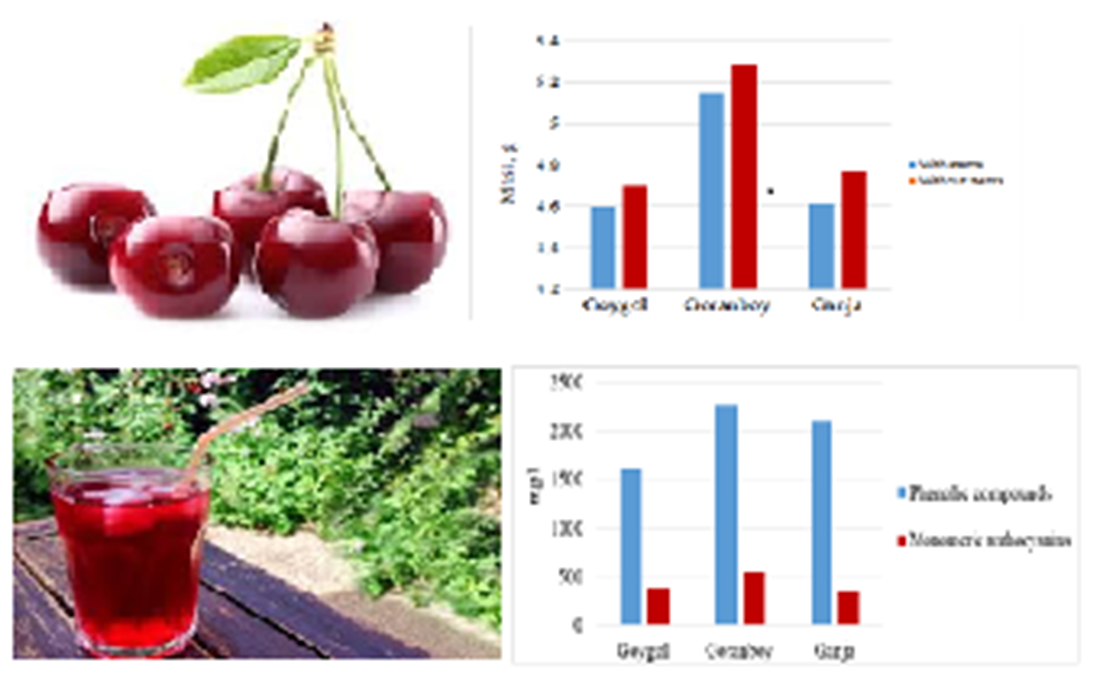
The Brix value of the juice obtained from the fruits was the lowest in Goygol (16.0), the highest in Goranboy (18.5), and the intermediate value was 16.9 in Ganja. The antioxidant content was highest in the Ganja sample (37.4 TEAC mmol/l), followed by Goranboy (28.3 TEAC mmol/l), and Goygol (20.0 TEAC mmol/l). When looking at the monomer anthocyanins, the lowest value was in Ganja (350 mg/l), followed by Goygol (366 mg/l), and Goranboy had the highest value (548 mg/l).
The physical-chemical composition of the wine samples, as well as the quality and quantity of volatile compounds, were studied. The highest of dry matter content was in Goranboy (76.7 g/dm3), the lowest in Goygol (38 g/dm3), and the intermediate value in Ganja (51.3 g/dm3). This can be attributed to the soil and climatic conditions of these regions. Goranboy is located in a hotter arid region, which results in higher dry matter content in the fruits compared to the other two regions. Ganja, located in a semi-mountainous area, has a more moderate climate compared to Goranboy, while Goygol, primarily situated in a mountainous region, is known for its cold winters and cool summers. All these differences are reflected in the products obtained from the fruit plants grown in these areas.
The results obtained can be used by family farms and winemaking enterprises
References
- Fataliyev, H. K. (2011). Wine technology. Baku: Elm, 596.
- Budak, N. H. (2024). A functional product in gastronomy: sour cherry vinegar. Journal of Tourism and Research, 13 (1), 120–136. https://doi.org/10.7460/turar.1464192
- Fataliyev, H., Askerova, A., Askerova, I. (2017). Processing technology for fruits and vegetables. Baku: Ecoprint, 368.
- Bayram, H. M., Öztürkcan, A. (2020). Investigating the Effects of Anthocyanin Rich Cherry Red Fruits on Human Health in Clinical Studies. İstanbul Gelişim Üniversitesi Sağlık Bilimleri Dergisi, 11, 230–254. https://doi.org/10.38079/igusabder.748640
- Jafarov, F. N., Fataliyev, H. K. (2014). Technology of functional food products. Baku: Elm, 384.
- Demirdöven, A., Erceyes, E., Erceyes, Ö. (2016). Changes in sour cherry juice concentrate antioxidants during production and storage. GIDA, 41 (4), 213–220. https://doi.org/10.15237/gida.gd15069
- Fataliyev, H. K., Musaev, T. M., Aliyeva, G. S. (2018). Technology of fruit and berry wines. Baku: Ecoprint, 312.
- Yeşilören, G., Ekşi, A. (2015). Neutralization as an alternative to reduce acidity of sour cherry juice. GIDA, 40 (3), 157–162. Available at: https://dergipark.org.tr/en/pub/gida/issue/43745/536819
- Fataliyev, Kh. K., Aliyeva, Sh. E., Musaev, T. M. (2019). Biotechnology. Baku: Ecoprint, 360.
- Türken, T., Pala, T. (2016). Modeling and Optimization of Sour Cherry Juice Antioxidant Activity by Using Response Surface Methodology and Genetic Algorithm. El-Cezeri Fen ve Mühendislik Dergisi, 3 (2). https://doi.org/10.31202/ecjse.264187
- Fataliyev, H., Malikov, A., Lezgiyev, Y., Gadimova, N., Musayev, T., Aliyeva, G. (2024). Identifying of the wine-making potential of the autochthon madrasa grape variety of different colors and quality. Eastern-European Journal of Enterprise Technologies, 2 (11 (128)), 56–63. https://doi.org/10.15587/1729-4061.2024.302971
- Yıldız, D., Gürel, D. B., Çağındı, Ö., Kayaardı, S. (2022). Heat treatment and microwave applications on homemade sour cherry juice: The effect on anthocyanin content and some physicochemical properties. Current Plant Biology, 29, 100242. https://doi.org/10.1016/j.cpb.2022.100242
- Vasylyshyna, O. (2021). Change of physical indicators of cherry fruit depending on treatment by polysaccharide compositions during storage. Scientific Reports of NULES of Ukraine, 1 (89). https://doi.org/10.31548/dopovidi2021.01.005
- Nacouzi, D., Masry, R., El Kayal, W. (2023). Quality and Phytochemical Composition of Sweet Cherry Cultivars Can Be Influenced by Altitude. Plants, 12 (12), 2254. https://doi.org/10.3390/plants12122254
- Nunes, A. R., Gonçalves, A. C., Pinto, E., Amaro, F., Flores-Félix, J. D., Almeida, A. et al. (2022). Mineral Content and Volatile Profiling of Prunus avium L. (Sweet Cherry) By-Products from Fundão Region (Portugal). Foods, 11 (5), 751. https://doi.org/10.3390/foods11050751
- Beloved, M. (2018). Effects of some chemical applications on cherries on fruit quality. Iğdır, 51.
- Tasova, M., Güzel, M. (2017). Determination Physico-Mechanic Properties and Color Values of İstanbul Variety Cherry (Prunus cerasus L.). Gaziosmanpasa Journal of Scientific Research, 6, 73–80. Available at: https://dergipark.org.tr/en/download/article-file/399631
- Akçin, E., Aslantaş, R., Bilgin, J. (2024). Determination of the Effects of Some Plant Growth Regulators on Harvest Time and Fruit Quality of Cordia Cherry Variety. Bahçe, 53, 249–259. https://doi.org/10.53471/bahce.1509642
- Fataliyev, H. K. (2013). Winemaking practicum. Baku: Elm, 328.
- Nabiyev, A. A. (2013). The Chemistry of Wine. Baku: Elm, 472.
- Sheskin, D. J. (2020). Handbook of Parametric and Nonparametric Statistical Procedures. Chapman and Hall/CRC, 1928. https://doi.org/10.1201/9780429186196
- Gadimova, N., Fataliyev, H., Heydarov, E., Lezgiyev, Y., Isgandarova, S. (2023). Development of a model and optimization of the interaction of factors in the grain malting process and its application in the production of functional beverages. Eastern-European Journal of Enterprise Technologies, 5 (11 (125)), 43–56. https://doi.org/10.15587/1729-4061.2023.289421
Downloads
Published
How to Cite
Issue
Section
License
Copyright (c) 2025 Hasil Fataliyev, Muhammad Mammadzade, Mehman Ismayılov, Natavan Gadimova, Naila Mammadova, Teymur Musayev

This work is licensed under a Creative Commons Attribution 4.0 International License.
The consolidation and conditions for the transfer of copyright (identification of authorship) is carried out in the License Agreement. In particular, the authors reserve the right to the authorship of their manuscript and transfer the first publication of this work to the journal under the terms of the Creative Commons CC BY license. At the same time, they have the right to conclude on their own additional agreements concerning the non-exclusive distribution of the work in the form in which it was published by this journal, but provided that the link to the first publication of the article in this journal is preserved.
A license agreement is a document in which the author warrants that he/she owns all copyright for the work (manuscript, article, etc.).
The authors, signing the License Agreement with TECHNOLOGY CENTER PC, have all rights to the further use of their work, provided that they link to our edition in which the work was published.
According to the terms of the License Agreement, the Publisher TECHNOLOGY CENTER PC does not take away your copyrights and receives permission from the authors to use and dissemination of the publication through the world's scientific resources (own electronic resources, scientometric databases, repositories, libraries, etc.).
In the absence of a signed License Agreement or in the absence of this agreement of identifiers allowing to identify the identity of the author, the editors have no right to work with the manuscript.
It is important to remember that there is another type of agreement between authors and publishers – when copyright is transferred from the authors to the publisher. In this case, the authors lose ownership of their work and may not use it in any way.








