Evaluating the impact of weight initialization on recurrent and transformer-based models in financial asset price prediction
DOI:
https://doi.org/10.15587/1729-4061.2025.326913Keywords:
deep learning, asset financial prediction, weight initialization, financial time seriesAbstract
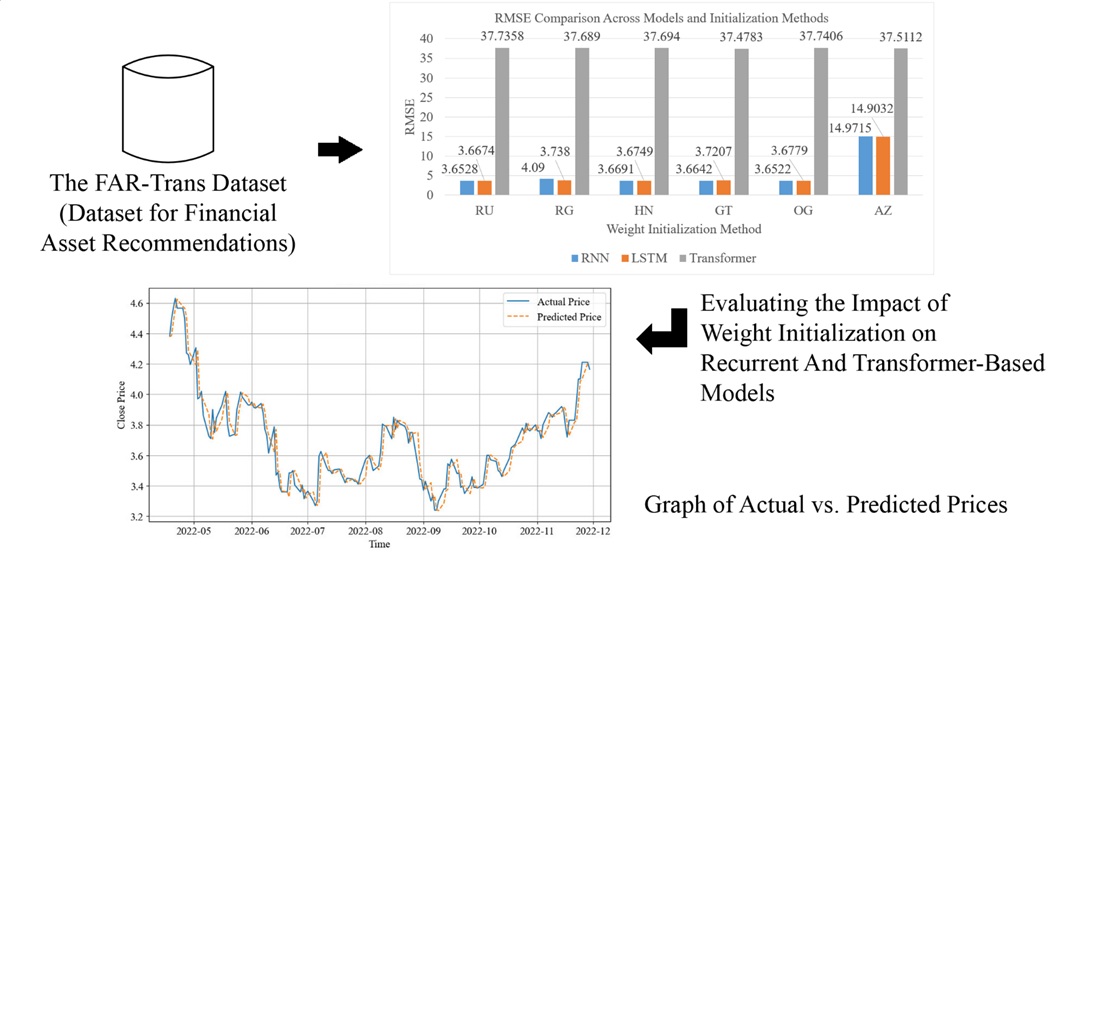
The object of this research is a deep learning model based on recurrent neural network (RNN), long short-term memory (LSTM), and transformer, applied to predict financial asset prices using historical time series data. The main problem addressed is the absence of a systematic study evaluating the combined effect of weight initialization methods and activation functions in time-series prediction models, particularly regarding convergence speed, prediction accuracy, and the model’s ability to capture price variability. The results show that RNN and LSTM have better training stability, are able to converge in one epoch, and provide high prediction performance (RMSE < 3.7, MAPE < 0.015, R2 close to 0.9999). In contrast, Transformer showed lower prediction performance (RMSE around 37, MAPE around 0.58, R2 between 0.9884–0.9885) and tended to overfitting on various strategy combinations. In RNN and LSTM models, the All-Zeros (AZ) and ReLU combination specifically degrades stability and leads to overfitting. The superiority of RNN and LSTM is attributed to their sequential architectures, which are more effective at learning short-term temporal patterns and more robust to suboptimal weight initialization. Therefore, selecting an appropriate combination of weight initialization and activation function plays a key role in enhancing model performance. These findings contribute empirical evidence to the importance of configuration choices in deep learning for time-series forecasting. The results can be applied in the development of deep learning-based financial asset prediction and recommendation systems, particularly for assets with long historical records and volatile market conditions
References
- Achury-Calderón, F., Arredondo, J. A., Sánchez Ascanio, L. C. (2025). A novel predictive analytics model for forecasting short-term trends in equity assets prices. Decision Analytics Journal, 14, 100534. https://doi.org/10.1016/j.dajour.2024.100534
- Tan, J., Deveci, M., Li, J., Zhong, K. (2024). Asset pricing via fused deep learning with visual clues. Information Fusion, 102, 102049. https://doi.org/10.1016/j.inffus.2023.102049
- Chen, Y., Zhang, L., Xie, Z., Zhang, W., Li, Q. (2025). Unraveling asset pricing with AI: A systematic literature review. Applied Soft Computing, 175, 112978. https://doi.org/10.1016/j.asoc.2025.112978
- Harumy, H. F., Hardi, S. M., Al Banna, M. F. (2024). EarlyStage Diabetes Risk Detection Using Comparison of Xgboost, Lightgbm, and Catboost Algorithms. Advanced Information Networking and Applications, 12–24. https://doi.org/10.1007/978-3-031-57931-8_2
- Al-Selwi, S. M., Hassan, M. F., Abdulkadir, S. J., Muneer, A., Sumiea, E. H., Alqushaibi, A., Ragab, M. G. (2024). RNN-LSTM: From applications to modeling techniques and beyond – Systematic review. Journal of King Saud University - Computer and Information Sciences, 36 (5), 102068. https://doi.org/10.1016/j.jksuci.2024.102068
- Kim, D.-K., Kim, K. (2022). A Convolutional Transformer Model for Multivariate Time Series Prediction. IEEE Access, 10, 101319–101329. https://doi.org/10.1109/access.2022.3203416
- Ahmed, S., Nielsen, I. E., Tripathi, A., Siddiqui, S., Ramachandran, R. P., Rasool, G. (2023). Transformers in Time-Series Analysis: A Tutorial. Circuits, Systems, and Signal Processing, 42 (12), 7433–7466. https://doi.org/10.1007/s00034-023-02454-8
- Ahn, J. Y., Kim, Y., Park, H., Park, S. H., Suh, H. K. (2024). Evaluating Time-Series Prediction of Temperature, Relative Humidity, and CO2 in the Greenhouse with Transformer-Based and RNN-Based Models. Agronomy, 14 (3), 417. https://doi.org/10.3390/agronomy14030417
- de Pater, I., Mitici, M. (2023). A mathematical framework for improved weight initialization of neural networks using Lagrange multipliers. Neural Networks, 166, 579–594. https://doi.org/10.1016/j.neunet.2023.07.035
- Harumy, T., Ginting, D. S. Br. (2021). Neural Network Enhancement Forecast of Dengue Fever Outbreaks in Coastal Region. Journal of Physics: Conference Series, 1898 (1), 012027. https://doi.org/10.1088/1742-6596/1898/1/012027
- Harumy, T. H. F., Zarlis, M., Lydia, M. S., Efendi, S. (2023). A novel approach to the development of neural network architecture based on metaheuristic protis approach. Eastern-European Journal of Enterprise Technologies, 4 (4 (124)), 46–59. https://doi.org/10.15587/1729-4061.2023.281986
- Ghallabi, F., Souissi, B., Du, A. M., Ali, S. (2025). ESG stock markets and clean energy prices prediction: Insights from advanced machine learning. International Review of Financial Analysis, 97, 103889. https://doi.org/10.1016/j.irfa.2024.103889
- Xu, F., Tan, S. (2021). Deep learning with multiple scale attention and direction regularization for asset price prediction. Expert Systems with Applications, 186, 115796. https://doi.org/10.1016/j.eswa.2021.115796
- Abolmakarem, S., Abdi, F., Khalili-Damghani, K., Didehkhani, H. (2022). A Multi-Stage Machine Learning Approach for Stock Price Prediction: Engineered and Derivative Indices. SSRN Electronic Journal. https://doi.org/10.2139/ssrn.4074883
- Pan, S., Long, S., Wang, Y., Xie, Y. (2023). Nonlinear asset pricing in Chinese stock market: A deep learning approach. International Review of Financial Analysis, 87, 102627. https://doi.org/10.1016/j.irfa.2023.102627
- Gülmez, B. (2025). GA-Attention-Fuzzy-Stock-Net: An optimized neuro-fuzzy system for stock market price prediction with genetic algorithm and attention mechanism. Heliyon, 11 (3), e42393. https://doi.org/10.1016/j.heliyon.2025.e42393
- Islam, B. ul, Ahmed, S. F. (2022). Short-Term Electrical Load Demand Forecasting Based on LSTM and RNN Deep Neural Networks. Mathematical Problems in Engineering, 2022, 1–10. https://doi.org/10.1155/2022/2316474
- Rahman, N. H. A., Yin, C. H., Zulkafli, H. S. (2024). Activation functions performance in multilayer perceptron for time series forecasting. Proceedings of the 38th International Conference of the Polymer Processing Society (PPS-38), 3158, 070001. https://doi.org/10.1063/5.0223864
- Sinanc Terzi, D. (2024). Effect of different weight initialization strategies on transfer learning for plant disease detection. Plant Pathology, 73 (9), 2325–2343. https://doi.org/10.1111/ppa.13997
- Srivastava, G., Vashisth, S., Dhall, I., Saraswat, S. (2020). Behavior Analysis of a Deep Feedforward Neural Network by Varying the Weight Initialization Methods. Smart Innovations in Communication and Computational Sciences, 167–175. https://doi.org/10.1007/978-981-15-5345-5_15
- Alhlffee, M. H. B., Ahmad Abuirbaiha, R. A. (2024). The Effects of Dropout and Weight Initialization on Human Face Classification Accuracy Using Multiple-agent Generative Adversarial Network. 2024 7th International Conference on Information and Computer Technologies (ICICT), 271–276. https://doi.org/10.1109/icict62343.2024.00050
- Rajaraman, S., Zamzmi, G., Yang, F., Liang, Z., Xue, Z., Antani, S. (2024). Uncovering the effects of model initialization on deep model generalization: A study with adult and pediatric chest X-ray images. PLOS Digital Health, 3 (1), e0000286. https://doi.org/10.1371/journal.pdig.0000286
- Berghout, T., Bentrcia, T., Lim, W. H., Benbouzid, M. (2023). A Neural Network Weights Initialization Approach for Diagnosing Real Aircraft Engine Inter-Shaft Bearing Faults. Machines, 11 (12), 1089. https://doi.org/10.3390/machines11121089
- Boulila, W., Alshanqiti, E., Alzahem, A., Koubaa, A., Mlaiki, N. (2024). An effective weight initialization method for deep learning: Application to satellite image classification. Expert Systems with Applications, 254, 124344. https://doi.org/10.1016/j.eswa.2024.124344
- Wong, K., Dornberger, R., Hanne, T. (2022). An analysis of weight initialization methods in connection with different activation functions for feedforward neural networks. Evolutionary Intelligence, 17 (3), 2081–2089. https://doi.org/10.1007/s12065-022-00795-y
- Mojtahedi, F. F., Yousefpour, N., Chow, S. H., Cassidy, M. (2025). Deep Learning for Time Series Forecasting: Review and Applications in Geotechnics and Geosciences. Archives of Computational Methods in Engineering. https://doi.org/10.1007/s11831-025-10244-5
- Mienye, I. D., Swart, T. G., Obaido, G. (2024). Recurrent Neural Networks: A Comprehensive Review of Architectures, Variants, and Applications. Information, 15 (9), 517. https://doi.org/10.3390/info15090517
- Huang, H., Wang, Z., Liao, Y., Gao, W., Lai, C., Wu, X., Zeng, Z. (2024). Improving the explainability of CNN-LSTM-based flood prediction with integrating SHAP technique. Ecological Informatics, 84, 102904. https://doi.org/10.1016/j.ecoinf.2024.102904
- Sanz-Cruzado, J., Droukas, N., McCreadie, R. (2024). FAR-Trans: An Investment Dataset for Financial Asset Recommendation. IJCAI-2024 Workshop on Recommender Systems in Finance (Fin-RecSys). https://doi.org/10.48550/arXiv.2407.08692
Downloads
Published
How to Cite
Issue
Section
License
Copyright (c) 2025 Andri Andri, Tengku Henny Febriana Harumy, Syahril Efendi

This work is licensed under a Creative Commons Attribution 4.0 International License.
The consolidation and conditions for the transfer of copyright (identification of authorship) is carried out in the License Agreement. In particular, the authors reserve the right to the authorship of their manuscript and transfer the first publication of this work to the journal under the terms of the Creative Commons CC BY license. At the same time, they have the right to conclude on their own additional agreements concerning the non-exclusive distribution of the work in the form in which it was published by this journal, but provided that the link to the first publication of the article in this journal is preserved.
A license agreement is a document in which the author warrants that he/she owns all copyright for the work (manuscript, article, etc.).
The authors, signing the License Agreement with TECHNOLOGY CENTER PC, have all rights to the further use of their work, provided that they link to our edition in which the work was published.
According to the terms of the License Agreement, the Publisher TECHNOLOGY CENTER PC does not take away your copyrights and receives permission from the authors to use and dissemination of the publication through the world's scientific resources (own electronic resources, scientometric databases, repositories, libraries, etc.).
In the absence of a signed License Agreement or in the absence of this agreement of identifiers allowing to identify the identity of the author, the editors have no right to work with the manuscript.
It is important to remember that there is another type of agreement between authors and publishers – when copyright is transferred from the authors to the publisher. In this case, the authors lose ownership of their work and may not use it in any way.





