Developing a sausage product which have increased nutritional value and improved amino acid properties
DOI:
https://doi.org/10.15587/1729-4061.2025.327439Keywords:
soy isolate, chickpeas, amino acids, fatty acids, food, semi-smoked sausageAbstract
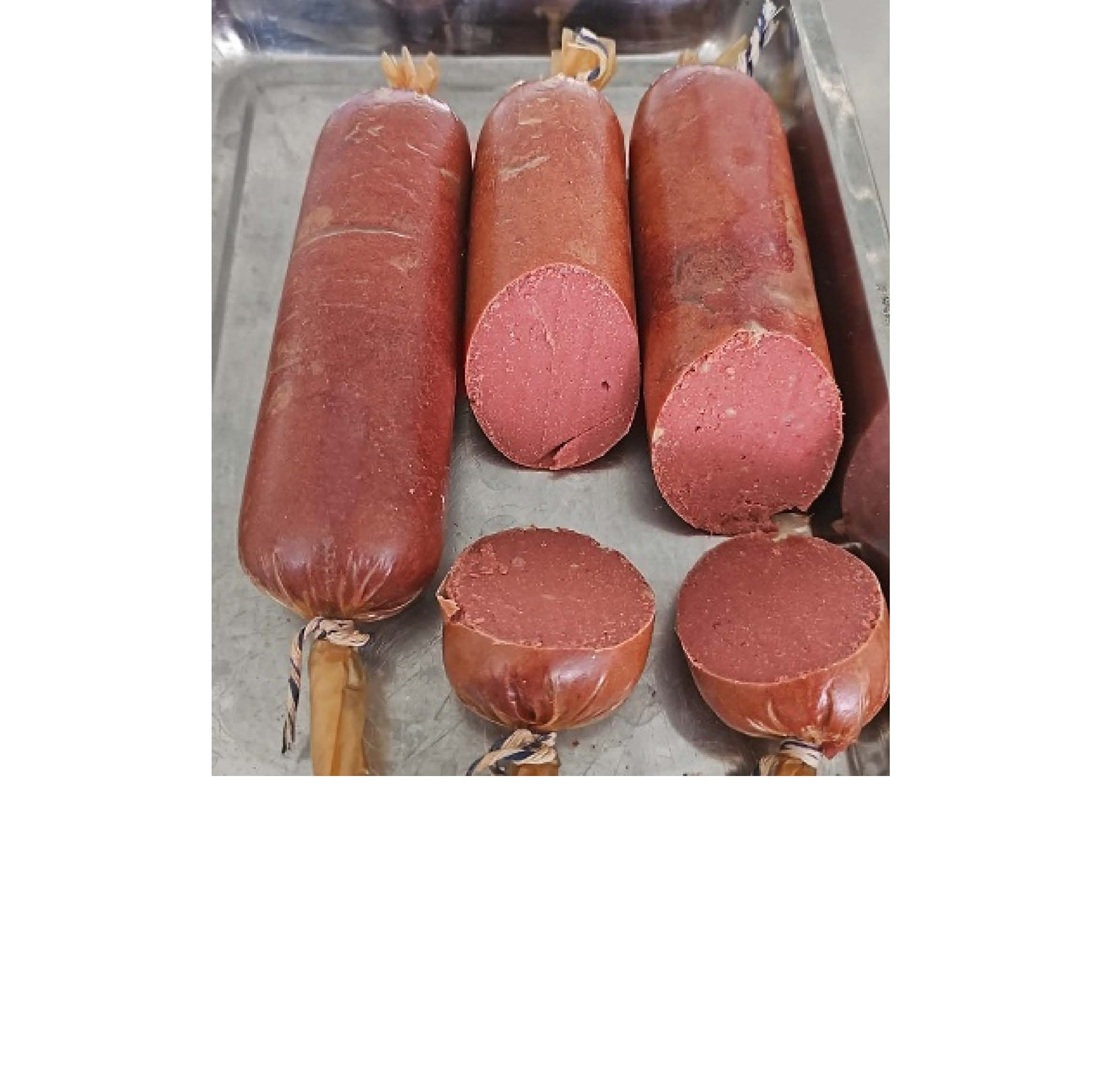
The object of the study is sausage products based on finely ground beef meat with the addition of soy isolate and chopped chickpeas. A technology for the preparation of semi-smoked sausages using plant-based raw materials as a functional component has been developed. Soy isolate and coarsely ground chickpea flour were used as additional functional components for comparison with the control sample, with ratios of 60:40, 70:30, 80:20, and 90:10.
Comparative analyses of the physico-chemical parameters, amino acid and fatty acid composition of the samples were carried out, which showed that, compared with the control samples, proteins increased by 2 times and the situation improved in terms of the content of amino acid groups, including aspartic acid by 4160 mg/100 g. and arginine by 2,510 mg/100 g. All samples were tasted and their organoleptic characteristics (taste, smell, color) were shown, which influenced the choice of the optimal option. Therefore, after the research, it is possible to study a new formulation with the addition of soy isolate and chickpeas, which corresponded and followed the processes for the entire technology of semi-smoked sausages.
The optimal variant of the sample, which positively influences the qualitative indicators and texture of the sausage product, was identified. The physicochemical attributes of the samples derived from plant raw materials exhibited significant differences from the control, with increases in the mass fractions of protein and fat. The results obtained can be used in the production of functional meat products for preventive purposes, especially for the creation of products with increased antioxidant potential and improved organoleptic characteristics. Such amino acid group contents may be in demand in the production of products for the prevention of the human body
References
- Waimaleongora‐ek, P., Prinyawiwatkul, W. (2020). Comparison of discriminability of common food acceptance scales for the elderly. International Journal of Food Science & Technology, 56 (1), 148–157. https://doi.org/10.1111/ijfs.14614
- Chernukha, I. M. (2009). Healthy food products: analysis of classification characteristics and methodological basis of classification. All about meat, 1, 24–28.
- Voytenko, O. S., Voytenko, L. G. (2017). Change of organoleptic indicators of meat products when using phytobiotics. In the collection: Innovative Technologies in Food Production. Materials of the All-Russian Scientific and Practical Conference, 11–14.
- Voitenko, O. S., Voitenko, L. G. (2017). Method for Producing Baked Sausage. In the Collection: Innovative Technologies in Food Production. Materials of the All-Russian Scientific and Practical Conference, 14–17.
- Voytenko, O. S., Sadolskiy, O. V. (2016). Method of injecting roasted pork. In the collection: Innovative Technologies in Food Production. Materials of the International Scientific and Practical Conference, 122–126.
- Voitenko, O. S., Voitenko, L. G., Skvortsov, M. V., Gashko, K. A. (2016). The Influence of Phytobiotics on the Quality of Functional Meat Products. In the collection: Current Trends in Innovative Development of Animal Husbandry and Modern Technologies for Food Production. Proceedings of the International Scientific and Practical Conference, 135–138.
- Inguglia, E. S., Song, Z., Kerry, J. P., O’Sullivan, M. G., Hamill, R. M. (2023). Addressing Clean Label Trends in Commercial Meat Processing: Strategies, Challenges and Insights from Consumer Perspectives. Foods, 12 (10), 2062. https://doi.org/10.3390/foods12102062
- Kostromkina, N. V., Milyaeva, T. A., Khaydukova, E. I. (2018). Features of using protein preparations in the production of cooked sausages. The role and place of information technologies in modern science, 97–101.
- Hong, K.-J., Lee, C.-H., Kim, S. W. (2004). Aspergillus oryzae GB-107 Fermentation Improves Nutritional Quality of Food Soybeans and Feed Soybean Meals. Journal of Medicinal Food, 7 (4), 430–435. https://doi.org/10.1089/jmf.2004.7.430
- Magomedov, R. D., Ryabukha, S. S., Shelyakin, V. A., Shelyakina, T. A., Didovich, S. V. (2012). The effect of inoculation by Bradyrhizobium japonicum strains on the protein and oil content in soybean seeds. Oilseeds, 2 (151-152)), 175–178.
- Litvinenko, O. V., Skripko, O. V. (2017). Varietal diversity of the biochemical composition of soybean seeds of Amur breeding. Storage and processing of agricultural raw materials, 7, 31–34.
- Rimareva, L. V., Krivova, A. Yu., Serba, E. M., Overchenko, M. B., Ignatova, N. I., Pogorzelskaya, N. S. et al. (2018). Biological preparation based on yeast and fungal biomass rich in polysaccharides and essential amino acids. Izvestia Ufimskogo Nauchnogo Tsentra RAN, 3 (3), 28–33. https://doi.org/10.31040/2222-8349-2018-3-3-28-33
- Zhang, Z., Zhang, X., Xin, G., Gong, X., Wang, Y., Wang, L., Sun, B. (2019). Umami taste and its association with energy status in harvested Pleurotus geesteranus stored at different temperatures. Food Chemistry, 279, 179–186. https://doi.org/10.1016/j.foodchem.2018.12.010
- Saranraj, P., Sivasakthi, S. (2014). Spirulina platensis – food for future: a review. Asian Journal of Pharmaceutical Science & Technology, 4 (1), 26–33. Available at: https://www.ajpst.com/File_Folder/26-33.pdf
- Ummalyma, S. B., Sahoo, D., Pandey, A. (2020). Microalgal Biorefineries for Industrial Products. Microalgae Cultivation for Biofuels Production, 187–195. https://doi.org/10.1016/b978-0-12-817536-1.00012-6
- Osovskaya, I. I., Prikhodko, A. A. (2020). Seaweed. Application in biotechnology. Saint Petersburg: HSE Spbsutd.
- Singh, P., Kumar, R., Sabapathy, S. N., Bawa, A. S. (2008). Functional and Edible Uses of Soy Protein Products. Comprehensive Reviews in Food Science and Food Safety, 7 (1), 14–28. https://doi.org/10.1111/j.1541-4337.2007.00025.x
- Yessengaziyeva, A. N., Uzakov, Y. M., Kuzembayeva, G. K., Kaimbayeva, L. A., Tlevlessova, D. A. (2023). The Use of the Protepsin Enzyme in the Production of Semi-Smoked Sausages. Journal of Culinary Science & Technology, 1–12. https://doi.org/10.1080/15428052.2023.2299027
- Ferreira, L. F., Minuzzi, N. M., Rodrigues, R. F., Pauletto, R., Rodrigues, E., Emanuelli, T., Bochi, V. C. (2020). Citric acid water-based solution for blueberry bagasse anthocyanins recovery: Optimization and comparisons with microwave-assisted extraction (MAE). LWT, 133, 110064. https://doi.org/10.1016/j.lwt.2020.110064
- Keerthana Priya, R., Rawson, A., Vidhyalakshmi, R., Jagan Mohan, R. (2021). Development of vegan sausage using banana floret (Musa paradisiaca) and jackfruit (Artocarpus heterophyllus Lam.) as a meat substitute: Evaluation of textural, physico‐chemical and sensory characteristics. Journal of Food Processing and Preservation, 46(1). https://doi.org/10.1111/jfpp.16118
- Carhuancho-Colca, K. P., Silva-Paz, R. J., Elías-Peñafiel, C., Salvá-Ruiz, B. K., Encina-Zelada, C. R. (2024). Comparison of Vegetarian Sausages: Proximal Composition, Instrumental Texture, Rapid Descriptive Sensory Method and Overall Consumer Liking. Foods, 13 (11), 1733. https://doi.org/10.3390/foods13111733
- Ghebremedhin, M., Baechle, M., Vilgis, T. A. (2022). Meat-, vegetarian-, and vegan sausages: Comparison of mechanics, friction, and structure. Physics of Fluids, 34 (4). https://doi.org/10.1063/5.0083730
Downloads
Published
How to Cite
Issue
Section
License
Copyright (c) 2025 Zhazira Zheleuova, Azret Shingisov, Ainur Berdenbetova, Aigul Balabekova, Alimzhan Imanbayev

This work is licensed under a Creative Commons Attribution 4.0 International License.
The consolidation and conditions for the transfer of copyright (identification of authorship) is carried out in the License Agreement. In particular, the authors reserve the right to the authorship of their manuscript and transfer the first publication of this work to the journal under the terms of the Creative Commons CC BY license. At the same time, they have the right to conclude on their own additional agreements concerning the non-exclusive distribution of the work in the form in which it was published by this journal, but provided that the link to the first publication of the article in this journal is preserved.
A license agreement is a document in which the author warrants that he/she owns all copyright for the work (manuscript, article, etc.).
The authors, signing the License Agreement with TECHNOLOGY CENTER PC, have all rights to the further use of their work, provided that they link to our edition in which the work was published.
According to the terms of the License Agreement, the Publisher TECHNOLOGY CENTER PC does not take away your copyrights and receives permission from the authors to use and dissemination of the publication through the world's scientific resources (own electronic resources, scientometric databases, repositories, libraries, etc.).
In the absence of a signed License Agreement or in the absence of this agreement of identifiers allowing to identify the identity of the author, the editors have no right to work with the manuscript.
It is important to remember that there is another type of agreement between authors and publishers – when copyright is transferred from the authors to the publisher. In this case, the authors lose ownership of their work and may not use it in any way.








