Development of contingency cost analysis model in construction project with cost-time-quality risk integration
DOI:
https://doi.org/10.15587/1729-4061.2025.330351Keywords:
construction project, risk integration, cost-time-quality, contingency cost, EMVAbstract
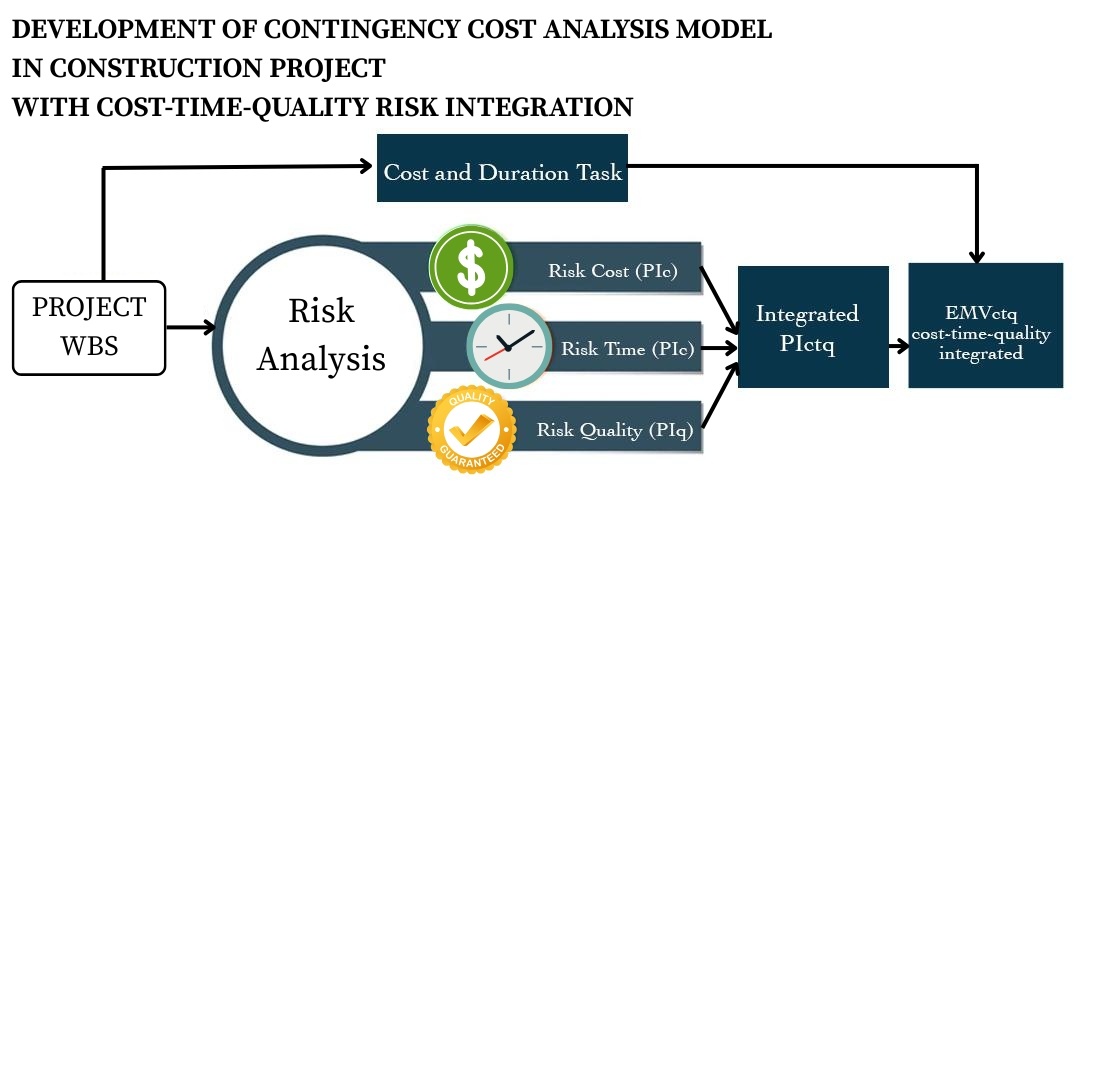
The object of this study is the contingency cost in the implementation of construction projects. The problem to be solved is the develop a contingency cost model in the implementation of construction projects, by integrating cost, quality, and time risks. The previously used models involve cost, quality, and time risks separately. It is still rare to find an analysis in construction project execution that incorporates these three risks into a contingency cost model. The formulation of this integration is crucial since every project is unique and carries varying degrees of risk. Data were investigated and collected from the Bali Province Regency Road Improvement Project, and the descriptive strategy analysis was employed. Using the probability (P) by impact (I) approach, which is the multiplication of (P) by (I) on a Likert scale of 5, triple constraint risks are included in the Expected Monetary Value (EMV) analysis. Moreover, monetary units are used to develop impact scale I, in which daily penalties and quality with rework costs are applied using the monetary unit approach of time effect. The simultaneous total of the PI from time, cost, and quality concerns is the EMV contingency cost formulation for the integration of these risks.
The study obtained that, a cost contingency model was created that incorporates the risk factors of cost, time, and quality. This model’s cost contingency value was 9.61% of the total cost when it was applied to a case study. Specifically, this finding falls between 5% and 10%, which is adequate and consistent with the empirical approach. This contingency cost model is thought to be more rational since it accounts for project risks, including the likelihood of potential risks as well as their effects. The project team can use this approach to estimate contingency expenses
References
- Barraza, G. A., Bueno, R. A. (2007). Cost Contingency Management. Journal of Management in Engineering, 23 (3), 140–146. https://doi.org/10.1061/(asce)0742-597x(2007)23:3(140)
- Matějková, J. (2024). Assessing Public Works Procurement in the Czech Republic´s over-limit Regime: Survey Results and Recommendations for Contracting Authorities. Civil and Environmental Engineering Reports, 34 (2), 84–99. https://doi.org/10.59440/ceer/189313
- Leśniak, A. (2023). Delays In Execution Of Building Projects And Their Financial Consequences For Contractors - Polish View. Civil and Environmental Engineering Reports, 33 (1), 99–108. https://doi.org/10.59440/ceer-2023-0007
- Turskis, Z., Zavadskas, E. K., Antucheviciene, J., Kosareva, N. (2015). A Hybrid Model Based on Fuzzy AHP and Fuzzy WASPAS for Construction Site Selection. International Journal of Computers Communications & Control, 10 (6), 113. https://doi.org/10.15837/ijccc.2015.6.2078
- Vaghela, V. N. (2020). Risk management in the construction industry. International Research Journal of Engineering and Technology (IRJET), 7, 584–588. Available at: https://www.irjet.net/archives/V7/i6/IRJET-V7I6107.pdf
- Ziegel, E. R., Vose, D. (1999). Quantitative Risk Analysis. Technometrics, 41 (4), 381. https://doi.org/10.2307/1271374
- Marco, A., Thaheem, M., Grimaldi, S., Rafele, C. (2014). A Framework Methodology for Selection of Risk Analysis Techniques in Construction Projects. Conference: Proceeedings of the Creative Construction Conference 2012. Available at: https://www.researchgate.net/publication/258506573_A_Framework_Methodology_for_Selection_of_Risk_Analysis_Techniques_in_Construction_Projects
- Walke, R., Topkar, V., Kabiraj, S. (2010). Risk Quantification Using EMV Analysis - A Strategic Case of Ready Mix Concrete Plants. International Journal of Computer, 7 (5), 399–408. Available at: https://www.researchgate.net/publication/266214429_Risk_Quantification_Using_EMV_Analysis_-_A_Strategic_Case_of_Ready_Mix_Concrete_Plants
- Purnus, A., Bodea, C.-N. (2014). Correlation between Time and Cost in a Quantitative Risk Analysis of Construction Projects. Procedia Engineering, 85, 436–445. https://doi.org/10.1016/j.proeng.2014.10.570
- Rezaian, A. (2011). Time-Cost-Quality-Risk of Construction and Development Projects or Investment. Middle-East Journal of Scientific Research, 10 (2), 218–223.
- Demir, S. T., Bryde, D. J., Fearon, D. J., Ochieng, E. G. (2014). A tool for integrating time, cost and quality perspectives in Probability Impact (P-I) Tables. International Journal of Project Organisation and Management, 6 (4), 303. https://doi.org/10.1504/ijpom.2014.066410
- Idrus, A., Fadhil Nuruddin, M., Rohman, M. A. (2011). Development of project cost contingency estimation model using risk analysis and fuzzy expert system. Expert Systems with Applications, 38 (3), 1501–1508. https://doi.org/10.1016/j.eswa.2010.07.061
- Jaya, N. M., Sudarsana, D. K. (2023). Development of Contingency Value Analysis Model Using Cost-Time Risk Integration and WBS-Pareto Hybrid in Construction Projects. International Journal on Engineering Applications (IREA), 11 (2), 121. https://doi.org/10.15866/irea.v11i2.23235
- Aloko, M. N. (2018). Risk Assessment Process for Construction Projects in Afghanistan. International Journal of Advanced Engineering Research and Science, 5 (8), 211–217. https://doi.org/10.22161/ijaers.5.8.26
- Simosa, F. (2024). Qualitative Risk Analysis Tools, Definition, Examples. Projectcubicle. Available at: https://www.projectcubicle.com/qualitative-risk-analysis-tools-definition-examples/
- Singam, H. B., Chaudhari, P. S. (2016). Risk Analysis of Construction Project Using Sensitivity Analysis. International Journal of Modern Trends in Engineering and Research, 3(6).
- Hulett, D. T., Nosbisch, M. R. (2018). Integrated Cost / Schedule Risk Analysis Using. Monte Carlo Simulation of CPM Model. Available at: http://www.projectrisk.com/white_papers/Presentation-Hulett-Nosbisch-rev2.pdf
- A guide to the project management body of knowledge (2017). PMI.
- Sudarsana, D. K., Astana, N. Y., Frederika, A., Sanjaya, P. A. (2024). Development of a Quantitative Scale for the Impact of Quality Risk on Construction Project. International Conference on Rehabilitation and Maintenance in Civil Engineering. Available at: https://icrmce06.ft.uns.ac.id/assets/doc/ICRMCE06Guidebook.pdf
- Cooper, D., MacDonald, D., Chapman, C. (1985). Risk analysis of a construction cost estimate. International Journal of Project Management, 3 (3), 141–149. https://doi.org/10.1016/0263-7863(85)90065-1
Downloads
Published
How to Cite
Issue
Section
License
Copyright (c) 2025 I Nyoman Yudha Astana, Dewa Ketut Sudarsana, Ariany Frederika, Putu Ari Sanjaya

This work is licensed under a Creative Commons Attribution 4.0 International License.
The consolidation and conditions for the transfer of copyright (identification of authorship) is carried out in the License Agreement. In particular, the authors reserve the right to the authorship of their manuscript and transfer the first publication of this work to the journal under the terms of the Creative Commons CC BY license. At the same time, they have the right to conclude on their own additional agreements concerning the non-exclusive distribution of the work in the form in which it was published by this journal, but provided that the link to the first publication of the article in this journal is preserved.
A license agreement is a document in which the author warrants that he/she owns all copyright for the work (manuscript, article, etc.).
The authors, signing the License Agreement with TECHNOLOGY CENTER PC, have all rights to the further use of their work, provided that they link to our edition in which the work was published.
According to the terms of the License Agreement, the Publisher TECHNOLOGY CENTER PC does not take away your copyrights and receives permission from the authors to use and dissemination of the publication through the world's scientific resources (own electronic resources, scientometric databases, repositories, libraries, etc.).
In the absence of a signed License Agreement or in the absence of this agreement of identifiers allowing to identify the identity of the author, the editors have no right to work with the manuscript.
It is important to remember that there is another type of agreement between authors and publishers – when copyright is transferred from the authors to the publisher. In this case, the authors lose ownership of their work and may not use it in any way.