Development and evaluation of radio frequency management approaches for stratospheric communication systems
DOI:
https://doi.org/10.15587/1729-4061.2025.331607Keywords:
stratospheric communication, HAPS, spectrum, interference, 5G, 6G, frequency, integration, management, telecommunicationsAbstract
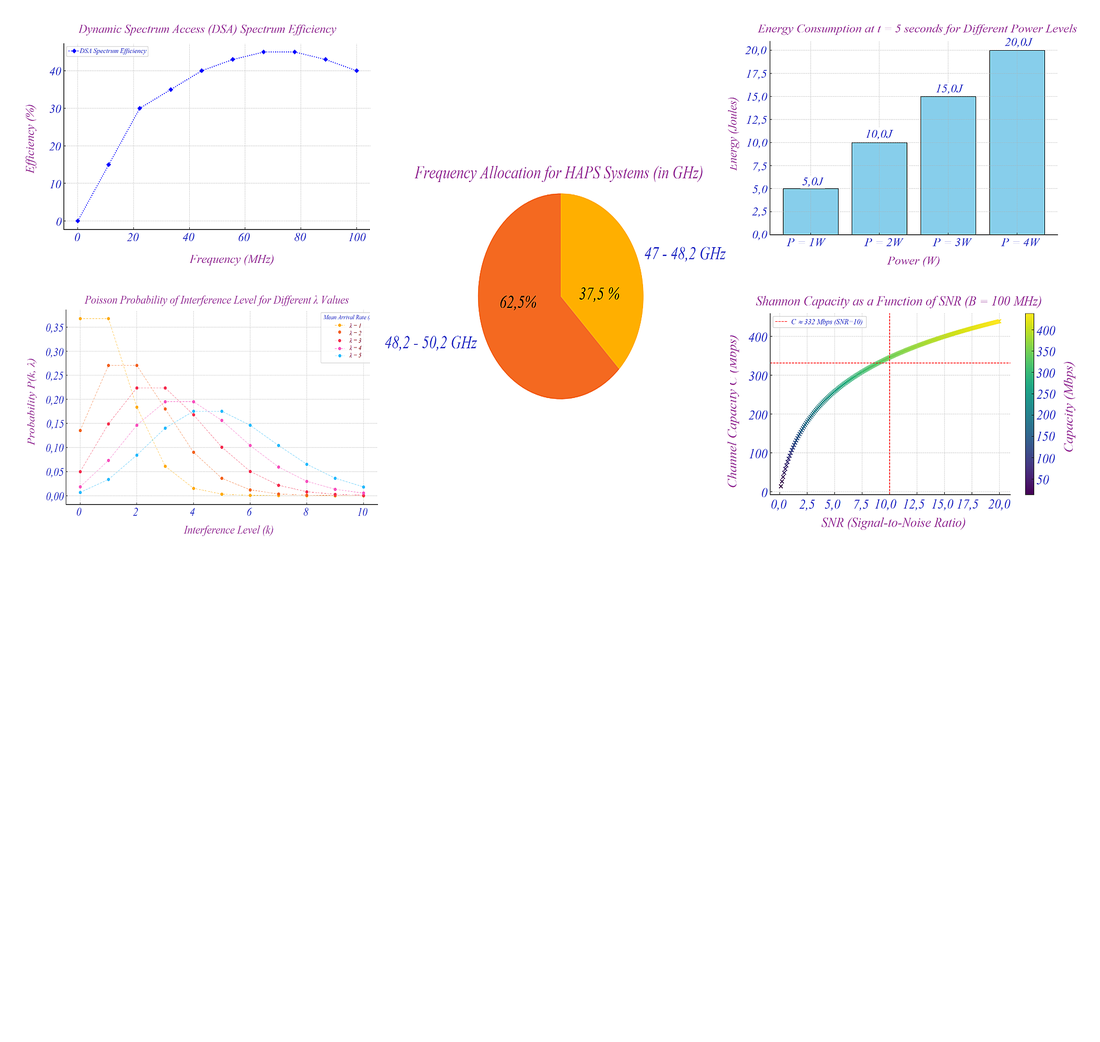
The object of the study is the methods of radio frequency resource management in stratospheric communication systems based on high altitude platform stations (HAPS). The problem addressed is the limited radio frequency spectrum, frequency overlap with fifth- and sixth-generation (5G/6G) networks, and the high probability of interference, which complicate efficient spectrum utilization and coordination. The obtained results indicate that within the frequency bands recommended by the International Telecommunication Union (ITU) — 21.4–22.0 GHz, 24.25–27.5 GHz, 47.2–47.5 GHz, and 47.9–48.2 GHz — the probability of interference reaches up to 70% in the 27.5–28.35 GHz band. By applying cognitive radio (CR) technology, interference levels decreased by 60%, and spectrum utilization efficiency increased by 35%. Dynamic spectrum access (DSA) improved spectrum efficiency by 30–45%, while spectrum sharing methods enhanced it by 40–60%. A brief explanation of the results shows that the proposed management approaches significantly increase the efficiency of radio frequency resource use and substantially reduce interference. For example, at a bandwidth of 100 MHz and a signal-to-noise ratio (SNR) of 10, the channel capacity reached approximately 332 Mbps. The distinctive features of the results lie in the comprehensive use of modern technologies that effectively address spectrum scarcity and interference issues, ensuring compatibility of HAPS with existing terrestrial and satellite communication systems. The proposed approaches are suitable for implementation in international and national spectrum coordination and licensing frameworks aimed at expanding broadband connectivity in underserved regions
References
- Mohammed, A., Mehmood, A., Pavlidou, F.-N., Mohorcic, M. (2011). The Role of High-Altitude Platforms (HAPs) in the Global Wireless Connectivity. Proceedings of the IEEE, 99 (11), 1939–1953. https://doi.org/10.1109/jproc.2011.2159690
- Karabulut Kurt, G., Khoshkholgh, M. G., Alfattani, S., Ibrahim, A., Darwish, T. S. J., Alam, M. S. et al. (2021). A Vision and Framework for the High Altitude Platform Station (HAPS) Networks of the Future. IEEE Communications Surveys & Tutorials, 23 (2), 729–779. https://doi.org/10.1109/comst.2021.3066905
- Zhou, D., Gao, S., Liu, R., Gao, F., Guizani, M. (2020). Overview of development and regulatory aspects of high altitude platform system. Intelligent and Converged Networks, 1 (1), 58–78. https://doi.org/10.23919/icn.2020.0004
- Sabibolda, A., Tsyporenko, V., Tsyporenko, V., Smailov, N., Zhunussov, K., Abdykadyrov, A. et al. (2022). Improving the accuracy and performance speed of the digital spectral-correlation method for measuring delay in radio signals and direction finding. Eastern-European Journal of Enterprise Technologies, 1 (9 (115)), 6–14. https://doi.org/10.15587/1729-4061.2022.252561
- Smailov, N., Tsyporenko, V., Sabibolda, A., Tsyporenko, V., Kabdoldina, A., Zhekambayeva, M. et al. (2023). Improving the accuracy of a digital spectral correlation-interferometric method of direction finding with analytical signal reconstruction for processing an incomplete spectrum of the signal. Eastern-European Journal of Enterprise Technologies, 5 (9 (125)), 14–25. https://doi.org/10.15587/1729-4061.2023.288397
- Wei, Z., Wang, L., Gao, Z., Wu, H., Zhang, N., Han, K., Feng, Z. (2023). Spectrum Sharing Between High Altitude Platform Network and Terrestrial Network: Modeling and Performance Analysis. IEEE Transactions on Communications, 71 (6), 3736–3751. https://doi.org/10.1109/tcomm.2023.3262305
- Arum, S. C., Grace, D., Mitchell, P. D. (2020). A review of wireless communication using high-altitude platforms for extended coverage and capacity. Computer Communications, 157, 232–256. https://doi.org/10.1016/j.comcom.2020.04.020
- Zhou, Y., Qi, F., Xie, W. (2022). Research on Spectrum Needs Prediction Method for HAPS as IMT Base Station. IEEE Access, 10, 119095–119105. https://doi.org/10.1109/access.2022.3220839
- Kement, C. E., Kara, F., Jaafar, W., Yanikomeroglu, H., Senarath, G., Đào, N. D., Zhu, P. (2023). Sustaining Dynamic Traffic in Dense Urban Areas with High Altitude Platform Stations (HAPS). IEEE Communications Magazine, 61 (7), 150–156. https://doi.org/10.1109/mcom.001.2200584
- Mershad, K., Dahrouj, H., Sarieddeen, H., Shihada, B., Al-Naffouri, T., Alouini, M.-S. (2021). Cloud-Enabled High-Altitude Platform Systems: Challenges and Opportunities. Frontiers in Communications and Networks, 2. https://doi.org/10.3389/frcmn.2021.716265
- Shamsabadi, A. A., Yadav, A., Yanikomeroglu, H. (2025). Interference Management Strategies for HAPS-Enabled vHetNets in Urban Deployments. IEEE Communications Standards Magazine, 1–1. https://doi.org/10.1109/mcomstd.2025.3569011
- Aven, T., Ylönen, M. (2016). Safety regulations: Implications of the new risk perspectives. Reliability Engineering & System Safety, 149, 164–171. https://doi.org/10.1016/j.ress.2016.01.007
- Shamsabadi, A. A., Yadav, A., Yanikomeroglu, H. (2024). Enhancing Next-Generation Urban Connectivity: Is the Integrated HAPS-Terrestrial Network a Solution? IEEE Communications Letters, 28 (5), 1112–1116. https://doi.org/10.1109/lcomm.2024.3370698
- Shibata, Y., Kanazawa, N., Konishi, M., Hoshino, K., Ohta, Y., Nagate, A. (2020). System Design of Gigabit HAPS Mobile Communications. IEEE Access, 8, 157995–158007. https://doi.org/10.1109/access.2020.3019820
- Jacob, P., Sirigina, R. P., Madhukumar, A. S., Prasad, V. A. (2016). Cognitive Radio for Aeronautical Communications: A Survey. IEEE Access, 4, 3417–3443. https://doi.org/10.1109/access.2016.2570802
- Zeng, Y., Wu, Q., Zhang, R. (2019). Accessing From the Sky: A Tutorial on UAV Communications for 5G and Beyond. Proceedings of the IEEE, 107 (12), 2327–2375. https://doi.org/10.1109/jproc.2019.2952892
- Lou, Z., Youcef Belmekki, B. E., Alouini, M.-S. (2023). HAPS in the Non-Terrestrial Network Nexus: Prospective Architectures and Performance Insights. IEEE Wireless Communications, 30 (6), 52–58. https://doi.org/10.1109/mwc.004.2300198
- Sun, S., Rappaport, T., Heath, R., Nix, A., Rangan, S. (2014). Mimo for millimeter-wave wireless communications: beamforming, spatial multiplexing, or both? IEEE Communications Magazine, 52 (12), 110–121. https://doi.org/10.1109/mcom.2014.6979962
- Yahia, O. B., Erdogan, E., Kurt, G. K., Altunbas, I., Yanikomeroglu, H. (2022). HAPS Selection for Hybrid RF/FSO Satellite Networks. IEEE Transactions on Aerospace and Electronic Systems, 58 (4), 2855–2867. https://doi.org/10.1109/taes.2022.3142116
- Gulati, K., Evans, B. L., Andrews, J. G., Tinsley, K. R. (2010). Statistics of Co-Channel Interference in a Field of Poisson and Poisson-Poisson Clustered Interferers. IEEE Transactions on Signal Processing, 58 (12), 6207–6222. https://doi.org/10.1109/tsp.2010.2072922
- Heath, R. W., Kountouris, M., Bai, T. (2013). Modeling Heterogeneous Network Interference Using Poisson Point Processes. IEEE Transactions on Signal Processing, 61 (16), 4114–4126. https://doi.org/10.1109/tsp.2013.2262679
- Slimeni, F., Chtourou, Z., Scheers, B., Nir, V. L., Attia, R. (2018). Cooperative Q-learning based channel selection for cognitive radio networks. Wireless Networks, 25 (7), 4161–4171. https://doi.org/10.1007/s11276-018-1737-9
- Khan, M. I., Reggiani, L., Alam, M. M., Le Moullec, Y., Sharma, N., Yaacoub, E., Magarini, M. (2020). Q-Learning Based Joint Energy-Spectral Efficiency Optimization in Multi-Hop Device-to-Device Communication. Sensors, 20 (22), 6692. https://doi.org/10.3390/s20226692
- Oodo, M., Miura, R., Hori, T., Morisaki, T., Kashiki, K., Suzuki, M. (2002). Sharing and Compatibility Study between Fixed Service Using High Altitude Platform Stations (HAPS) and Other Services in the 31/28 GHz Bands. Wireless Personal Communications, 23 (1), 3–14. https://doi.org/10.1023/a:1020945122344
- Testolina, P., Polese, M., Melodia, T. (2024). Sharing Spectrum and Services in the 7–24 GHz Upper Midband. IEEE Communications Magazine, 62 (8), 170–177. https://doi.org/10.1109/mcom.001.2400086
- Dodman, D., Adelekan, I., Brown, D., Leck, H., Manda, M., Mberu, B. et al. (2018). A spectrum of methods for a spectrum of risk: Generating evidence to understand and reduce urban risk in sub‐Saharan Africa. Area, 51 (3), 586–594. https://doi.org/10.1111/area.12510
- Luo, G., Yuan, Q., Li, J., Wang, S., Yang, F. (2022). Artificial Intelligence Powered Mobile Networks: From Cognition to Decision. IEEE Network, 36 (3), 136–144. https://doi.org/10.1109/mnet.013.2100087
- Polese, M., Cantos-Roman, X., Singh, A., Marcus, M. J., Maccarone, T. J., Melodia, T., Jornet, J. M. (2023). Coexistence and Spectrum Sharing Above 100 GHz. Proceedings of the IEEE, 111 (8), 928–954. https://doi.org/10.1109/jproc.2023.3286172
- Ponsignon, F., Smart, P. A., Maull, R. S. (2011). Service delivery system design: characteristics and contingencies. International Journal of Operations & Production Management, 31 (3), 324–349. https://doi.org/10.1108/01443571111111946
- Mohebbi Nia, M., Abdul Rahman, T. (2012). Spectrum Correlated Criteria and Their Impacts on High Altitude Platform Station (HAPS) and Fixed Satellite Service (FSS) Coexistence in Frequency Range 5,850–7,075 MHz. Wireless Personal Communications, 69 (1), 357–372. https://doi.org/10.1007/s11277-012-0577-7
Downloads
Published
How to Cite
Issue
Section
License
Copyright (c) 2025 Askar Abdykadyrov, Mukhit Abdullayev, Ainur Kuttybayeva, Kalmukhamed Tazhen, Nurlan Kystaubayev, Muratbek Ermekbayev, Tatyana Meshcheryakova, Altynkul Turebekova, Nurlan Sarsenbayev

This work is licensed under a Creative Commons Attribution 4.0 International License.
The consolidation and conditions for the transfer of copyright (identification of authorship) is carried out in the License Agreement. In particular, the authors reserve the right to the authorship of their manuscript and transfer the first publication of this work to the journal under the terms of the Creative Commons CC BY license. At the same time, they have the right to conclude on their own additional agreements concerning the non-exclusive distribution of the work in the form in which it was published by this journal, but provided that the link to the first publication of the article in this journal is preserved.
A license agreement is a document in which the author warrants that he/she owns all copyright for the work (manuscript, article, etc.).
The authors, signing the License Agreement with TECHNOLOGY CENTER PC, have all rights to the further use of their work, provided that they link to our edition in which the work was published.
According to the terms of the License Agreement, the Publisher TECHNOLOGY CENTER PC does not take away your copyrights and receives permission from the authors to use and dissemination of the publication through the world's scientific resources (own electronic resources, scientometric databases, repositories, libraries, etc.).
In the absence of a signed License Agreement or in the absence of this agreement of identifiers allowing to identify the identity of the author, the editors have no right to work with the manuscript.
It is important to remember that there is another type of agreement between authors and publishers – when copyright is transferred from the authors to the publisher. In this case, the authors lose ownership of their work and may not use it in any way.








