Розробка та оцінка підходів до управління радіочастотами для стратосферних систем зв'язку
DOI:
https://doi.org/10.15587/1729-4061.2025.331607Ключові слова:
стратосферний зв'язок, ВПС, спектр, перешкоди, 5G, 6G, частота, інтеграція, управління, телекомунікаціїАнотація
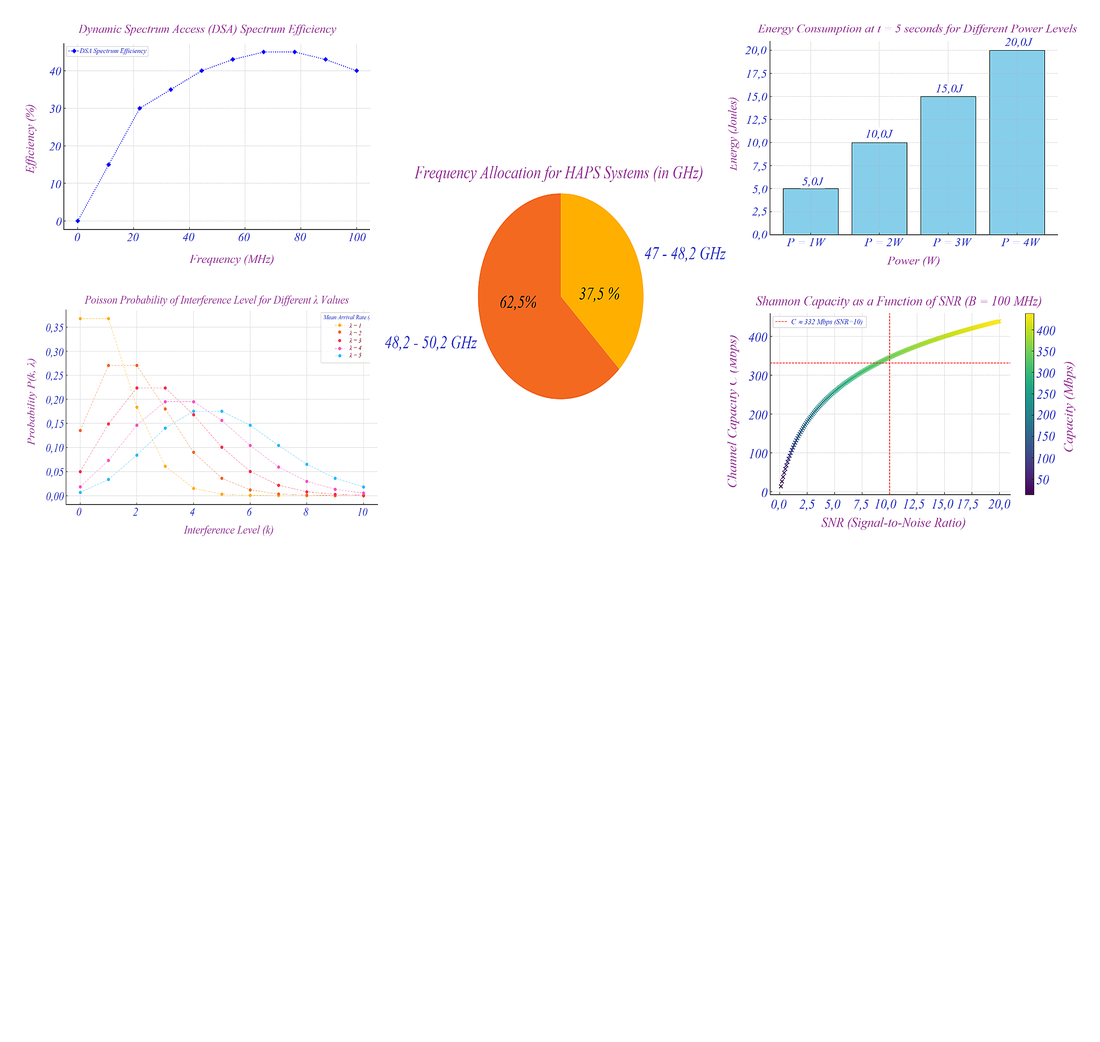
Об'єктом дослідження є методи управління радіочастотними ресурсами в стратосферних системах зв'язку на базі висотних платформних станцій (ВПС). Розглянута проблема полягає в обмеженому радіочастотному спектрі, перекритті частот з мережами п'ятого та шостого поколінь (5G/6G) та високій ймовірності перешкод, що ускладнюють ефективне використання та координацію спектру. Отримані результати свідчать про те, що в межах частотних діапазонів, рекомендованих Міжнародним союзом електрозв'язку (МСЕ) — 21,4–22,0 ГГц, 24,25–27,5 ГГц, 47,2–47,5 ГГц та 47,9–48,2 ГГц — ймовірність перешкод сягає 70% у діапазоні 27,5–28,35 ГГц. Завдяки застосуванню технології когнітивного радіо (КР) рівні перешкод знизилися на 60%, а ефективність використання спектру зросла на 35%. Динамічний доступ до спектру (ДДС) покращив ефективність використання спектру на 30–45%, тоді як методи спільного використання спектру підвищили її на 40–60%. Короткий опис результатів показує, що запропоновані підходи до управління значно підвищують ефективність використання радіочастотного ресурсу та суттєво зменшують перешкоди. Наприклад, при смузі пропускання 100 МГц та співвідношенні сигнал/шум 10 пропускна здатність каналу досягла приблизно 332 Мбіт/с. Відмінними рисами результатів є комплексне використання сучасних технологій, які ефективно вирішують проблеми дефіциту спектру та перешкод, забезпечуючи сумісність ВПС з існуючими наземними та супутниковими системами зв'язку. Запропоновані підходи придатні для впровадження в міжнародних та національних рамках координації та ліцензування спектру, спрямованих на розширення широкосмугового зв'язку в недостатньо обслуговуваних регіонах
Посилання
- Mohammed, A., Mehmood, A., Pavlidou, F.-N., Mohorcic, M. (2011). The Role of High-Altitude Platforms (HAPs) in the Global Wireless Connectivity. Proceedings of the IEEE, 99 (11), 1939–1953. https://doi.org/10.1109/jproc.2011.2159690
- Karabulut Kurt, G., Khoshkholgh, M. G., Alfattani, S., Ibrahim, A., Darwish, T. S. J., Alam, M. S. et al. (2021). A Vision and Framework for the High Altitude Platform Station (HAPS) Networks of the Future. IEEE Communications Surveys & Tutorials, 23 (2), 729–779. https://doi.org/10.1109/comst.2021.3066905
- Zhou, D., Gao, S., Liu, R., Gao, F., Guizani, M. (2020). Overview of development and regulatory aspects of high altitude platform system. Intelligent and Converged Networks, 1 (1), 58–78. https://doi.org/10.23919/icn.2020.0004
- Sabibolda, A., Tsyporenko, V., Tsyporenko, V., Smailov, N., Zhunussov, K., Abdykadyrov, A. et al. (2022). Improving the accuracy and performance speed of the digital spectral-correlation method for measuring delay in radio signals and direction finding. Eastern-European Journal of Enterprise Technologies, 1 (9 (115)), 6–14. https://doi.org/10.15587/1729-4061.2022.252561
- Smailov, N., Tsyporenko, V., Sabibolda, A., Tsyporenko, V., Kabdoldina, A., Zhekambayeva, M. et al. (2023). Improving the accuracy of a digital spectral correlation-interferometric method of direction finding with analytical signal reconstruction for processing an incomplete spectrum of the signal. Eastern-European Journal of Enterprise Technologies, 5 (9 (125)), 14–25. https://doi.org/10.15587/1729-4061.2023.288397
- Wei, Z., Wang, L., Gao, Z., Wu, H., Zhang, N., Han, K., Feng, Z. (2023). Spectrum Sharing Between High Altitude Platform Network and Terrestrial Network: Modeling and Performance Analysis. IEEE Transactions on Communications, 71 (6), 3736–3751. https://doi.org/10.1109/tcomm.2023.3262305
- Arum, S. C., Grace, D., Mitchell, P. D. (2020). A review of wireless communication using high-altitude platforms for extended coverage and capacity. Computer Communications, 157, 232–256. https://doi.org/10.1016/j.comcom.2020.04.020
- Zhou, Y., Qi, F., Xie, W. (2022). Research on Spectrum Needs Prediction Method for HAPS as IMT Base Station. IEEE Access, 10, 119095–119105. https://doi.org/10.1109/access.2022.3220839
- Kement, C. E., Kara, F., Jaafar, W., Yanikomeroglu, H., Senarath, G., Đào, N. D., Zhu, P. (2023). Sustaining Dynamic Traffic in Dense Urban Areas with High Altitude Platform Stations (HAPS). IEEE Communications Magazine, 61 (7), 150–156. https://doi.org/10.1109/mcom.001.2200584
- Mershad, K., Dahrouj, H., Sarieddeen, H., Shihada, B., Al-Naffouri, T., Alouini, M.-S. (2021). Cloud-Enabled High-Altitude Platform Systems: Challenges and Opportunities. Frontiers in Communications and Networks, 2. https://doi.org/10.3389/frcmn.2021.716265
- Shamsabadi, A. A., Yadav, A., Yanikomeroglu, H. (2025). Interference Management Strategies for HAPS-Enabled vHetNets in Urban Deployments. IEEE Communications Standards Magazine, 1–1. https://doi.org/10.1109/mcomstd.2025.3569011
- Aven, T., Ylönen, M. (2016). Safety regulations: Implications of the new risk perspectives. Reliability Engineering & System Safety, 149, 164–171. https://doi.org/10.1016/j.ress.2016.01.007
- Shamsabadi, A. A., Yadav, A., Yanikomeroglu, H. (2024). Enhancing Next-Generation Urban Connectivity: Is the Integrated HAPS-Terrestrial Network a Solution? IEEE Communications Letters, 28 (5), 1112–1116. https://doi.org/10.1109/lcomm.2024.3370698
- Shibata, Y., Kanazawa, N., Konishi, M., Hoshino, K., Ohta, Y., Nagate, A. (2020). System Design of Gigabit HAPS Mobile Communications. IEEE Access, 8, 157995–158007. https://doi.org/10.1109/access.2020.3019820
- Jacob, P., Sirigina, R. P., Madhukumar, A. S., Prasad, V. A. (2016). Cognitive Radio for Aeronautical Communications: A Survey. IEEE Access, 4, 3417–3443. https://doi.org/10.1109/access.2016.2570802
- Zeng, Y., Wu, Q., Zhang, R. (2019). Accessing From the Sky: A Tutorial on UAV Communications for 5G and Beyond. Proceedings of the IEEE, 107 (12), 2327–2375. https://doi.org/10.1109/jproc.2019.2952892
- Lou, Z., Youcef Belmekki, B. E., Alouini, M.-S. (2023). HAPS in the Non-Terrestrial Network Nexus: Prospective Architectures and Performance Insights. IEEE Wireless Communications, 30 (6), 52–58. https://doi.org/10.1109/mwc.004.2300198
- Sun, S., Rappaport, T., Heath, R., Nix, A., Rangan, S. (2014). Mimo for millimeter-wave wireless communications: beamforming, spatial multiplexing, or both? IEEE Communications Magazine, 52 (12), 110–121. https://doi.org/10.1109/mcom.2014.6979962
- Yahia, O. B., Erdogan, E., Kurt, G. K., Altunbas, I., Yanikomeroglu, H. (2022). HAPS Selection for Hybrid RF/FSO Satellite Networks. IEEE Transactions on Aerospace and Electronic Systems, 58 (4), 2855–2867. https://doi.org/10.1109/taes.2022.3142116
- Gulati, K., Evans, B. L., Andrews, J. G., Tinsley, K. R. (2010). Statistics of Co-Channel Interference in a Field of Poisson and Poisson-Poisson Clustered Interferers. IEEE Transactions on Signal Processing, 58 (12), 6207–6222. https://doi.org/10.1109/tsp.2010.2072922
- Heath, R. W., Kountouris, M., Bai, T. (2013). Modeling Heterogeneous Network Interference Using Poisson Point Processes. IEEE Transactions on Signal Processing, 61 (16), 4114–4126. https://doi.org/10.1109/tsp.2013.2262679
- Slimeni, F., Chtourou, Z., Scheers, B., Nir, V. L., Attia, R. (2018). Cooperative Q-learning based channel selection for cognitive radio networks. Wireless Networks, 25 (7), 4161–4171. https://doi.org/10.1007/s11276-018-1737-9
- Khan, M. I., Reggiani, L., Alam, M. M., Le Moullec, Y., Sharma, N., Yaacoub, E., Magarini, M. (2020). Q-Learning Based Joint Energy-Spectral Efficiency Optimization in Multi-Hop Device-to-Device Communication. Sensors, 20 (22), 6692. https://doi.org/10.3390/s20226692
- Oodo, M., Miura, R., Hori, T., Morisaki, T., Kashiki, K., Suzuki, M. (2002). Sharing and Compatibility Study between Fixed Service Using High Altitude Platform Stations (HAPS) and Other Services in the 31/28 GHz Bands. Wireless Personal Communications, 23 (1), 3–14. https://doi.org/10.1023/a:1020945122344
- Testolina, P., Polese, M., Melodia, T. (2024). Sharing Spectrum and Services in the 7–24 GHz Upper Midband. IEEE Communications Magazine, 62 (8), 170–177. https://doi.org/10.1109/mcom.001.2400086
- Dodman, D., Adelekan, I., Brown, D., Leck, H., Manda, M., Mberu, B. et al. (2018). A spectrum of methods for a spectrum of risk: Generating evidence to understand and reduce urban risk in sub‐Saharan Africa. Area, 51 (3), 586–594. https://doi.org/10.1111/area.12510
- Luo, G., Yuan, Q., Li, J., Wang, S., Yang, F. (2022). Artificial Intelligence Powered Mobile Networks: From Cognition to Decision. IEEE Network, 36 (3), 136–144. https://doi.org/10.1109/mnet.013.2100087
- Polese, M., Cantos-Roman, X., Singh, A., Marcus, M. J., Maccarone, T. J., Melodia, T., Jornet, J. M. (2023). Coexistence and Spectrum Sharing Above 100 GHz. Proceedings of the IEEE, 111 (8), 928–954. https://doi.org/10.1109/jproc.2023.3286172
- Ponsignon, F., Smart, P. A., Maull, R. S. (2011). Service delivery system design: characteristics and contingencies. International Journal of Operations & Production Management, 31 (3), 324–349. https://doi.org/10.1108/01443571111111946
- Mohebbi Nia, M., Abdul Rahman, T. (2012). Spectrum Correlated Criteria and Their Impacts on High Altitude Platform Station (HAPS) and Fixed Satellite Service (FSS) Coexistence in Frequency Range 5,850–7,075 MHz. Wireless Personal Communications, 69 (1), 357–372. https://doi.org/10.1007/s11277-012-0577-7
##submission.downloads##
Опубліковано
Як цитувати
Номер
Розділ
Ліцензія
Авторське право (c) 2025 Askar Abdykadyrov, Mukhit Abdullayev, Ainur Kuttybayeva, Kalmukhamed Tazhen, Nurlan Kystaubayev, Muratbek Ermekbayev, Tatyana Meshcheryakova, Altynkul Turebekova, Nurlan Sarsenbayev

Ця робота ліцензується відповідно до Creative Commons Attribution 4.0 International License.
Закріплення та умови передачі авторських прав (ідентифікація авторства) здійснюється у Ліцензійному договорі. Зокрема, автори залишають за собою право на авторство свого рукопису та передають журналу право першої публікації цієї роботи на умовах ліцензії Creative Commons CC BY. При цьому вони мають право укладати самостійно додаткові угоди, що стосуються неексклюзивного поширення роботи у тому вигляді, в якому вона була опублікована цим журналом, але за умови збереження посилання на першу публікацію статті в цьому журналі.
Ліцензійний договір – це документ, в якому автор гарантує, що володіє усіма авторськими правами на твір (рукопис, статтю, тощо).
Автори, підписуючи Ліцензійний договір з ПП «ТЕХНОЛОГІЧНИЙ ЦЕНТР», мають усі права на подальше використання свого твору за умови посилання на наше видання, в якому твір опублікований. Відповідно до умов Ліцензійного договору, Видавець ПП «ТЕХНОЛОГІЧНИЙ ЦЕНТР» не забирає ваші авторські права та отримує від авторів дозвіл на використання та розповсюдження публікації через світові наукові ресурси (власні електронні ресурси, наукометричні бази даних, репозитарії, бібліотеки тощо).
За відсутності підписаного Ліцензійного договору або за відсутністю вказаних в цьому договорі ідентифікаторів, що дають змогу ідентифікувати особу автора, редакція не має права працювати з рукописом.
Важливо пам’ятати, що існує і інший тип угоди між авторами та видавцями – коли авторські права передаються від авторів до видавця. В такому разі автори втрачають права власності на свій твір та не можуть його використовувати в будь-який спосіб.