Multi-criteria optimization of digital marketing for enterprises in the agro-industrial complex based on NSGA-III algorithm and machine learning
DOI:
https://doi.org/10.15587/1729-4061.2025.332468Keywords:
hybrid method, digital marketing, multi-criteria optimization, NSGA-III algorithm, cluster analysisAbstract
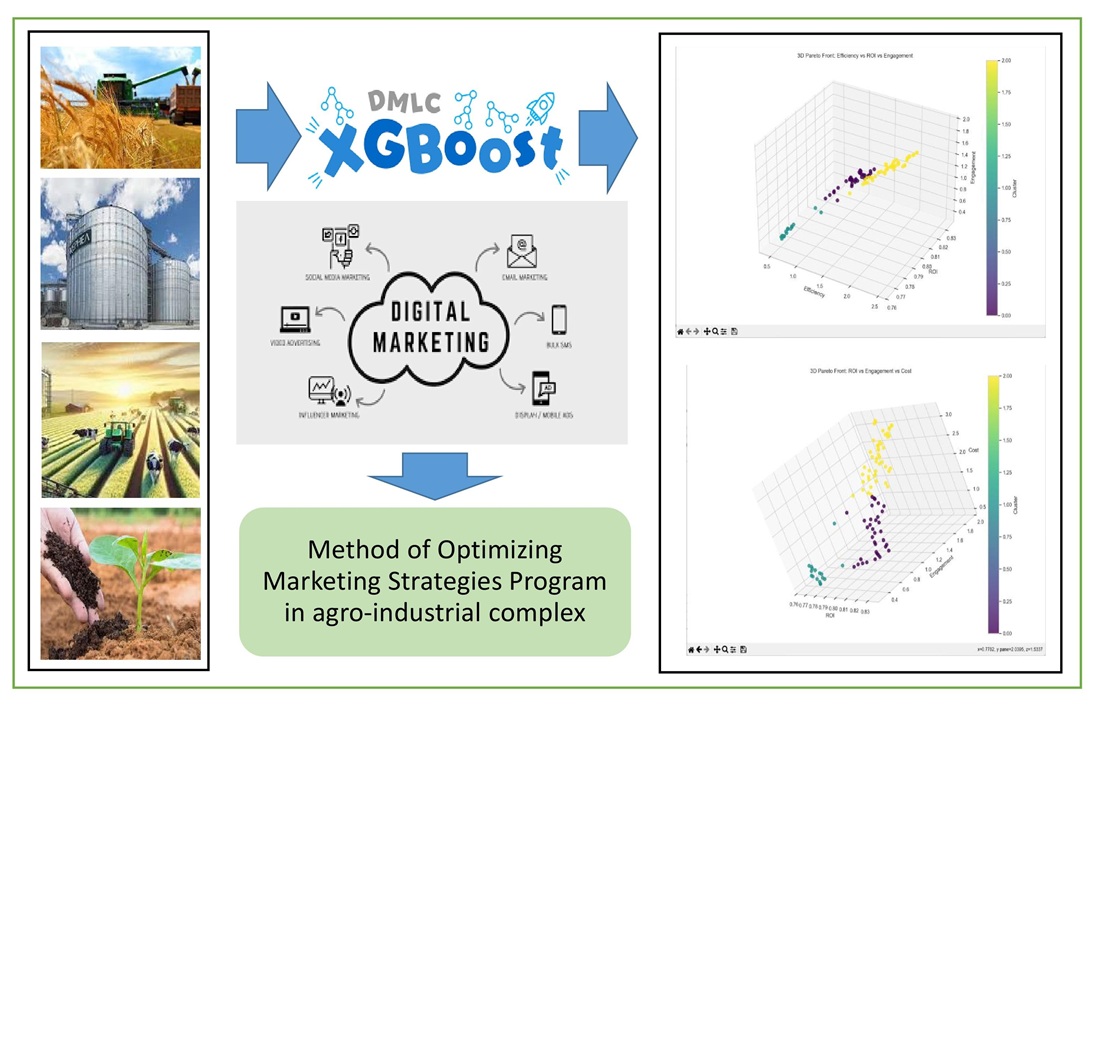
The object of this study is the process of optimizing digital marketing for agro-industrial enterprises under conditions of multi-criteria and uncertainty. A formal statement of the problem of optimizing marketing strategies for agricultural production has been given by using the genetic algorithm NSGA-III. A hybrid method was devised to solve the task of multi-criteria optimization of marketing strategies for agro-industrial enterprises. The method is based on the NSGA-III algorithm in combination with the XGBoost software library and adapted to industry constraints for marketing strategies in the agricultural markets of Ukraine and Kazakhstan Republic. This allows for the generation and interpretation of Pareto-optimal strategies taking into account such criteria as efficiency, coverage, return on investment (ROI), costs, and engagement.
A cluster analysis of solutions has been performed; three characteristic scenarios were identified – balanced, cautious, and aggressive. Empirical validation by regression analysis demonstrated the high accuracy of the model, as well as its ability to extrapolate new solutions. In particular, the mean square error on the test sample was 0.0316 with the achieved coefficient of determination of 0.9041. The results confirm the effectiveness of the devised method to support decision-making under conditions of multi-criteria and limited resources.
The proposed method was used as the basis for the development of software implemented in practice at enterprises of the agro-industrial complex. However, the scope of method application also includes the activities by other business entities that devise marketing strategies to achieve the efficiency of their activities
References
- Juswadi, J., Sumarna, P., Mulyati, N. S. (2020). Digital Marketing Strategy of Indonesian Agricultural Products. Proceedings of the International Conference on Agriculture, Social Sciences, Education, Technology and Health (ICASSETH 2019). https://doi.org/10.2991/assehr.k.200402.024
- Valenzuela-Hurtado, Y., Meneses-Claudio, B., Carmen-Choquehuanca, E. (2023). Elements of digital marketing and the positioning of the company INNOVA BIOTECH AGRO SAC. Salud, Ciencia y Tecnología - Serie de Conferencias, 2, 373. https://doi.org/10.56294/sctconf2023373
- Jadhav, G. G., Gaikwad, S. V., Bapat, D. (2023). A systematic literature review: digital marketing and its impact on SMEs. Journal of Indian Business Research, 15 (1), 76–91. https://doi.org/10.1108/jibr-05-2022-0129
- Saura, J. R., Ribeiro-Soriano, D., Palacios-Marqués, D. (2021). Setting B2B digital marketing in artificial intelligence-based CRMs: A review and directions for future research. Industrial Marketing Management, 98, 161–178. https://doi.org/10.1016/j.indmarman.2021.08.006
- Lima, G. C., Figueiredo, F. L., Barbieri, A. E., Seki, J. (2020). Agro 4.0: Enabling agriculture digital transformation through IoT. REVISTA CIÊNCIA AGRONÔMICA, 51 (5). https://doi.org/10.5935/1806-6690.20200100
- Martins, F. S., Fornari Junior, J. C. F., Mazieri, M. R., Gaspar, M. A. (2023). A fuzzy AHP analysis of potential criteria for initiatives in digital transformation for agribusiness. Revista de Administração Mackenzie,, 24 (1). Available at: https://www.scielo.br/j/ram/a/f4gBJmGJBDgC4HBDZQbHkKR/?format=pdf&lang=en
- Kanellos, N., Karountzos, P., Giannakopoulos, N. T., Terzi, M. C., Sakas, D. P. (2024). Digital Marketing Strategies and Profitability in the Agri-Food Industry: Resource Efficiency and Value Chains. Sustainability, 16 (14), 5889. https://doi.org/10.3390/su16145889
- Ravi, S., Rajasekaran, S. R. C. (2023). A Perspective of Digital Marketing in Rural Areas: a Literature Review. International Journal of Professional Business Review, 8 (4), e01388. https://doi.org/10.26668/businessreview/2023.v8i4.1388
- Dang, Y., Ma, H., Wang, J., Zhou, Z., Xu, Z. (2022). An Improved Multi-Objective Optimization Decision Method Using NSGA-III for a Bivariate Precision Fertilizer Applicator. Agriculture, 12 (9), 1492. https://doi.org/10.3390/agriculture12091492
- Chen, H. (2023). Enterprise marketing strategy using big data mining technology combined with XGBoost model in the new economic era. PLOS ONE, 18 (6), e0285506. https://doi.org/10.1371/journal.pone.0285506
- Chen, Z., Wang, Y., Zou, X., Wang, H. (2024). A Multi-Objective Optimization Model for Agricultural Crop Planting Strategies Using Enhanced Genetic Algorithms and Big Data Analysis. Transactions on Environment, Energy and Earth Sciences, 4, 142–152. https://doi.org/10.62051/52ckrn48
- Perera, A. T. D., Attalage, R. A., Perera, K. K. C. K., Dassanayake, V. P. C. (2013). A hybrid tool to combine multi-objective optimization and multi-criterion decision making in designing standalone hybrid energy systems. Applied Energy, 107, 412–425. https://doi.org/10.1016/j.apenergy.2013.02.049
- Yazdani, H., Baneshi, M., Yaghoubi, M. (2023). Techno-economic and environmental design of hybrid energy systems using multi-objective optimization and multi-criteria decision making methods. Energy Conversion and Management, 282, 116873. https://doi.org/10.1016/j.enconman.2023.116873
- Elkadeem, M. R., Younes, A., Sharshir, S. W., Campana, P. E., Wang, S. (2021). Sustainable siting and design optimization of hybrid renewable energy system: A geospatial multi-criteria analysis. Applied Energy, 295, 117071. https://doi.org/10.1016/j.apenergy.2021.117071
- Mazzeo, D., Baglivo, C., Matera, N., Congedo, P. M., Oliveti, G. (2020). A novel energy-economic-environmental multi-criteria decision-making in the optimization of a hybrid renewable system. Sustainable Cities and Society, 52, 101780. https://doi.org/10.1016/j.scs.2019.101780
- Ishibuchi, H., Imada, R., Setoguchi, Y., Nojima, Y. (2016). Performance comparison of NSGA-II and NSGA-III on various many-objective test problems. 2016 IEEE Congress on Evolutionary Computation (CEC). https://doi.org/10.1109/cec.2016.7744174
- Vesikar, Y., Deb, K., Blank, J. (2018). Reference Point Based NSGA-III for Preferred Solutions. 2018 IEEE Symposium Series on Computational Intelligence (SSCI). https://doi.org/10.1109/ssci.2018.8628819
- Mosa, M. A. (2025). Optimizing text classification accuracy: a hybrid strategy incorporating enhanced NSGA-II and XGBoost techniques for feature selection. Progress in Artificial Intelligence, 14 (2), 275–299. https://doi.org/10.1007/s13748-025-00365-0
- Behera, A. P., Dhawan, A., Rathinakumar, V., Bharadwaj, M., Rajput, J. S., Sethi, K. C. (2024). Optimizing time, cost, environmental impact, and client satisfaction in sustainable construction projects using LHS-NSGA-III: a multi-objective approach. Asian Journal of Civil Engineering, 26 (2), 761–776. https://doi.org/10.1007/s42107-024-01221-7
Downloads
Published
How to Cite
Issue
Section
License
Copyright (c) 2025 Olena Kryvoruchko, Zhansaya Abildaeva, Valeriia Lakhno, Mykola Tsiutsiura, Svitlana Tsiutsiura, Anna Kharchenko, Mykola Kolbasin

This work is licensed under a Creative Commons Attribution 4.0 International License.
The consolidation and conditions for the transfer of copyright (identification of authorship) is carried out in the License Agreement. In particular, the authors reserve the right to the authorship of their manuscript and transfer the first publication of this work to the journal under the terms of the Creative Commons CC BY license. At the same time, they have the right to conclude on their own additional agreements concerning the non-exclusive distribution of the work in the form in which it was published by this journal, but provided that the link to the first publication of the article in this journal is preserved.
A license agreement is a document in which the author warrants that he/she owns all copyright for the work (manuscript, article, etc.).
The authors, signing the License Agreement with TECHNOLOGY CENTER PC, have all rights to the further use of their work, provided that they link to our edition in which the work was published.
According to the terms of the License Agreement, the Publisher TECHNOLOGY CENTER PC does not take away your copyrights and receives permission from the authors to use and dissemination of the publication through the world's scientific resources (own electronic resources, scientometric databases, repositories, libraries, etc.).
In the absence of a signed License Agreement or in the absence of this agreement of identifiers allowing to identify the identity of the author, the editors have no right to work with the manuscript.
It is important to remember that there is another type of agreement between authors and publishers – when copyright is transferred from the authors to the publisher. In this case, the authors lose ownership of their work and may not use it in any way.








