Devising an approach to conducting full-scale experiments in physics that provides for the improved efficiency when measuring physical quantities
DOI:
https://doi.org/10.15587/1729-4061.2025.333084Keywords:
video processing, laboratory setups, YOLOv8n, Hough method, computer vision, online learningAbstract
The object of this study is a procedure for measuring physical quantities under laboratory conditions at educational institutions. The issue related to this case is the lack of any comprehensive method and technical solution suitable for the experimental study of physics in both offline and online learning formats. To solve this problem, an approach has been proposed, based on computer vision technology and training special neural models to recognize objects in video frames that perform mechanical movement.
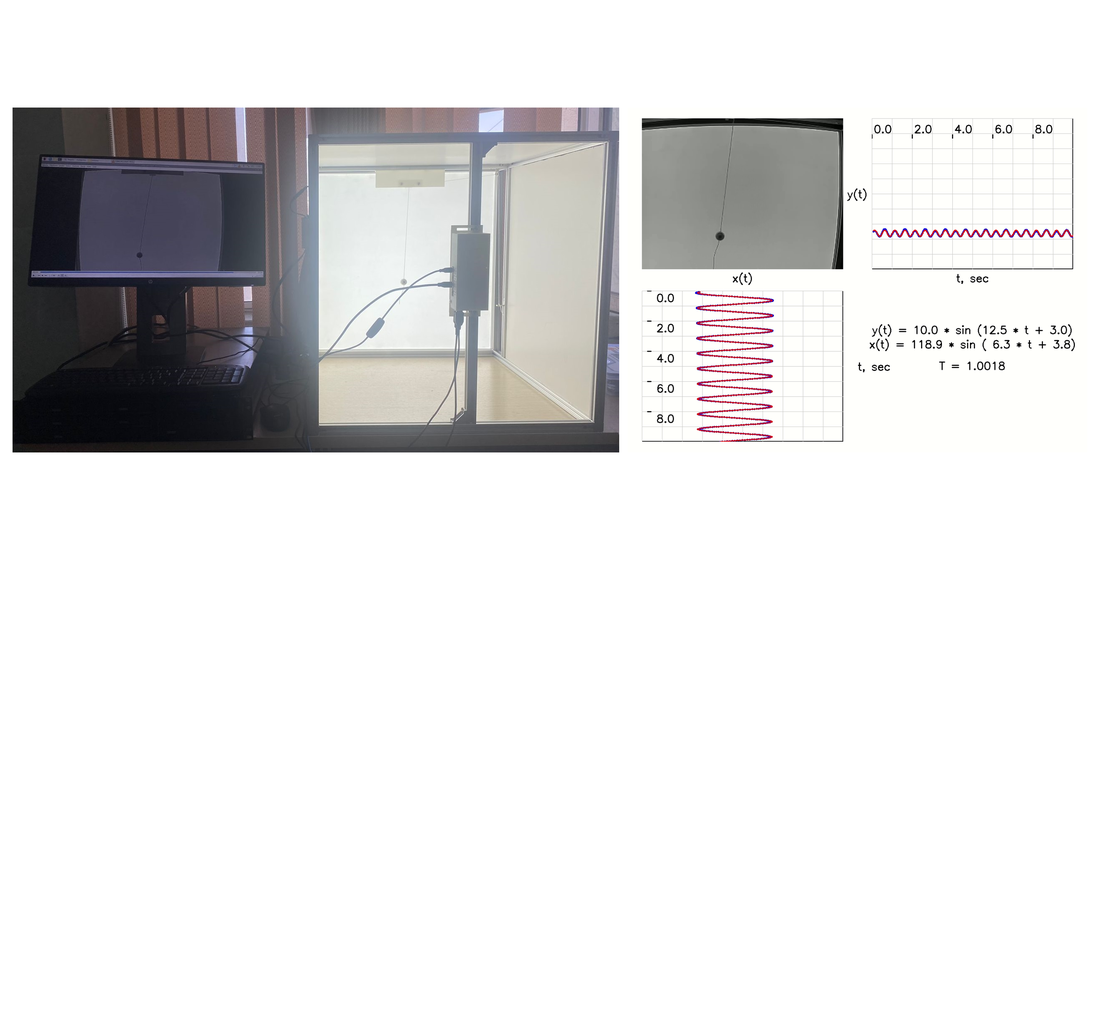
The idea of the proposed approach is based on the hypothesis that by measuring the position of an object in video frames with sufficient accuracy, it is possible to determine the functional type of the law of its motion. Further, knowing the function of the law of motion, it is possible to calculate any physical quantities describing the process under consideration. The idea is implemented in the form of a technical solution, which is a set of prototypes of automated laboratory devices.
The choice of the method for determining the law of motion was carried out using the analysis of the recognition error, measurement error, speed and resistance to external conditions of the Hough algorithmic method and the YOLOv8n neural network model. It is shown that the neural network method YOLOv8n has very high accuracy but low performance. The Hough method shows high performance but lower accuracy and resistance to external conditions. It was found that the accuracy of the YOLOv8n method is 4 times higher, but the execution speed is 10 times lower than that of the Hough method. However, in the case of artificial lighting and fixing the distance from the camera to objects, the Hough method provides 99.9% accuracy in recognizing an object in video frames.
The obtained prototypes of devices can be used for further research to determine their impact on the quality of physics education
References
- Illeperuma, G. D., Sonnadara, D. U. J. (2017). Computer vision based object tracking as a teaching aid for high school physics experiments. 2017 4th International Conference on Electrical Engineering, Computer Science and Informatics (EECSI), 1–6. https://doi.org/10.1109/eecsi.2017.8239112
- Singh, L., Gupta, A., Nigam, A. (2022). Vibration analysis of simple pendulum using computer vision method. Journal of Mechanics and Design, 06 (1), 11–18.
- Guedri, B., Guedri, N., Gharbi, R. (2023). A New Approach for Real-Time Camera-Object Distance Measurement Through Computer Vision. 2023 IEEE Third International Conference on Signal, Control and Communication (SCC), 1–5. https://doi.org/10.1109/scc59637.2023.10527537
- Pattanashetty, K. C., Kumar, R., Pandian, S. R. (2016). Web-based physics experiments in dynamics using image processing. 2016 IEEE 1st International Conference on Power Electronics, Intelligent Control and Energy Systems (ICPEICES), 1–5. https://doi.org/10.1109/icpeices.2016.7853575
- Nakagawa, G., Fujii, K. (2017). A Learning Material for Physics Experiment with High-Accuracy Using Computer Vision Technique. 2017 5th Intl Conf on Applied Computing and Information Technology/4th Intl Conf on Computational Science/Intelligence and Applied Informatics/2nd Intl Conf on Big Data, Cloud Computing, Data Science (ACIT-CSII-BCD), 86–89. https://doi.org/10.1109/acit-csii-bcd.2017.71
- Martín-Ramos, P., Gomes, M. S. M. N. F., Silva, M. R. (2018). Newton’s cradle. Proceedings of the Sixth International Conference on Technological Ecosystems for Enhancing Multiculturality, 71–77. https://doi.org/10.1145/3284179.3284195
- Bogdan, G., Ovidiu, T., Cristina, M., Ștefan, A. (2024). Digital electricity experiments with Raspberry Pi. Romanian Reports in Physics, 76 (4), 905–905. https://doi.org/10.59277/romrepphys.2024.76.905
- Çoban, A., Akat, E., Erdoğan, A. C. (2022). Two different experiments with the rope-attached sphere by using Arduino. Physics Education, 58 (1), 015022. https://doi.org/10.1088/1361-6552/aca19d
- Bach, R. A., Trantham, K. W. (2007). Automated two-dimensional position measurements with computer vision. American Journal of Physics, 75 (1), 48–52. https://doi.org/10.1119/1.2348892
- Khatri, P., Chhatre, U., Kadge, S. (2021). Visual Vibration Analysis of Vibrating Object at Low Frequency. 2021 6th International Conference for Convergence in Technology (I2CT), 1–5. https://doi.org/10.1109/i2ct51068.2021.9418210
- Cheng, L., Niu, W.-C., Zhao, X.-G., Xu, C.-L., Hou, Z.-Y. (2021). Design and implementation of college physics teaching platform based on virtual experiment scene. International Journal of Electrical Engineering & Education, 62 (1), 73–86. https://doi.org/10.1177/0020720920984688
- Hough Line Transform. Available at: https://docs.opencv.org/4.x/d6/d10/tutorial_py_houghlines.html
- Python Usage. Available at: https://docs.ultralytics.com/usage/python/
Downloads
Published
How to Cite
Issue
Section
License
Copyright (c) 2025 Bekbolat Medetov, Ainur Zhetpisbayeva, Tansaule Serikov, Botagoz Khamzina, Ainur Akhmediyarova, Asset Yskak, Dauren Zhexebay, Nurtay Albanbay

This work is licensed under a Creative Commons Attribution 4.0 International License.
The consolidation and conditions for the transfer of copyright (identification of authorship) is carried out in the License Agreement. In particular, the authors reserve the right to the authorship of their manuscript and transfer the first publication of this work to the journal under the terms of the Creative Commons CC BY license. At the same time, they have the right to conclude on their own additional agreements concerning the non-exclusive distribution of the work in the form in which it was published by this journal, but provided that the link to the first publication of the article in this journal is preserved.
A license agreement is a document in which the author warrants that he/she owns all copyright for the work (manuscript, article, etc.).
The authors, signing the License Agreement with TECHNOLOGY CENTER PC, have all rights to the further use of their work, provided that they link to our edition in which the work was published.
According to the terms of the License Agreement, the Publisher TECHNOLOGY CENTER PC does not take away your copyrights and receives permission from the authors to use and dissemination of the publication through the world's scientific resources (own electronic resources, scientometric databases, repositories, libraries, etc.).
In the absence of a signed License Agreement or in the absence of this agreement of identifiers allowing to identify the identity of the author, the editors have no right to work with the manuscript.
It is important to remember that there is another type of agreement between authors and publishers – when copyright is transferred from the authors to the publisher. In this case, the authors lose ownership of their work and may not use it in any way.