Identifying the role of aggressive low carbon innovation on a firm’s environmental, social, and governance performance
DOI:
https://doi.org/10.15587/1729-4061.2025.335639Keywords:
aggressive low carbon innovation, firm’s ESG performance, green market orientation, management commitmentAbstract
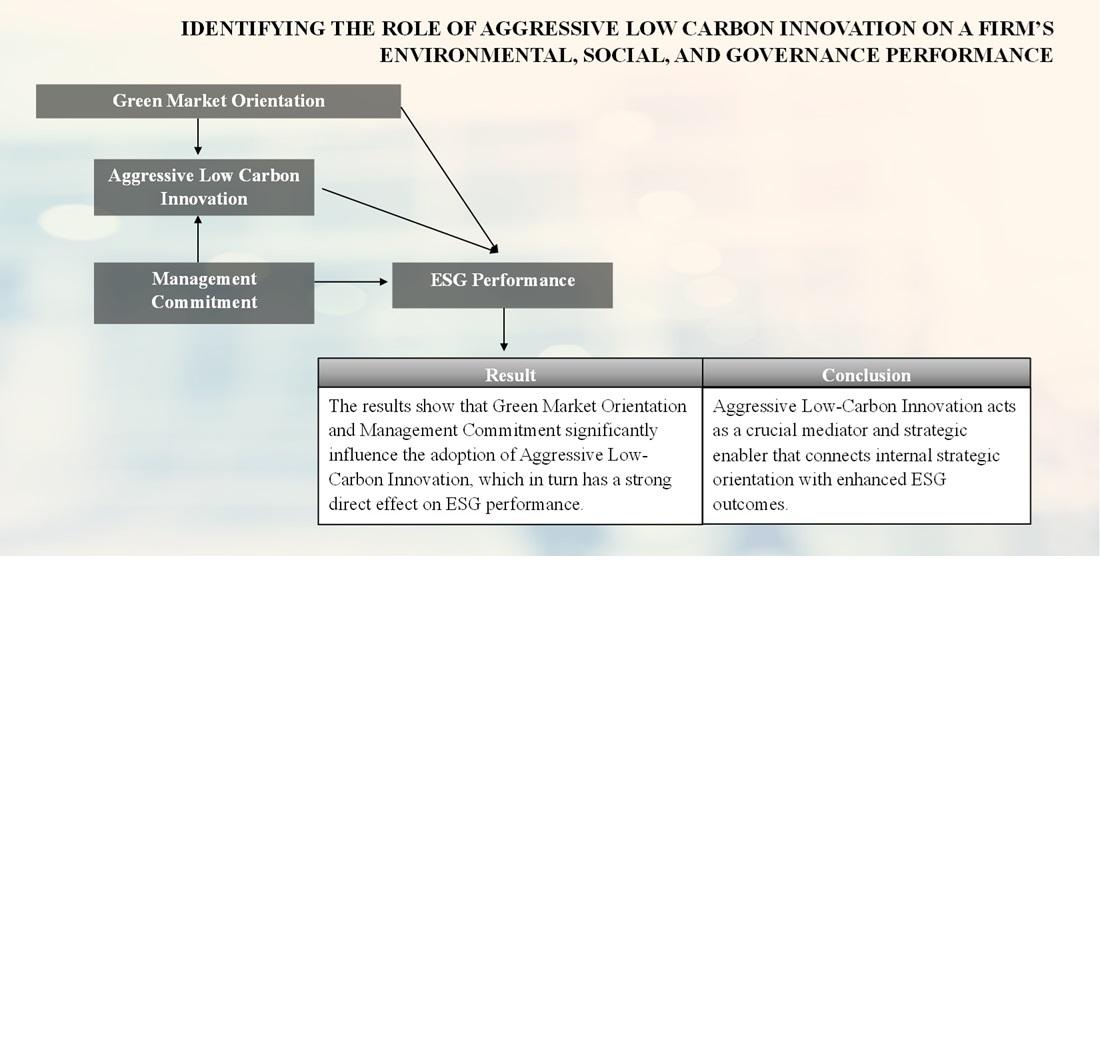
The object of this study is the ESG performance in emerging market energy companies. The problem to be solved is the identifying how internal strategic orientations translate into measurable sustainability outcomes. Despite the theoretical acknowledgment of GMO and MC as sustainability enablers, empirical evidence on their pathways to ESG outcomes remains limited.
The study examines the role of Aggressive Low Carbon Innovation (ALCI) as a mechanism through which GMO and MC exert their influence on ESG performance.
The findings indicate that MC has a significant indirect effect on ESG performance through ALCI (β = 0.312, p < 0.01), while its direct effect is not statistically significant (β = 0.127, p > 0.05). GMO shows a strong positive effect on ALCI (β = 0.488, p < 0.001), but its direct influence on ESG performance is also insignificant (β = 0.089, p > 0.05). In contrast, ALCI demonstrates a strong direct impact on ESG performance (β = 0.446, p < 0.001), confirming its role as a pivotal mediator.
These results suggest that the implementation of ALCI serves as a necessary bridge between strategic orientation and sustainability outcomes. The effectiveness of ALCI in improving ESG performance can be explained by its capacity to integrate environmental innovations into business operations aggressively, thereby enhancing compliance, reputation, and stakeholder trust. The findings are most applicable under conditions where organizational leadership is committed, market orientation supports sustainable value, and regulatory environments encourage innovation. This research provides actionable insights for firms seeking to enhance ESG outcomes through internal capability building and strategic innovation pathways
References
- Yenita, Widodo, L. (2023). Environmental, social and governance (ESG) strategy implementation plan during the Covid-19 pandemic at retail company “X” in Jakarta. AIP Conference Proceedings, 2485 (1), 080025. https://doi.org/10.1063/5.0105059
- Mila, G., Primasari, B., Aziz, R. (2021). Application of Life Cycle Assessment (LCA) On Green Tea Product (Case Study in the X Company). IOP Conference Series: Materials Science and Engineering, 1041 (1), 012025. https://doi.org/10.1088/1757-899x/1041/1/012025
- Yusmar, Q. C. M. M., Sumirat, E., Sudrajad, O. Y. (2023). Company Fair Valuation Considering Esg Factor (Case Study: Pt Pertamina Geothermal Energy, Tbk). European Journal of Business and Management Research, 8 (5), 95–101. https://doi.org/10.24018/ejbmr.2023.8.5.2086
- Wang, C. H. (2020). An environmental perspective extends market orientation: Green innovation sustainability. Business Strategy and the Environment, 29 (8), 3123–3134. https://doi.org/10.1002/bse.2561
- Sharma, P., Singh, S. P., Iqbal, H. M. N., Parra-Saldivar, R., Varjani, S., Tong, Y. W. (2022). Genetic modifications associated with sustainability aspects for sustainable developments. Bioengineered, 13 (4), 9509–9521. https://doi.org/10.1080/21655979.2022.2061146
- Niu, S., Park, B. I., Jung, J. S. (2022). The Effects of Digital Leadership and ESG Management on Organizational Innovation and Sustainability. Sustainability, 14 (23), 15639. https://doi.org/10.3390/su142315639
- Andreassen, Å., Brandtzæg, P., Aasmo Finne, M., Lorentz Holck, A., Jevnaker, A.-M., Junttila, O. et al. (2020). Final Health and Environmental Risk Assessment of Genetically Modified Maize 59122. European Journal of Nutrition & Food Safety, 242–245. https://doi.org/10.9734/ejnfs/2019/v11i430169
- Andreassen, Å., Brandtzæg, P., Aasmo Finne, M., Lorentz Holck, A., Jevnaker, A.-M., Junttila, O. et al. (2020). Environmental Risk Assessment of Insect-resistant and Herbicide-tolerant Genetically Modified Maize 1507 x 59122 for Food and Feed Uses, Import and Processing under Regulation (EC) No 1829/2003 (EFSA/GMO/NL/2005/15). European Journal of Nutrition & Food Safety, 221–224. https://doi.org/10.9734/ejnfs/2019/v11i430164
- Andreassen, Å., Brandtzæg, P., Finne, M. A., Holck, A. L., Jevnaker, A.-M. G., Junttila, O. et al. (2020). Food/Feed and Environmental Risk Assessment of Insect-Resistant and Herbicide-Tolerant Genetically Modified Maize Bt11 from Syngenta Seeds for Food and Feed Uses, Import and Processing under Regulation (EC) No 1829/2003 (EFSA/GMO/RX/Bt11). European Journal of Nutrition & Food Safety, 35–38. https://doi.org/10.9734/ejnfs/2020/v12i330206
- Jeong, W., Gaggioli, C. A., Gagliardi, L. (2021). Active Learning Configuration Interaction for Excited-State Calculations of Polycyclic Aromatic Hydrocarbons. Journal of Chemical Theory and Computation, 17 (12), 7518–7530. https://doi.org/10.1021/acs.jctc.1c00769
- Kumar, M., Tsolakis, N., Agarwal, A., Srai, J. S. (2020). Developing distributed manufacturing strategies from the perspective of a product-process matrix. International Journal of Production Economics, 219, 1–17. https://doi.org/10.1016/j.ijpe.2019.05.005
- Goaill, M. M., Al-Hakimi, M., A. (2021). Does absorptive capacity moderate the relationship between entrepreneurial orientation and supply chain resilience? Cogent Business & Management, 8 (1). https://doi.org/10.1080/23311975.2021.1962487
- Barko, T., Cremers, M., Renneboog, L. (2022). Shareholder Engagement on Environmental, Social, and Governance Performance. Journal of Business Ethics, 180 (2), 777–812. https://doi.org/10.1007/s10551-021-04850-z
- Fuadah, L. L., Mukhtaruddin, M., Andriana, I., Arisman, A. (2022). The Ownership Structure, and the Environmental, Social, and Governance (ESG) Disclosure, Firm Value and Firm Performance: The Audit Committee as Moderating Variable. Economies, 10 (12), 314. https://doi.org/10.3390/economies10120314
- Du, Y., Wang, H. (2022). Green Innovation Sustainability: How Green Market Orientation and Absorptive Capacity Matter? Sustainability, 14 (13), 8192. https://doi.org/10.3390/su14138192
- Paluseri, A. H., Kaihatu, T. S., Christian, T. F. (2025). Aggressive low carbon innovation (ALCI): A conceptual framework for sustainable business competitiveness. Jurnal Indonesia Sosial Teknologi, 6 (2), 952–964.
- Tjahjadi, B., Soewarno, N., Hariyati, H., Nafidah, L. N., Kustiningsih, N., Nadyaningrum, V. (2020). The Role of Green Innovation between Green Market Orientation and Business Performance: Its Implication for Open Innovation. Journal of Open Innovation: Technology, Market, and Complexity, 6 (4), 173. https://doi.org/10.3390/joitmc6040173
- He, R., Chen, X., Chen, C., Zhai, J., Cui, L. (2021). Environmental, Social, and Governance Incidents and Bank Loan Contracts. Sustainability, 13 (4), 1885. https://doi.org/10.3390/su13041885
- Senadheera, S. S., Gregory, R., Rinklebe, J., Farrukh, M., Rhee, J. H., Ok, Y. S. (2022). The development of research on environmental, social, and governance (ESG): A bibliometric analysis. Sustainable Environment, 8 (1). https://doi.org/10.1080/27658511.2022.2125869
- Bernardi, C., Stark, A. W. (2018). Environmental, social and governance disclosure, integrated reporting, and the accuracy of analyst forecasts. The British Accounting Review, 50 (1), 16–31. https://doi.org/10.1016/j.bar.2016.10.001
- Mavlutova, I., Fomins, A., Spilbergs, A., Atstaja, D., Brizga, J. (2022). Opportunities to Increase Financial Well-Being by Investing in Environmental, Social and Governance with Respect to Improving Financial Literacy under COVID-19: The Case of Latvia. Sustainability, 14 (1), 339. https://doi.org/10.3390/su14010339
- Venkataramanan, V. S., Shahrukh, M., Papageorgiou, D. J., Rajagopalan, S., Srinivasan, R. (2024). Identifying Key Drivers for a National Transition to Low Carbon Energy using Agent-based Supply Chain Models. Computers & Chemical Engineering, 182, 108541. https://doi.org/10.1016/j.compchemeng.2023.108541
- Lu, J., Li, H. (2024). The impact of ESG ratings on low carbon investment: Evidence from renewable energy companies. Renewable Energy, 223, 119984. https://doi.org/10.1016/j.renene.2024.119984
- Bakenne, A., Nuttall, W., Kazantzis, N. (2016). Sankey-Diagram-based insights into the hydrogen economy of today. International Journal of Hydrogen Energy, 41 (19), 7744–7753. https://doi.org/10.1016/j.ijhydene.2015.12.216
- Matsuhashi, R., Takase, K. (2015). Green Innovation and Green Growth for Realizing an Affluent Low-Carbon Society. Low Carbon Economy, 6 (4), 87–95. https://doi.org/10.4236/lce.2015.64010
- Sovacool, B. K., Griffiths, S. (2020). The cultural barriers to a low-carbon future: A review of six mobility and energy transitions across 28 countries. Renewable and Sustainable Energy Reviews, 119, 109569. https://doi.org/10.1016/j.rser.2019.109569
- Llamas-Orozco, J. A., Meng, F., Walker, G. S., Abdul-Manan, A. F. N., MacLean, H. L., Posen, I. D. et al. (2023). Estimating the environmental impacts of global lithium-ion battery supply chain: A temporal, geographical, and technological perspective. PNAS Nexus, 2 (11). https://doi.org/10.1093/pnasnexus/pgad361
- Hair, J. F., Hult, G. T. M., Ringle, C. M., Sarstedt, M. (2017). A Primer on Partial Least Squares Structural Equation Modeling (PLS-SEM). SAGE Publications.
- Nalule, V. R., Anaman, P., Acheampong, T.; Acheampong, T., Kojo Stephens, T. (Eds.) (2022). Energy Transition and Africa’s Oil and Gas Resources: Challenges and Opportunities. Petroleum Resource Management in Africa. Cham: Palgrave Macmillan, 523–572. https://doi.org/10.1007/978-3-030-83051-9_16
- Gautam, M., Lele, U., Kartodihardjo, H., Khan, A., Erwinsyah, Ir., Rana, S. (2000). Indonesia: The challenges of World Bank involvement in forests. Washington: World Bank Group. https://doi.org/10.1596/0-8213-4763-2
- Sun, L., Saat, N. A. M. (2023). How Does Intelligent Manufacturing Affect the ESG Performance of Manufacturing Firms? Evidence from China. Sustainability, 15 (4), 2898. https://doi.org/10.3390/su15042898
- Tsang, A., Frost, T., Cao, H. (2023). Environmental, Social, and Governance (ESG) disclosure: A literature review. The British Accounting Review, 55 (1), 101149. https://doi.org/10.1016/j.bar.2022.101149
- Rajesh, R. (2020). Exploring the sustainability performances of firms using environmental, social, and governance scores. Journal of Cleaner Production, 247, 119600. https://doi.org/10.1016/j.jclepro.2019.119600
Downloads
Published
How to Cite
Issue
Section
License
Copyright (c) 2025 Andi Hendra Paluseri, Thomas S. Kaihatu, Timotius F. C. W. Sutrisno, Denny Bernandus

This work is licensed under a Creative Commons Attribution 4.0 International License.
The consolidation and conditions for the transfer of copyright (identification of authorship) is carried out in the License Agreement. In particular, the authors reserve the right to the authorship of their manuscript and transfer the first publication of this work to the journal under the terms of the Creative Commons CC BY license. At the same time, they have the right to conclude on their own additional agreements concerning the non-exclusive distribution of the work in the form in which it was published by this journal, but provided that the link to the first publication of the article in this journal is preserved.
A license agreement is a document in which the author warrants that he/she owns all copyright for the work (manuscript, article, etc.).
The authors, signing the License Agreement with TECHNOLOGY CENTER PC, have all rights to the further use of their work, provided that they link to our edition in which the work was published.
According to the terms of the License Agreement, the Publisher TECHNOLOGY CENTER PC does not take away your copyrights and receives permission from the authors to use and dissemination of the publication through the world's scientific resources (own electronic resources, scientometric databases, repositories, libraries, etc.).
In the absence of a signed License Agreement or in the absence of this agreement of identifiers allowing to identify the identity of the author, the editors have no right to work with the manuscript.
It is important to remember that there is another type of agreement between authors and publishers – when copyright is transferred from the authors to the publisher. In this case, the authors lose ownership of their work and may not use it in any way.








