Minimization of digital risks and threats to the economic security of the state through the use of generative artificial intelligence
DOI:
https://doi.org/10.15587/1729-4061.2025.336640Keywords:
economic security, generative artificial intelligence, cybersecurity, security-oriented information environmentAbstract
This study's object is the process that provides for the state's economic security in the context of digital transformation, which is accompanied by the growth of cyber threats and digital risks. Its relevance is predetermined by the urgent need to rethink approaches to cybersecurity and the growing dependence of the economy on information technologies. The issue is the insufficient integration of security-oriented mechanisms into national digital development strategies, which limits the state’s ability to counter hybrid threats and ensure the resilience of critical infrastructures.
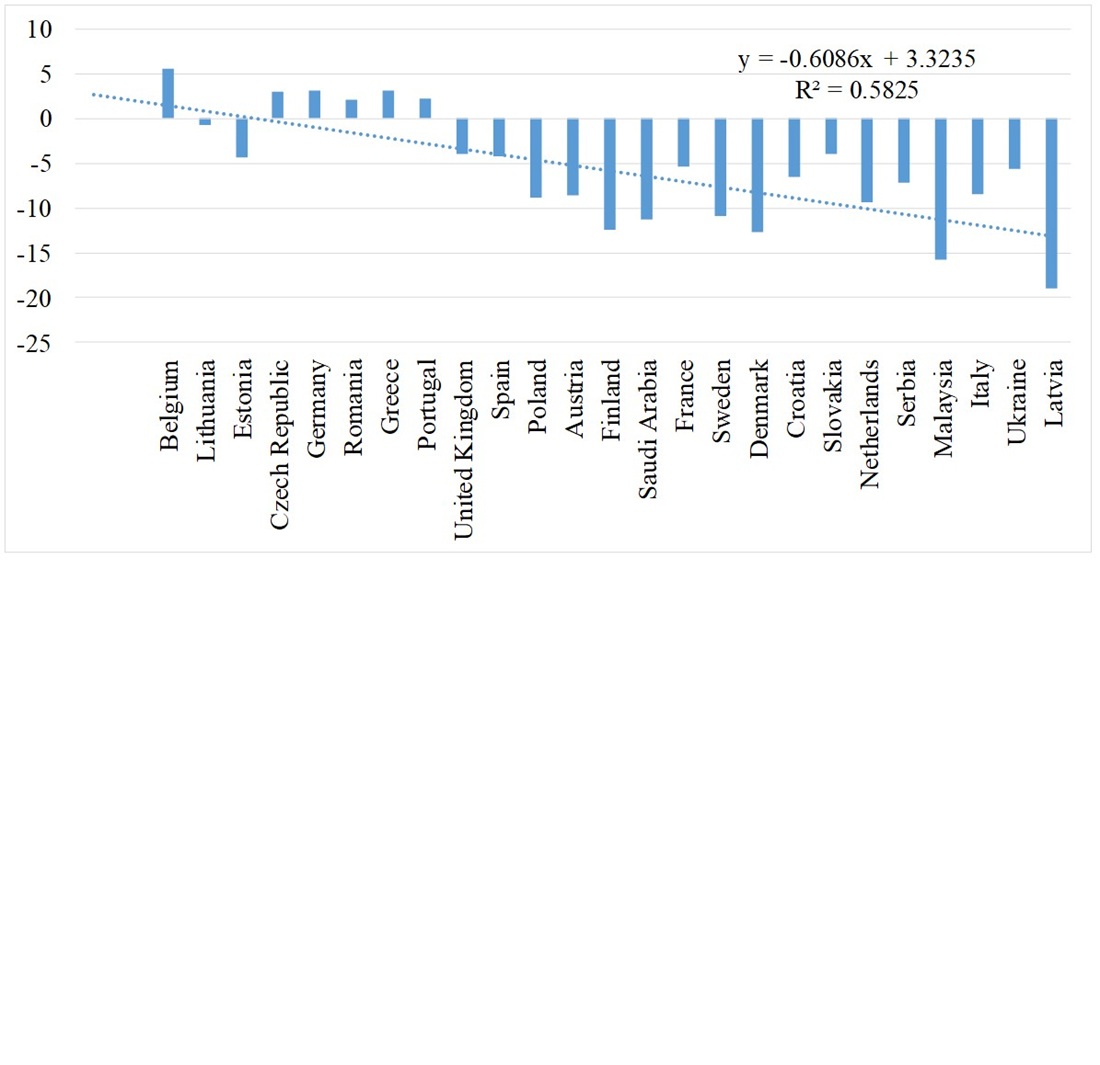
This study confirms the presence of a statistically significant inverse relationship between the level of information and communication technologies development and cybersecurity (correlation coefficient r = –0.763, p < 0.05), indicating a potential technological imbalance. A concept of digital risk mitigation has been proposed, which integrates generative artificial intelligence (GAI) into the analytical, infrastructural, regulatory, and educational components of the national cybersecurity system.
The proposed approach is based on the application of regression modeling, comparative analysis of international indices, graph-analytical visualization, and expert evaluation, providing interdisciplinary coverage of the research domain. It has been shown that the effectiveness of intelligent security solutions depends significantly on institutional maturity, transparency of the regulatory environment, access to data, digital inclusion, and readiness for cross-sectoral cooperation.
The findings can be applied to enhance national digital policy and design a strategic framework for integrating GAI into the state’s economic security system, particularly under wartime conditions
References
- Hang, H., Chen, Z. (2022). How to realize the full potentials of artificial intelligence (AI) in digital economy? A literature review. Journal of Digital Economy, 1 (3), 180–191. https://doi.org/10.1016/j.jdec.2022.11.003
- Maslii, O., Buriak, A., Chaikina, A., Cherviak, A. (2025). Improving conceptual approaches to ensuring state economic security under conditions of digitalization. Eastern-European Journal of Enterprise Technologies, 1 (13 (133)), 35–45. https://doi.org/10.15587/1729-4061.2025.319256
- Griffioen, P., Krogh, B. H., Sinopoli, B. (2024). Ensuring Resilience Against Stealthy Attacks on Cyber-Physical Systems. IEEE Transactions on Automatic Control, 69 (12), 8234–8246. https://doi.org/10.1109/tac.2024.3401013
- Birthriya, S. K., Ahlawat, P., Jain, A. K. (2024). A Comprehensive Survey of Social Engineering Attacks: Taxonomy of Attacks, Prevention, and Mitigation Strategies. Journal of Applied Security Research, 20 (2), 244–292. https://doi.org/10.1080/19361610.2024.2372986
- Yanko, A., Hlushko, A., Onyshchenko, S., Maslii, O. (2023). Economic cybersecurity of business in Ukraine: strategic directions and implementation mechanism. Economic And Cyber Security, 30–58. https://doi.org/10.15587/978-617-7319-98-5.ch2
- Parkin, S., Kuhn, K., Shaikh, S. A. (2023). Executive decision-makers: a scenario-based approach to assessing organizational cyber-risk perception. Journal of Cybersecurity, 9 (1). https://doi.org/10.1093/cybsec/tyad018
- Ho, H., Ko, R., Mazerolle, L., Gilmour, J., Miao, C. (2024). Using Situational Crime Prevention (SCP)-C3 cycle and common inventory of cybersecurity controls from ISO/IEC 27002:2022 to prevent cybercrimes. Journal of Cybersecurity, 10 (1). https://doi.org/10.1093/cybsec/tyae020
- Khan, K., Khurshid, A., Cifuentes-Faura, J. (2024). Is artificial intelligence a new battleground for cybersecurity? Internet of Things, 28, 101428. https://doi.org/10.1016/j.iot.2024.101428
- Onyshchenko, S. V., Masliy, O. A., Buriak, A. A. (2023). Threats and Risks of Ecological and Economic Security of Ukraine in the Conditions of War. 17th International Conference Monitoring of Geological Processes and Ecological Condition of the Environment, 1–5. https://doi.org/10.3997/2214-4609.2023520072
- Network Readiness Index 2024. Portulans Institute. Available at: https://networkreadinessindex.org/
- Report on direct damages to infrastructure due to Russia’s military aggression against Ukraine as of early 2024 (2024). Kyiv School of Economics. Available at: https://kse.ua/wp-content/uploads/2024/04/01.01.24_Damages_Report.pdf
- Digital Restoration Ecosystem for Accountable Management (DREAM) (2024). Ministry for Communities, Territories and Infrastructure Development of Ukraine. Available at: https://dream.gov.ua
- Indeks tsyfrovoi transformatsiyi rehioniv Ukrainy. Pidsumky 2024 roku. Ministerstvo tsyfrovoi transformatsiyi Ukrainy. Available at: https://thedigital.gov.ua/storage/uploads/files/page/community/reports/%D0%86%D0%9D%D0%94%D0%95%D0%9A%D0%A1%202024%202%201.pdf
- Onyshchenko, V., Onyshchenko, S., Verhal, K., Buriak, A. (2023). The Energy Efficiency of the Digital Economy. Proceedings of the 4th International Conference on Building Innovations, 761–767. https://doi.org/10.1007/978-3-031-17385-1_64
- Ponochovniy, Y., Bulba, E., Yanko, A., Hozbenko, E. (2018). Influence of diagnostics errors on safety: Indicators and requirements. 2018 IEEE 9th International Conference on Dependable Systems, Services and Technologies (DESSERT), 53–57. https://doi.org/10.1109/dessert.2018.8409098
- Maslii, O., Maksymenko, A. (2025). Digital transformation and economic deindustrialisation: impact on state financial security. Financial and Credit Activity Problems of Theory and Practice, 1 (60), 401–414. https://doi.org/10.55643/fcaptp.1.60.2025.4599
- Chychkalo-Kondratska, I., Buriak, A. (2014). Factors of foreign direct investment attracting into economy of Ukraine’s regions. Economic Annals-XXI, 11-12, 88–92. Available at: https://ea21journal.world/index.php/ea-v146-22/
- E-Government Development Index 2024. United Nations. Available at: https://publicadministration.un.org/egovkb/en-us/Data/Country-Information/id/185-Ukraine
- Onyshchenko, V., Onyshchenko, S., Maslii, O., Maksymenko, A. (2023). Systematization of Threats to Financial Security of Individual, Society, Business and the State in Terms of the Pandemic. Proceedings of the 4th International Conference on Building Innovations, 749–760. https://doi.org/10.1007/978-3-031-17385-1_63
- Krasnobayev, V., Yanko, A., Kovalchuk, D. (2023). Control, Diagnostics and Error Correction in the Modular Number System. Computer Modeling and Intelligent Systems, 3392, 199–213. https://doi.org/10.32782/cmis/3392-17
- Svistun, L., Glushko, А., Shtepenko, K. (2018). Organizational Aspects of Development Projects Implementation at the Real Estate Market in Ukraine. International Journal of Engineering & Technology, 7 (3.2), 447. https://doi.org/10.14419/ijet.v7i3.2.14569
- Onyshchenko, S., Hlushko, A., Kivshyk, O., Sokolov, A. (2021). The shadow economy as a threat to the economic security of the state. Economics of Development, 20 (4). https://doi.org/10.57111/econ.20(4).2021.24-30
- National Cyber Security Index. E-Governance Academy. Available at: https://ncsi.ega.ee
- Measuring digital development – ICT Development Index 2024. International Telecommunication Union. Available at: https://www.itu.int/hub/publication/D-IND-ICT_MDD-2024-3/
- Onyshchenko, S., Yanko, A., Hlushko, A., Maslii, O., Cherviak, A. (2023). Cybersecurity and Improvement of the Information Security System. Journal of the Balkan Tribological Association, 29 (5), 818–835. Available at: https://scibulcom.net/en/article/L8nV7It2dVTBPX09mzWB
- Kadam, S., Agrawal, A., Bajaj, A., Agarwal, R., Kalra, R., Shah, J. (2023). Predicting Crude Oil Future Price Using Traditional and Artificial Intelligence-Based Model: Comparative Analysis. Journal of International Commerce, Economics and Policy, 14 (03). https://doi.org/10.1142/s179399332350014x
- Asvial, M., Zagloel, T. Y. M., Fitri, I. R., Kusrini, E., Whulanza, Y. (2023). Resolving Engineering, Industrial and Healthcare Challenges through AI-Driven Applications. International Journal of Technology, 14 (6), 1177. https://doi.org/10.14716/ijtech.v14i6.6767
- E-Government Development Index (EGDI). United Nations. Available at: https://publicadministration.un.org/egovkb/en-us/About/Overview/-E-Government-Development-Index
- Creemers, R. (2022). China’s emerging data protection framework. Journal of Cybersecurity, 8 (1). https://doi.org/10.1093/cybsec/tyac011
- Kravets, I. V., Mуkhalchenko, H. H., Buriak, А. А., Davidyuk, L. P., Dubych, C. V. (2020). Long-term consequences of capital outflows for transition countries. International Journal of Management, 11 (5), 1017–1026. Available at: https://ssrn.com/abstract=3631765
Downloads
Published
How to Cite
Issue
Section
License
Copyright (c) 2025 Alona Buriak, Oleksandra Maslii

This work is licensed under a Creative Commons Attribution 4.0 International License.
The consolidation and conditions for the transfer of copyright (identification of authorship) is carried out in the License Agreement. In particular, the authors reserve the right to the authorship of their manuscript and transfer the first publication of this work to the journal under the terms of the Creative Commons CC BY license. At the same time, they have the right to conclude on their own additional agreements concerning the non-exclusive distribution of the work in the form in which it was published by this journal, but provided that the link to the first publication of the article in this journal is preserved.
A license agreement is a document in which the author warrants that he/she owns all copyright for the work (manuscript, article, etc.).
The authors, signing the License Agreement with TECHNOLOGY CENTER PC, have all rights to the further use of their work, provided that they link to our edition in which the work was published.
According to the terms of the License Agreement, the Publisher TECHNOLOGY CENTER PC does not take away your copyrights and receives permission from the authors to use and dissemination of the publication through the world's scientific resources (own electronic resources, scientometric databases, repositories, libraries, etc.).
In the absence of a signed License Agreement or in the absence of this agreement of identifiers allowing to identify the identity of the author, the editors have no right to work with the manuscript.
It is important to remember that there is another type of agreement between authors and publishers – when copyright is transferred from the authors to the publisher. In this case, the authors lose ownership of their work and may not use it in any way.








