Building a consolidated model of digital coherence for managing the information potential at power enterprises
DOI:
https://doi.org/10.15587/1729-4061.2025.336641Keywords:
integrated digital coherence index, digital coherence of energy enterprises, digital transformation management, digital consistency of management decisionsAbstract
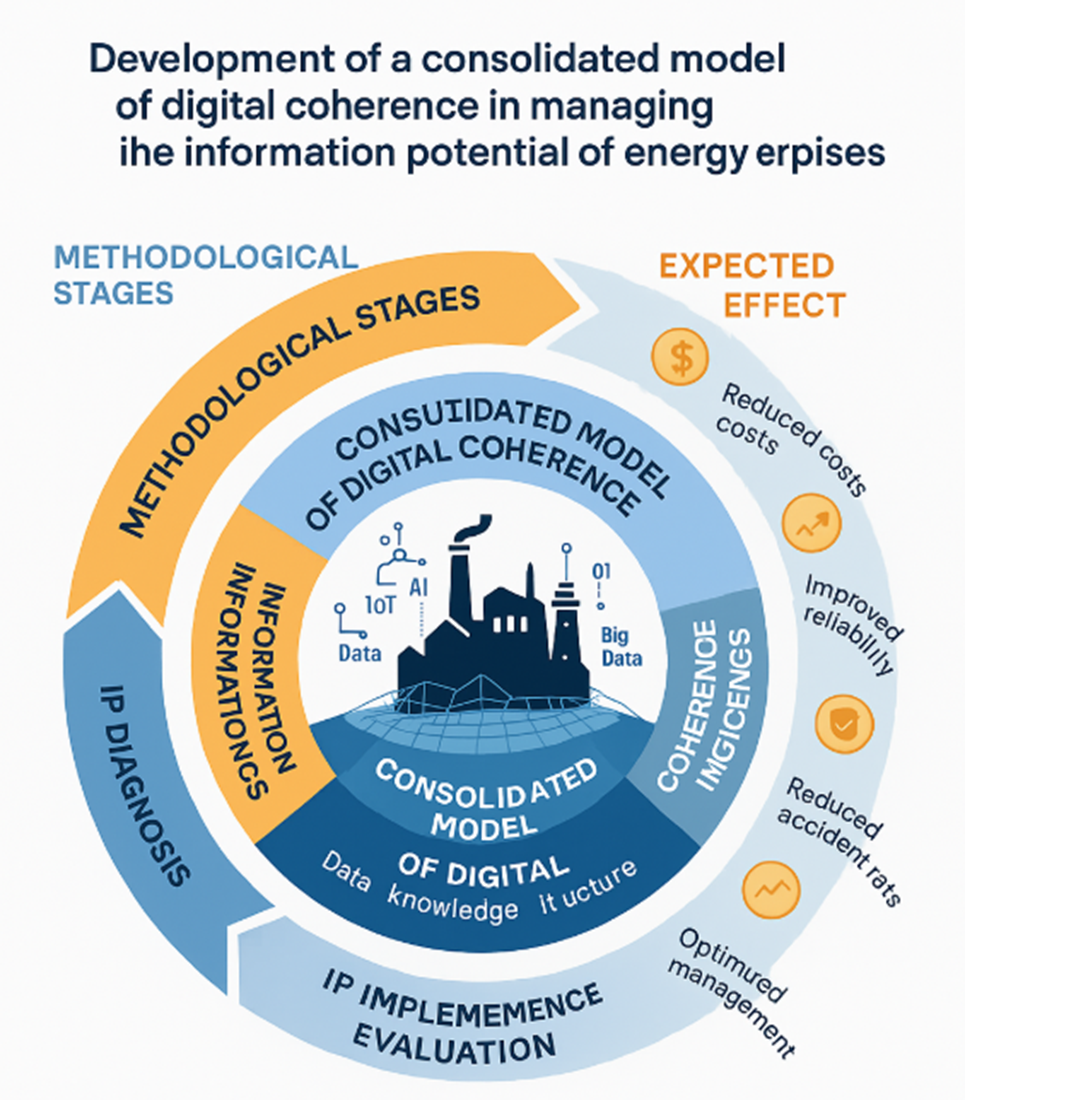
This study's object is the process of managing the information potential of energy enterprises under the conditions of digital coherence. The task addressed is to build a consolidated model of digital coherence, which would enable the functioning of digital, management, and information elements of the enterprise, promote the integrated development of information potential, and increase the adaptability of energy enterprises to digitalization.
A consolidated model of digital coherence has been constructed and substantiated as a basic methodological basis for effective management of the information potential of energy enterprises. Digital coherence is considered as an integrative characteristic that ensures the consistency of digital resources, technologies, processes, and management practices within the strategic, operational, and analytical levels of an energy enterprise.
The proposed model combines elements of digital strategy, digital platforms, innovative technologies, and digital culture into a single coherent system, which makes it possible to increase stability, adaptability, and management efficiency under the conditions of digital transformation.
A system of quantitative criteria and indicators for assessing digital coherence has been designed, implemented in the form of an integrated index. The model has been tested on the example of the Zaporizhzhia Power Plant, which made it possible to track the dynamics of digital integration and the impact of crisis events (in particular, wartime) on the level of information potential in 2012–2024.
The digital maturity of the power plant demonstrates regressive dynamics: the integrated digital coherence index decreased from 0.386 (2021) to 0.260 (2024), which indicates a degradation of the level of integration of digital solutions into the management processes of the enterprise
References
- Plekhanov, D., Franke, H., Netland, T. H. (2023). Digital transformation: A review and research agenda. European Management Journal, 41 (6), 821–844. https://doi.org/10.1016/j.emj.2022.09.007
- Zhu, Q., Ma, D., He, X. (2023). Digital transformation and firms’ pollution emissions. Technological Forecasting and Social Change, 197, 122910. https://doi.org/10.1016/j.techfore.2023.122910
- Honic, M., Kovacic, I., Aschenbrenner, P., Ragossnig, A. (2021). Material Passports for the end-of-life stage of buildings: Challenges and potentials. Journal of Cleaner Production, 319, 128702. https://doi.org/10.1016/j.jclepro.2021.128702
- Berdik, D., Otoum, S., Schmidt, N., Porter, D., Jararweh, Y. (2021). A Survey on Blockchain for Information Systems Management and Security. Information Processing & Management, 58 (1), 102397. https://doi.org/10.1016/j.ipm.2020.102397
- Hustad, E., Olsen, D. H. (2021). Creating a sustainable digital infrastructure: The role of service-oriented architecture. Procedia Computer Science, 181, 597–604. https://doi.org/10.1016/j.procs.2021.01.210
- Canhoto, A. I., Quinton, S., Pera, R., Molinillo, S., Simkin, L. (2021). Digital strategy aligning in SMEs: A dynamic capabilities perspective. The Journal of Strategic Information Systems, 30 (3), 101682. https://doi.org/10.1016/j.jsis.2021.101682
- Veile, J. W., Schmidt, M.-C., Voigt, K.-I. (2022). Toward a new era of cooperation: How industrial digital platforms transform business models in Industry 4.0. Journal of Business Research, 143, 387–405. https://doi.org/10.1016/j.jbusres.2021.11.062
- Jovanovic, M., Sjödin, D., Parida, V. (2022). Co-evolution of platform architecture, platform services, and platform governance: Expanding the platform value of industrial digital platforms. Technovation, 118, 102218. https://doi.org/10.1016/j.technovation.2020.102218
- Butt, A., Imran, F., Helo, P., Kantola, J. (2024). Strategic design of culture for digital transformation. Long Range Planning, 57 (2), 102415. https://doi.org/10.1016/j.lrp.2024.102415
- Grover, V., Tseng, S.-L., Pu, W. (2022). A theoretical perspective on organizational culture and digitalization. Information & Management, 59 (4), 103639. https://doi.org/10.1016/j.im.2022.103639
- Lo, L. S. (2023). The CLEAR path: A framework for enhancing information literacy through prompt engineering. The Journal of Academic Librarianship, 49 (4), 102720. https://doi.org/10.1016/j.acalib.2023.102720
- Du, Z.-Y., Wang, Q. (2024). Digital infrastructure and innovation: Digital divide or digital dividend? Journal of Innovation & Knowledge, 9 (3), 100542. https://doi.org/10.1016/j.jik.2024.100542
- Prokhorova, V., Protsenko, V., Bezuglaya, Y., Us, J. (2018). The optimization algorithm for the directions of influence of risk factors on the system that manages the potential of machine-building enterprises. Eastern-European Journal of Enterprise Technologies, 4 (1 (94)), 6–13. https://doi.org/10.15587/1729-4061.2018.139513
- Babenko, V., Baksalova, O., Prokhorova, V., Dykan, V., Ovchynnikova, V., Chobitok, V. (2021). Information And Consulting Service Using In The Organization Of Personnel Management. Studies of Applied Economics, 38 (4). https://doi.org/10.25115/eea.v38i4.3999
- Iarmosh, O., Prokhorova, V., Shcherbyna, I., Kashaba, O., Slastianykova, K. (2021). Innovativeness of the creative economy as a component of the Ukrainian and the world sustainable development strategy. IOP Conference Series: Earth and Environmental Science, 628 (1), 012035. https://doi.org/10.1088/1755-1315/628/1/012035
- Prokhorova, V., Budanov, M., Budanov, P., Zaitseva, A., Slastianykova, A. (2025). Devising a comprehensive methodology for estimating the economic efficiency of implementing an investment project for ensuring energy security of enterprises: organizational-economic aspect. Eastern-European Journal of Enterprise Technologies, 1 (13 (133)), 59–68. https://doi.org/10.15587/1729-4061.2025.321965
- Prokhorova, V., Budanov, O., Budanov, P., Slastianykova, K. (2025). Comprehensive methodology for estimating information safety at enterprises of electroenergy system under the conditions of digital coherence. Eastern-European Journal of Enterprise Technologies, 2 (13 (134)), 27–37. https://doi.org/10.15587/1729-4061.2025.327159
- Prokhorova, V., Budanov, O., Budanov, P., Slastianykova, K. (2025). Devising a methodology for estimating the information potential of energy enterprises under the conditions of digital coherency. Eastern-European Journal of Enterprise Technologies, 3 (13 (135)), 6–16. https://doi.org/10.15587/1729-4061.2025.332324
Downloads
Published
How to Cite
Issue
Section
License
Copyright (c) 2025 Viktoriia Prokhorova, Oleksandr Budanov, Mykola Budanov, Krystyna Slastianykova

This work is licensed under a Creative Commons Attribution 4.0 International License.
The consolidation and conditions for the transfer of copyright (identification of authorship) is carried out in the License Agreement. In particular, the authors reserve the right to the authorship of their manuscript and transfer the first publication of this work to the journal under the terms of the Creative Commons CC BY license. At the same time, they have the right to conclude on their own additional agreements concerning the non-exclusive distribution of the work in the form in which it was published by this journal, but provided that the link to the first publication of the article in this journal is preserved.
A license agreement is a document in which the author warrants that he/she owns all copyright for the work (manuscript, article, etc.).
The authors, signing the License Agreement with TECHNOLOGY CENTER PC, have all rights to the further use of their work, provided that they link to our edition in which the work was published.
According to the terms of the License Agreement, the Publisher TECHNOLOGY CENTER PC does not take away your copyrights and receives permission from the authors to use and dissemination of the publication through the world's scientific resources (own electronic resources, scientometric databases, repositories, libraries, etc.).
In the absence of a signed License Agreement or in the absence of this agreement of identifiers allowing to identify the identity of the author, the editors have no right to work with the manuscript.
It is important to remember that there is another type of agreement between authors and publishers – when copyright is transferred from the authors to the publisher. In this case, the authors lose ownership of their work and may not use it in any way.








