Determining the influence of enzymes and sourdough of lactic acid bacteria on the quality of wheat-hemp bread
DOI:
https://doi.org/10.15587/1729-4061.2025.337473Keywords:
hemp flour, enzyme treatment, lactic acid bacteria, bread qualityAbstract
The object of this study is wheat bread with the addition of whole grain hemp flour. The principal issue related to using hemp flour in bread baking is its high oil and dietary fiber content. The inclusion of such raw materials in the recipe worsens the structural and mechanical properties of the dough and the quality of the bread.
It was established that hemp flour is a valuable raw material for increasing the nutritional value of wheat bread as it contains 22.3% protein, 34.4% oil, and 16.5% fiber. It has been established that the rational dosage of such raw materials in bread recipes is 5–10%. However, even this amount affects the quality of the dough and bread. The content of raw gluten decreases by 2.8% and its quality deteriorates, the color of the crust improves, the crumb darkens slightly, and notes of walnut appear in the aroma.
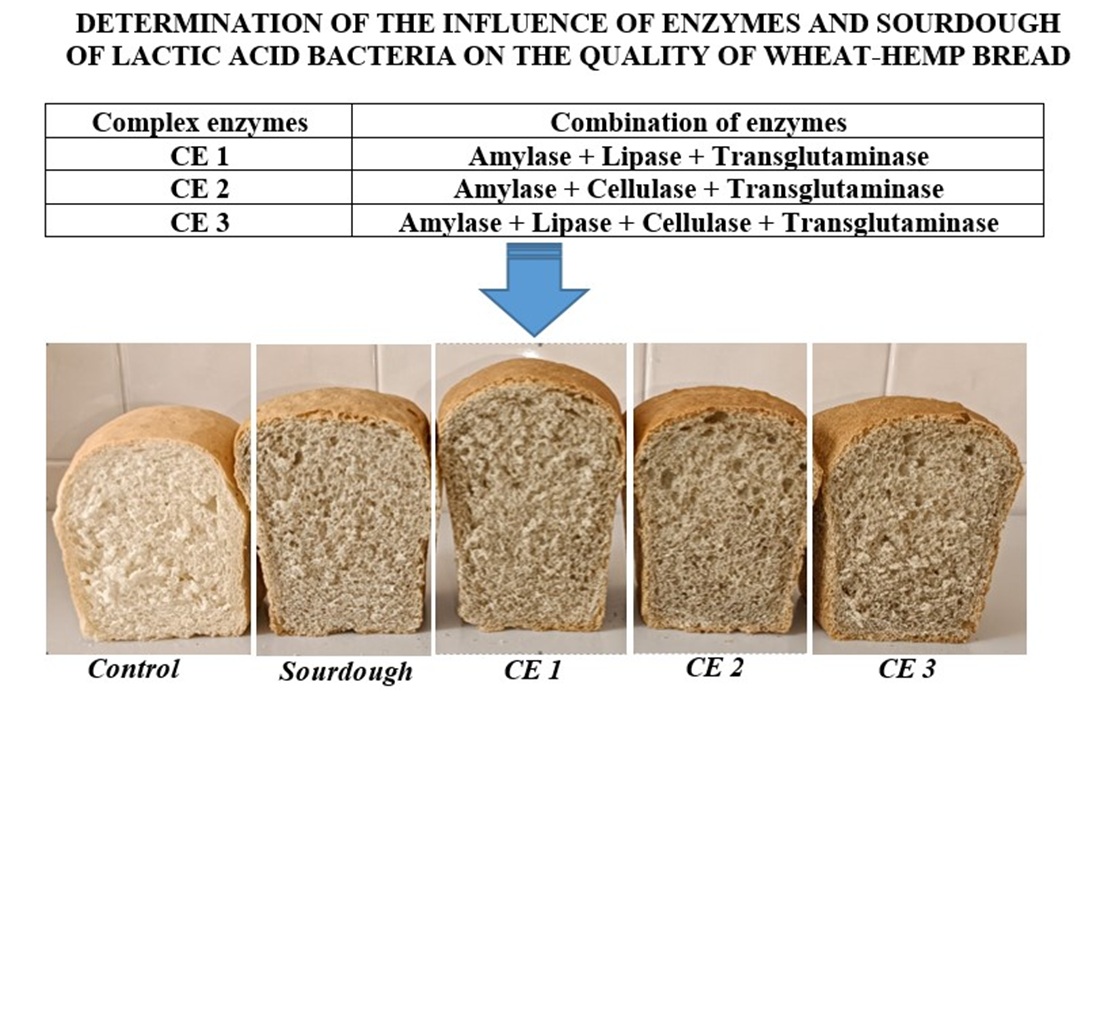
The effectiveness of using sourdough of lactic acid bacteria and enzymes α-amylase, lipase, cellulase, transglutaminase to improve the bread quality and its nutritional and physiological value, has been confirmed. In particular, the specific volume of bread increased from 4.3 to 39.1%. Its freshness improved, as evidenced by a decrease in crumbly texture, from 9.9 to 29.6%, and an increase in water absorption capacity from 16.9 to 44.5%, depending on the variant.
The results could be used in the technology of producing wheat-hemp bread for health and preventive purposes with increased nutritional and physiological value. The proposed technological solutions make it possible to expand the range of such products for mass production
References
- Švec, I., Hrušková, M. (2010). Evaluation of wheat bread features. Journal of Food Engineering, 99 (4), 505–510. https://doi.org/10.1016/j.jfoodeng.2009.09.022
- Dewettinck, K., Van Bockstaele, F., Kühne, B., Van de Walle, D., Courtens, T. M., Gellynck, X. (2008). Nutritional value of bread: Influence of processing, food interaction and consumer perception. Journal of Cereal Science, 48 (2), 243–257. https://doi.org/10.1016/j.jcs.2008.01.003
- Brouns, F., van Rooy, G., Shewry, P., Rustgi, S., Jonkers, D. (2019). Adverse Reactions to Wheat or Wheat Components. Comprehensive Reviews in Food Science and Food Safety, 18 (5), 1437–1452. https://doi.org/10.1111/1541-4337.12475
- Torbica, A., Radosavljević, M., Belović, M., Djukić, N., Marković, S. (2022). Overview of nature, frequency and technological role of dietary fibre from cereals and pseudocereals from grain to bread. Carbohydrate Polymers, 290, 119470. https://doi.org/10.1016/j.carbpol.2022.119470
- Wirkijowska, A., Zarzycki, P., Teterycz, D., Nawrocka, A., Blicharz-Kania, A., Łysakowska, P. (2023). The Influence of Tomato and Pepper Processing Waste on Bread Quality. Applied Sciences, 13 (16), 9312. https://doi.org/10.3390/app13169312
- Naumenko, O., Нetmаn, I., Chyzh, V., Gunko, S., Bal-Prylypko, L., Bilko, M. et al. (2023). Improving the quality of wheat bread by enriching teff flour. Eastern-European Journal of Enterprise Technologies, 3 (11 (123)), 33–41. https://doi.org/10.15587/1729-4061.2023.279286
- Mikulec, A., Kowalski, S., Sabat, R., Skoczylas, Ł., Tabaszewska, M., Wywrocka-Gurgul, A. (2019). Hemp flour as a valuable component for enriching physicochemical and antioxidant properties of wheat bread. LWT, 102, 164–172. https://doi.org/10.1016/j.lwt.2018.12.028
- Siudem, P., Wawer, I., Paradowska, K. (2019). Rapid evaluation of edible hemp oil quality using NMR and FT-IR spectroscopy. Journal of Molecular Structure, 1177, 204–208. https://doi.org/10.1016/j.molstruc.2018.09.057
- Istrate, A. M., Dabija, A., Codină, G. G., Rusu, L. (2021). Influence of hemp flour on dough rheology and bread quality. Scientific Study & Research. Chemistry & Chemical Engineering, Biotechnology, Food Industry, 22 (4), 521–531. Available at: https://www.proquest.com/openview/4151dca98bc790ff599d9b607b60e214/1?pq-origsite=gscholar&cbl=716381
- Tebben, L., Shen, Y., Li, Y. (2018). Improvers and functional ingredients in whole wheat bread: A review of their effects on dough properties and bread quality. Trends in Food Science & Technology, 81, 10–24. https://doi.org/10.1016/j.tifs.2018.08.015
- Korzhenivska, A., Danylenko, S., Gunko, S., Kozlovska, G., Lukianets, А. (2023). Application of bacterial sourdough and enzymes in the production of bread from a mixture of rye and wheat flour. Food Science and Technology, 17 (4). https://doi.org/10.15673/fst.v17i4.2761
- Leonard, W., Zhang, P., Ying, D., Fang, Z. (2019). Hempseed in food industry: Nutritional value, health benefits, and industrial applications. Comprehensive Reviews in Food Science and Food Safety, 19 (1), 282–308. https://doi.org/10.1111/1541-4337.12517
- Gunko, S., Naumenko, O., Hetman, I., Korolyuk, K., Lukianchuk, I., Kuznietsova, I. (2024). Use of products of hemp seed processing for bread production. Food Resources, 12 (22), 50–60. https://doi.org/10.31073/foodresources2024-22-06
- Alonso-Esteban, J. I., Pinela, J., Ćirić, A., Calhelha, R. C., Soković, M., Ferreira, I. C. F. R. et al. (2022). Chemical composition and biological activities of whole and dehulled hemp (Cannabis sativa L.) seeds. Food Chemistry, 374, 131754. https://doi.org/10.1016/j.foodchem.2021.131754
- Promhuad, K., Srisa, A., San, H., Laorenza, Y., Wongphan, P., Sodsai, J. et al. (2022). Applications of Hemp Polymers and Extracts in Food, Textile and Packaging: A Review. Polymers, 14 (20), 4274. https://doi.org/10.3390/polym14204274
- Pojić, M., Dapčević Hadnađev, T., Hadnađev, M., Rakita, S., Brlek, T. (2015). Bread Supplementation with Hemp Seed Cake: A By‐Product of Hemp Oil Processing. Journal of Food Quality, 38 (6), 431–440. https://doi.org/10.1111/jfq.12159
- Ropciuc, S., Apostol, L. C., Damian, C., Prisacaru, A. E. (2022). Effect of Hemp Seed Oil Addition on the Rheological Properties of Dough and Bread. Applied Sciences, 12 (6), 2764. https://doi.org/10.3390/app12062764
- Sciacca, F., Virzì, N., Pecchioni, N., Melilli, M. G., Buzzanca, C., Bonacci, S., Di Stefano, V. (2023). Functional End-Use of Hemp Seed Waste: Technological, Qualitative, Nutritional, and Sensorial Characterization of Fortified Bread. Sustainability, 15 (17), 12899. https://doi.org/10.3390/su151712899
- Blazhenko, M., Falendysh, N. (2023). Use of products of hemp seed processing in the production of bread. Herald of Khmelnytskyi National University. Technical Sciences, 325 (5 (1)), 35–39. Available at: https://heraldts.khmnu.edu.ua/index.php/heraldts/article/view/453/453
- Wiedemair, V., Gruber, K., Knöpfle, N., Bach, K. E. (2022). Technological Changes in Wheat-Based Breads Enriched with Hemp Seed Press Cakes and Hemp Seed Grit. Molecules, 27 (6), 1840. https://doi.org/10.3390/molecules27061840
- Liliana, B. C., Livia, A., Laura, M. (2018). Effects of hemp flour, seeds and oil additions on bread quality. J. Eng. Res. Appl., 8 (5), 73–78. Available at: https://d1wqtxts1xzle7.cloudfront.net/56938230/J0805037378-libre.pdf?1530852067=&response-content-disposition=inline%3B+filename%3DEffects_of_Hemp_Flour_Seeds_And_Oil_Addi.pdf&Expires=1756205900&Signature=ggGhfWCGWep4IQDwKJnb-AMhHoKZHjTHY0~tWbu1Y2mp2C7Si1BfmwLg8cniGUNo8-HaLn9P2Xdk66giMtt6gxjMLrU2zd25YULSelLYMV24JiFoeEfAb73~4p8Euuj6RyktYxet1S5x7aREqjQkS1kVLghJb~mYrA5uroZ6ZzOV2cfWCFUC~2kj3ttJnuvJvuvTVWYd8XoXEytGM32gsIMChuDlvrp2n~RTJLnac-2OOmYQpUnba6ltesFmY-TWWhG5U9KGLBrR2fidUHlpvlNPxgaZYSCkGTozVL~ckm38SceoNMSrYgfYyPebKFVN-bY~gnykkw68uq5nzOj6DA__&Key-Pair-Id=APKAJLOHF5GGSLRBV4ZA
- Drobot, V. I. (2019). Dovidnyk z tekhnolohiyi khlibopekarskoho vyrobnytstva. Kyiv: ProfKnyha, 580. Available at: https://profbook.com.ua/index.php?route=product/product/download&product_id=3131&download_id=1203&srsltid=AfmBOooECYmODrpJzFA1M_zWzNBty4i0RjCSSGTfiAY_M0uzAV9ihH3v
- Lebedenko, T. Ye., Pshenyshniuk, H. F., Sokolova, N. Yu. (2014). Tekhnolohiya khlibopekarskoho vyrobnytstva. Praktykum. Odesa: Osvita Ukrainy, 392. Available at: https://card-file.ontu.edu.ua/items/8a80be78-001c-40d9-a833-766805a31273
- Drobot, V. I. (Ed.) (2015). Tekhnokhimichnyi kontrol syrovyny ta khlibobulochnykh i makaronnykh vyrobiv. Kyiv: Kondor-Vydavnytstvo, 948. Available at: https://condor-books.com.ua/pryrodnycha-literatura/tekhnokhimichnyy-kontrol-syrovyny-ta-khlibobulochnykh-i-makaronnykh-vyrobiv
- Zhang, M., Jia, R., Ma, M., Yang, T., Sun, Q., Li, M. (2022). Versatile wheat gluten: functional properties and application in the food-related industry. Critical Reviews in Food Science and Nutrition, 63 (30), 10444–10460. https://doi.org/10.1080/10408398.2022.2078785
- Hayward, L., McSweeney, M. B. (2020). Acceptability of bread made with hemp (Cannabis sativa subsp. sativa) flour evaluated fresh and following a partial bake method. Journal of Food Science, 85 (9), 2915–2922. https://doi.org/10.1111/1750-3841.15372
- Sanfilippo, R., Canale, M., Fascella, G., Scarangella, M., Strano, M. C., Mangione, G. et al. (2025). Nutritional and technological characterization of rosehip seed flours as a functional ingredient in common wheat bread. European Food Research and Technology, 251 (6), 1033–1045. https://doi.org/10.1007/s00217-025-04686-1
- Rusu, I. E., Marc (Vlaic), R. A., Mureşan, C. C., Mureşan, A. E., Mureşan, V., Pop, C. R. et al. (2021). Hemp (Cannabis sativa L.) Flour-Based Wheat Bread as Fortified Bakery Product. Plants, 10 (8), 1558. https://doi.org/10.3390/plants10081558
- Gómez, M., Gutkoski, L. C., Bravo‐Núñez, Á. (2020). Understanding whole‐wheat flour and its effect in breads: A review. Comprehensive Reviews in Food Science and Food Safety, 19 (6), 3241–3265. https://doi.org/10.1111/1541-4337.12625
- Tebben, L., Chen, G., Tilley, M., Li, Y. (2020). Individual effects of enzymes and vital wheat gluten on whole wheat dough and bread properties. Journal of Food Science, 85 (12), 4201–4208. https://doi.org/10.1111/1750-3841.15517
Downloads
Published
How to Cite
Issue
Section
License
Copyright (c) 2025 Sergiy Gunko, Oksana Naumenko, Inna Нetmаn, Lubomyr Khomichak, Ivanna Lukianchuk, Marina Bilko, Anatolii Bober, Oksana Zavadska, Nadiya Yashchuk, Svitlana Liashenko

This work is licensed under a Creative Commons Attribution 4.0 International License.
The consolidation and conditions for the transfer of copyright (identification of authorship) is carried out in the License Agreement. In particular, the authors reserve the right to the authorship of their manuscript and transfer the first publication of this work to the journal under the terms of the Creative Commons CC BY license. At the same time, they have the right to conclude on their own additional agreements concerning the non-exclusive distribution of the work in the form in which it was published by this journal, but provided that the link to the first publication of the article in this journal is preserved.
A license agreement is a document in which the author warrants that he/she owns all copyright for the work (manuscript, article, etc.).
The authors, signing the License Agreement with TECHNOLOGY CENTER PC, have all rights to the further use of their work, provided that they link to our edition in which the work was published.
According to the terms of the License Agreement, the Publisher TECHNOLOGY CENTER PC does not take away your copyrights and receives permission from the authors to use and dissemination of the publication through the world's scientific resources (own electronic resources, scientometric databases, repositories, libraries, etc.).
In the absence of a signed License Agreement or in the absence of this agreement of identifiers allowing to identify the identity of the author, the editors have no right to work with the manuscript.
It is important to remember that there is another type of agreement between authors and publishers – when copyright is transferred from the authors to the publisher. In this case, the authors lose ownership of their work and may not use it in any way.








