Assessing the potential to overcome economic barriers in the design and implementation of energy-saving technologies
DOI:
https://doi.org/10.15587/1729-4061.2025.337648Keywords:
enterprise potential, enterprise potential assessment toolkit, energy-saving technologies, economic obstacles, overcoming obstacles, energy-saving projectAbstract
This study’s object is the potential to overcome economic barriers in the design and implementation of energy-saving technologies at enterprises. The task addressed is to devise an effective toolset for assessing this potential.
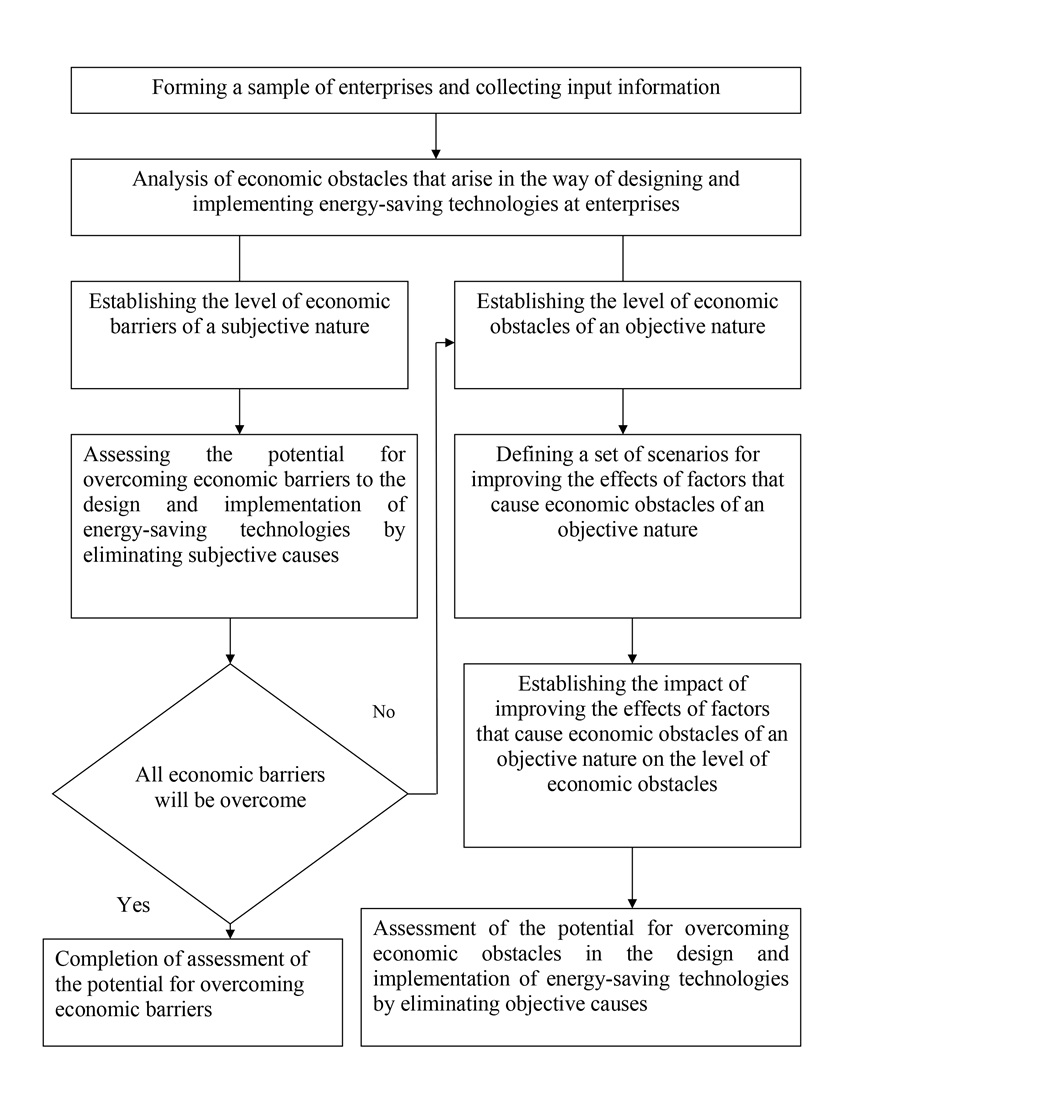
The theoretical foundations for analyzing economic barriers in the design and implementation of energy-saving technologies have been substantiated. A procedure for assessing the potential for overcoming these obstacles was developed. This procedure involves determining the capabilities of enterprises under certain conditions to overcome specified barriers of a subjective and objective nature. In turn, such conditions include enhancing the competence of company personnel and improving the processes of information support for the process that assesses the effectiveness of energy-saving projects, as well as positive changes of an external nature.
The designed toolkit was assessed using data from 98 industrial enterprises in the western region of Ukraine. Among other things, it was found that the companies studied have a sufficiently high potential for overcoming economic obstacles that arise when implementing energy-saving technological processes. In particular, the share of energy-saving technology projects that were considered and rejected because of the presence of subjective economic obstacles in the total number of rejected projects varies by industry from 39.29% to 47.54%.
The proposed toolkit produces accurate and comprehensive results using a formalized procedure. It could be used by enterprises in various industries to assess the potential for overcoming economic barriers to the design and implementation of energy-saving technologies
References
- Kirikkaleli, D., Güngör, H., Adebayo, T. S. (2021). Consumption‐based carbon emissions, renewable energy consumption, financial development and economic growth in Chile. Business Strategy and the Environment, 31 (3), 1123–1137. https://doi.org/10.1002/bse.2945
- Dolge, K., Āzis, R., Lund, P. D., Blumberga, D. (2021). Importance of Energy Efficiency in Manufacturing Industries for Climate and Competitiveness. Environmental and Climate Technologies, 25 (1), 306–317. https://doi.org/10.2478/rtuect-2021-0022
- Chevallier, J. (2011). Detecting instability in the volatility of carbon prices. Energy Economics, 33 (1), 99–110. https://doi.org/10.1016/j.eneco.2010.09.006
- Yemelyanov, O., Petrushka, T., Lesyk, L., Havryliak, A., Yanevych, N., Kurylo, O. et al. (2023). Assessing the Sustainability of the Consumption of Agricultural Products with Regard to a Possible Reduction in Its Imports: The Case of Countries That Import Corn and Wheat. Sustainability, 15 (12), 9761. https://doi.org/10.3390/su15129761
- Liutak, O., Baula, O., Poruchnyk, A., Stoliarchuk, Ya., Kravchuk, P., Kostynets, Iu. (2021). The Development Of Renewable Energy In The Context Of Formation Of Innovative Economy And Energy Independence As The Geopolitical Priorities Of The State. IOP Conference Series: Earth and Environmental Science, 628 (1), 012012. https://doi.org/10.1088/1755-1315/628/1/012012
- Sutthichaimethee, P., Sa-Ngiamvibool, W., Wattana, B., Luo, J., Wattana, S. (2025). Enhancing Sustainable Strategic Governance for Energy-Consumption Reduction Towards Carbon Neutrality in the Energy and Transportation Sectors. Sustainability, 17 (6), 2659. https://doi.org/10.3390/su17062659
- Ayres, R., Turton, H., Casten, T. (2007). Energy efficiency, sustainability and economic growth. Energy, 32 (5), 634–648. https://doi.org/10.1016/j.energy.2006.06.005
- Bhowmik, C., Bhowmik, S., Ray, A., Pandey, K. M. (2017). Optimal green energy planning for sustainable development: A review. Renewable and Sustainable Energy Reviews, 71, 796–813. https://doi.org/10.1016/j.rser.2016.12.105
- Petrushka, I., Yemelyanov, O., Petrushka, T., Koleshchuk, O., Reznik, N. (2020). Influence of energy-saving technology changes on the agro-industrial enterprises innovativeness in terms of digitalization. International Journal of Advanced Science and Technology, 29, 2489–2496.
- Lesinskyi, V., Yemelyanov, O., Zarytska, O., Petrushka, T., Myroshchenko, N. (2022). Designing a toolset for assessing the organizational and technological inertia of energy consumption processes at enterprises. Eastern-European Journal of Enterprise Technologies, 6 (13 (120)), 29–40. https://doi.org/10.15587/1729-4061.2022.267231
- Backman, F. (2017). Barriers to Energy Efficiency in Swedish Non-Energy-Intensive Micro- and Small-Sized Enterprises – A Case Study of a Local Energy Program. Energies, 10 (1), 100. https://doi.org/10.3390/en10010100
- Kostka, G., Moslener, U., Andreas, J. (2013). Barriers to increasing energy efficiency: evidence from small-and medium-sized enterprises in China. Journal of Cleaner Production, 57, 59–68. https://doi.org/10.1016/j.jclepro.2013.06.025
- Yemelyanov, O., Petrushka, I., Zahoretska, O., Petrushka, K., Havryliak, A. (2023). Information support for managing energy-saving technological changes at enterprises. Procedia Computer Science, 217, 258–267. https://doi.org/10.1016/j.procs.2022.12.221
- Kazemi, M., Kazemi, A. (2022). Financial barriers to residential buildings’ energy efficiency in Iran. Energy Efficiency, 15 (5). https://doi.org/10.1007/s12053-022-10039-8
- Trianni, A., Cagno, E., Worrell, E., Pugliese, G. (2013). Empirical investigation of energy efficiency barriers in Italian manufacturing SMEs. Energy, 49, 444–458. https://doi.org/10.1016/j.energy.2012.10.012
- Zhang, Z., Jin, X., Yang, Q., Zhang, Y. (2013). An empirical study on the institutional factors of energy conservation and emissions reduction: Evidence from listed companies in China. Energy Policy, 57, 36–42. https://doi.org/10.1016/j.enpol.2012.07.011
- Jackson, J. (2010). Promoting energy efficiency investments with risk management decision tools. Energy Policy, 38 (8), 3865–3873. https://doi.org/10.1016/j.enpol.2010.03.006
- Musiiovska, O., Petrushka, K., Muzychenko-Kozlovska, O., Yemelyanov, O., Zhyhalo, O. (2024). System of Indicators for Assessing the Susceptibility of Enterprises to Energy-Saving Technologies. Systems, Decision and Control in Energy VI, 173–192. https://doi.org/10.1007/978-3-031-67091-6_8
- Nesbakken, R. (1999). Price sensitivity of residential energy consumption in Norway. Energy Economics, 21 (6), 493–515. https://doi.org/10.1016/s0140-9883(99)00022-5
- Trianni, A., Cagno, E., Worrell, E. (2013). Innovation and adoption of energy efficient technologies: An exploratory analysis of Italian primary metal manufacturing SMEs. Energy Policy, 61, 430–440. https://doi.org/10.1016/j.enpol.2013.06.034
- Yepifanova, I., Dzhedzhula, V. (2020). Methodology of evaluation of innovative potential of enterprises. Agricultural and Resource Economics: International Scientific E-Journal, 6 (3), 171–190. https://doi.org/10.51599/are.2020.06.03.10
- Loo, M. K., Ramachandran, S., Raja Yusof, R. N. (2023). Unleashing the potential: Enhancing technology adoption and innovation for micro, small and medium-sized enterprises (MSMEs). Cogent Economics & Finance, 11 (2). https://doi.org/10.1080/23322039.2023.2267748
- Zhu, Q., Li, X., Li, F., Zhou, D. (2020). The potential for energy saving and carbon emission reduction in China’s regional industrial sectors. Science of The Total Environment, 716, 135009. https://doi.org/10.1016/j.scitotenv.2019.135009
- Özkara, Y., Atak, M. (2015). Regional total-factor energy efficiency and electricity saving potential of manufacturing industry in Turkey. Energy, 93, 495–510. https://doi.org/10.1016/j.energy.2015.09.036
- Richnák, P., Fidlerová, H. (2022). Impact and Potential of Sustainable Development Goals in Dimension of the Technological Revolution Industry 4.0 within the Analysis of Industrial Enterprises. Energies, 15 (10), 3697. https://doi.org/10.3390/en15103697
- Kangas, H.-L., Lazarevic, D., Kivimaa, P. (2018). Technical skills, disinterest and non-functional regulation: Barriers to building energy efficiency in Finland viewed by energy service companies. Energy Policy, 114, 63–76. https://doi.org/10.1016/j.enpol.2017.11.060
- Palm, J., Backman, F. (2020). Energy efficiency in SMEs: overcoming the communication barrier. Energy Efficiency, 13 (5), 809–821. https://doi.org/10.1007/s12053-020-09839-7
- Yemelyanov, O., Petrushka, T., Lesyk, L., Symak, A., Vovk, O. (2020). Modelling and Information Support for the Development of Government Programs to Increase the Accessibility of Small Business Lending. 2020 IEEE 15th International Conference on Computer Sciences and Information Technologies (CSIT), 229–232. https://doi.org/10.1109/csit49958.2020.9322040
- Hui, J., Cai, W., Wang, C., Ye, M. (2017). Analyzing the penetration barriers of clean generation technologies in China’s power sector using a multi-region optimization model. Applied Energy, 185, 1809–1820. https://doi.org/10.1016/j.apenergy.2016.02.034
- Yemelyanov, O. Yu., Petrushka, T. O., Symak, A. V., Lesyk, L. I., Musiiovska, O. B. (2021). Modelling the Impact of Energy-Saving Technological Changes on the Market Capitalization of Companies. Systems, Decision and Control in Energy III, 89–106. https://doi.org/10.1007/978-3-030-87675-3_5
- Kim, T. K. (2017). Understanding one-way ANOVA using conceptual figures. Korean Journal of Anesthesiology, 70 (1), 22. https://doi.org/10.4097/kjae.2017.70.1.22
Downloads
Published
How to Cite
Issue
Section
License
Copyright (c) 2025 Valentyn Lesinskyi, Olexandr Yemelyanov, Oksana Zarytska, Tetyana Petrushka, Nataliia Myroshchenko

This work is licensed under a Creative Commons Attribution 4.0 International License.
The consolidation and conditions for the transfer of copyright (identification of authorship) is carried out in the License Agreement. In particular, the authors reserve the right to the authorship of their manuscript and transfer the first publication of this work to the journal under the terms of the Creative Commons CC BY license. At the same time, they have the right to conclude on their own additional agreements concerning the non-exclusive distribution of the work in the form in which it was published by this journal, but provided that the link to the first publication of the article in this journal is preserved.
A license agreement is a document in which the author warrants that he/she owns all copyright for the work (manuscript, article, etc.).
The authors, signing the License Agreement with TECHNOLOGY CENTER PC, have all rights to the further use of their work, provided that they link to our edition in which the work was published.
According to the terms of the License Agreement, the Publisher TECHNOLOGY CENTER PC does not take away your copyrights and receives permission from the authors to use and dissemination of the publication through the world's scientific resources (own electronic resources, scientometric databases, repositories, libraries, etc.).
In the absence of a signed License Agreement or in the absence of this agreement of identifiers allowing to identify the identity of the author, the editors have no right to work with the manuscript.
It is important to remember that there is another type of agreement between authors and publishers – when copyright is transferred from the authors to the publisher. In this case, the authors lose ownership of their work and may not use it in any way.





