Assessing the applicability of energy storage system for plug-in hybrid traction system in rail rolling stock
DOI:
https://doi.org/10.15587/1729-4061.2025.337731Keywords:
plug-in hybrid traction systems, energy storage system, Harrington desirability functionAbstract
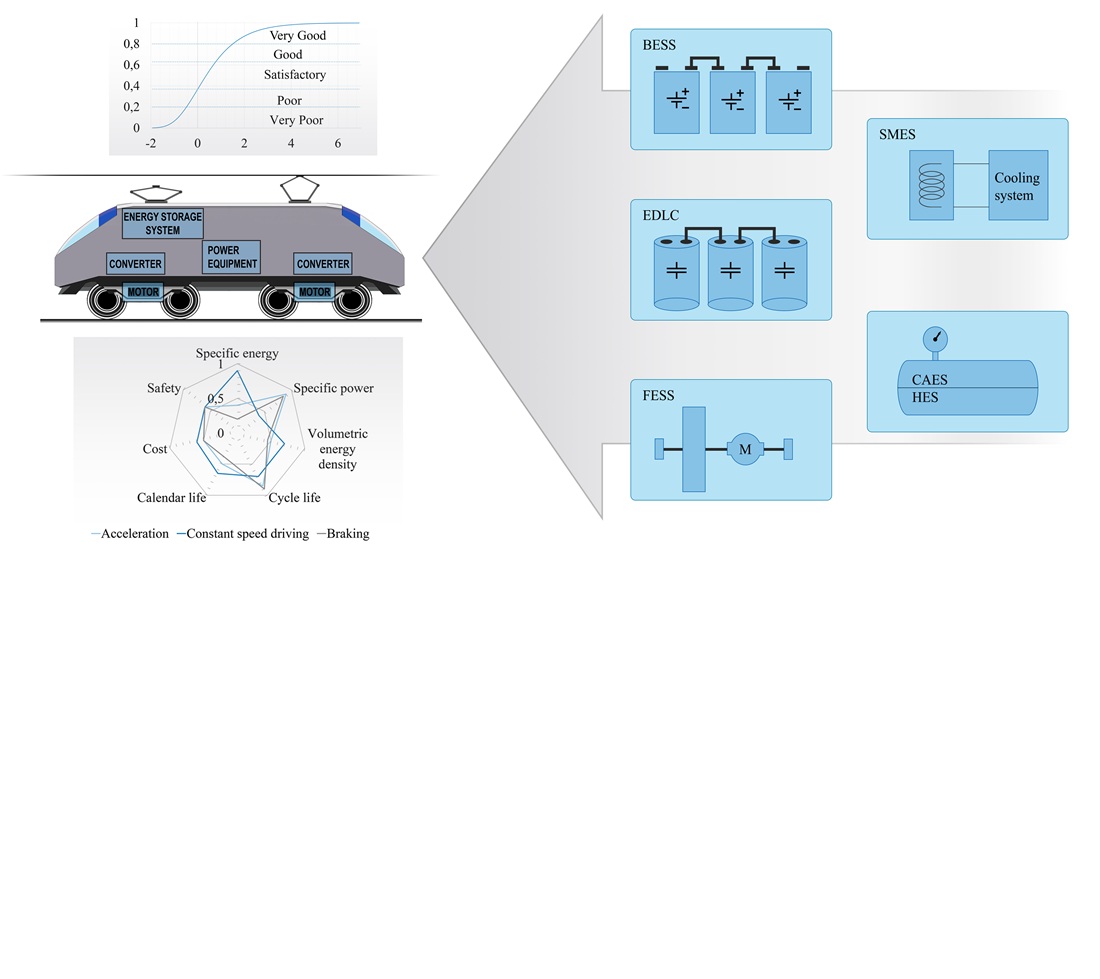
This study examines the rolling stock that currently employs or could be equipped with plug-in hybrid traction systems.
Existing methodologies for selecting energy storage systems often limit their applicability, which creates certain constraints when choosing a solution for hybrid traction systems.
As a result of the study, a well-founded preliminary selection of an energy storage system based on expert evaluation and the Harrington desirability function was carried out.
Engaging experts in relevant fields makes it possible to obtain up-to-date information on technology development and assess whether parameters meet specific requirements. The application of methods for evaluating expert consensus provides a foundation for using the results in subsequent calculations.
Harrington desirability function makes it possible to combine parameters with varying units of measurement and other differences, yielding a single value that can simplify decision-making.
Using expert-derived evaluations, weighting coefficients for various parameters were calculated for the defined types of rolling stock.
In the current research, three types of energy storage systems were selected for locomotives and multiple-unit rolling stock, meeting the specified conditions. These include battery, supercapacitor-based and flywheel-based storage systems, with overall desirability scores (without weighting coefficients) of 0.638, 0.636, and 0.573, respectively.
Modifying the set of parameters, introducing additional constraints, and adjusting weighting coefficients in conjunction with motion optimization tasks makes it possible to adapt the methodology to the requirements for specific projects for constructing or upgrading rolling stock with plug-in hybrid traction systems
References
- Pal, P., Gopal, P. R. C., Ramkumar, M. (2023). Impact of transportation on climate change: An ecological modernization theoretical perspective. Transport Policy, 130, 167–183. https://doi.org/10.1016/j.tranpol.2022.11.008
- Railway Handbook (2017). IEA. Available at: https://www.iea.org/reports/railway-handbook-2017
- Domínguez, M., Fernández-Cardador, A., Fernández-Rodríguez, A., Cucala, A. P., Pecharromán, R. R., Urosa Sánchez, P., Vadillo Cortázar, I. (2025). Review on the use of energy storage systems in railway applications. Renewable and Sustainable Energy Reviews, 207, 114904. https://doi.org/10.1016/j.rser.2024.114904
- Mitali, J., Dhinakaran, S., Mohamad, A. A. (2022). Energy storage systems: a review. Energy Storage and Saving, 1 (3), 166–216. https://doi.org/10.1016/j.enss.2022.07.002
- Fedele, E., Iannuzzi, D., Del Pizzo, A. (2021). Onboard energy storage in rail transport: Review of real applications and techno‐economic assessments. IET Electrical Systems in Transportation, 11 (4), 279–309. https://doi.org/10.1049/els2.12026
- Saeed, M., Briz, F., Guerrero, J. M., Larrazabal, I., Ortega, D., Lopez, V., Valera, J. J. (2023). Onboard Energy Storage Systems for Railway: Present and Trends. IEEE Open Journal of Industry Applications, 4, 238–259. https://doi.org/10.1109/ojia.2023.3293059
- Knibbe, R., Harding, D., Burton, J., Cooper, E., Amir Zadeh, Z., Sagulenko, M. et al. (2023). Optimal battery and hydrogen fuel cell sizing in heavy-haul locomotives. Journal of Energy Storage, 71, 108090. https://doi.org/10.1016/j.est.2023.108090
- Chang, A. S., Kalawsky, R. S. (2025). Retrofitting existing rolling stock for wire-free travel: Exploring energy storage solutions for partial catenary-free light rail vehicle. Transportation Engineering, 19, 100291. https://doi.org/10.1016/j.treng.2024.100291
- Liu, X., Li, K. (2020). Energy storage devices in electrified railway systems: A review. Transportation Safety and Environment, 2 (3), 183–201. https://doi.org/10.1093/tse/tdaa016
- Riabov, I., Overianova, L., Iakunin, D., Neshcheret, V., Ivanov, K. (2025). Equipping suburban diesel–electric multiple unit with a hybrid power unit. E-Prime - Advances in Electrical Engineering, Electronics and Energy, 11, 100949. https://doi.org/10.1016/j.prime.2025.100949
- Zubiria, A., Menéndez, Á., Grande, H.-J., Meneses, P., Fernández, G. (2022). Multi-Criteria Decision-Making Problem for Energy Storage Technology Selection for Different Grid Applications. Energies, 15 (20), 7612. https://doi.org/10.3390/en15207612
- Qie, X., Zhang, R., Hu, Y., Sun, X., Chen, X. (2021). A Multi-Criteria Decision-Making Approach for Energy Storage Technology Selection Based on Demand. Energies, 14 (20), 6592. https://doi.org/10.3390/en14206592
- Buriakovskiy, S., Maslii, A., Pomazan, D., Panchenko, V., Overianova, L., Omelianenko, H. (2020). Multi-criteria Quality Evaluation of Energy Storage Devices for Rolling Stock Using Harrington’s Desirability Function. 2020 IEEE 7th International Conference on Energy Smart Systems (ESS), 158–163. https://doi.org/10.1109/ess50319.2020.9160105
- Shrout, P. E., Fleiss, J. L. (1979). Intraclass correlations: Uses in assessing rater reliability. Psychological Bulletin, 86 (2), 420–428. https://doi.org/10.1037/0033-2909.86.2.420
- McGraw, K. O., Wong, S. P. (1996). Forming inferences about some intraclass correlation coefficients. Psychological Methods, 1 (1), 30–46. https://doi.org/10.1037/1082-989x.1.1.30
- Vallat, R. (2018). Pingouin: statistics in Python. Journal of Open Source Software, 3 (31), 1026. https://doi.org/10.21105/joss.01026
- Harrington, E. C., Jr. (1965). The Desirability Function. Industrial Quality Control, 21 (10), 494–498.
- Schöberl, J., Ank, M., Schreiber, M., Wassiliadis, N., Lienkamp, M. (2024). Thermal runaway propagation in automotive lithium-ion batteries with NMC-811 and LFP cathodes: Safety requirements and impact on system integration. ETransportation, 19, 100305. https://doi.org/10.1016/j.etran.2023.100305
- Ciccarelli, F., Iannuzzi, D., Tricoli, P. (2012). Control of metro-trains equipped with onboard supercapacitors for energy saving and reduction of power peak demand. Transportation Research Part C: Emerging Technologies, 24, 36–49. https://doi.org/10.1016/j.trc.2012.02.001
- Xu, K., Guo, Y., Lei, G., Zhu, J. (2023). A Review of Flywheel Energy Storage System Technologies. Energies, 16 (18), 6462. https://doi.org/10.3390/en16186462
- Khodaparastan, M., Mohamed, A. (2019). Flywheel vs. Supercapacitor as Wayside Energy Storage for Electric Rail Transit Systems. Inventions, 4 (4), 62. https://doi.org/10.3390/inventions4040062
- Dindorf, R., Takosoglu, J., Wos, P. (2023). Review of Compressed Air Receiver Tanks for Improved Energy Efficiency of Various Pneumatic Systems. Energies, 16 (10), 4153. https://doi.org/10.3390/en16104153
- Leon-Quiroga, J., Newell, B., Krishnamurthy, M., Gonzalez-Mancera, A., Garcia-Bravo, J. (2020). Energy Efficiency Comparison of Hydraulic Accumulators and Ultracapacitors. Energies, 13 (7), 1632. https://doi.org/10.3390/en13071632
- Pro zatverdzhennia Tekhnichnoho rehlamentu bezpeky rukhomoho skladu zaliznychnoho transportu (2015). Postanova Kabinetu Ministriv Ukrainy No. 1194. 30.12.2015. Redaktsiya vid 18.12.2019. Available at: https://zakon.rada.gov.ua/laws/show/1194-2015-%D0%BF#Text
- Riabov, I., Goolak, S., Neduzha, L. (2024). An Estimation of the Energy Savings of a Mainline Diesel Locomotive Equipped with an Energy Storage Device. Vehicles, 6 (2), 611–631. https://doi.org/10.3390/vehicles6020028
- Kondratieva, L., Bogdanovs, A., Overianova, L., Riabov, I., Goolak, S. (2023). Determination of the working energy capacity of the on-board energy storage system of an electric locomotive for quarry railway transport during working with a limitation of consumed power. Archives of Transport, 65 (1), 119–136. https://doi.org/10.5604/01.3001.0016.2631
Downloads
Published
How to Cite
Issue
Section
License
Copyright (c) 2025 Artem Maslii, Serhii Buriakovskyi, Roman Antonenko, Valentyn Gevrasov, Andrii Maslii

This work is licensed under a Creative Commons Attribution 4.0 International License.
The consolidation and conditions for the transfer of copyright (identification of authorship) is carried out in the License Agreement. In particular, the authors reserve the right to the authorship of their manuscript and transfer the first publication of this work to the journal under the terms of the Creative Commons CC BY license. At the same time, they have the right to conclude on their own additional agreements concerning the non-exclusive distribution of the work in the form in which it was published by this journal, but provided that the link to the first publication of the article in this journal is preserved.
A license agreement is a document in which the author warrants that he/she owns all copyright for the work (manuscript, article, etc.).
The authors, signing the License Agreement with TECHNOLOGY CENTER PC, have all rights to the further use of their work, provided that they link to our edition in which the work was published.
According to the terms of the License Agreement, the Publisher TECHNOLOGY CENTER PC does not take away your copyrights and receives permission from the authors to use and dissemination of the publication through the world's scientific resources (own electronic resources, scientometric databases, repositories, libraries, etc.).
In the absence of a signed License Agreement or in the absence of this agreement of identifiers allowing to identify the identity of the author, the editors have no right to work with the manuscript.
It is important to remember that there is another type of agreement between authors and publishers – when copyright is transferred from the authors to the publisher. In this case, the authors lose ownership of their work and may not use it in any way.








