Improving the efficiency of greenhouse control by using a Markov decision-making process model
DOI:
https://doi.org/10.15587/1729-4061.2025.338565Keywords:
greenhouse microclimate, two-level optimization, stochastic Markov decision-making process, precision agriculture, control problemAbstract
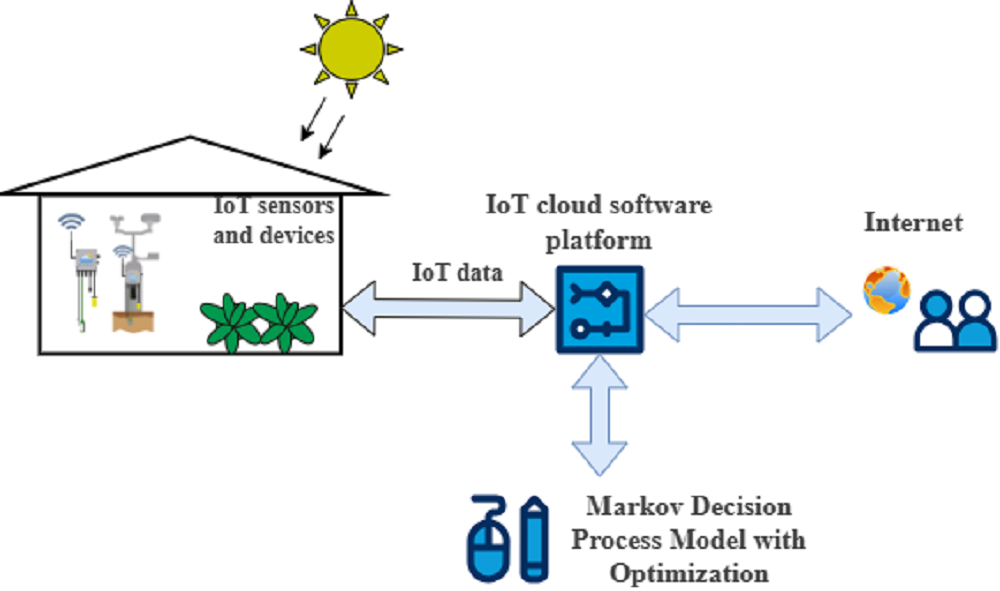
The object of this paper is the process of greenhouse control. The study solves the task of rational greenhouse control based on the Markov decision-making process taking into account two-level optimization. A random Markov decision-making process has been defined for the problem of greenhouse operation improvement.
A greenhouse control model was built, which makes it possible to determine rational microclimate parameters to grow agricultural crops. To validate the greenhouse control model, real data from an experiment on growing strawberries in a greenhouse complex were used.
Observations lasted from May 17 to June 8, 2025. Monitoring of microclimate parameters was carried out around the clock with an interval of 1 minute, which ensured high accuracy of the analysis. The experimental scenario included three irrigation circuits, a heating system, LED lighting, ventilation, and CO2 monitoring.
The proposed approach to greenhouse management based on the Markov decision-making process model demonstrates high practical value, especially in the context of growing sensitive crops such as strawberries. The simulation shows that the implementation of two-level optimization in autonomous greenhouse control systems could provide an increase in yield by 10.15%. At the same time, due to the significant volume of the greenhouse and the high thermal inertia of the structures, the actual values of the microclimate parameters deviate from the rational ones by 10–15%, as a result of which the calculated yield increase for the model built is about 7%.
References
- Sulser, T., Wiebe, K. D., Dunston, S., Cenacchi, N., Nin-Pratt, A., Mason-D’Croz, D. et al. (2021). Climate Change and hunger: Estimating costs of adaptation in the agrifood system. International Food Policy Research Institute. https://doi.org/10.2499/9780896294165
- Kazakhstan. Climate Change Knowledge Portal. Available at: https://climateknowledgeportal.worldbank.org/country/kazakhstan/climate-data-historical
- Visser, S., Keesstra, S., Maas, G., de Cleen, M., Molenaar, C. (2019). Soil as a Basis to Create Enabling Conditions for Transitions Towards Sustainable Land Management as a Key to Achieve the SDGs by 2030. Sustainability, 11 (23), 6792. https://doi.org/10.3390/su11236792
- Muhie, S. H. (2022). Novel approaches and practices to sustainable agriculture. Journal of Agriculture and Food Research, 10, 100446. https://doi.org/10.1016/j.jafr.2022.100446
- Okolie, C. C., Danso-Abbeam, G., Groupson-Paul, O., Ogundeji, A. A. (2022). Climate-Smart Agriculture Amidst Climate Change to Enhance Agricultural Production: A Bibliometric Analysis. Land, 12 (1), 50. https://doi.org/10.3390/land12010050
- Kazancoglu, Y., Lafci, C., Kumar, A., Luthra, S., Garza‐Reyes, J. A., Berberoglu, Y. (2023). The role of agri‐food 4.0 in climate‐smart farming for controlling climate change‐related risks: A business perspective analysis. Business Strategy and the Environment, 33 (4), 2788–2802. https://doi.org/10.1002/bse.3629
- Zhang, N., Wang, M., Wang, N. (2002). Precision agriculture – a worldwide overview. Computers and Electronics in Agriculture, 36 (2-3), 113–132. https://doi.org/10.1016/s0168-1699(02)00096-0
- Loures, L., Chamizo, A., Ferreira, P., Loures, A., Castanho, R., Panagopoulos, T. (2020). Assessing the Effectiveness of Precision Agriculture Management Systems in Mediterranean Small Farms. Sustainability, 12 (9), 3765. https://doi.org/10.3390/su12093765
- Sparks, B. D. (2018). What Is the Current State of Labor in the Greenhouse Industry? Available at: https://www.greenhousegrower.com/management/what-is-the-current-state-of-labor-in-the-greenhouse-industry/
- Cao, X., Yao, Y., Li, L., Zhang, W., An, Z., Zhang, Z. et al. (2022). iGrow: A Smart Agriculture Solution to Autonomous Greenhouse Control. Proceedings of the AAAI Conference on Artificial Intelligence, 36 (11), 11837–11845. https://doi.org/10.1609/aaai.v36i11.21440
- Badji, A., Benseddik, A., Bensaha, H., Boukhelifa, A., Hasrane, I. (2022). Design, technology, and management of greenhouse: A review. Journal of Cleaner Production, 373, 133753. https://doi.org/10.1016/j.jclepro.2022.133753
- Choab, N., Allouhi, A., El Maakoul, A., Kousksou, T., Saadeddine, S., Jamil, A. (2019). Review on greenhouse microclimate and application: Design parameters, thermal modeling and simulation, climate controlling technologies. Solar Energy, 191, 109–137. https://doi.org/10.1016/j.solener.2019.08.042
- Voogt, J., van Weel, P. (2008). Climate control based on stomatal behavior in a semi-closed greenhouse system “Aircokas.” Acta Horticulturae, 797, 151–156. https://doi.org/10.17660/actahortic.2008.797.19
- Robles Algarín, C., Callejas Cabarcas, J., Polo Llanos, A. (2017). Low-Cost Fuzzy Logic Control for Greenhouse Environments with Web Monitoring. Electronics, 6 (4), 71. https://doi.org/10.3390/electronics6040071
- Noma, F., Babu, S. (2024). Predicting climate smart agriculture (CSA) practices using machine learning: A prime exploratory survey. Climate Services, 34, 100484. https://doi.org/10.1016/j.cliser.2024.100484
- Jones, J. W., Hoogenboom, G., Porter, C. H., Boote, K. J., Batchelor, W. D., Hunt, L. A. et al. (2003). The DSSAT cropping system model. European Journal of Agronomy, 18 (3-4), 235–265. https://doi.org/10.1016/s1161-0301(02)00107-7
- Mekala, M. S., Viswanathan, P. (2017). A Survey: Smart agriculture IoT with cloud computing. 2017 International Conference on Microelectronic Devices, Circuits and Systems (ICMDCS), 1–7. https://doi.org/10.1109/icmdcs.2017.8211551
- van Beveren, P. J. M., Bontsema, J., van Straten, G., van Henten, E. J. (2015). Optimal control of greenhouse climate using minimal energy and grower defined bounds. Applied Energy, 159, 509–519. https://doi.org/10.1016/j.apenergy.2015.09.012
- Parameswaran, G., Sivaprasath, K. (2016). Arduino based smart drip irrigation system using Internet of Things. International Journal of Engineering Science and Computing, 6 (5), 5518–5521.
- Platero-Horcajadas, M., Pardo-Pina, S., Cámara-Zapata, J.-M., Brenes-Carranza, J.-A., Ferrández-Pastor, F.-J. (2024). Enhancing Greenhouse Efficiency: Integrating IoT and Reinforcement Learning for Optimized Climate Control. Sensors, 24 (24), 8109. https://doi.org/10.3390/s24248109
- Vatskel, V., Kuchanskyi, O., Andrashko, Y. (2025). Strawberry Greenhouse Environmental Control Dataset. Zenodo. https://doi.org/10.5281/zenodo.16268298
- Cordwell, S. (2015). Markov Decision Process (MDP) Toolbox for Python. GitHub. Available at: https://github.com/sawcordwell/pymdptoolbox
- Nguyen, N. M., Tran, H. T., Duong, M. V., Bui, H., Tran, K. (2022). Differentiable physics-based greenhouse simulation. NeurIPS 2022 Workshop on Machine Learning and the Physical Sciences. Available at: https://ml4physicalsciences.github.io/2022/files/NeurIPS_ML4PS_2022_52.pdf
- Neftissov, A., Biloshchytskyi, A., Andrashko, Y., Vatskel, V., Toxanov, S., Gladka, M. (2024). Assessing the efficiency of using precision farming technology and remote monitoring of weather conditions in the activities of agricultural enterprises. Eastern-European Journal of Enterprise Technologies, 4 (13 (130)), 84–94. https://doi.org/10.15587/1729-4061.2024.309028
- Neftissov, A., Biloshchytskyi, A., Andrashko, Y., Kuchanskyi, O., Vatskel, V., Toxanov, S., Gladka, M. (2024). Evaluating the effectiveness of precision farming technologies in the activities of agricultural enterprises. Eastern-European Journal of Enterprise Technologies, 1 (13 (127)), 6–13. https://doi.org/10.15587/1729-4061.2024.298478
Downloads
Published
How to Cite
Issue
Section
License
Copyright (c) 2025 Andrii Biloshchytskyi, Yurii Andrashko, Oleksandr Kuchanskyi, Alexandr Neftissov, Myroslava Gladka, Volodymyr Vatskel, Sofiia Berdei

This work is licensed under a Creative Commons Attribution 4.0 International License.
The consolidation and conditions for the transfer of copyright (identification of authorship) is carried out in the License Agreement. In particular, the authors reserve the right to the authorship of their manuscript and transfer the first publication of this work to the journal under the terms of the Creative Commons CC BY license. At the same time, they have the right to conclude on their own additional agreements concerning the non-exclusive distribution of the work in the form in which it was published by this journal, but provided that the link to the first publication of the article in this journal is preserved.
A license agreement is a document in which the author warrants that he/she owns all copyright for the work (manuscript, article, etc.).
The authors, signing the License Agreement with TECHNOLOGY CENTER PC, have all rights to the further use of their work, provided that they link to our edition in which the work was published.
According to the terms of the License Agreement, the Publisher TECHNOLOGY CENTER PC does not take away your copyrights and receives permission from the authors to use and dissemination of the publication through the world's scientific resources (own electronic resources, scientometric databases, repositories, libraries, etc.).
In the absence of a signed License Agreement or in the absence of this agreement of identifiers allowing to identify the identity of the author, the editors have no right to work with the manuscript.
It is important to remember that there is another type of agreement between authors and publishers – when copyright is transferred from the authors to the publisher. In this case, the authors lose ownership of their work and may not use it in any way.








