Determining the possibility of high-precision deformation measurement in building structures using fiber-optic methods
DOI:
https://doi.org/10.15587/1729-4061.2025.342161Keywords:
fiber-optic sensor, deformation measurement, construction structure, Bragg grating, structural monitoringAbstract
The object of this study is the deformation process in reinforced-concrete structural elements equipped with embedded fiber-optic sensors. The problem addressed corresponds to unresolved issues identified in previous studies – namely, the lack of standardized quantitative evaluation of accuracy and stability in fiber-optic deformation measurement. Despite high laboratory precision, existing methods show reduced long-term reliability, temperature-strain cross-sensitivity, and calibration inconsistency when applied to real structures.
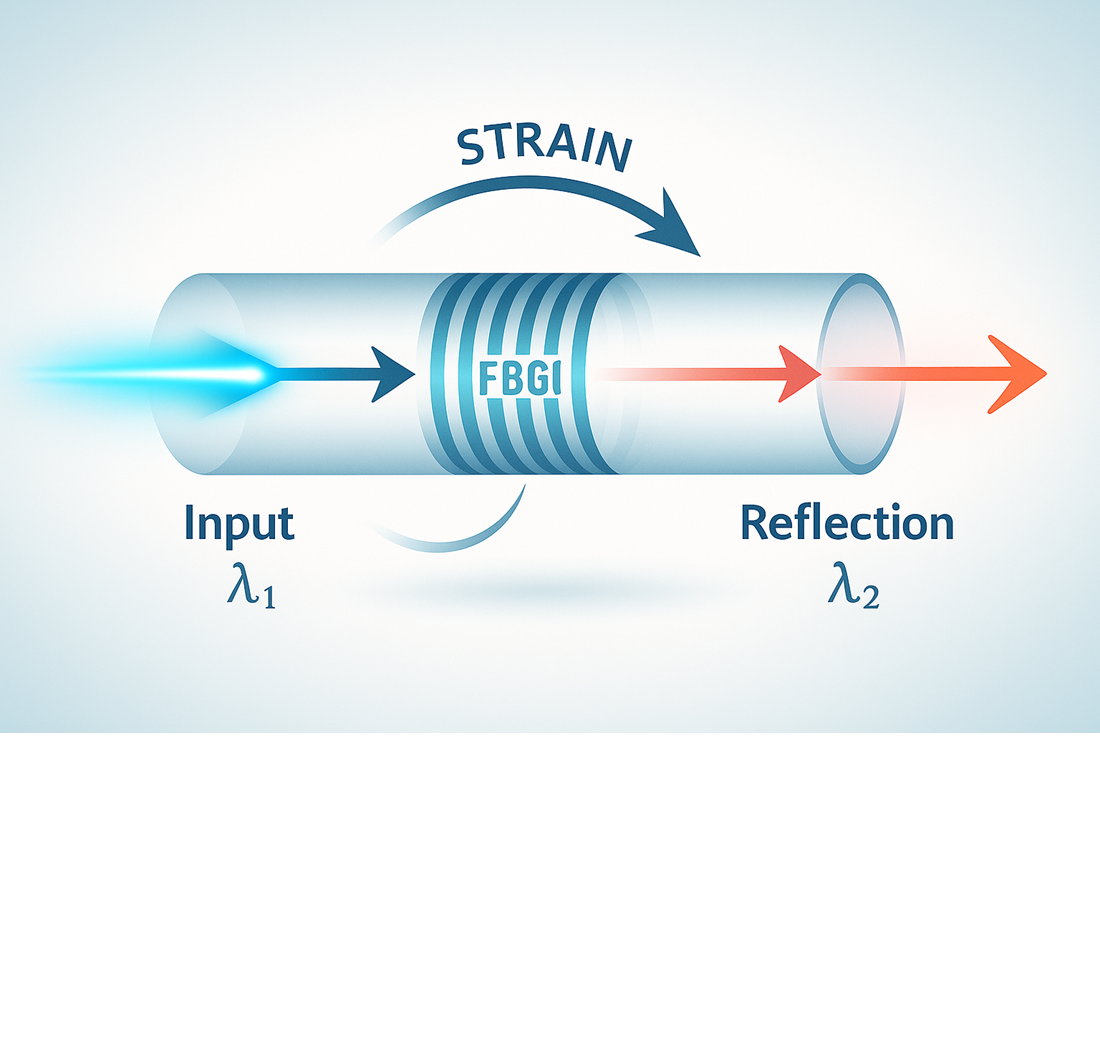
The main results show that fiber Bragg grating (FBG) and interferometric sensors achieved sub-micrometer deformation resolution with deviations below 2–3 με and long-term drift under 0.5%. Measurements remained stable under variable loading and temperature, confirming high reproducibility and electromagnetic immunity. These findings validate the hypothesis that optical wavelength shifts directly correspond to mechanical strain, ensuring reliable strain detection without recalibration.
This effectiveness stems from the intrinsic photoelastic coupling and refractive-index sensitivity of the optical fiber, which provide nanometric resolution, corrosion resistance, and long-term operational stability. The proposed method is applicable for long-term monitoring of bridges, tunnels, and high-rise facilities exposed to environmental and cyclic stresses. Therefore, research on high-precision fiber-optic deformation measurement remains scientifically relevant for improving the safety and durability of modern civil engineering structures.
References
- Wu, T., Liu, G., Fu, S., Xing, F. (2020). Recent Progress of Fiber-Optic Sensors for the Structural Health Monitoring of Civil Infrastructure. Sensors, 20 (16), 4517. https://doi.org/10.3390/s20164517
- Lopez-Higuera, J. M., Rodriguez Cobo, L., Quintela Incera, A., Cobo, A. (2011). Fiber Optic Sensors in Structural Health Monitoring. Journal of Lightwave Technology, 29 (4), 587–608. https://doi.org/10.1109/jlt.2011.2106479
- Barrias, A., Casas, J., Villalba, S. (2016). A Review of Distributed Optical Fiber Sensors for Civil Engineering Applications. Sensors, 16 (5), 748. https://doi.org/10.3390/s16050748
- Ye, X. W., Su, Y. H., Han, J. P. (2014). Structural Health Monitoring of Civil Infrastructure Using Optical Fiber Sensing Technology: A Comprehensive Review. The Scientific World Journal, 2014, 1–11. https://doi.org/10.1155/2014/652329
- Guo, H., Xiao, G., Mrad, N., Yao, J. (2011). Fiber Optic Sensors for Structural Health Monitoring of Air Platforms. Sensors, 11 (4), 3687–3705. https://doi.org/10.3390/s110403687
- Bao, X., Chen, L. (2012). Recent Progress in Distributed Fiber Optic Sensors. Sensors, 12 (7), 8601–8639. https://doi.org/10.3390/s120708601
- Motil, A., Bergman, A., Tur, M. (2016). [INVITED] State of the art of Brillouin fiber-optic distributed sensing. Optics & Laser Technology, 78, 81–103. https://doi.org/10.1016/j.optlastec.2015.09.013
- Bado, M. F., Casas, J. R. (2021). A Review of Recent Distributed Optical Fiber Sensors Applications for Civil Engineering Structural Health Monitoring. Sensors, 21 (5), 1818. https://doi.org/10.3390/s21051818
- Guemes, A., Mujica, L. E., del-Río-Velilla, D., Fernandez-Lopez, A. (2025). Structural Health Monitoring by Fiber Optic Sensors. Photonics, 12 (6), 604. https://doi.org/10.3390/photonics12060604
- Smailov, N., Tolemanova, A., Aziskhan, A., Sekenov, B., Sabibolda, A. (2025). Zastosowanie systemów czujników światłowodowych w monitorowaniu stanu technicznego konstrukcji betonowych. Informatyka, Automatyka, Pomiary w Gospodarce i Ochronie Środowiska, 15 (3), 73–76. https://doi.org/10.35784/iapgos.7606
- Wawrzyk, M. (2022). The spectrum length method in quantitative interpretation of selected optical spectra. Informatyka, Automatyka, Pomiary w Gospodarce i Ochronie Środowiska, 12 (2), 20–23. https://doi.org/10.35784/iapgos.2931
- Smailov, N., Koshkinbayev, S., Tashtay, Y., Kuttybayeva, A., Abdykadyrkyzy, R., Arseniev, D. et al. (2023). Numerical Simulation and Measurement of Deformation Wave Parameters by Sensors of Various Types. Sensors, 23 (22), 9215. https://doi.org/10.3390/s23229215
- Jati, M. P., Yao, C.-K., Wu, Y.-C., Luthfi, M. I., Yang, S.-H., Dehnaw, A. M., Peng, P.-C. (2025). A Deep Learning Framework for Enhancing High-Frequency Optical Fiber Vibration Sensing from Low-Sampling-Rate FBG Interrogators. Sensors, 25 (13), 4047. https://doi.org/10.3390/s25134047
- Sabibolda, A., Tsyporenko, V., Smailov, N., Tsyporenko, V., Abdykadyrov, A. (2024). Estimation of the Time Efficiency of a Radio Direction Finder Operating on the Basis of a Searchless Spectral Method of Dispersion-Correlation Radio Direction Finding. Advances in Asian Mechanism and Machine Science, 167, 62–70. https://doi.org/10.1007/978-3-031-67569-0_8
- Chen, X., Liu, M., Li, C., Song, H., Zhu, S. (2024). A novel integrated sensing structure based on double quartz tubes stepped fiber grating and its theoretical study on temperature sensing performance. Optics and Lasers in Engineering, 181, 108382. https://doi.org/10.1016/j.optlaseng.2024.108382
- Smailov, N., Orynbet, M., Nazarova, A., Torekhan, Z., Koshkinbayev, S., Yssyraiyl, K. et al. (2025). Optymalizacja pracy światłowodowych czujników w warunkach kosmicznych. Informatyka, Automatyka, Pomiary w Gospodarce i Ochronie Środowiska, 15 (2), 130–134. https://doi.org/10.35784/iapgos.7200
- Macedo, L., Souza, E. A., Frizera, A., Pontes, M. J., Marques, C., Leal-Junior, A. (2023). Static and Dynamic Multiparameter Assessment of Structural Elements Using Chirped Fiber Bragg Gratings. Sensors, 23 (4), 1860. https://doi.org/10.3390/s23041860
- Smailov, N., Zhadiger, T., Tashtay, Y., Abdykadyrov, A., Amir, A. (2024). Fiber laser-based two-wavelength sensors for detecting temperature and strain on concrete structures. International Journal of Innovative Research and Scientific Studies, 7 (4), 1693–1710. https://doi.org/10.53894/ijirss.v7i4.3481
- Huang, L., Zhao, Z., Sun, Y. (2024). Damage Monitoring of Reinforced Concrete Slabs Utilizing Distributed Fiber Sensing Technology. https://doi.org/10.2139/ssrn.4946103
- Smailov, N., Akmardin, S., Ayapbergenova, A., Ayapbergenova, G., Kadyrova, R., Sabibolda, A. (2025). Analiza wydajności VLC w optycznych systemach komunikacji bezprzewodowej do zastosowań wewnętrznych. Informatyka, Automatyka, Pomiary w Gospodarce i Ochronie Środowiska, 15 (2), 135–138. https://doi.org/10.35784/iapgos.6971
- Alj, I., Quiertant, M., Khadour, A., Grando, Q., Benzarti, K. (2022). Application of Distributed Optical Fiber Sensing Technology to the Detection and Monitoring of Internal Swelling Pathologies in Massive Concrete Blocks. Sensors, 22 (20), 7797. https://doi.org/10.3390/s22207797
- Smailov, N., Tsyporenko, V., Sabibolda, A., Tsyporenko, V., Abdykadyrov, A., Kabdoldina, A. et al. (2024). Streamlining digital correlation-interferometric direction finding with spatial analytical signal. Informatyka, Automatyka, Pomiary w Gospodarce i Ochronie Środowiska, 14 (3), 43–48. https://doi.org/10.35784/iapgos.6177
- Chethana, K., Nandi, S., Prasad, A. S. G., Asokan, S. (2025). Fiber Bragg Grating based optical sensor for pulse morphology. Journal of Optics. https://doi.org/10.1007/s12596-025-02895-1
- Abdykadyrov, A., Smailov, N., Sabibolda, A., Tolen, G., Dosbayev, Z., Ualiyev, Z., Kadyrova, R. (2024). Optimization of distributed acoustic sensors based on fiber optic technologies. Eastern-European Journal of Enterprise Technologies, 5 (5 (131)), 50–59. https://doi.org/10.15587/1729-4061.2024.313455
- Xue, W., Huang, H., Pang, X., Yan, G. (2025). Fiber Bragg Grating Based Load Monitoring for Carrier-Based Aircraft Main Landing Gear. Sensors, 25 (17), 5559. https://doi.org/10.3390/s25175559
- Yassin, M. H., Farhat, M. H., Nahas, M., Saad, A. S. (2024). Investigation of fiber Bragg grating sensor measurability in concrete beams under static load conditions. Heliyon, 10 (22), e40105. https://doi.org/10.1016/j.heliyon.2024.e40105
- Yang, H., Huang, Y., Zhou, Z., Ou, J. (2022). Long-term performance of packaged fiber Bragg grating sensors for strain monitoring inside creep medium. International Journal of Smart and Nano Materials, 13 (1), 42–63. https://doi.org/10.1080/19475411.2022.2027548
- Zdanowicz, K., Gebauer, D., Koschemann, M., Speck, K., Steinbock, O., Beckmann, B., Marx, S. (2022). Distributed fiber optic sensors for measuring strains of concrete, steel, and textile reinforcement: Possible fields of application. Structural Concrete, 23 (6), 3367–3382. https://doi.org/10.1002/suco.202100689
- Sahota, J. K., Gupta, N., Dhawan, D. (2020). Fiber Bragg grating sensors for monitoring of physical parameters: a comprehensive review. Optical Engineering, 59 (06), 1. https://doi.org/10.1117/1.oe.59.6.060901
- Smailov, N., Tolemanova, A., Ayapbergenova, A., Tashtay, Y., Amir, A. (2025). Modelling and Application of Fibre Optic Sensors for Concrete Structures: A Literature Review. Civil Engineering and Architecture, 13 (3), 1885–1897. https://doi.org/10.13189/cea.2025.130332
Downloads
Published
How to Cite
Issue
Section
License
Copyright (c) 2025 Nurzhigit Smailov, Amandyk Tuleshov, Akezhan Sabibolda, Yersaiyn Mailybayev, Nurzhamal Kashkimbayeva, Ainur Kuttybayeva, Gulbakhar Yussupova, Askhat Batyrgaliyev, Beibarys Sekenov, Aziskhan Amir

This work is licensed under a Creative Commons Attribution 4.0 International License.
The consolidation and conditions for the transfer of copyright (identification of authorship) is carried out in the License Agreement. In particular, the authors reserve the right to the authorship of their manuscript and transfer the first publication of this work to the journal under the terms of the Creative Commons CC BY license. At the same time, they have the right to conclude on their own additional agreements concerning the non-exclusive distribution of the work in the form in which it was published by this journal, but provided that the link to the first publication of the article in this journal is preserved.
A license agreement is a document in which the author warrants that he/she owns all copyright for the work (manuscript, article, etc.).
The authors, signing the License Agreement with TECHNOLOGY CENTER PC, have all rights to the further use of their work, provided that they link to our edition in which the work was published.
According to the terms of the License Agreement, the Publisher TECHNOLOGY CENTER PC does not take away your copyrights and receives permission from the authors to use and dissemination of the publication through the world's scientific resources (own electronic resources, scientometric databases, repositories, libraries, etc.).
In the absence of a signed License Agreement or in the absence of this agreement of identifiers allowing to identify the identity of the author, the editors have no right to work with the manuscript.
It is important to remember that there is another type of agreement between authors and publishers – when copyright is transferred from the authors to the publisher. In this case, the authors lose ownership of their work and may not use it in any way.








