Determining the effect of rotation speed on the energy efficiency of the impact, compression, and abrasion grinding processes in a tumbling mill
DOI:
https://doi.org/10.15587/1729-4061.2025.343388Keywords:
tumbling mill, intra-chamber filling, grinding by impact, crushing, and abrasion, energy efficiencyAbstract
This study investigates a grinding process in a tumbling mill loaded by impact, crushing, and abrasion. The impact, compression, and shear interactions of particles are taken into account, the intensity of which is determined by the zones of flight, shear layer, and solid flow of the fill in the cross-section of the rotating drum chamber.
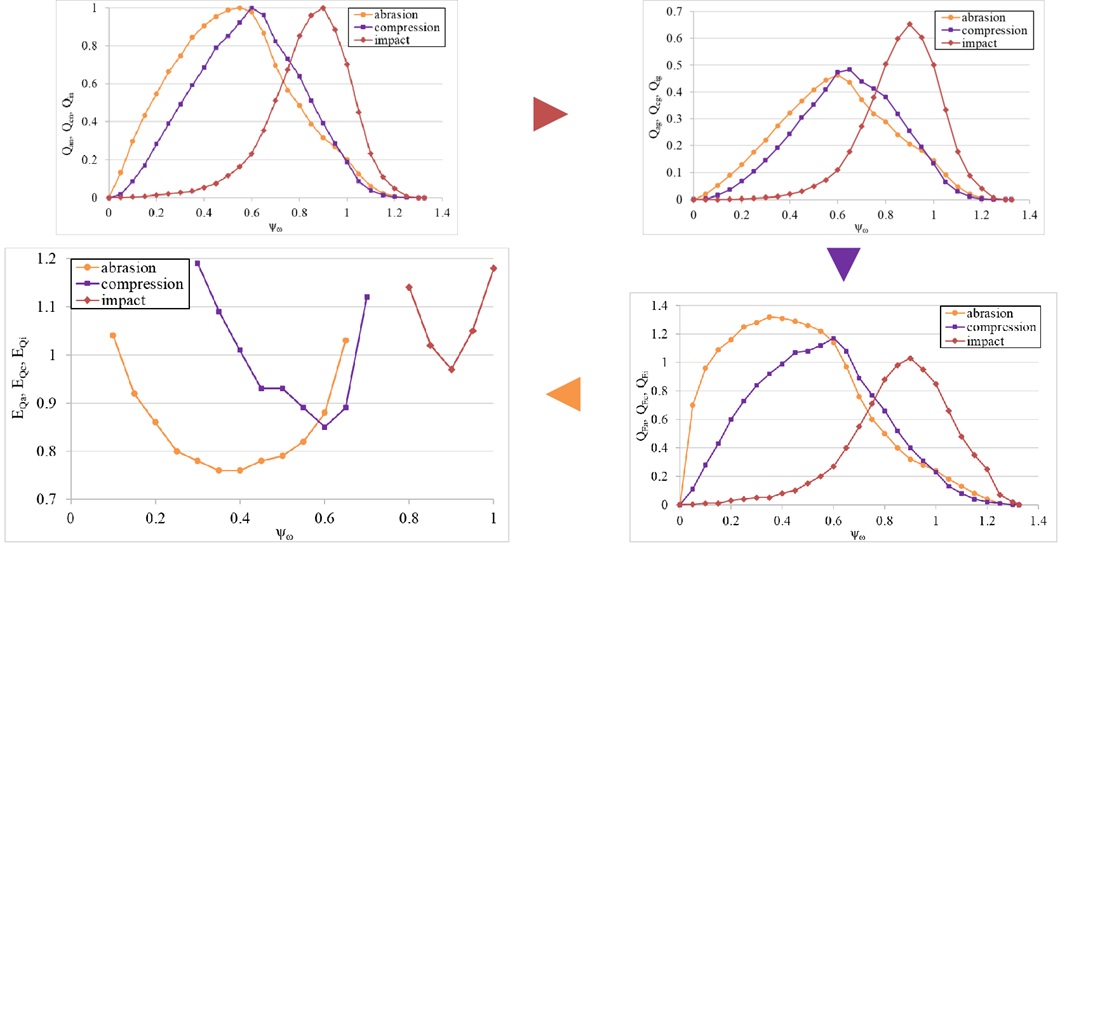
The task addressed is to determine the influence of rotation speed on the energy intensity of the grinding process for individual loading mechanisms.
An experimental method for numerical modeling of productivity analogs for grinding mechanisms by the energies of the corresponding interactions was applied.
The energy intensity of the process was estimated by the ratios of productivity analogs and the relative power of rotation drive. Energy efficiency was determined taking into account experimental data on physical productivity and drive power of the mill model.
The effect of rotation speed on grinding was experimentally estimated at a chamber filling degree of 0.45.
The phenomenon of an intensive decrease in the energy intensity of the grinding process with a decrease in rotation speed was established.
The results made it possible to identify energy-efficient values of the relative rotation speed for the grinding processes: coarse – by impact at ψω = 0.75–0.9, medium – by crushing at ψω = 0.55–0.65, and fine – by abrasion at ψω = 0.3–0.4. The established effect is explained by the revealed activation of interactions: impact – at high-speed, compressive – at medium-speed, and shear – at low-speed rotation.
The established patterns enable prediction of rational technological parameters for energy-saving processes of multi-stage grinding in tumbling mills.
References
- Deniz, V. (2013). Comparisons of Dry Grinding Kinetics of Lignite, Bituminous Coal, and Petroleum Coke. Energy Sources, Part A: Recovery, Utilization, and Environmental Effects, 35 (10), 913–920. https://doi.org/10.1080/15567036.2010.514591
- Góralczyk, M., Krot, P., Zimroz, R., Ogonowski, S. (2020). Increasing Energy Efficiency and Productivity of the Comminution Process in Tumbling Mills by Indirect Measurements of Internal Dynamics – An Overview. Energies, 13 (24), 6735. https://doi.org/10.3390/en13246735
- Tavares, L. M. (2017). A Review of Advanced Ball Mill Modelling. KONA Powder and Particle Journal, 34, 106–124. https://doi.org/10.14356/kona.2017015
- Kelly, E. G., Spottiswood, D. J. (1982). Introduction to Mineral Processing. Wiley.
- Gupta, A., Yan, D. S. (Eds.) (2016). Mineral processing design and operations: An introduction. Elsevier. https://doi.org/10.1016/c2014-0-01236-1
- King, R. P. (2001). Modeling and simulation of mineral processing systems. Elsevier. https://doi.org/10.1016/c2009-0-26303-3
- Wills, B. A., Finch, J. (2015). Wills’ mineral processing technology: an introduction to the practical aspects of ore treatment and mineral recovery. Butterworth-Heinemann. https://doi.org/10.1016/c2010-0-65478-2
- Kwon, J., Jeong, J., Cho, H. (2016). Simulation and optimization of a two-stage ball mill grinding circuit of molybdenum ore. Advanced Powder Technology, 27 (4), 1073–1085. https://doi.org/10.1016/j.apt.2016.03.016
- Dhiman, S., Joshi, R. S., Singh, S., Gill, S. S., Singh, H., Kumar, R., Kumar, V. (2022). Recycling of Ti6Al4V machining swarf into additive manufacturing feedstock powder to realise sustainable recycling goals. Journal of Cleaner Production, 348, 131342. https://doi.org/10.1016/j.jclepro.2022.131342
- Mulenga, F. K., Moys, M. H. (2014). Effects of slurry filling and mill speed on the net power draw of a tumbling ball mill. Minerals Engineering, 56, 45–56. https://doi.org/10.1016/j.mineng.2013.10.028
- Soleymani, M. M., Fooladi, M., Rezaeizadeh, M. (2016). Experimental investigation of the power draw of tumbling mills in wet grinding. Proceedings of the Institution of Mechanical Engineers, Part C: Journal of Mechanical Engineering Science, 230 (15), 2709–2719. https://doi.org/10.1177/0954406215598801
- Soleymani, M. M., Fooladi, M., Rezaeizadeh, M. (2016). Effect of slurry pool formation on the load orientation, power draw, and impact force in tumbling mills. Powder Technology, 287, 160–168. https://doi.org/10.1016/j.powtec.2015.10.009
- Yin, Z., Peng, Y., Zhu, Z., Ma, C., Yu, Z., Wu, G. (2019). Effect of mill speed and slurry filling on the charge dynamics by an instrumented ball. Advanced Powder Technology, 30 (8), 1611–1616. https://doi.org/10.1016/j.apt.2019.05.009
- Bian, X., Wang, G., Wang, H., Wang, S., Lv, W. (2017). Effect of lifters and mill speed on particle behaviour, torque, and power consumption of a tumbling ball mill: Experimental study and DEM simulation. Minerals Engineering, 105, 22–35. https://doi.org/10.1016/j.mineng.2016.12.014
- Anticoi, H., Guasch, E., Pérez-Álvarez, R., de Luis-Ruiz, J. M., Oliva, J., Hoffman Sampaio, C. (2022). Rod Mill Product Control and Its Relation to Energy Consumption: A Case Study. Minerals, 12 (2), 183. https://doi.org/10.3390/min12020183
- Deniz, V. (2004). The effect of mill speed on kinetic breakage parameters of clinker and limestone. Cement and Concrete Research, 34 (8), 1365–1371. https://doi.org/10.1016/j.cemconres.2003.12.025
- Deniz, V. (2013). Effects of Mill Speed on Kinetic Breakage Parameters of Four Different Particulate Pumices. Particulate Science and Technology, 31 (2), 101–108. https://doi.org/10.1080/02726351.2012.658903
- Mulenga, F. K., Chimwani, N. (2013). Introduction to the use of the attainable region method in determining the optimal residence time of a ball mill. International Journal of Mineral Processing, 125, 39–50. https://doi.org/10.1016/j.minpro.2013.09.007
- Yin, Z., Peng, Y., Zhu, Z., Yu, Z., Li, T. (2017). Impact Load Behavior between Different Charge and Lifter in a Laboratory-Scale Mill. Materials, 10 (8), 882. https://doi.org/10.3390/ma10080882
- Soleymani, M. M. (2021). RETRACTED: Experimental Study of Operational Parameters on Product Size Distribution of Tumbling Mill. Proceedings of the Institution of Mechanical Engineers, Part E: Journal of Process Mechanical Engineering. https://doi.org/10.1177/09544089211062763
- Li, T., Yin, Z., Wu, G. (2021). Study on heat transfer behavior and thermal breakage characteristic of the charge in ball mills. Advances in Mechanical Engineering, 13 (3). https://doi.org/10.1177/1687814021994964
- Cayirli, S. (2018). Influences of operating parameters on dry ball mill performance. Physicochemical Problems of Mineral Processing, 54 (3). https://doi.org/10.5277/ppmp1876
- Hanumanthappa, H., Vardhan, H., Mandela, G. R., Kaza, M., Sah, R., Shanmugam, B. K. (2020). A comparative study on a newly designed ball mill and the conventional ball mill performance with respect to the particle size distribution and recirculating load at the discharge end. Minerals Engineering, 145, 106091. https://doi.org/10.1016/j.mineng.2019.106091
- Gupta, V. K., Sharma, S. (2014). Analysis of ball mill grinding operation using mill power specific kinetic parameters. Advanced Powder Technology, 25 (2), 625–634. https://doi.org/10.1016/j.apt.2013.10.003
- Gupta, V. K. (2020). Energy absorption and specific breakage rate of particles under different operating conditions in dry ball milling. Powder Technology, 361, 827–835. https://doi.org/10.1016/j.powtec.2019.11.033
- Chimwani, N., Mulenga, F. K., Hildebrandt, D., Glasser, D., Bwalya, M. M. (2014). Scale-up of batch grinding data for simulation of industrial milling of platinum group minerals ore. Minerals Engineering, 63, 100–109. https://doi.org/10.1016/j.mineng.2014.01.023
- Chimwani, N., Mulenga, F. K., Hildebrandt, D., Glasser, D., Bwalya, M. M. (2015). Use of the attainable region method to simulate a full-scale ball mill with a realistic transport model. Minerals Engineering, 73, 116–123. https://doi.org/10.1016/j.mineng.2014.06.012
- Chimwani, N., Hildebrandt, D. (2018). Modeling of an open mill with scalped feed for the maximum production of a desired particle size range. Particulate Science and Technology, 37 (3), 314–324. https://doi.org/10.1080/02726351.2017.1370048
- Chimwani, N. (2021). A Review of the Milestones Reached by the Attainable Region Optimisation Technique in Particle Size Reduction. Minerals, 11 (11), 1280. https://doi.org/10.3390/min11111280
- Makgoale, D. M. (2019). Effects Of Mill Rotational Speed On The Batch Grinding Kinetics Of A UG2 Platinum Ore. UNISA. Available at: https://uir.unisa.ac.za/items/2894bd6d-32c1-418e-a4c5-e011f4b757d0
- Metzger, M. J., Glasser, B. J. (2013). Simulation of the breakage of bonded agglomerates in a ball mill. Powder Technology, 237, 286–302. https://doi.org/10.1016/j.powtec.2012.12.006
- Metzger, M. J., Desai, S. P., Glasser, D., Hildebrandt, D., Glasser, B. J. (2011). Using the attainable region analysis to determine the effect of process parameters on breakage in a ball mill. AIChE Journal, 58 (9), 2665–2673. https://doi.org/10.1002/aic.12792
- Metzger, M. J., Glasser, D., Hausberger, B., Hildebrandt, D., Glasser, B. J. (2009). Use of the attainable region analysis to optimize particle breakage in a ball mill. Chemical Engineering Science, 64 (17), 3766–3777. https://doi.org/10.1016/j.ces.2009.05.012
- Naumenko, Y. (2017). Modeling of fracture surface of the quasi solid-body zone of motion of the granular fill in a rotating chamber. Eastern-European Journal of Enterprise Technologies, 2 (1 (86)), 50–57. https://doi.org/10.15587/1729-4061.2017.96447
- Naumenko, Y., Sivko, V. (2017). The rotating chamber granular fill shear layer flow simulation. Eastern-European Journal of Enterprise Technologies, 4 (7 (88)), 57–64. https://doi.org/10.15587/1729-4061.2017.107242
- Naumenko, Y. (2017). Modeling a flow pattern of the granular fill in the cross section of a rotating chamber. Eastern-European Journal of Enterprise Technologies, 5 (1 (89)), 59–69. https://doi.org/10.15587/1729-4061.2017.110444
- Deineka, K., Naumenko, Y. (2019). Revealing the effect of decreased energy intensity of grinding in a tumbling mill during self-excitation of auto-oscillations of the intrachamber fill. Eastern-European Journal of Enterprise Technologies, 1 (1), 6–15. https://doi.org/10.15587/1729-4061.2019.155461
- Deineka, K., Naumenko, Y. (2019). Establishing the effect of a decrease in power intensity of self-oscillating grinding in a tumbling mill with a reduction in an intrachamber fill. Eastern-European Journal of Enterprise Technologies, 6 (7 (102)), 43–52. https://doi.org/10.15587/1729-4061.2019.183291
- Deineka, K., Naumenko, Y. (2020). Establishing the effect of decreased power intensity of self-oscillatory grinding in a tumbling mill when the crushed material content in the intra-chamber fill is reduced. Eastern-European Journal of Enterprise Technologies, 4 (1 (106)), 39–48. https://doi.org/10.15587/1729-4061.2020.209050
- Deineka, K., Naumenko, Y. (2021). Establishing the effect of a simultaneous reduction in the filling load inside a chamber and in the content of the crushed material on the energy intensity of self-oscillatory grinding in a tumbling mill. Eastern-European Journal of Enterprise Technologies, 1 (1 (109)), 77–87. https://doi.org/10.15587/1729-4061.2021.224948
- Deineka, K., Naumenko, Y. (2022). Revealing the mechanism of stability loss of a two-fraction granular flow in a rotating drum. Eastern-European Journal of Enterprise Technologies, 4 (1 (118)), 34–46. https://doi.org/10.15587/1729-4061.2022.263097
- Deineka, K. Yu., Naumenko, Yu. V. (2018). The tumbling mill rotation stability. Scientific Bulletin of National Mining University, 1, 60–68. https://doi.org/10.29202/nvngu/2018-1/10
- Naumenko, Y., Deineka, K. (2023). Building a model of the impact grinding mechanism in a tumbling mill based on data visualization. Eastern-European Journal of Enterprise Technologies, 3 (7 (123)), 65–73. https://doi.org/10.15587/1729-4061.2023.283073
- Naumenko, Y., Deineka, K. (2023). Building a model of the compression grinding mechanism in a tumbling mill based on data visualization. Eastern-European Journal of Enterprise Technologies, 5 (1 (125)), 64–72. https://doi.org/10.15587/1729-4061.2023.287565
- Naumenko, Y., Deineka, K., Zabchyk, S. (2024). Building a model of the abrasion grinding mechanism in a tumbling mill based on data visualization. Eastern-European Journal of Enterprise Technologies, 2 (1 (128)), 21–33. https://doi.org/10.15587/1729-4061.2024.301653
- Coal preparation plant – Principles and conventions for flowsheets (ISO/IEC Standard No. 924:1989). International Organization for Standardization. Available at: https://www.iso.org/ru/standard/5340.html
- DIN EN 1009-3. Maschinen für die mechanische Aufbereitung von Mineralien und ähnlichen festen Stoffen - Sicherheit - Teil 3: Spezifische Anforderungen für Brecher und Mühlen; Deutsche Fassung EN 1009-3:2020. Deutsches Institut für Normung. Available at: https://www.din.de/de/mitwirken/normenausschuesse/nam/veroeffentlichungen/wdc-beuth:din21:316006092
Downloads
Published
How to Cite
Issue
Section
License
Copyright (c) 2025 Yuriy Naumenko, Kateryna Deineka

This work is licensed under a Creative Commons Attribution 4.0 International License.
The consolidation and conditions for the transfer of copyright (identification of authorship) is carried out in the License Agreement. In particular, the authors reserve the right to the authorship of their manuscript and transfer the first publication of this work to the journal under the terms of the Creative Commons CC BY license. At the same time, they have the right to conclude on their own additional agreements concerning the non-exclusive distribution of the work in the form in which it was published by this journal, but provided that the link to the first publication of the article in this journal is preserved.
A license agreement is a document in which the author warrants that he/she owns all copyright for the work (manuscript, article, etc.).
The authors, signing the License Agreement with TECHNOLOGY CENTER PC, have all rights to the further use of their work, provided that they link to our edition in which the work was published.
According to the terms of the License Agreement, the Publisher TECHNOLOGY CENTER PC does not take away your copyrights and receives permission from the authors to use and dissemination of the publication through the world's scientific resources (own electronic resources, scientometric databases, repositories, libraries, etc.).
In the absence of a signed License Agreement or in the absence of this agreement of identifiers allowing to identify the identity of the author, the editors have no right to work with the manuscript.
It is important to remember that there is another type of agreement between authors and publishers – when copyright is transferred from the authors to the publisher. In this case, the authors lose ownership of their work and may not use it in any way.








