Identifying the factors on the intensification affecting of the wine clarification process
DOI:
https://doi.org/10.15587/1729-4061.2025.344043Keywords:
enzyme preparations, clarification, wine material, ultrasound, membrane filtration, cold maceration, monomeric anthocyanins, phenolic compoundsAbstract
The object of the study is the intensification of the wine clarification process. Although a number of studies have been conducted on the clarification of wines, the effect of enzymes, ultrasound, membrane filter, ultrasound and maceration factor on the clarification intensity has not been sufficiently studied.
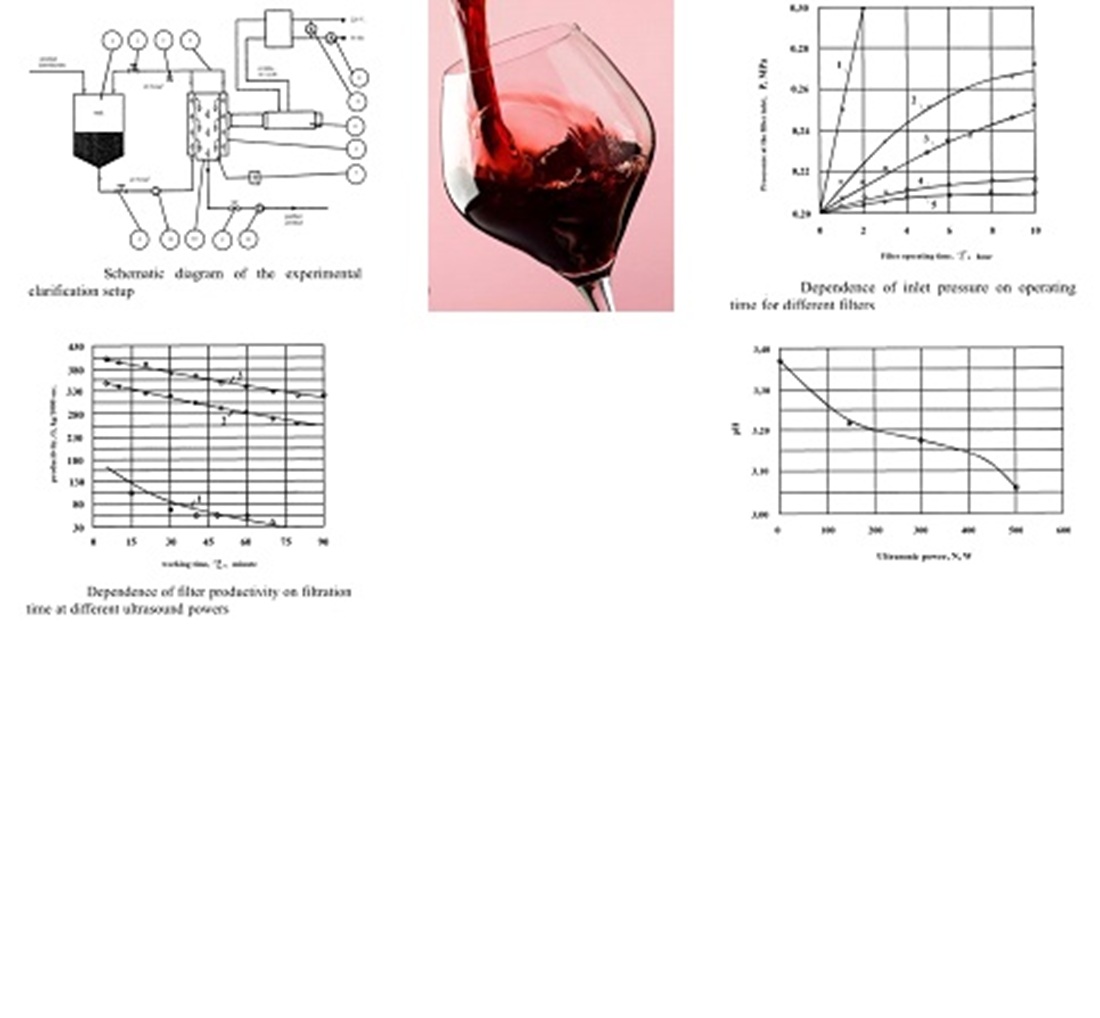
It has been found that the β-glucanase enzyme, compared to other enzymes, creates a basis for a greater decrease in the amount of polysaccharides, especially glucomannan, in pink wines and that the sample remains stable for 10 months. For white table wines, treatment with pectofoetidin P 10х and G 10х enzymes and subsequent pasting, cold processing and filtration gave better results. It has been established that ultrasonic processing of wine materials increases the aromatic substances in the composition, color, acidity, and improves the stability of wines. The productivity of membrane filters increases, the filtration and clarification processes of wine materials are intensified. Ultrasonic frequency, acoustic oscillations applied to the liquid increase the permeability of the filters and allow them to operate in a self-cleaning mode. Cold maceration of Madrasa and Merlot grape varieties at 7-8°C for 4 days before fermentation allows for the production of juice with high color density, rich in total anthocyanins and phenolic compounds.
The production of stable wines using enzymes and cold maceration, as well as the intensification of clarification using ultrasound and membrane filter ultrasound, solves the problem and makes these studies important for production. The results obtained can be used in factories and wineries.
References
- Vázquez-Pateiro, I., Mirás-Avalos, J. M., Falqué, E. (2022). Influence of Must Clarification Technique on the Volatile Composition of Albariño and Treixadura Wines. Molecules, 27 (3), 810. https://doi.org/10.3390/molecules27030810
- Mierczynska-Vasilev, A., Smith, P. A. (2015). Current state of knowledge and challenges in wine clarification. Australian Journal of Grape and Wine Research, 21, 615–626. https://doi.org/10.1111/ajgw.12198
- Oro, C. E. D., Puton, B. M. S., Venquiaruto, L. D., Dallago, R. M., Arend, G. D., Tres, M. V. (2025). The Role of Membranes in Modern Winemaking: From Clarification to Dealcoholization. Membranes, 15 (1), 14. https://doi.org/10.3390/membranes15010014
- Cui, W., Wang, X., Han, S., Guo, W., Meng, N., Li, J. et al. (2024). Research progress of tartaric acid stabilization on wine characteristics. Food Chemistry: X, 23, 101728. https://doi.org/10.1016/j.fochx.2024.101728
- Angela, S., Wollan, D., Muhlack, R., Bindon, K., Wilkinson, K. (2024). Compositional Consequences of Ultrafiltration Treatment of White and Red Wines. Foods, 13 (12), 1850. https://doi.org/10.3390/foods13121850
- Wang, H., Fan, X., Zhou, Y., Li, D., Ling, M., Wei, X. et al. (2025). Balancing wine stability with color and phenolic quality: insights into the impact of fining agents and tartrate stabilization methods. Food Chemistry, 493, 145731. https://doi.org/10.1016/j.foodchem.2025.145731
- Hozoc (Nedelcu), M. M., Constantin, O. E., Lazăr (Condurache), N. N., Bahrim, G., Stănciuc, N., Aprodu, I. et al. (2023). Studies on white must clarification using enzyme preparations. The Annals of the University Dunarea de Jos of Galati. Fascicle VI - Food Technology, 47 (1), 180–194. https://doi.org/10.35219/foodtechnology.2023.1.12
- Martínez-Lapuente, L., Guadalupe, Z., Ayestarán, B. (2017). Effect of egg albumin fining, progressive clarification and cross-flow microfiltration on the polysaccharide and proanthocyanidin composition of red varietal wines. Food Research International, 96, 235–243. https://doi.org/10.1016/j.foodres.2017.03.022
- Ma, T.-Z., Gong, P.-F., Lu, R.-R., Zhang, B., Morata, A., Han, S.-Y. (2020). Effect of Different Clarification Treatments on the Volatile Composition and Aromatic Attributes of ‘Italian Riesling’ Icewine. Molecules, 25 (11), 2657. https://doi.org/10.3390/molecules25112657
- Dıblan, S., Özkan, M. (2021). Effects of various clarification treatments on anthocyanins, color, phenolics and antioxidant activity of red grape juice. Food Chemistry, 352, 129321. https://doi.org/10.1016/j.foodchem.2021.129321
- Nahurska, О. М., Frys, Kh. O., Hnatiuk, R. P. (2024). Study of the wine clarification process. Chemistry, Technology and Application of Substances, 7 (2), 133–137. https://doi.org/10.23939/ctas2024.02.133
- Maicas, S. (2021). Advances in Wine Fermentation. Fermentation, 7 (3), 187. https://doi.org/10.3390/fermentation7030187
- Lukić, I., Horvat, I., Radeka, S., Delač Salopek, D., Markeš, M., Ivić, M., Butorac, A. (2024). Wine proteome after partial clarification during fermentation reveals differential efficiency of various bentonite types. Journal of Food Composition and Analysis, 126, 105889. https://doi.org/10.1016/j.jfca.2023.105889
- Kemp, B., Marangon, M., Curioni, A., Waters, E., Marchal, R. (2022). New directions in stabilization, clarification, and fining. Managing Wine Quality, 245–301. https://doi.org/10.1016/b978-0-08-102065-4.00002-x
- Baca-Bocanegra, B., Gonçalves, S., Nogales-Bueno, J., Mansinhos, I., Heredia, F. J., Hernández-Hierro, J. M., Romano, A. (2022). Influence of Wine pH and Ethanol Content on the Fining Efficacy of Proteins from Winemaking By-Products. Foods, 11 (12), 1688. https://doi.org/10.3390/foods11121688
- Bestulić, E., Rossi, S., Plavša, T., Horvat, I., Lukić, I., Bubola, M. et al. (2022). Comparison of different maceration and non-maceration treatments for enhancement of phenolic composition, colour intensity, and taste attributes of Malvazija istarska (Vitis vinifera L.) white wines. Journal of Food Composition and Analysis, 109, 104472. https://doi.org/10.1016/j.jfca.2022.104472
- Sindou, E., Vaimakis, V., Vaimakis, T., Roussis, I. G. (2008). Effect of juice clarification by flotation on the quality of white wine and orange juice and drink - Short Communication. Czech Journal of Food Sciences, 26 (3), 223–228. https://doi.org/10.17221/2565-cjfs
- Radeka, S., Orbanić, F., Rossi, S., Bestulić, E., Horvat, I., Ilak Peršurić, A. S. et al. (2024). Evaluating the Impact of Pre-Fermentative and Post-Fermentative Vinification Technologies on Bioactive Compounds and Antioxidant Activity of Teran Red Wine By-Products. Foods, 13 (21), 3493. https://doi.org/10.3390/foods13213493
- Roldán, A. M., Sánchez-García, F., Pérez-Rodríguez, L., Palacios, V. M. (2021). Influence of Different Vinification Techniques on Volatile Compounds and the Aromatic Profile of Palomino Fino Wines. Foods, 10 (2), 453. https://doi.org/10.3390/foods10020453
- Fataliyev, H., Aghazade, Y., Heydarov, E., Gadimova, N., Ismayilov, M., Imanova, K. (2025). Identifying the factors affecting the production of juice and wine from the autochthonous Bayanshira grape variety. Eastern-European Journal of Enterprise Technologies, 1 (11 (133)), 38–50. https://doi.org/10.15587/1729-4061.2025.323382
- Fataliev, H. K., Agayeva, S. G., Mamedova, N. N. (2025). Study of the influence of fining on the physicochemical composition of juices and wines. International scientific journal "Bulletin of Science", 2 (2 (83)).
- Fataliev, H., Agaeva, S. G., Lezgiev, Yu. N. (2023). Investigation of the Effect of Some Fining Agents on the Amount of Phenolic Compounds in Madrasa Wine. Processing and Quality Management of Agricultural Products, Proceedings of the VI International Scientific and Practical Conference, 48–49.
- Kamaladdin, F. H., Galib, A. S., Elman, H. E., Elxan, A. S., Mammadtagi, A. I., Abbasgulu, H. A., Tofig, C. K. (2022). The research of effect of diluents to the amount of pesticide residues in wine. Food Science and Technology, 42. https://doi.org/10.1590/fst.39322
- Fataliev, H., Agayeva, S., Mamedova, N. Lezgiev, Y. (2025). Study of the influence of clarifying agents on the amount of p-thyrosol. Scientific Collection «InterConf», 238, 193–196. Available at: https://archive.interconf.center/index.php/conference-proceeding/article/view/6828/6852
- Fataliyev, H. K. (2013). Winemaking practicum. Baku: Elm, 328.
- Fataliyev, H. K. (2011). Technology of wine. Baku: Elm, 596.
- Sheskin, D. J. (2020). Handbook of Parametric and Nonparametric Statistical Procedures. Chapman and Hall/CRC, 1928. https://doi.org/10.1201/9780429186196
- Gadimova, N., Fataliyev, H., Heydarov, E., Lezgiyev, Y., Isgandarova, S. (2023). Development of a model and optimization of the interaction of factors in the grain malting process and its application in the production of functional beverages. Eastern-European Journal of Enterprise Technologies, 5 (11 (125)), 43–56. https://doi.org/10.15587/1729-4061.2023.289421
Downloads
Published
How to Cite
Issue
Section
License
Copyright (c) 2025 Hasil Fataliyev, Elnur Heydarov, Natavan Gadimova, Mehman Ismayilov, Naila Mammadova, Asaf Rushanov

This work is licensed under a Creative Commons Attribution 4.0 International License.
The consolidation and conditions for the transfer of copyright (identification of authorship) is carried out in the License Agreement. In particular, the authors reserve the right to the authorship of their manuscript and transfer the first publication of this work to the journal under the terms of the Creative Commons CC BY license. At the same time, they have the right to conclude on their own additional agreements concerning the non-exclusive distribution of the work in the form in which it was published by this journal, but provided that the link to the first publication of the article in this journal is preserved.
A license agreement is a document in which the author warrants that he/she owns all copyright for the work (manuscript, article, etc.).
The authors, signing the License Agreement with TECHNOLOGY CENTER PC, have all rights to the further use of their work, provided that they link to our edition in which the work was published.
According to the terms of the License Agreement, the Publisher TECHNOLOGY CENTER PC does not take away your copyrights and receives permission from the authors to use and dissemination of the publication through the world's scientific resources (own electronic resources, scientometric databases, repositories, libraries, etc.).
In the absence of a signed License Agreement or in the absence of this agreement of identifiers allowing to identify the identity of the author, the editors have no right to work with the manuscript.
It is important to remember that there is another type of agreement between authors and publishers – when copyright is transferred from the authors to the publisher. In this case, the authors lose ownership of their work and may not use it in any way.








