Визначення факторів інтенсифікації, що впливають на процес освітлення вина
DOI:
https://doi.org/10.15587/1729-4061.2025.344043Ключові слова:
ферментні препарати, освітлення, виноматеріал, ультразвук, мембранна фільтрація, холодна мацерація, мономерні антоціани, фенольні сполукиАнотація
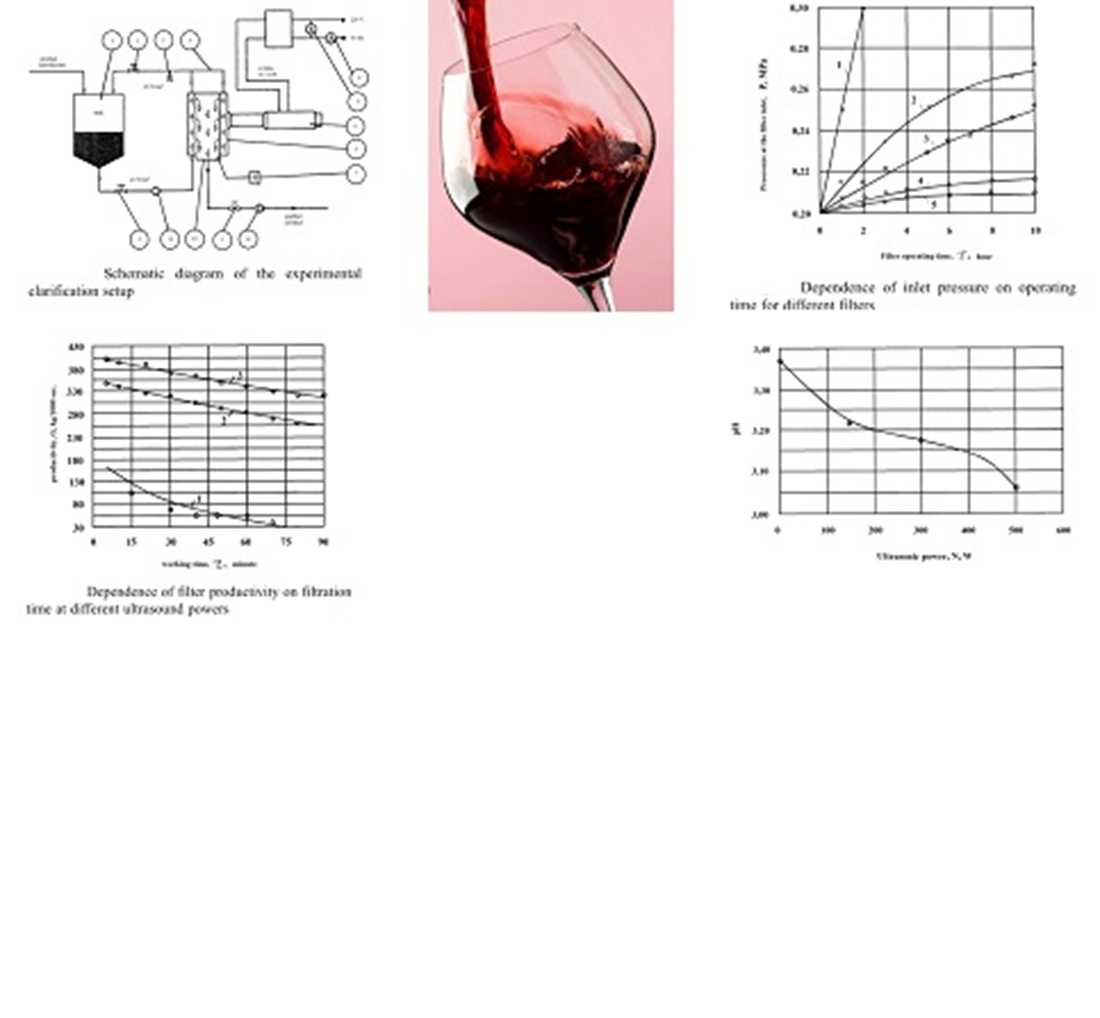
Об'єктом дослідження є інтенсифікація процесу освітлення вин. Хоча було проведено низку досліджень щодо освітлення вин, вплив ферментів, ультразвуку, мембранного фільтра, ультразвуку та фактора мацерації на інтенсивність освітлення вивчений недостатньо.
Встановлено, що фермент β-глюканаза, порівняно з іншими ферментами, створює основу для більшого зменшення кількості полісахаридів, особливо глюкоманану, у рожевих винах, і що зразок залишається стабільним протягом 10 місяців. Для білих столових вин обробка ферментами пектофоетидину П 10х та Г 10х з подальшим пастуванням, холодною обробкою та фільтрацією дала кращі результати. Встановлено, що ультразвукова обробка виноматеріалів збільшує вміст ароматичних речовин у складі, колір, кислотність та покращує стабільність вин. Підвищується продуктивність мембранних фільтрів, інтенсифікуються процеси фільтрації та освітлення виноматеріалів. Ультразвукова частота, акустичні коливання, що прикладаються до рідини, збільшують проникність фільтрів та дозволяють їм працювати в режимі самоочищення. Холодна мацерація винограду сортів Мадраса та Мерло при температурі 7-8°C протягом 4 днів перед ферментацією дозволяє отримувати сік з високою щільністю кольору, багатий на загальний вміст антоціанів та фенольних сполук.
Виробництво стабільних вин з використанням ферментів та холодної мацерації, а також інтенсифікація освітлення за допомогою ультразвуку та мембранного фільтрування ультразвуком вирішує проблему та робить ці дослідження важливими для виробництва. Отримані результати можуть бути використані на заводах та виноробнях.
Посилання
- Vázquez-Pateiro, I., Mirás-Avalos, J. M., Falqué, E. (2022). Influence of Must Clarification Technique on the Volatile Composition of Albariño and Treixadura Wines. Molecules, 27 (3), 810. https://doi.org/10.3390/molecules27030810
- Mierczynska-Vasilev, A., Smith, P. A. (2015). Current state of knowledge and challenges in wine clarification. Australian Journal of Grape and Wine Research, 21, 615–626. https://doi.org/10.1111/ajgw.12198
- Oro, C. E. D., Puton, B. M. S., Venquiaruto, L. D., Dallago, R. M., Arend, G. D., Tres, M. V. (2025). The Role of Membranes in Modern Winemaking: From Clarification to Dealcoholization. Membranes, 15 (1), 14. https://doi.org/10.3390/membranes15010014
- Cui, W., Wang, X., Han, S., Guo, W., Meng, N., Li, J. et al. (2024). Research progress of tartaric acid stabilization on wine characteristics. Food Chemistry: X, 23, 101728. https://doi.org/10.1016/j.fochx.2024.101728
- Angela, S., Wollan, D., Muhlack, R., Bindon, K., Wilkinson, K. (2024). Compositional Consequences of Ultrafiltration Treatment of White and Red Wines. Foods, 13 (12), 1850. https://doi.org/10.3390/foods13121850
- Wang, H., Fan, X., Zhou, Y., Li, D., Ling, M., Wei, X. et al. (2025). Balancing wine stability with color and phenolic quality: insights into the impact of fining agents and tartrate stabilization methods. Food Chemistry, 493, 145731. https://doi.org/10.1016/j.foodchem.2025.145731
- Hozoc (Nedelcu), M. M., Constantin, O. E., Lazăr (Condurache), N. N., Bahrim, G., Stănciuc, N., Aprodu, I. et al. (2023). Studies on white must clarification using enzyme preparations. The Annals of the University Dunarea de Jos of Galati. Fascicle VI - Food Technology, 47 (1), 180–194. https://doi.org/10.35219/foodtechnology.2023.1.12
- Martínez-Lapuente, L., Guadalupe, Z., Ayestarán, B. (2017). Effect of egg albumin fining, progressive clarification and cross-flow microfiltration on the polysaccharide and proanthocyanidin composition of red varietal wines. Food Research International, 96, 235–243. https://doi.org/10.1016/j.foodres.2017.03.022
- Ma, T.-Z., Gong, P.-F., Lu, R.-R., Zhang, B., Morata, A., Han, S.-Y. (2020). Effect of Different Clarification Treatments on the Volatile Composition and Aromatic Attributes of ‘Italian Riesling’ Icewine. Molecules, 25 (11), 2657. https://doi.org/10.3390/molecules25112657
- Dıblan, S., Özkan, M. (2021). Effects of various clarification treatments on anthocyanins, color, phenolics and antioxidant activity of red grape juice. Food Chemistry, 352, 129321. https://doi.org/10.1016/j.foodchem.2021.129321
- Nahurska, О. М., Frys, Kh. O., Hnatiuk, R. P. (2024). Study of the wine clarification process. Chemistry, Technology and Application of Substances, 7 (2), 133–137. https://doi.org/10.23939/ctas2024.02.133
- Maicas, S. (2021). Advances in Wine Fermentation. Fermentation, 7 (3), 187. https://doi.org/10.3390/fermentation7030187
- Lukić, I., Horvat, I., Radeka, S., Delač Salopek, D., Markeš, M., Ivić, M., Butorac, A. (2024). Wine proteome after partial clarification during fermentation reveals differential efficiency of various bentonite types. Journal of Food Composition and Analysis, 126, 105889. https://doi.org/10.1016/j.jfca.2023.105889
- Kemp, B., Marangon, M., Curioni, A., Waters, E., Marchal, R. (2022). New directions in stabilization, clarification, and fining. Managing Wine Quality, 245–301. https://doi.org/10.1016/b978-0-08-102065-4.00002-x
- Baca-Bocanegra, B., Gonçalves, S., Nogales-Bueno, J., Mansinhos, I., Heredia, F. J., Hernández-Hierro, J. M., Romano, A. (2022). Influence of Wine pH and Ethanol Content on the Fining Efficacy of Proteins from Winemaking By-Products. Foods, 11 (12), 1688. https://doi.org/10.3390/foods11121688
- Bestulić, E., Rossi, S., Plavša, T., Horvat, I., Lukić, I., Bubola, M. et al. (2022). Comparison of different maceration and non-maceration treatments for enhancement of phenolic composition, colour intensity, and taste attributes of Malvazija istarska (Vitis vinifera L.) white wines. Journal of Food Composition and Analysis, 109, 104472. https://doi.org/10.1016/j.jfca.2022.104472
- Sindou, E., Vaimakis, V., Vaimakis, T., Roussis, I. G. (2008). Effect of juice clarification by flotation on the quality of white wine and orange juice and drink - Short Communication. Czech Journal of Food Sciences, 26 (3), 223–228. https://doi.org/10.17221/2565-cjfs
- Radeka, S., Orbanić, F., Rossi, S., Bestulić, E., Horvat, I., Ilak Peršurić, A. S. et al. (2024). Evaluating the Impact of Pre-Fermentative and Post-Fermentative Vinification Technologies on Bioactive Compounds and Antioxidant Activity of Teran Red Wine By-Products. Foods, 13 (21), 3493. https://doi.org/10.3390/foods13213493
- Roldán, A. M., Sánchez-García, F., Pérez-Rodríguez, L., Palacios, V. M. (2021). Influence of Different Vinification Techniques on Volatile Compounds and the Aromatic Profile of Palomino Fino Wines. Foods, 10 (2), 453. https://doi.org/10.3390/foods10020453
- Fataliyev, H., Aghazade, Y., Heydarov, E., Gadimova, N., Ismayilov, M., Imanova, K. (2025). Identifying the factors affecting the production of juice and wine from the autochthonous Bayanshira grape variety. Eastern-European Journal of Enterprise Technologies, 1 (11 (133)), 38–50. https://doi.org/10.15587/1729-4061.2025.323382
- Fataliev, H. K., Agayeva, S. G., Mamedova, N. N. (2025). Study of the influence of fining on the physicochemical composition of juices and wines. International scientific journal "Bulletin of Science", 2 (2 (83)).
- Fataliev, H., Agaeva, S. G., Lezgiev, Yu. N. (2023). Investigation of the Effect of Some Fining Agents on the Amount of Phenolic Compounds in Madrasa Wine. Processing and Quality Management of Agricultural Products, Proceedings of the VI International Scientific and Practical Conference, 48–49.
- Kamaladdin, F. H., Galib, A. S., Elman, H. E., Elxan, A. S., Mammadtagi, A. I., Abbasgulu, H. A., Tofig, C. K. (2022). The research of effect of diluents to the amount of pesticide residues in wine. Food Science and Technology, 42. https://doi.org/10.1590/fst.39322
- Fataliev, H., Agayeva, S., Mamedova, N. Lezgiev, Y. (2025). Study of the influence of clarifying agents on the amount of p-thyrosol. Scientific Collection «InterConf», 238, 193–196. Available at: https://archive.interconf.center/index.php/conference-proceeding/article/view/6828/6852
- Fataliyev, H. K. (2013). Winemaking practicum. Baku: Elm, 328.
- Fataliyev, H. K. (2011). Technology of wine. Baku: Elm, 596.
- Sheskin, D. J. (2020). Handbook of Parametric and Nonparametric Statistical Procedures. Chapman and Hall/CRC, 1928. https://doi.org/10.1201/9780429186196
- Gadimova, N., Fataliyev, H., Heydarov, E., Lezgiyev, Y., Isgandarova, S. (2023). Development of a model and optimization of the interaction of factors in the grain malting process and its application in the production of functional beverages. Eastern-European Journal of Enterprise Technologies, 5 (11 (125)), 43–56. https://doi.org/10.15587/1729-4061.2023.289421
##submission.downloads##
Опубліковано
Як цитувати
Номер
Розділ
Ліцензія
Авторське право (c) 2025 Hasil Fataliyev, Elnur Heydarov, Natavan Gadimova, Mehman Ismayilov, Naila Mammadova, Asaf Rushanov

Ця робота ліцензується відповідно до Creative Commons Attribution 4.0 International License.
Закріплення та умови передачі авторських прав (ідентифікація авторства) здійснюється у Ліцензійному договорі. Зокрема, автори залишають за собою право на авторство свого рукопису та передають журналу право першої публікації цієї роботи на умовах ліцензії Creative Commons CC BY. При цьому вони мають право укладати самостійно додаткові угоди, що стосуються неексклюзивного поширення роботи у тому вигляді, в якому вона була опублікована цим журналом, але за умови збереження посилання на першу публікацію статті в цьому журналі.
Ліцензійний договір – це документ, в якому автор гарантує, що володіє усіма авторськими правами на твір (рукопис, статтю, тощо).
Автори, підписуючи Ліцензійний договір з ПП «ТЕХНОЛОГІЧНИЙ ЦЕНТР», мають усі права на подальше використання свого твору за умови посилання на наше видання, в якому твір опублікований. Відповідно до умов Ліцензійного договору, Видавець ПП «ТЕХНОЛОГІЧНИЙ ЦЕНТР» не забирає ваші авторські права та отримує від авторів дозвіл на використання та розповсюдження публікації через світові наукові ресурси (власні електронні ресурси, наукометричні бази даних, репозитарії, бібліотеки тощо).
За відсутності підписаного Ліцензійного договору або за відсутністю вказаних в цьому договорі ідентифікаторів, що дають змогу ідентифікувати особу автора, редакція не має права працювати з рукописом.
Важливо пам’ятати, що існує і інший тип угоди між авторами та видавцями – коли авторські права передаються від авторів до видавця. В такому разі автори втрачають права власності на свій твір та не можуть його використовувати в будь-який спосіб.