Devising a methodology for estimating the economic efficiency of managing power enterprises' information potential under the conditions of digital coherence
DOI:
https://doi.org/10.15587/1729-4061.2025.344259Keywords:
information potential, digital coherence, digital transformation, economic efficiency, energy enterpriseAbstract
This study investigates the process that assesses the economic efficiency of implementing an investment project aimed at managing the information potential of energy enterprises, taking into account digital coherence factors.
The task addressed relates to the lack of a holistic methodology that could make it possible to quantitatively assess the economic efficiency of managing the information potential of energy enterprises, taking into account the level of digital coherence.
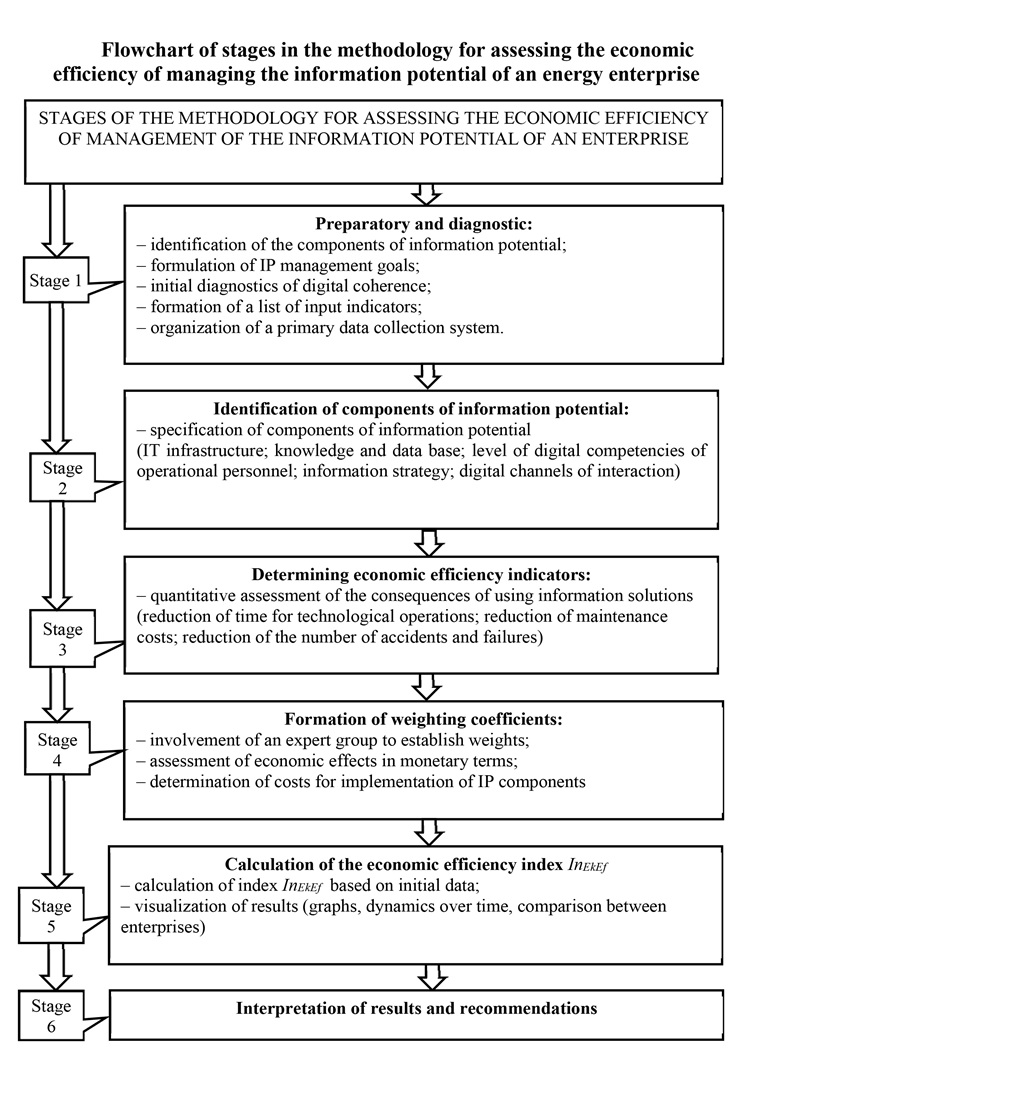
A methodology for assessing the economic efficiency of managing the information potential of energy enterprises in the context of digital coherence has been devised and substantiated. The methodology was considered as an integrated tool for diagnosing, analyzing, and predicting the effectiveness of management decisions based on the consistency of digital, analytical, organizational, and strategic components of the enterprise.
The methodology makes it possible to assess the economic efficiency of using information potential, taking into account digital coherence, identifying imbalances in the digital architecture, and justifying management decisions regarding the optimization of digital resources and transformations in the energy sector.
A system of quantitative criteria and indicators has been formed to assess the economic efficiency of information potential management of energy enterprises, which reflects the level of digital coherence and allows for an objective analysis of the results of digital transformation.
The methodology has been tested using an example of Zaporizhzhia Power Plant, which made it possible to trace the economic efficiency index that increased from 0.295 to 0.616, which confirms a more than twofold increase in the effectiveness of information potential management.
References
- Bag, S., Wood, L. C., Mangla, S. K., Luthra, S. (2020). Procurement 4.0 and its implications on business process performance in a circular economy. Resources, Conservation and Recycling, 152, 104502. https://doi.org/10.1016/j.resconrec.2019.104502
- Sacchi, R., Terlouw, T., Siala, K., Dirnaichner, A., Bauer, C., Cox, B. et al. (2022). PRospective EnvironMental Impact asSEment (premise): A streamlined approach to producing databases for prospective life cycle assessment using integrated assessment models. Renewable and Sustainable Energy Reviews, 160, 112311. https://doi.org/10.1016/j.rser.2022.112311
- Varadarajan, R. (2020). Customer information resources advantage, marketing strategy and business performance: A market resources based view. Industrial Marketing Management, 89, 89–97. https://doi.org/10.1016/j.indmarman.2020.03.003
- Yu, C., Moslehpour, M., Tran, T. K., Trung, L. M., Ou, J. P., Tien, N. H. (2023). Impact of non-renewable energy and natural resources on economic recovery: Empirical evidence from selected developing economies. Resources Policy, 80, 103221. https://doi.org/10.1016/j.resourpol.2022.103221
- Wang, S., Sun, L., Iqbal, S. (2022). Green financing role on renewable energy dependence and energy transition in E7 economies. Renewable Energy, 200, 1561–1572. https://doi.org/10.1016/j.renene.2022.10.067
- Sergi, S. B., D’Aleo, V., Arbolino, R., Carlucci, F., Barilla, D., Ioppolo, G. (2020). Evaluation of the Italian transport infrastructures: A technical and economic efficiency analysis. Land Use Policy, 99, 104961. https://doi.org/10.1016/j.landusepol.2020.104961
- Zhao, L., Chau, K. Y., Tran, T. K., Sadiq, M., Xuyen, N. T. M., Phan, T. T. H. (2022). Enhancing green economic recovery through green bonds financing and energy efficiency investments. Economic Analysis and Policy, 76, 488–501. https://doi.org/10.1016/j.eap.2022.08.019
- Liu, H., Khan, I., Zakari, A., Alharthi, M. (2022). Roles of trilemma in the world energy sector and transition towards sustainable energy: A study of economic growth and the environment. Energy Policy, 170, 113238. https://doi.org/10.1016/j.enpol.2022.113238
- Caglar, A. E., Zafar, M. W., Bekun, F. V., Mert, M. (2022). Determinants of CO2 emissions in the BRICS economies: The role of partnerships investment in energy and economic complexity. Sustainable Energy Technologies and Assessments, 51, 101907. https://doi.org/10.1016/j.seta.2021.101907
- Zakari, A., Khan, I., Tan, D., Alvarado, R., Dagar, V. (2022). Energy efficiency and sustainable development goals (SDGs). Energy, 239, 122365. https://doi.org/10.1016/j.energy.2021.122365
- Wang, L., Shao, J. (2023). Digital economy, entrepreneurship and energy efficiency. Energy, 269, 126801. https://doi.org/10.1016/j.energy.2023.126801
- Di Maio, F., Rem, P. C., Baldé, K., Polder, M. (2017). Measuring resource efficiency and circular economy: A market value approach. Resources, Conservation and Recycling, 122, 163–171. https://doi.org/10.1016/j.resconrec.2017.02.009
- Zhao, X., Guo, Y., Feng, T. (2023). Towards green recovery: Natural resources utilization efficiency under the impact of environmental information disclosure. Resources Policy, 83, 103657. https://doi.org/10.1016/j.resourpol.2023.103657
- Prokhorova, V., Mushnykova, S., Zaitseva, A., Gavrysh, O. (2024). Convergence of dominant forms of investment capital in the development of socio-economic systems. Eastern-European Journal of Enterprise Technologies, 1 (13 (127)), 122–130. https://doi.org/10.15587/1729-4061.2024.299127
- Prokhorova, V., Mushnykova, S., Kovalenko, D., Koleshchuk, O., Babichev, A. (2023). Convergence of educational technologies as an imperative for the development of innovation cooperation in the context of circular transformation. Eastern-European Journal of Enterprise Technologies, 4 (13 (124)), 26–35. https://doi.org/10.15587/1729-4061.2023.286183
- Prokhorova, V., Budanov, M., Budanov, P. (2024). Devising an integrated methodology for energy safety assessment at an industrial power-generating enterprise. Eastern-European Journal of Enterprise Technologies, 4 (13 (130)), 118–131. https://doi.org/10.15587/1729-4061.2024.308056
- Budanov, P., Brovko, K., Melnikov, V., Yakymchuk, M., Kononov, V., Kyrysov, I. et al. (2025). Construction of an information model of the digital twin of the technological process in a power unit at a nuclear power plant. Eastern-European Journal of Enterprise Technologies, 4 (8 (136)), 39–49. https://doi.org/10.15587/1729-4061.2025.335712
- Brovko, K., Budanov, P., Velykohorskyi, O., Vynokurova, N. (2025). Providing quantitative assessment of the quality of management of the technological process of a NPP power unit using digital twin. Bulletin of the National Technical University «KhPI» Series: New Solutions in Modern Technologies, 3 (25), 3–12. https://doi.org/10.20998/2413-4295.2025.03.01
- Prokhorova, V., Budanov, O., Budanov, P., Slastianykova, K. (2025). Comprehensive methodology for estimating information safety at enterprises of electroenergy system under the conditions of digital coherence. Eastern-European Journal of Enterprise Technologies, 2 (13 (134)), 27–37. https://doi.org/10.15587/1729-4061.2025.327159
- Prokhorova, V., Budanov, O., Budanov, P., Slastianykova, K. (2025). Devising a methodology for estimating the information potential of energy enterprises under the conditions of digital coherency. Eastern-European Journal of Enterprise Technologies, 3 (13 (135)), 6–16. https://doi.org/10.15587/1729-4061.2025.332324
- Prokhorova, V., Budanov, O., Budanov, M., Slastianykova, K. (2025). Building a consolidated model of digital coherence for managing the information potential at power enterprises. Eastern-European Journal of Enterprise Technologies, 4 (13 (136)), 58–69. https://doi.org/10.15587/1729-4061.2025.336641
Downloads
Published
How to Cite
Issue
Section
License
Copyright (c) 2025 Viktoriia Prokhorova, Oleksandr Budanov, Pavlo Budanov, Anatoliy Babichev, Krystyna Slastianykova

This work is licensed under a Creative Commons Attribution 4.0 International License.
The consolidation and conditions for the transfer of copyright (identification of authorship) is carried out in the License Agreement. In particular, the authors reserve the right to the authorship of their manuscript and transfer the first publication of this work to the journal under the terms of the Creative Commons CC BY license. At the same time, they have the right to conclude on their own additional agreements concerning the non-exclusive distribution of the work in the form in which it was published by this journal, but provided that the link to the first publication of the article in this journal is preserved.
A license agreement is a document in which the author warrants that he/she owns all copyright for the work (manuscript, article, etc.).
The authors, signing the License Agreement with TECHNOLOGY CENTER PC, have all rights to the further use of their work, provided that they link to our edition in which the work was published.
According to the terms of the License Agreement, the Publisher TECHNOLOGY CENTER PC does not take away your copyrights and receives permission from the authors to use and dissemination of the publication through the world's scientific resources (own electronic resources, scientometric databases, repositories, libraries, etc.).
In the absence of a signed License Agreement or in the absence of this agreement of identifiers allowing to identify the identity of the author, the editors have no right to work with the manuscript.
It is important to remember that there is another type of agreement between authors and publishers – when copyright is transferred from the authors to the publisher. In this case, the authors lose ownership of their work and may not use it in any way.








