Construction of a model for the development of social entrepreneurship based on innovation and technology transfer
DOI:
https://doi.org/10.15587/1729-4061.2025.344260Keywords:
social entrepreneurship, innovation, technology transfer model, institutional support, social impactAbstract
This study considers social entrepreneurship in the Republic of Kazakhstan in the context of the national innovation ecosystem. The social entrepreneurship is becoming a tool for solving socio-economic problems. The task addressed in this study is to improve ways in order to increase the sustainability of social entrepreneurship through the effective use of its institutional and technological potential and the introduction of technology transfer mechanisms.
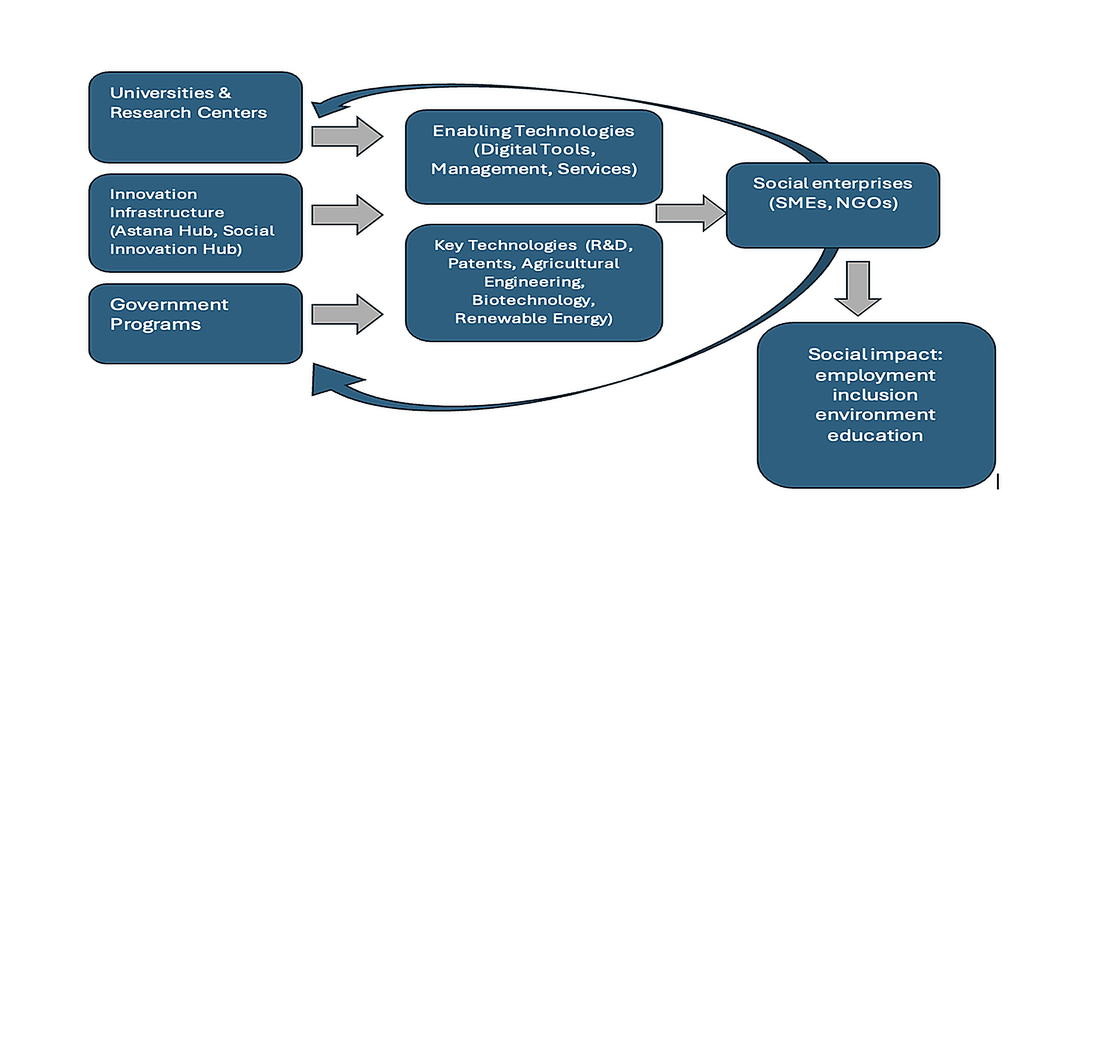
The results have shown that social entrepreneurship has regional and sectoral inequalities, but its overall development dynamics demonstrate a steady growth. Correlation and regression analyses revealed that the relationship between the national development of social entrepreneurship and innovational and institutional factors was weak; that proved the complexity and non-homogeneity of the factors that have an impact on social business. In addition, the two-level model proposed suggests mechanisms for integrating social entrepreneurship into the national innovation environment and describes possible ways to improve the efficiency and economic effectiveness of social projects.
The results involve providing the adaptive mechanisms for integrating social entrepreneurship with technological and institutional support systems. These, in turn, contribute to the formation of technological innovations, social entrepreneurship, innovatory solutions to social problems, efficiency, the scalability, and financial sustainability. The findings have shown that the implementation of a technology transfer model in the development of social entrepreneurship could promote the design of innovative platforms that create both an economic and social value.
References
- Global Innovation Index 2024. WIPO. Available at: https://www.wipo.int/en/web/global-innovation-index/2024/index
- Parmanova, R., Baimoldayeva, M., Azretbergenova, G., Beisekova, P. (2025). Relationship between Energy Consumption, Economic Growth and Population in Kazakhstan. International Journal of Energy Economics and Policy, 15 (3), 608–613. https://doi.org/10.32479/ijeep.19104
- Stephan, U., Uhlaner, L. M., Stride, C. (2014). Institutions and social entrepreneurship: The role of institutional voids, institutional support, and institutional configurations. Journal of International Business Studies, 46 (3), 308–331. https://doi.org/10.1057/jibs.2014.38
- Zahra, S. A., Wright, M. (2015). Understanding the Social Role of Entrepreneurship. Journal of Management Studies, 53 (4), 610–629. https://doi.org/10.1111/joms.12149
- Savaget, P., Ozcan, P., Pitsis, T. (2024). Social Entrepreneurs as Ecosystem Catalysts: The Dynamics of Forming and Withdrawing from a Self‐Sustaining Ecosystem. Journal of Management Studies, 62 (1), 246–278. https://doi.org/10.1111/joms.13055
- Battilana, J., Sengul, M., Pache, A.-C., Model, J. (2015). Harnessing Productive Tensions in Hybrid Organizations: The Case of Work Integration Social Enterprises. Academy of Management Journal, 58 (6), 1658–1685. https://doi.org/10.5465/amj.2013.0903
- Pache, A.-C., Battilana, J., Spencer, C. (2024). An Integrative Model of Hybrid Governance: The Role of Boards in Helping Sustain Organizational Hybridity. Academy of Management Journal, 67 (2), 437–467. https://doi.org/10.5465/amj.2021.0966
- Smith, W. K., Besharov, M. L. (2017). Bowing before Dual Gods: How Structured Flexibility Sustains Organizational Hybridity. Administrative Science Quarterly, 64 (1), 1–44. https://doi.org/10.1177/0001839217750826
- Gerli, F., Chiodo, V., Bengo, I. (2020). Technology Transfer for Social Entrepreneurship: Designing Problem-Oriented Innovation Ecosystems. Sustainability, 13 (1), 20. https://doi.org/10.3390/su13010020
- Oelberger, C. R., Shachter, S. Y. (2021). National Sovereignty and Transnational Philanthropy: The Impact of Countries’ Foreign Aid Restrictions on US Foundation Funding. VOLUNTAS: International Journal of Voluntary and Nonprofit Organizations, 32 (2), 204–219. https://doi.org/10.1007/s11266-020-00265-y
- Battilana, J., Dorado, S. (2010). Building Sustainable Hybrid Organizations: The Case of Commercial Microfinance Organizations. Academy of Management Journal, 53 (6), 1419–1440. https://doi.org/10.5465/amj.2010.57318391
- Girum, T., Wattanakomol, S., Silpcharu, T. (2022). Guidelines to Drive Social Enterprises to Grow Sustainability in the Digital Economy Era. Humanities and Social Sciences Letters, 10 (3), 356–368. https://doi.org/10.18488/73.v10i3.3075
- Nyussupova, G. N., Aidarkhanova, G. B., Tokbergenova, A. A. (2022). Geography of Human Capital in Republic of Kazakhstan: a Comparison Between Regions. Economics: The Strategy and Practice, 16 (4), 160–173. https://doi.org/10.51176/1997-9967-2021-4-160-173
- Kraemer-Mbula, E. (2024). Harnessing innovation: The transformative potential of social enterprises in Africa. Global Innovation Index 2024. Available at: https://www.wipo.int/documents/d/global-innovation-index/docs-en-2024-gii-2024-contributors-erika-kraemer.pdf
- Kraemer-Mbula, E., Wunsch-Vincent, S. (Eds.) (2016). The Informal Economy in Developing Nations: Hidden Engine of Innovation? Cambridge University Press. https://doi.org/10.1017/CBO9781316662076
- Audretsch, D. B., Belitski, M., Eichler, G. M., Schwarz, E. (2023). Entrepreneurial ecosystems, institutional quality, and the unexpected role of the sustainability orientation of entrepreneurs. Small Business Economics, 62 (2), 503–522. https://doi.org/10.1007/s11187-023-00763-5
- Polishchuk, Y., Kornyliuk, A., Lavreniuk, V., Horbov, V., Ivashchenko, A., Tepliuk, M. (2024). Running a business during wartime: Voice of Ukrainian displaced business. Problems and Perspectives in Management, 22 (3), 287–302. https://doi.org/10.21511/ppm.22(3).2024.23
- Del Giudice, M., Khan, Z., De Silva, M., Scuotto, V., Caputo, F., Carayannis, E. (2017). The microlevel actions undertaken by owner‐managers in improving the sustainability practices of cultural and creative small and medium enterprises: A United Kingdom–Italy comparison. Journal of Organizational Behavior, 38 (9), 1396–1414. https://doi.org/10.1002/job.2237
- Reestr subektov socialnogo predprinimatelstva. Ministerstvo nacionalnoy ekonomiki Respubliki Kazahstan. Available at: https://rsp.gov.kz/ru/rssp
- Structural statistics. Bureau of National statistics of Agency for Strategic planning and reforms of the Republic of Kazakhstan. Available at: https://stat.gov.kz/en/industries/business-statistics/stat-struct/
Downloads
Published
How to Cite
Issue
Section
License
Copyright (c) 2025 Madina Mukanova, Aigul Mukhamejanova, Nazym Nurpeisova, Zaure Zambinova, Kuralay Yeltayeva, Daryika Tugolbaeva

This work is licensed under a Creative Commons Attribution 4.0 International License.
The consolidation and conditions for the transfer of copyright (identification of authorship) is carried out in the License Agreement. In particular, the authors reserve the right to the authorship of their manuscript and transfer the first publication of this work to the journal under the terms of the Creative Commons CC BY license. At the same time, they have the right to conclude on their own additional agreements concerning the non-exclusive distribution of the work in the form in which it was published by this journal, but provided that the link to the first publication of the article in this journal is preserved.
A license agreement is a document in which the author warrants that he/she owns all copyright for the work (manuscript, article, etc.).
The authors, signing the License Agreement with TECHNOLOGY CENTER PC, have all rights to the further use of their work, provided that they link to our edition in which the work was published.
According to the terms of the License Agreement, the Publisher TECHNOLOGY CENTER PC does not take away your copyrights and receives permission from the authors to use and dissemination of the publication through the world's scientific resources (own electronic resources, scientometric databases, repositories, libraries, etc.).
In the absence of a signed License Agreement or in the absence of this agreement of identifiers allowing to identify the identity of the author, the editors have no right to work with the manuscript.
It is important to remember that there is another type of agreement between authors and publishers – when copyright is transferred from the authors to the publisher. In this case, the authors lose ownership of their work and may not use it in any way.








